Market Summary
Executive Summary and Global Market Analysis
Commercial aviation aircraft seating refers to the subset of aircraft manufacturers' efforts dedicated to developing and incorporating seats for passengers, pilots, and crew members. Such seats have to offer high levels of ergonomics, lightness, and compliance with all regulatory requirements. This allows for improving the quality of passengers' experience while ensuring better performance from an operational and energy standpoint.
The growth in the sector can be explained by the growing air traffic, as well as the increasing demand for more comfortable traveling conditions. Modern cabin renovation projects are increasingly concerned with ergonomic design and lightweight materials. In addition, the increased competition among airlines leads to higher interest in improving their seating configurations to attract customers and enhance their experience.
The segmentation patterns in terms of volume vary depending on whether we are talking about passenger, pilot, or crew seating. Passenger seats account for a major proportion of this market since there is a large number of commercial flights performed globally. Economy class dominates the market in terms of size, but premium, business, and first-class seating continue to grow.
Technological development within aircraft seating revolves around issues such as minimizing seat weight, implementing a modular design approach, and incorporating features that enhance comfort. Technologies such as advanced foams, electrical mechanisms for seat adjustments, and even actuator systems have helped to enhance the comfort levels and efficiencies associated with seats on aircraft.
Competitive forces will be characterized by innovations in lightweight materials used in seats and ergonomic designs that maximize passenger comfort while at the same time ensuring that the seating complies with aviation safety regulations. Customized seat solutions that incorporate the branding efforts of airlines will emerge as a major trend in this competitive industry.
Segment Analysis
Commercial Aviation Aircraft Seating Market Segmentation
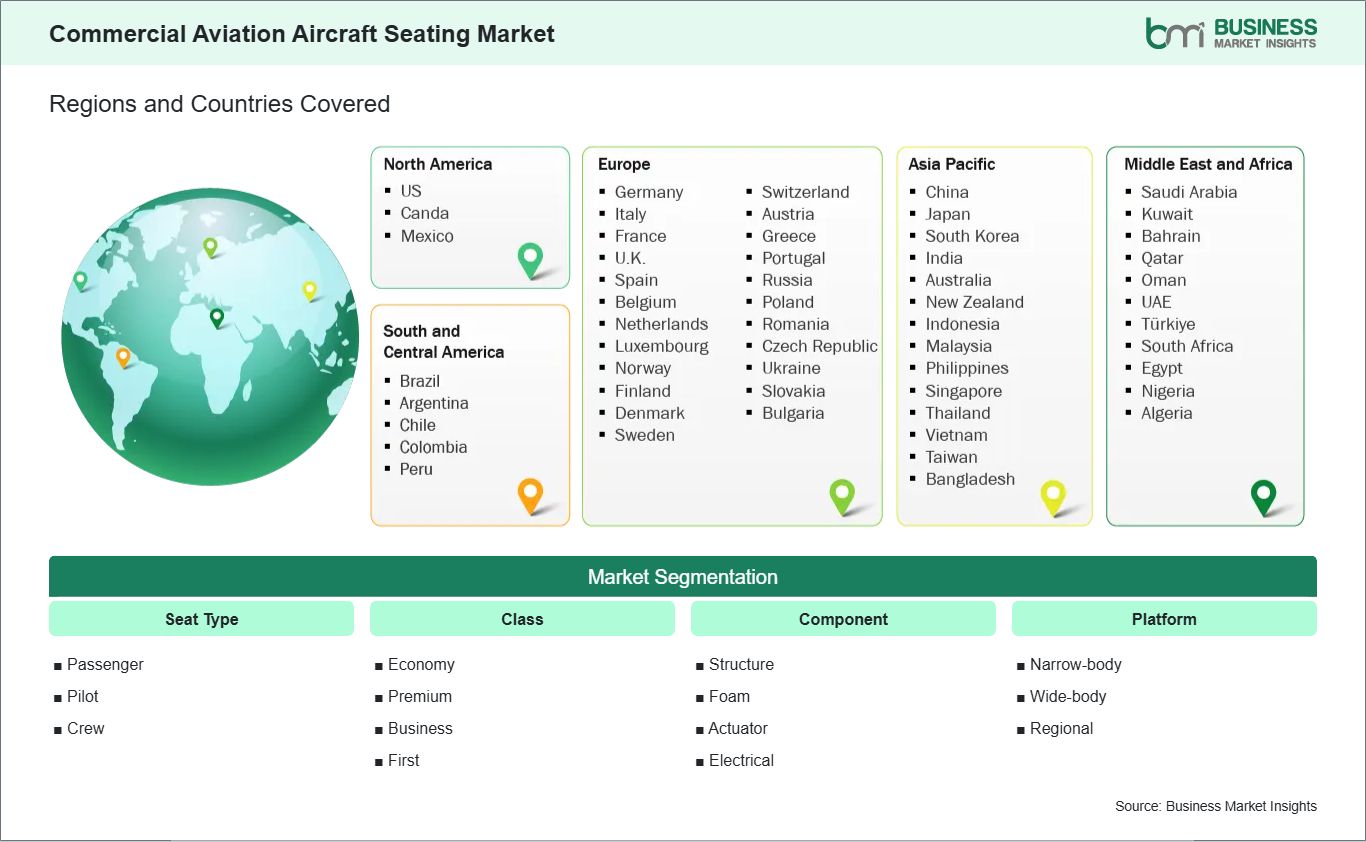
The commercial aviation aircraft seating market is segmented based on seat type, class, component, and platform, reflecting the aviation industry’s focus on cabin optimization, passenger comfort enhancement, and aircraft efficiency across different fleet categories and travel experiences.
By Seat Type
- Passenger: High-density seating configurations support commercial airline operations and passenger volume efficiency.
- Pilot: Ergonomically designed seats ensure safety, control accessibility, and operational precision.
- Crew: Functional seating supports in-flight service efficiency and operational mobility.
By Class
- Economy: Standardized seating maximizes capacity and cost efficiency across routes.
- Premium: Enhanced comfort features improve passenger experience on mid-tier travel segments.
- Business: Spacious configurations support productivity and elevated service standards.
- First: Luxury-focused seating integrates advanced comfort and privacy features.
By Component
- Structure: Lightweight frameworks improve fuel efficiency and aircraft performance.
- Foam: Comfort-enhancing materials optimize passenger seating ergonomics.
- Actuator: Adjustable systems enable personalized seating configurations.
- Electrical: Integrated controls support smart seat functionality and passenger convenience.
By Platform
- Narrow-body: Efficient seating layouts support short to medium-haul operational demand.
- Wide-body: High-capacity configurations enable long-haul international travel comfort.
- Regional: Compact seating designs optimize space in short-distance aircraft operations.
Market Forces
Commercial Aviation Aircraft Seating Market Drivers and Opportunities
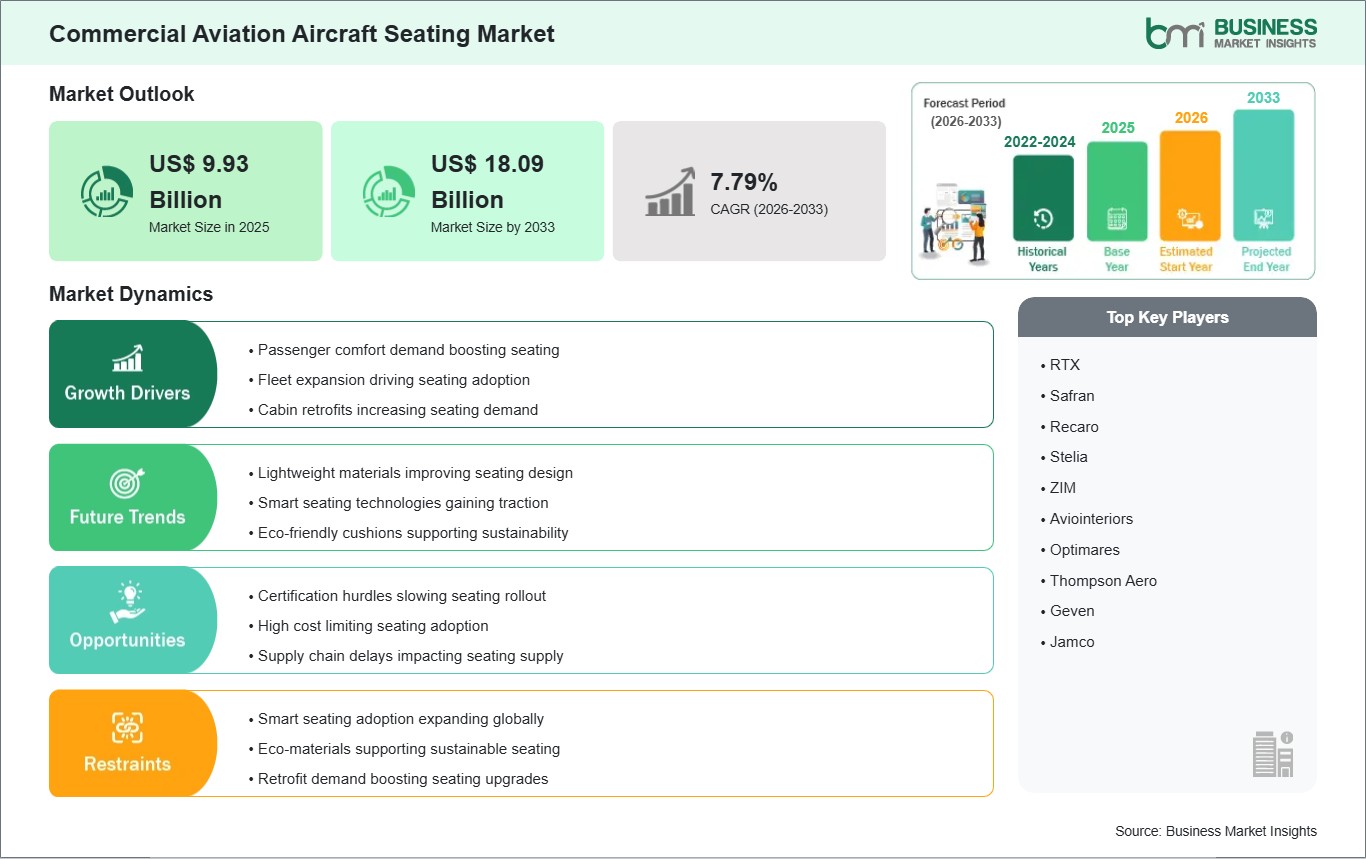
Passenger comfort demand boosting seating
The expectation by passengers concerning their comfort during flights is fast becoming one of the key factors that are motivating airlines to develop new aircraft seats that will meet these expectations. There is more concern about increasing comfort levels through better design of seats, legroom, comfort, and convenience, among other considerations. Airlines are beginning to recognize that travelers are making decisions about which airline to use depending not just on the cost and schedule but also on the comfort levels available on their airplanes. This has led to greater attention to developing better seats that facilitate comfort without compromising on efficiency.
Increased emphasis on the well-being of the traveler is leading to greater demand for lightweight and technologically advanced seating solutions. There is increased focus from the regulatory body and airlines on meeting certain seating standards that enhance the safety, health, and comfort of passengers. Innovations such as modular seat designs, enhanced seating functionality, and the use of foam technology have all come into play in responding to changes in traveler demands. In particular, premium and business class travel trends are playing a role in promoting innovations in seating functionality.
Smart seating adoption expanding globally
The implementation of smart seating technology is opening up new possibilities in terms of the commercial aviation aircraft seating market. Air carriers are actively investigating connected seating technologies that include automated adjustment features, passenger monitoring tools, entertainment control options, and personalized seating preferences. Besides enhancing the cabin experience and passenger services, smart seating helps air operators manage their operations through increased data accessibility. The introduction of smart seating technology fits well into the general transformation trend towards the creation of connected aircraft and digital-based passenger services offered by the aviation industry. As fleets become more technologically advanced, smart cabin infrastructure will become a standard requirement in future purchases.
In addition, smart seating is expected to positively affect innovation in terms of the interior design of narrow-body and wide-body aircraft in the future. The development of seating technology with sensor-based components that facilitate predictive maintenance, energy-saving measures, and lifecycle improvements is on the rise. Further incorporation of wireless connections and cabin management system software solutions adds additional incentives to implement these systems on board planes. The aviation sector in emerging markets understands the importance of using advanced digital technology in the seats to improve passenger experience.
Size and Share Analysis
Commercial Aviation Aircraft Seating Market Size and Share Analysis
The Commercial Aviation Aircraft Seating Market is projected to grow from US$ 9.93 Billion in 2025 to US$ 18.09 Billion by 2033 , registering a CAGR of 7.79% from 2026 to 2033.
By seat type, passenger seats maintain the leading position because commercial aircraft are designed with a substantially higher number of passenger seats compared to pilot and crew seating. Rising global air travel, increasing aircraft deliveries, and airline investments in passenger comfort, lightweight seating, and cabin modernization continue to drive strong demand for passenger seating systems.
By class, economy dominates due to its large seating capacity and widespread adoption across full-service and low-cost airlines. Airlines prioritize maximizing passenger volume and operational profitability, leading to higher installation and replacement rates for economy seats, particularly in narrow-body aircraft operating high-frequency domestic and regional routes.
By component, structure leads the market as it forms the core framework of aircraft seats, contributing significantly to overall seat weight, durability, and manufacturing cost. Growing emphasis on lightweight materials to improve fuel efficiency and comply with aviation standards continues to increase demand for advanced seat structure components.
By platform, narrow-body holds a significant share due to their large operational fleet and extensive use in short- and medium-haul commercial routes worldwide. High production volumes from major aircraft manufacturers, increasing regional connectivity, and rising passenger traffic significantly boost seating demand and replacement activities within this aircraft category.
Report Coverage
Commercial Aviation Aircraft Seating Market Report Coverage and Deliverables
The "Commercial Aviation Aircraft Seating Market Size and Forecast (2022-2033)" report provides a detailed analysis of the market covering below areas:
- The market size and forecast at global, regional, and country levels for all market segments covered under the scope
- The market trends, as well as drivers, restraints, and opportunities
- The market analysis covering key trends, global and regional framework, major players, regulations, and recent developments
- Industry landscape and competition analysis covering market concentration, heat map analysis, prominent players, and recent developments for the market
- Detailed company profiles, including SWOT analysis
Geographic Insights
Commercial Aviation Aircraft Seating Market Geographic Insights
There is a wide variety of adoption trends for the commercial aviation aircraft seating market based on fleet development, passenger experience requirements, and new investments made in aircraft renovation. Demand differs regionally according to the volume of air traffic, airline competition, and infrastructure developed for the use of commercial aircraft in various regions around the world. This market demonstrates a shift towards lighter and more innovative cabin interior components, including improved aircraft seats.
The North American market plays a key role in this industry owing to high levels of commercial aviation and ongoing cabin renewal programs within the sector. The United States is the dominant country within the region, with large airlines purchasing advanced seating systems for their aircraft. Additionally, Canada is making a contribution to ongoing market growth through investment in aircraft renovation programs.
The Asia-Pacific is an area of fast growth driven by increases in air traffic and huge aircraft procurement plans. The growth in Asia-Pacific is mainly due to China and India, which have growing airlines and airports, while Japan is developing its cabin interiors to provide high levels of comfort. The growth in narrow-body aircraft seats in the region is also influenced by low-cost carriers in Southeast Asia.
Europe shows strong adoption thanks to the robust manufacturing capabilities of aerospace companies and highly developed airline services. Countries such as Germany, France, and the UK concentrate on the development of lightweight aircraft seats and cabin interiors to optimize fuel consumption. Emerging regions such as the Middle East and Latin America will be gradually gaining momentum as airlines in the United Arab Emirates, Saudi Arabia, and Brazil grow and purchase new aircraft.
Industry Activity
Recent Developments
The commercial aviation aircraft seating market is evaluated by gathering qualitative and quantitative data post primary and secondary research, which includes important corporate publications, association data, and databases. A few of the key developments in the commercial aviation aircraft seating market are:
- In August 2024, RECARO Aircraft Seating announced that IndiGo had selected its R5 seats for the business-class cabins of A321neo aircraft, marking the airline’s first introduction of business-class seating and covering 45 aircraft shipsets.
- In May 2024, RTX (Collins Aerospace) announced the launch of its Helix next-generation main cabin seat for narrowbody aircraft at the 2024 Aircraft Interiors Expo, focusing on lightweight design, improved passenger comfort, and lower fuel consumption for commercial airlines.
Trust & Transparency
Research Methodology
The market analysis combines proprietary research with secondary data from government agencies, company disclosures, regulatory filings, industry databases and expert interviews. Market estimates are validated through data triangulation, cross-market benchmarking and analyst
review.
View Full Research Methodology
Key Sources Referred:
Federal Aviation Administration (FAA) European Union Aviation Safety Agency (EASA) International Civil Aviation Organization (ICAO) International Air Transport Association (IATA) Civil Aviation Administration of China (CAAC) Company Websites Company Annual Reports Company Investor Presentations