
AI in Aviation Market Outlook: Size, Share, Trends, Growth Analysis, Competitive Landscape & Forecast, 2026-2033

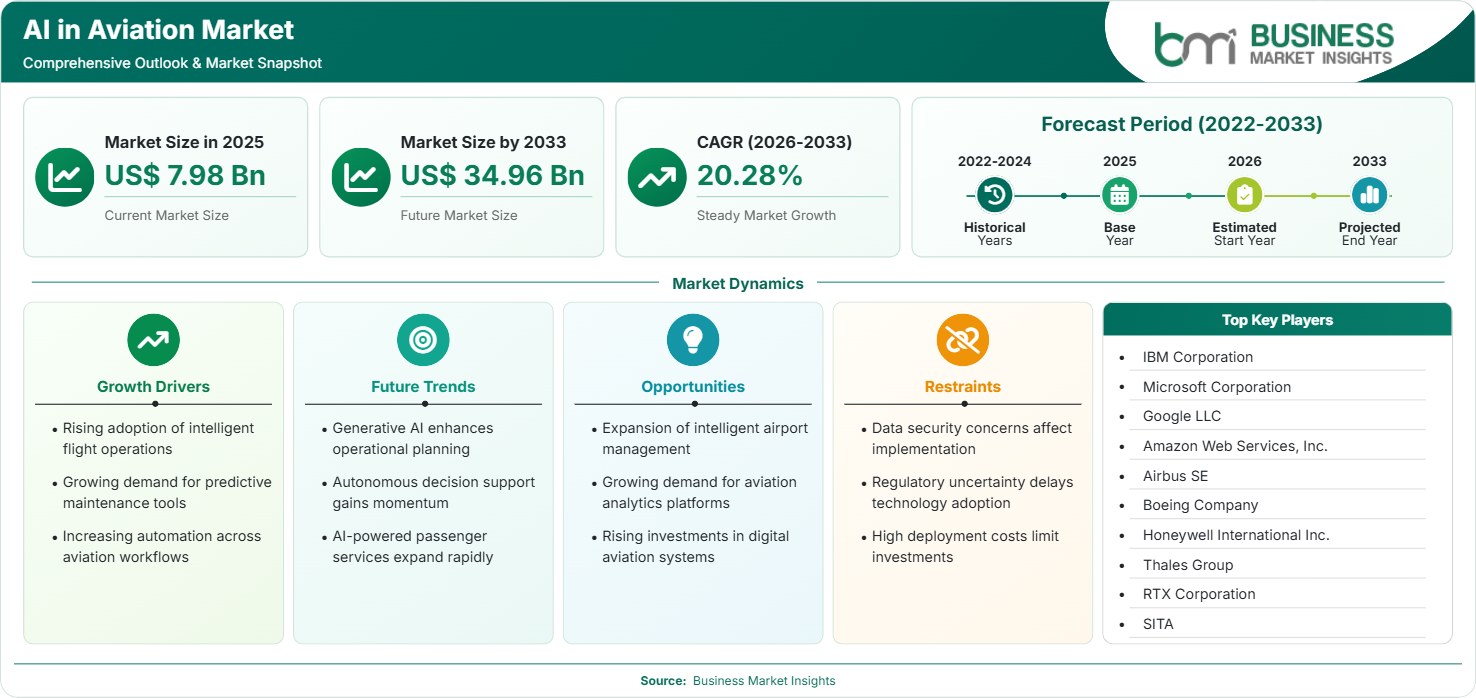
The AI in Aviation Market size was valued at US$ 7.98 billion in 2025 and is projected to reach US$ 34.96 billion by 2033, growing at a CAGR of 20.28% during 2026–2033. Rising adoption of intelligent flight operations, growing demand for predictive maintenance, increasing aviation workflow automation, and expanding investments in digital aviation ecosystems continue to support market expansion.

Report Coverage
  • Application: Flight Operations, Maintenance, Air Traffic Management, Others
  • Offering: Software, Hardware, Service
  • Technology: Machine Learning, Computer Vision, Data Analytics, Others
  • End User: Airlines, Airports, OEMs, MRO
US$ 7.98 Bn Market size in 2025
US$ 34.96 Bn Market Size by 2033
20.28% CAGR, 2026 - 2033
2026-2033 Forecast Period

AI Overview

AI in Aviation Market Summary

  • North America Region: Holds 39%–42% share in 2025 and is projected to grow at 19.0%–19.8% CAGR during 2026–2033, supported by AI-enabled airline operations, smart airports, and digital aviation investments. The U.S. leads regional adoption through advanced airline infrastructure and AI innovation, registering approximately 19.3%–20.0% CAGR.
  • Fastest Growing Region: Asia Pacific accounts for 25%–28% share in 2025 and is expected to expand at 22.1%–23.0% CAGR, driven by airport expansion, airline fleet modernization, and government-backed aviation digitalization.
  • Leading Segment: Flight Operations represents 35%–38% share in 2025 and grows at 20.8%–21.5% CAGR, supported by intelligent flight planning, fuel optimization, and operational decision support.
  • High Growth Segment: Machine Learning captures 37%–40% share in 2025 and records 22.5%–23.4% CAGR, driven by predictive maintenance, anomaly detection, and aircraft performance optimization.
  • Key Market Opportunity: Increasing deployment of AI across airports, airlines, maintenance operations, passenger management, and air traffic systems is creating scalable opportunities for intelligent aviation platforms.
  • Major Market Players: IBM Corporation, Microsoft Corporation, Google LLC, Amazon Web Services, Inc., Airbus SE, The Boeing Company, Honeywell International Inc., Thales Group, RTX Corporation, and SITA.
Strategic Insights

AI in Aviation Market: Strategic Insights

AI in Aviation Market Strategic Framework
FREE PDF
Request your free sample
Request free sample
Stakeholder View

Key Takeaways

  • The aviation industry is moving towards integrated digital platforms where airlines, airports, OEMs, MRO organizations, and technology players work together using artificial intelligence to increase operational efficiency, enhance safety, and optimize passengers' experience.
  • Flight operations remain the biggest commercial opportunity because airlines seek ways to optimize routes, manage fuel consumption, schedule crews, and assist operational decisions to increase profits.
  • Machine learning, computer vision, and analytics continue driving innovation as these capabilities enable predictive maintenance, automation of inspection and aircraft health monitoring, as well as smart operational planning in aviation.
  • The region with the most interesting investment opportunity remains Asia Pacific thanks to growing airport infrastructures, increased aircraft deliveries, governmental digital aviation programs, and adoption of AI-operated operational platforms.
  • Partnerships between aerospace companies, cloud providers, and software development organizations are driving commercialization of AI-driven aviation products while providing for digital services subscriptions.
  • Sustainability programs and next-gen air traffic management systems drive interest in investments in smart aviation technologies aimed at reducing fuel usage and enhancing operational resilience.
Geographic Outlook

AI in Aviation Market Regional Highlights

North America AI in Aviation Market

North America accounts for 39%–42% AI in Aviation Market share in 2025 and is projected to register a CAGR of 19.0%–19.8% during 2026–2033. Aviation facilities in the region are state-of-the-art, early adopters of artificial intelligence technology, have cloud computing abilities, and make regular investments in making the airports smarter. Airlines, aircraft manufacturers, and airport operators are regularly incorporating artificial intelligence into various aspects of the operations at airports.

  • Airlines increasingly deploy AI-powered flight planning, crew optimization, and fuel management solutions to improve operational performance while reducing costs and carbon emissions.
  • Airport operators continue implementing intelligent passenger processing, biometric verification, automated baggage handling, and resource optimization technologies to enhance traveler experience.
  • Aircraft manufacturers strengthen AI deployment across aircraft design, predictive maintenance, digital twins, and manufacturing automation to improve fleet reliability.
  • Government investments in aviation modernization, cybersecurity, and next-generation air traffic management continue supporting long-term AI adoption.

US AI in Aviation Market

The United States contributes 81%–84% of North American revenue and is expected to expand at a CAGR of 19.3%–20.0% during 2026–2033. Strong commercial aviation activity, advanced technology infrastructure, leading cloud service providers, and continuous aerospace innovation support widespread AI implementation across airline and airport operations.

  • Commercial airlines increasingly utilize AI for operational control, predictive maintenance, and passenger service optimization.
  • Smart airport investments continue expanding automated security screening, digital passenger services, and intelligent gate management.
  • Aerospace companies accelerate AI integration into aircraft engineering, manufacturing, and lifecycle management.
  • Federal aviation modernization programs encourage deployment of intelligent traffic management and digital aviation technologies.

Europe AI in Aviation Market

Europe represents 26%–29% market share in 2025 and is anticipated to grow at a CAGR of 19.5%–20.3% through 2026–2033. Projects in sustainable aviation, smart investments in airports, and modern aerospace manufacturing keep driving regional development. The country leading in market adoption is Germany, while France is growing fast due to increased investment in aviation technology empowered by AI.

  • Airlines adopt AI to optimize flight operations, predictive maintenance, and environmental performance.
  • Airport modernization projects accelerate deployment of intelligent passenger management and automated security technologies.
  • Aerospace manufacturers expand digital engineering and AI-assisted aircraft production capabilities.
  • Regional air traffic modernization programs strengthen implementation of AI-driven operational systems.

Asia Pacific AI in Aviation Market

Asia Pacific holds 25%–28% market share in 2025 and records the fastest 22.1%–23.0% CAGR during 2026–2033. Increasing numbers of passengers, building of new airports, growing fleets, and aviation digitalization efforts supported by the governments increase regional demand. China is still the largest regional market, and India has the highest growth rate owing to intelligent airport and airline development.

  • Airlines increasingly implement AI-powered maintenance, scheduling, and operational analytics platforms.
  • Airport authorities expand intelligent passenger services, automated boarding, and digital resource management systems.
  • Aviation regulators modernize air traffic infrastructure through AI-enabled operational technologies.
  • Rising cloud adoption supports scalable aviation analytics and real-time operational intelligence.

Rest of World AI in Aviation Market

The Rest of World region accounts for 7%–10% market share in 2025 and is forecast to grow at a CAGR of 20.0%–20.8% during 2026–2033. Middle Eastern countries continue investing in globally competitive airport infrastructure, while Latin America gradually expands adoption of AI-powered aviation technologies to improve operational performance, maintenance efficiency, and passenger services.

  • Gulf countries continue developing intelligent airport ecosystems supporting global aviation hubs and digital passenger experiences.
  • Brazil leads Latin American adoption through airport modernization and airline digital transformation initiatives.
  • Aviation organizations increasingly implement predictive maintenance and AI-driven operational planning platforms.
  • Expanding investments in digital infrastructure continue strengthening adoption of intelligent aviation technologies across emerging markets.
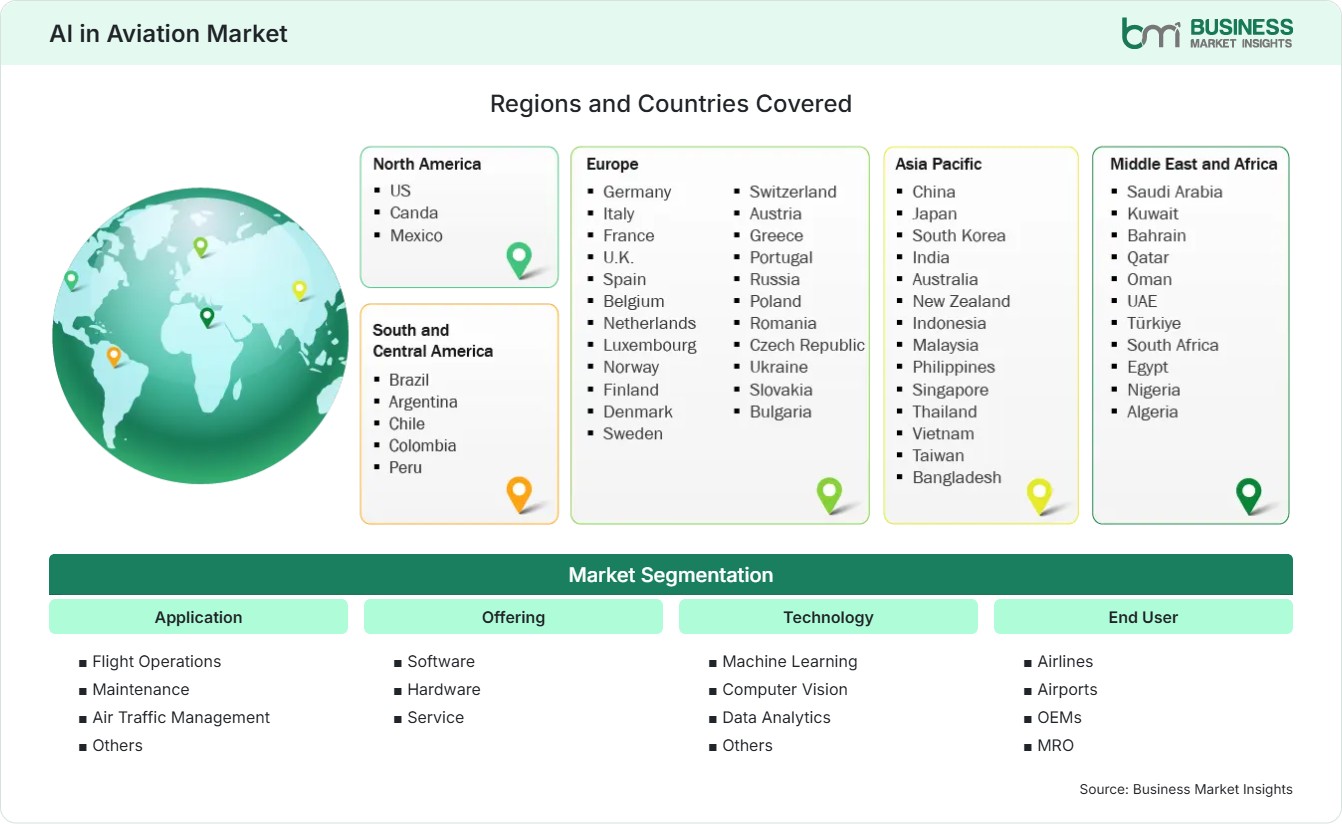
Global Market Geography
FREE PDF
Request your free sample
Request free sample
Segment Analysis

AI in Aviation Market Segmentation

Application

The application segment represents the largest revenue contributor, supported by increasing deployment of artificial intelligence across airline operations, airport management, maintenance planning, and air traffic optimization. It accounted for 35%–38% market share in 2025 and is projected to expand at a CAGR of 20.8%–21.5% during 2026–2033. Growing digital transformation across aviation operations and increasing demand for intelligent decision-making continue strengthening the AI in Aviation Market scope across commercial and defense aviation.

  • Flight Operations: Widely adopted for intelligent flight planning, route optimization, fuel efficiency improvement, crew scheduling, and real-time operational decision support, helping airlines improve punctuality, reduce operating costs, and enhance passenger satisfaction.
  • Maintenance: AI-powered predictive maintenance enables continuous aircraft health monitoring, component failure prediction, maintenance scheduling, and reduced aircraft downtime, improving fleet availability while lowering lifecycle maintenance costs.
  • Air Traffic Management: Increasingly deployed to optimize airspace utilization, aircraft sequencing, congestion management, and flight coordination, supporting safer and more efficient airport and airspace operations.
  • Others: Includes passenger services, baggage handling, airport security, resource allocation, and operational planning applications where intelligent automation improves service quality, operational efficiency, and passenger experience.

Offering

The offering segment continues expanding as aviation organizations invest in integrated software platforms, intelligent hardware, and specialized implementation services. It accounted for 43%–46% market share in 2025 and is expected to register a CAGR of 20.2%–20.9% through 2026–2033. Cloud adoption, digital modernization, and increasing AI integration across aviation infrastructure continue supporting long-term market expansion.

  • Software: Represents the largest deployment category through AI-powered analytics, flight optimization platforms, predictive maintenance software, airport management systems, and intelligent operational dashboards supporting aviation decision-making.
  • Hardware: Includes high-performance computing infrastructure, onboard sensors, edge devices, smart cameras, and aviation communication equipment supporting real-time data collection and AI model execution.
  • Service: Covers consulting, system integration, cloud deployment, technical support, training, and managed services that enable successful AI implementation and long-term operational optimization across aviation organizations.

Technology

Technology innovation remains central to aviation digitalization as organizations increasingly deploy intelligent algorithms for operational efficiency and predictive analytics. This segment captured 37%–40% market share in 2025 and is forecast to grow at a CAGR of 22.5%–23.4% during 2026–2033. Expanding AI in Aviation Market trends reflect continuous investment in advanced artificial intelligence technologies supporting autonomous decision-making and aviation safety.

  • Machine Learning: Leads the use of technologies in areas such as predictive maintenance, forecasting, anomaly detection, smart scheduling, and operation optimization in airlines, airports, and airframe manufacturing organizations.
  • Computer Vision: Enables automated inspection of aircraft, facial recognition, baggage screening, and runway and airport surveillance, enhancing accuracy and minimizing human effort.
  • Data Analytics: Facilitates operational intelligence, passenger flow analysis, fleet analysis, revenue management, and maintenance scheduling using data analytics techniques.
  • Others: Includes natural language processing, reinforcement learning, robotic process automation, and intelligent decision-support technologies expanding AI capabilities across aviation operations.

End User

End-user adoption continues increasing as aviation stakeholders accelerate digital transformation strategies to improve operational performance, safety, and customer experience. The segment accounted for 33%–36% market share in 2025 and is projected to expand at a CAGR of 20.4%–21.1% through 2026–2033. Growing investments in intelligent aviation ecosystems continue driving enterprise-wide AI implementation.

  • Airlines: Lead adoption through AI-powered flight operations, predictive maintenance, crew scheduling, revenue management, passenger services, and operational efficiency initiatives supporting profitable airline operations.
  • Airports: Increasingly deploy intelligent passenger processing, resource optimization, security management, automated baggage handling, and smart infrastructure solutions to improve operational performance and passenger experience.
  • OEMs: Integrate artificial intelligence into aircraft design, manufacturing, quality inspection, digital engineering, and lifecycle management to enhance product reliability and production efficiency.
  • MRO: Maintenance, repair, and overhaul organizations utilize AI for predictive diagnostics, spare parts optimization, maintenance scheduling, technical documentation analysis, and asset performance management, reducing turnaround time and maintenance costs.
Market Forces

AI in Aviation Market Dynamics

Key Market Drivers

Rising adoption of intelligent flight operations

Artificial Intelligence is increasingly being used by airlines in planning flights, optimizing routes, fueling airplanes, and scheduling crews to increase efficiency and save costs. The decision-making systems powered by Artificial Intelligence offer real-time analysis of weather, airplane performance, and traffic to help in planning optimal flight routes. According to the International Air Transport Association (IATA), global air passenger traffic continues to recover, increasing pressure on airlines to improve operational efficiency through digital technologies. Consequently, AI in Aviation Market growth is supported by growing investments in intelligent flight operations that enhance productivity, reduce fuel consumption, and strengthen airline competitiveness.

Growing demand for predictive maintenance tools

Aircraft operators increasingly rely on predictive maintenance solutions to improve fleet reliability and minimize unexpected equipment failures. Artificial intelligence analyzes aircraft sensor data, maintenance records, and operational parameters to identify potential component failures before they occur. This strategy helps lower maintenance costs, increases aircraft availability, and ensures safety. Original Equipment Manufacturers (OEMs), airlines, and Maintenance Repair & Overhaul companies (MROs) are constantly developing digital maintenance systems that will help increase efficiency of maintenance scheduling and minimize downtime. As the number of commercial aircraft increases worldwide, predictive maintenance becomes a necessary part of modern aviation business.

Increasing automation across aviation workflows

Artificial intelligence is accelerating automation across airport operations, air traffic management, passenger services, baggage handling, and administrative processes. Intelligent systems improve operational coordination while reducing manual intervention and human error. Automated document processing, digital passenger assistance, resource scheduling, and AI-enabled operational analytics allow aviation organizations to improve efficiency and service quality. Growing adoption of cloud computing, connected aircraft technologies, and intelligent airport infrastructure continues strengthening AI in Aviation Market trends, enabling aviation stakeholders to modernize operations and deliver more efficient passenger experiences.

Key Market Opportunities

Expansion of intelligent airport management

Global airport operators are developing intelligent infrastructure systems for enhancing the processing, security, baggage handling, and management processes within airports. With artificial intelligence, real-time monitoring, predictive distribution of resources, and management of passenger traffic is possible. Large international airports increasingly implement AI-driven digital platforms to enhance capacity utilization while improving passenger satisfaction. The AI in Aviation Market Forecasts indicate that continuous airport modernization projects and smart infrastructure investments will create substantial long-term opportunities for technology providers delivering intelligent airport management solutions.

Growing demand for aviation analytics platforms

Airlines, airports, OEMs, and regulatory authorities increasingly depend on advanced analytics platforms to convert operational data into actionable business intelligence. Artificial intelligence supports demand forecasting, operational planning, revenue optimization, aircraft performance analysis, and passenger behavior assessment through advanced analytical capabilities. As aviation organizations generate larger volumes of operational data, demand continues increasing for scalable analytics platforms capable of improving strategic decision-making. Technology providers offering cloud-native aviation analytics solutions are expected to benefit from growing enterprise investments in digital transformation initiatives.

Rising investments in digital aviation systems

Governments, airport authorities, and commercial airlines continue allocating substantial investments toward digital aviation ecosystems integrating artificial intelligence, cloud computing, IoT, and automation technologies. Digital air traffic management, connected airport infrastructure, intelligent maintenance systems, and autonomous operational platforms are becoming strategic priorities across developed and emerging aviation markets. These investments create favorable conditions for AI solution providers capable of delivering interoperable, secure, and scalable digital aviation platforms supporting operational efficiency, sustainability, and long-term modernization objectives.

Market Restraints and Challenges

Data security concerns affect implementation

Artificial intelligence platforms process significant volumes of operational, passenger, maintenance, and flight information across interconnected aviation systems. Factor: Increasing cyber threats, unauthorized access risks, and data privacy requirements require aviation organizations to strengthen cybersecurity frameworks before implementing AI technologies. Impact: Increased cybersecurity expenditure, prolonged time of deployment, and greater compliance needs make AI implementation more complicated, especially for those businesses that run critical operations. While cybersecurity technologies keep evolving, data security is one of the important factors to consider in the deployment of AI.

Regulatory uncertainty delays technology adoption

Artificial intelligence deployment within aviation must comply with rigorous safety certification, operational standards, and international regulatory requirements. Factor: Differences in regulatory frameworks across countries create uncertainty regarding AI validation, certification, and operational approval processes. Impact: The introduction of AI-based aviation solutions is often associated with lengthy product development periods, delayed commercial launch, and greater compliance costs for technology suppliers and aviation service providers. Collaboration between aviation regulators, aircraft manufacturers, and technology companies will continue to be key to setting common standards for AI usage.

Company Analysis

Competitive Landscape

The competitive landscape is characterized by strategic collaborations between aerospace manufacturers, cloud technology providers, and artificial intelligence specialists to accelerate digital aviation transformation. AI in Aviation Market analysis indicates that companies are strengthening AI capabilities through machine learning, cloud computing, predictive analytics, intelligent automation, and digital aviation platforms to improve flight operations, airport management, maintenance efficiency, and air traffic optimization.

Company Name

Overview

Products and Services Relevant to this Market

IBM Corporation

Develops enterprise artificial intelligence, cloud computing, and analytics solutions supporting digital transformation across aviation, transportation, and aerospace industries.

Watson AI, hybrid cloud platforms, predictive analytics, operational intelligence, aviation data management, and AI consulting services.

Microsoft Corporation

Provides cloud infrastructure, artificial intelligence, and enterprise software supporting intelligent aviation operations and digital airport modernization initiatives.

Microsoft Azure AI, cloud computing, machine learning services, data analytics, digital twins, and enterprise productivity platforms.

Google LLC

Delivers artificial intelligence, cloud analytics, machine learning, and data processing technologies enabling aviation organizations to improve operational efficiency and customer experience.

Google Cloud AI, Vertex AI, data analytics, computer vision, predictive modeling, and cloud infrastructure services.

Amazon Web Services, Inc.

Offers scalable cloud computing and artificial intelligence platforms supporting aviation analytics, operational optimization, and enterprise digital transformation.

AWS AI services, machine learning, cloud storage, predictive analytics, IoT platforms, and aviation data processing solutions.

Airbus SE

Global aerospace manufacturer integrating artificial intelligence across aircraft design, flight operations, predictive maintenance, and digital aviation technologies.

Skywise platform, predictive maintenance solutions, digital twins, aircraft analytics, and intelligent operational software.

The Boeing Company

Leading aerospace company utilizing artificial intelligence to improve aircraft performance, engineering, maintenance, and operational decision-making.

Digital aviation platforms, aircraft analytics, predictive maintenance, autonomous systems, and operational intelligence solutions.

Honeywell International Inc.

Provides advanced avionics, connected aircraft technologies, and intelligent software supporting airline operational efficiency and aviation safety.

Connected aircraft solutions, predictive maintenance, flight management systems, avionics, and operational analytics.

Thales Group

Develops advanced aerospace technologies focused on digital air traffic management, cybersecurity, and intelligent aviation infrastructure.

Air traffic management systems, AI software, cybersecurity, digital navigation, and airport operational platforms.

RTX Corporation

Supplies intelligent aerospace technologies supporting commercial aviation, defense aviation, predictive maintenance, and advanced aircraft systems.

Connected aerospace systems, avionics, aircraft diagnostics, AI-enabled maintenance, and intelligent flight technologies.

SITA

Global aviation technology provider specializing in digital airport operations, passenger processing, and intelligent airline information systems.

Airport management platforms, passenger processing, biometric solutions, AI analytics, baggage management, and aviation connectivity services.

Trust & Transparency

Research Methodology

The market analysis combines proprietary research with secondary data from government agencies, company disclosures, regulatory filings, industry databases and expert interviews. Market estimates are validated through data triangulation, cross-market benchmarking and analyst review.

View Full Research Methodology

Questions Answered

Frequently Asked Questions

What does the AI in Aviation Market Report provide to stakeholders?

The Market Report delivers comprehensive insights into market dynamics, technology trends, competitive landscape, regional opportunities, segmentation analysis, investment prospects, and strategic developments, enabling informed business and investment decisions.

How is machine learning transforming aviation operations?

Machine learning enables predictive maintenance, anomaly detection, demand forecasting, aircraft performance optimization, intelligent scheduling, and operational analytics, helping aviation organizations improve safety, reduce costs, and maximize fleet efficiency.

Which region is expected to experience the fastest growth?

Asia Pacific is anticipated to register the highest growth during the forecast period, driven by airport infrastructure expansion, increasing aircraft fleets, government digital aviation initiatives, and growing airline investments in artificial intelligence technologies.

Which application segment leads the market?

Flight Operations holds the leading market position due to increasing adoption of AI for route optimization, fuel efficiency, crew scheduling, operational planning, and real-time flight decision support across commercial airlines.

What is the primary objective of artificial intelligence in aviation?

Artificial intelligence improves operational efficiency by supporting intelligent flight operations, predictive maintenance, air traffic management, passenger services, and airport resource optimization while enhancing safety, sustainability, and decision-making.

Access the Full AI in Aviation Market Report

Get segment-level forecasts, regional estimates, competitive benchmarking, company profiles and downloadable Excel datasets.

Access the full AI in Aviation Market Report
350 pages PDF & Excel | 2026-08-06