
Aerial Refueling Systems Market Outlook: Size, Share, Trends, Growth Analysis, Competitive Landscape & Forecast, 2026-2033

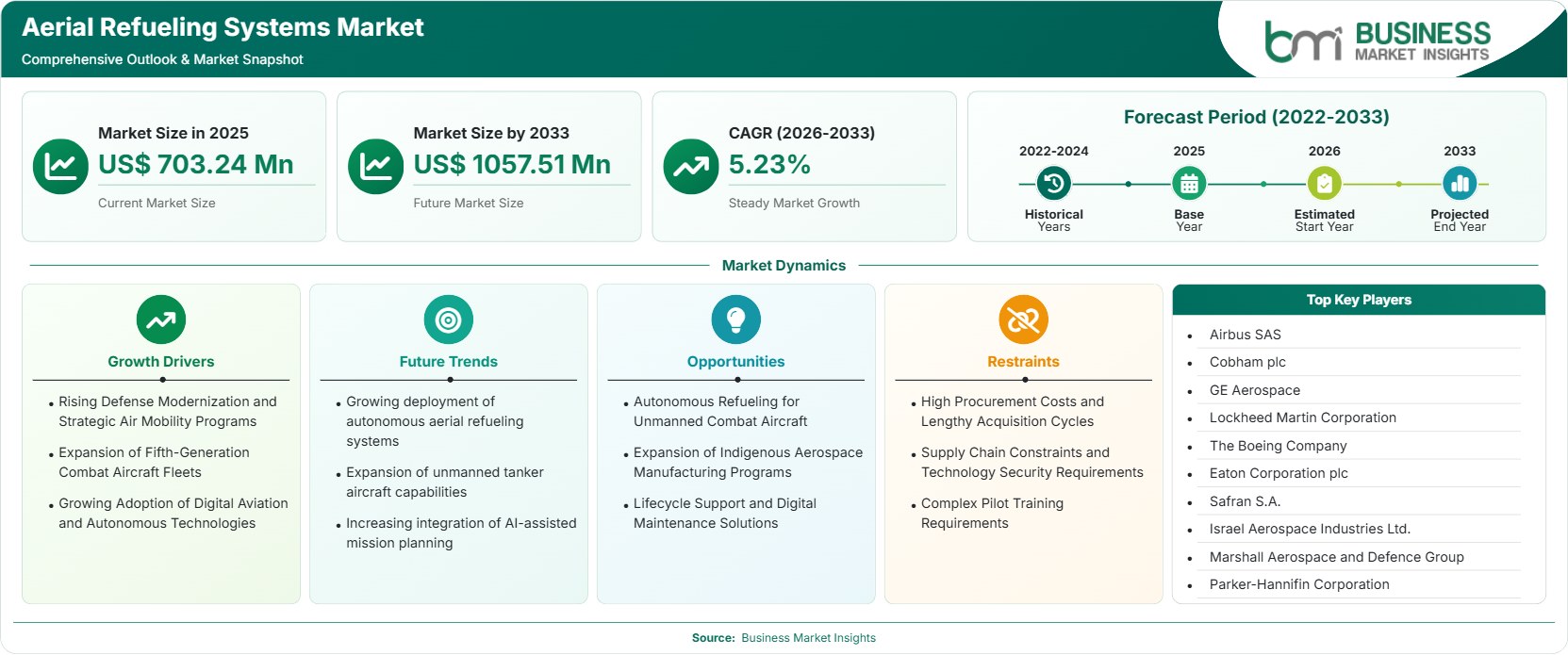
The Aerial Refueling Systems Market size was valued at US$ 703.24 million in 2025 and is projected to reach US$ 1057.51 million by 2033, growing at a CAGR of 5.23% during 2026–2033. Rising defense modernization programs, increasing procurement of tanker aircraft, expanding unmanned aerial vehicle capabilities, and investments in autonomous refueling technologies continue creating long-term opportunities across military and specialized aviation sectors.

Report Coverage
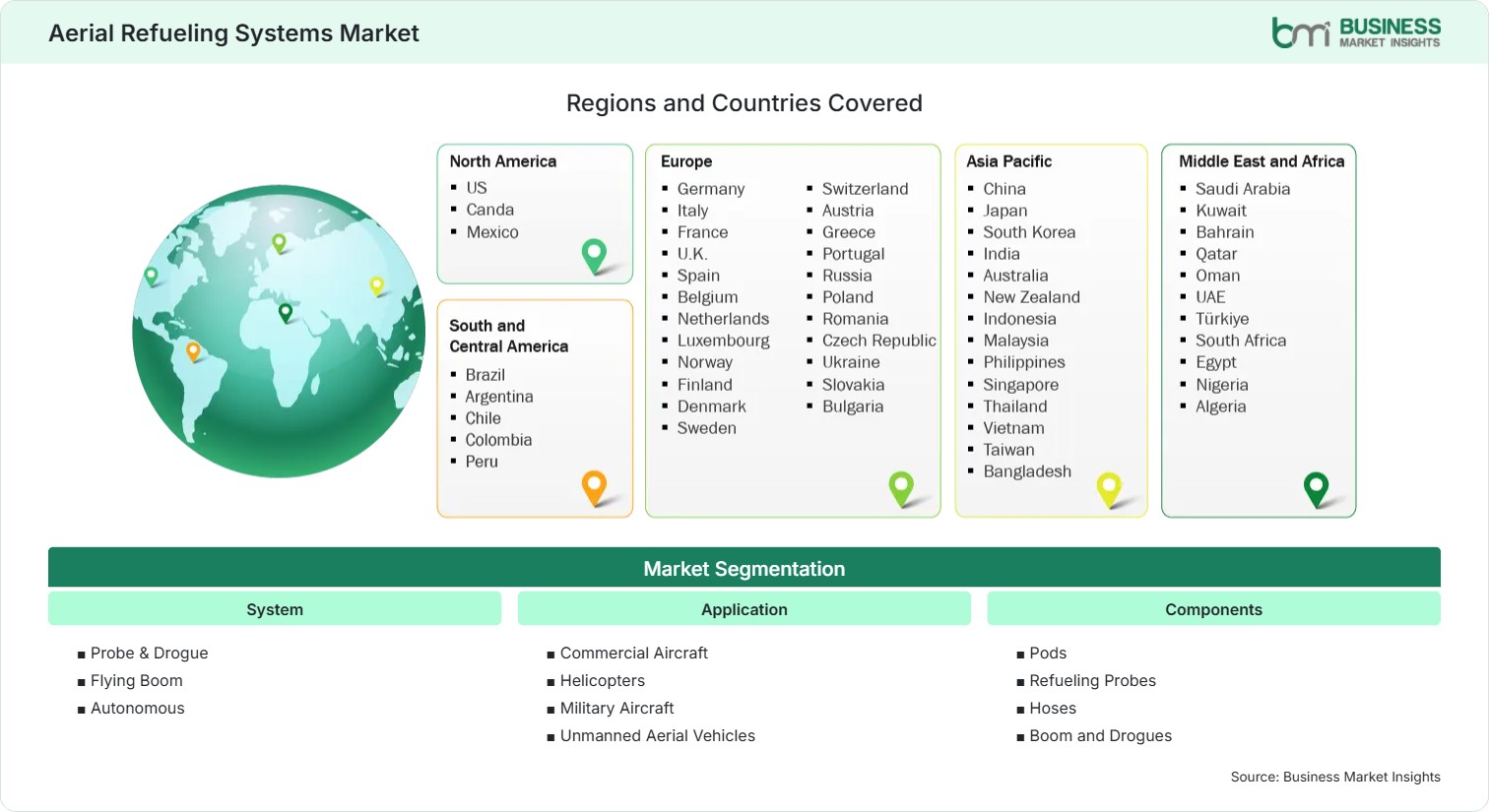
  • System: Probe & Drogue, Flying Boom, Autonomous
  • Application: Commercial Aircraft, Helicopters, Military Aircraft, Unmanned Aerial Vehicles
  • Components: Pods, Refueling Probes, Hoses, Boom and Drogues
US$ 703.24 Mn Market size in 2025
US$ 1057.51 Mn Market Size by 2033
5.23% CAGR, 2026 - 2033
2026-2033 Forecast Period

01 AI Overview

Aerial Refueling Systems Market Summary

  • North America Region: North America held 36%–39% market share in 2025 and is expected to grow at a 4.8%–5.3% CAGR through 2033. Growth is driven by defense spending, tanker modernization, autonomous refueling technologies, and military collaborations. The U.S. supports expansion through KC-46A programs, autonomous research, and next-generation aircraft investments.
  • Fastest Growing Region: Asia Pacific accounts for 23%–26% market share in 2025 while expanding at a 6.3%–6.9% CAGR during 2026–2033. Rising defense budgets, growing indigenous aircraft manufacturing, expanding surveillance missions, and regional security initiatives accelerate procurement of advanced airborne refueling platforms and supporting infrastructure.
  • Leading Segment: Military Aircraft represents 57%–61% market share in 2025 and is forecast to register a 5.2%–5.7% CAGR. Fleet modernization, long-range combat readiness, multinational defense cooperation, and increased aerial endurance requirements continue supporting sustained procurement across developed and emerging defense organizations.
  • High Growth Segment: Autonomous Systems contribute 11%–14% market share during 2025 while advancing at a 7.2%–7.8% CAGR through 2033. Artificial intelligence integration, autonomous flight management, unmanned combat platforms, and reduced operational risks encourage greater investments from defense agencies and aerospace manufacturers worldwide.
  • Key Market Opportunity: Increasing deployment of autonomous refueling technologies for unmanned combat aircraft, next-generation tankers, and collaborative defense operations enables manufacturers to develop intelligent airborne systems, software-defined mission capabilities, and advanced digital fleet management solutions.
  • Major Market Players: Airbus SAS, Cobham plc, GE Aerospace, Lockheed Martin Corporation, The Boeing Company, Eaton Corporation plc, Safran S.A., Israel Aerospace Industries Ltd., Marshall Aerospace and Defence Group, Parker-Hannifin Corporation.
02 Strategic Insights

Aerial Refueling Systems Market: Strategic Insights

Aerial Refueling Systems Market Strategic Framework
FREE PDF
Request your free sample
Request free sample
03 Stakeholder View

Key Takeaways

  • The industry value chain is increasingly integrating aircraft manufacturers, mission-system developers, software providers, component suppliers, and maintenance organizations to improve lifecycle efficiency while supporting modernization of strategic air mobility fleets across multiple defense alliances.
  • Procurement opportunities remain strongest within military aviation programs where governments continue prioritizing tanker fleet replacement, unmanned combat aircraft integration, and long-range operational readiness for rapidly evolving security environments requiring enhanced aerial endurance.
  • Innovation is shifting toward autonomous refueling, digital mission planning, artificial intelligence-assisted flight control, predictive diagnostics, lightweight materials, and cyber-secure airborne communication architectures that improve operational safety and reduce maintenance complexity.
  • Asia Pacific presents one of the most attractive investment destinations as regional governments accelerate indigenous aerospace manufacturing, defense industrial partnerships, and advanced tanker acquisition programs supporting expanding strategic airlift and surveillance missions.
  • Strategic collaborations, technology licensing agreements, defense contracts, and cross-border aerospace partnerships continue shaping competitive positioning as manufacturers invest in next-generation airborne refueling technologies and integrated lifecycle support capabilities.
  • Future competitiveness will increasingly depend on software-defined mission systems, autonomous flight technologies, modular refueling architectures, and digital maintenance ecosystems capable of supporting diverse military aircraft and unmanned operational requirements.
04 Geographic Outlook

Aerial Refueling Systems Market Regional Highlights

North America Aerial Refueling Systems Market

North America accounted for 36%–39% of the global Aerial Refueling Systems Market share in 2025 and is anticipated to register a 4.8%–5.3% CAGR during 2026–2033. The region benefits from sustained defense modernization budgets, replacement of aging aerial tanker fleets, and continuous investments in next-generation combat aircraft. Strong aerospace manufacturing capabilities, extensive research programs, and long-term procurement contracts continue strengthening industrial competitiveness.

  • U.S. defense investments in tanker modernization and digital systems are supporting aerospace manufacturing growth.
  • Autonomous refueling technologies are creating opportunities for software, avionics, and component providers.
  • U.S.-Canada collaboration strengthens military aviation supply chains, maintenance, and engineering support.
  • Investments in AI, predictive maintenance, and lightweight structures improve mission efficiency and reduce costs.
  • Defense partnerships and exports support demand for tanker aircraft and advanced refueling systems.

US Aerial Refueling Systems Market

The United States represents approximately 82%–86% of the North American market and is expected to expand at a 4.9%–5.4% CAGR through 2033 in Aerial Refueling Systems Market. The country's leadership is supported by advanced aerospace manufacturing, high defense expenditures, continuous fleet modernization, and extensive deployment of tanker aircraft supporting global military operations.

  • Advanced tanker aircraft procurement improves endurance for deployments, humanitarian missions, and military exercises.
  • Defense research is advancing autonomous refueling, AI integration, and secure communication systems.
  • Aerospace and technology partnerships accelerate development of digital airborne refueling solutions.
  • Maintenance and overhaul programs support long-term aftermarket demand and fleet life extension.

Europe Aerial Refueling Systems Market

Europe held 26%–29% of the global market during 2025 and is projected to grow at a 4.9%–5.5% CAGR throughout the forecast period. Regional demand is supported by NATO interoperability requirements, multinational defense cooperation, and increasing investments in strategic air mobility. France, the United Kingdom, and Germany remain leading contributors, while Poland records one of the fastest expansion rates with an estimated 6.0%–6.5% CAGR owing to accelerated military modernization initiatives.

  • France is strengthening aerospace capabilities through tanker modernization, advanced refueling technologies, and defense communication systems.
  • The United Kingdom maintains strong participation with engineering expertise, component manufacturing, and military aviation support services.
  • Germany focuses on European defense programs, digital maintenance, and airborne logistics modernization.
  • Poland is expanding defense investments, military procurement, and aerial refueling capabilities through strategic partnerships.
  • European aerospace companies are investing in lightweight materials, autonomous systems, and sustainable manufacturing to improve performance and reduce costs.

Asia Pacific Aerial Refueling Systems Market

Asia Pacific accounted for 23%–26% of global revenue in 2025 and is forecast to register the highest 6.3%–6.9% CAGR through 2033. Rising geopolitical tensions, expanding indigenous aircraft production, and increasing defense modernization programs are driving procurement of tanker aircraft and advanced airborne refueling technologies. China leads regional demand in Aerial Refueling Systems Market, while India demonstrates the fastest expansion with an estimated 6.8%–7.3% CAGR, supported by growing defense investments and domestic aerospace initiatives.

  • China is investing in tanker aircraft development, advanced military aviation, and defense manufacturing capabilities.
  • India is expanding defense programs through domestic aerospace production, technology transfers, and partnerships.
  • Japan supports demand through surveillance, strategic mobility, and allied defense interoperability initiatives.
  • South Korea is advancing combat aircraft, autonomous aviation, and digital defense technologies.
  • Regional collaboration is strengthening aerospace innovation, localized production, and maintenance ecosystems.

Rest of World Aerial Refueling Systems Market

The Rest of World region represented 10%–13% of the global market in 2025 and is anticipated to expand at a 5.1%–5.7% CAGR during 2026–2033. South & Central America continue investing selectively in military aviation modernization, while Middle East & Africa countries prioritize strategic air mobility and defense readiness in Aerial Refueling Systems Market. Saudi Arabia remains the leading regional market, whereas the United Arab Emirates demonstrates one of the strongest growth trajectories with a 5.8%–6.3% CAGR.

  • Saudi Arabia continues strengthening defense capabilities through procurement of advanced military aircraft, strategic partnerships, and long-term modernization programs supporting aerial refueling infrastructure.
  • The United Arab Emirates invests in smart defense technologies, aerospace innovation, and next-generation aviation capabilities, creating opportunities for international aerospace manufacturers and technology providers.
  • Brazil supports gradual modernization of military aviation assets while expanding domestic aerospace manufacturing capabilities and strengthening regional defense cooperation initiatives.
  • Increasing defense collaboration across Middle Eastern nations encourages procurement of advanced tanker aircraft, mission systems, and integrated airborne refueling technologies supporting regional operational readiness.
  • International technology transfer agreements and industrial partnerships continue improving maintenance capabilities, local production, and lifecycle support services across emerging defense aviation markets.
Global Market Geography
FREE PDF
Request your free sample
Request free sample
05 Segment Analysis

Aerial Refueling Systems Market Segmentation

System

The System segment accounted for approximately 34%–37% market share in 2025 and is projected to register a 5.5%–6.0% CAGR through 2033. The Aerial Refueling Systems Market scope continues expanding as military forces prioritize interoperability, mission flexibility, and autonomous capabilities. Continuous investments in digitally controlled refueling technologies and modern tanker aircraft support sustainable long-term segment growth.

  • Probe & Drogue: Widely used in naval and multinational fleets due to flexibility, aircraft compatibility, and reliable refueling performance.
  • Flying Boom: Preferred for heavy aircraft due to high fuel transfer capacity, precision, and long-range mission support.
  • Autonomous: AI, sensors, and automation are enabling safer refueling with reduced pilot workload and unmanned platform compatibility.

Application

The Application segment represented nearly 43%–46% market share during 2025 while expanding at a 5.4%–5.9% CAGR during 2026–2033 through the forecast period. Defense modernization remains the primary growth catalyst, supported by increasing procurement of combat aircraft, surveillance platforms, helicopters, and unmanned aerial vehicles. Aerial Refueling Systems Market trends continue favoring multi-role operational capabilities and extended mission endurance.

  • Commercial Aircraft: Adoption remains limited, focusing on specialized programs, emergency response, and research applications.
  • Helicopters: Refueling capabilities support tactical, rescue, and special operations requiring extended mission range.
  • Military Aircraft: Dominates demand through fleet modernization, long-range missions, and defense operations.
  • Unmanned Aerial Vehicles: Growing drone deployment increases demand for autonomous refueling technologies.

Components

The Components segment contributed approximately 27%–30% market share in 2025 and is anticipated to grow at a 5.1%–5.6% CAGR during 2026–2033. Demand is driven by modernization of tanker aircraft, increasing replacement of aging equipment, and adoption of lightweight high-performance aerospace materials. Manufacturers continue emphasizing modular component designs, predictive maintenance capabilities, and improved operational reliability in Aerial Refueling Systems Market.

  • Pods: Modular refueling pods support multiple aircraft platforms and flexible mission requirements.
  • Refueling Probes: Improve connection accuracy, safety, and compatibility with modern tanker aircraft.
  • Hoses: Lightweight, durable hose systems enhance fuel transfer efficiency and reliability.
  • Boom and Drogues: Enable efficient refueling, fleet interoperability, and improved airborne mission performance.
06 Market Forces

Aerial Refueling Systems Market Dynamics

Key Market Drivers

Rising Defense Modernization and Strategic Air Mobility Programs

Governments worldwide continue prioritizing modernization of military aviation fleets to improve operational reach, rapid deployment, and mission endurance. NATO members are increasing defense expenditure following revised capability targets, while Indo-Pacific countries are accelerating procurement of tanker aircraft and long-range combat platforms. These investments directly strengthen demand for advanced aerial refueling technologies capable of supporting multi-domain operations. The Aerial Refueling Systems Market growth is reinforced by expanding strategic airlift requirements, multinational military exercises, and replacement of aging tanker fleets. Modern digital mission systems, secure communications, and integrated flight management technologies further enhance operational efficiency, encouraging procurement agencies to adopt technologically advanced airborne refueling solutions that improve readiness, interoperability, and lifecycle performance across allied defense organizations.

Expansion of Fifth-Generation Combat Aircraft Fleets

The increased use of fifth generation fighters is driving steady growth in need for dependable airborne refueling solutions that can support long-range and continuous surveillance missions. Modern aircraft like stealth fighters require high levels of mission readiness, network centric warfare capability, and extended endurance. As more advanced combat aircraft are purchased by defense agencies, so do the investments in compatible tanker aircraft, digital booms, and precise refueling systems grow. Interoperability needs among allied air forces make the development of standardized refueling solutions capable of operating with various aircraft types a necessity. Aerospace companies are addressing these needs through lightweight composite structures, smart monitoring solutions, and digital refueling architecture.

Growing Adoption of Digital Aviation and Autonomous Technologies

The application of artificial intelligence, predictive analytics, autonomous navigation, and sensor fusion technology is transforming the way in which military aircraft operate. Military defense agencies have a growing need for automated air-refueling systems, which will help ease pilots' workload, enhance precision, and support unmanned aerial operations. The use of digital twins, predictive maintenance software, and avionics enables real-time tracking of system performance without interrupting the operational process. The convergence of the software-defined aircraft architecture and autonomous mission management enhances future investment prospects for aerospace technology companies.

Key Market Opportunities

Autonomous Refueling for Unmanned Combat Aircraft

The rapid expansion of unmanned combat aerial vehicle programs presents a substantial opportunity for manufacturers developing autonomous airborne refueling technologies. Defense organizations increasingly recognize unmanned platforms as critical assets for intelligence, surveillance, reconnaissance, and precision strike missions requiring extended operational endurance. Autonomous boom control, machine vision, and artificial intelligence-driven flight coordination enable safe refueling with minimal human intervention. Aerial Refueling Systems Market Forecasts indicate continued investments in autonomous mission capabilities as governments prioritize force multiplication and operational flexibility. Companies capable of integrating secure communications, adaptive control algorithms, and autonomous flight management into refueling systems are well positioned to capture future procurement opportunities across advanced military aviation programs worldwide.

Expansion of Indigenous Aerospace Manufacturing Programs

The emerging economies are increasingly investing in their local aerospace industries to improve their defense capabilities while reducing their reliance on foreign military equipment. Economies like India, South Korea, Turkiye, and some nations in the Middle East have been steadily increasing the production of locally manufactured aircraft through technology transfer agreements, industrial alliances, and government-supported research. Such initiatives would result in sustained demand for refueling equipment, engineering services, maintenance facilities, and mission systems, which can be supplied by international aerospace companies through joint-venture and license-production schemes.

Lifecycle Support and Digital Maintenance Solutions

Apart from aircraft acquisition, the focus is shifting towards long-term maintenance, diagnostic and software updates and lifecycle optimization for defense organizations. The use of digital maintenance systems that leverage artificial intelligence, cloud-based analytics, and condition-based monitoring has dramatically reduced downtime of aircraft. Aerospace organizations which can provide lifecycle management services, spare parts optimization, digital mission planning, and cybersecurity have been projected to benefit from regular revenues during the entire lifetime of aircraft operations. With growing focus of defense budgets on availability rather than size of fleets, complete aftermarket services will be a key differentiating factor in future growth of manufacturers.

Market Restraints and Challenges

High Procurement Costs and Lengthy Acquisition Cycles

Factor: The installation of an advanced aerial refueling system entails considerable costs for integration with the aircraft, software, parts, certification, pilot training, and maintenance support. Impact: Since such equipment requires substantial capital expenditures, the purchase process is likely to be delayed. In many cases, governments spend much time evaluating, testing, regulating, and negotiating about their purchases. In addition, budgetary constraints, geopolitical instability, and shifting priorities in the defense industry may delay the updating process. These factors increase project complexity and lead to limited purchases and uncertain revenue for producers.

Supply Chain Constraints and Technology Security Requirements

Factor: The suppliers to the aerospace industry rely on specialized providers for avionics, precision parts, sophisticated materials, cybersecurity systems, and mission-critical software that needs to adhere to the regulations imposed by the defense department. Impact: Disruptions in the supply chain, export control measures, cybersecurity requirements, and certification processes will greatly impact the production cycle and delivery time. The control of the movement of technology across borders can also impact collaboration among foreign partners and increase the cost of development. The aerospace industry needs to focus on supplier diversification, secure information technology infrastructure, and robust production network systems to mitigate operational risks.

07 Company Analysis

Competitive Landscape

The competitive environment is characterized by long-term defense contracts, technological innovation, and strategic collaborations among aircraft manufacturers, subsystem suppliers, and aerospace engineering companies. The Aerial Refueling Systems Market analysis indicates that companies are prioritizing autonomous refueling technologies, lightweight composite structures, digital mission management, predictive maintenance capabilities, and interoperability with next-generation military aircraft.

Company Name

Overview

Products and Services Relevant to this Market

Airbus SAS

Airbus develops advanced military aircraft and aerial mobility solutions, supporting multinational defense programs with strong engineering expertise and integrated aerospace technologies.

A330 MRTT tanker aircraft, military aviation platforms, aerial refueling integration, digital mission systems, maintenance, lifecycle support, and defense engineering services.

Cobham plc

Cobham is a globally recognized supplier of mission-critical aerospace and defense technologies with extensive experience in airborne refueling equipment and aircraft integration.

Hose-and-drogue refueling systems, wing pods, refueling probes, mission equipment, engineering support, modernization services, and aerospace integration technologies.

GE Aerospace

GE Aerospace delivers propulsion technologies and digital aviation solutions supporting military aircraft performance, reliability, and operational efficiency across global defense programs.

Aircraft engines, digital aviation software, predictive maintenance, propulsion systems, avionics integration support, and aerospace engineering solutions.

Lockheed Martin Corporation

Lockheed Martin provides advanced defense systems, military aircraft, mission technologies, and integrated aerospace capabilities supporting strategic military operations worldwide.

Military aircraft, mission systems, autonomous technologies, avionics integration, defense software, logistics support, and lifecycle modernization solutions.

The Boeing Company

Boeing is among the world's leading aerospace manufacturers with extensive capabilities in military tanker aircraft, defense technologies, and global aviation support services.

KC-46A Pegasus tanker aircraft, aerial refueling systems, defense platforms, mission planning technologies, maintenance services, and integrated logistics support.

Eaton Corporation plc

Eaton supplies advanced aerospace components and power management technologies improving aircraft safety, operational efficiency, and mission reliability.

Fuel management systems, hydraulic components, aerospace power solutions, fluid conveyance technologies, valves, and aircraft subsystem engineering services.

Safran S.A.

Safran develops aerospace propulsion, avionics, landing systems, and defense technologies supporting commercial and military aviation modernization initiatives.

Aircraft equipment, navigation systems, avionics, mission electronics, aerospace engineering, propulsion technologies, and maintenance support solutions.

Israel Aerospace Industries Ltd.

Israel Aerospace Industries designs advanced defense platforms, military aircraft upgrades, and aerospace technologies supporting national and international security programs.

Aircraft modernization, unmanned aerial systems, mission electronics, defense integration, aerospace engineering, and military support services.

Marshall Aerospace and Defence Group

Marshall Aerospace specializes in military aircraft engineering, maintenance, conversions, and integrated lifecycle support for defense aviation customers globally.

Aircraft modification, engineering services, maintenance, military logistics, structural upgrades, and mission support solutions for tanker fleets.

Parker-Hannifin Corporation

Parker-Hannifin provides precision motion and control technologies supporting aerospace applications requiring exceptional reliability and performance.

Fuel systems, hydraulic technologies, aerospace filtration, fluid connectors, motion control components, and aircraft subsystem solutions.

10 Trust & Transparency

Research Methodology

The market analysis combines proprietary research with secondary data from government agencies, company disclosures, regulatory filings, industry databases and expert interviews. Market estimates are validated through data triangulation, cross-market benchmarking and analyst review.

View Full Research Methodology

11 Questions Answered

Frequently Asked Questions

What does an Aerial Refueling Systems Market Report typically include?

A report generally provides market sizing, growth outlook, regional assessment, segmentation analysis, competitive benchmarking, technology trends, investment opportunities, regulatory developments, and strategic recommendations for manufacturers, investors, and defense stakeholders.

Which application segment offers the highest growth potential?

Unmanned aerial vehicles present the strongest long-term growth opportunity as defense organizations increasingly invest in persistent intelligence, surveillance, reconnaissance, and combat missions requiring autonomous airborne refueling and extended operational endurance.

What technologies are transforming the future of this industry?

Artificial intelligence, autonomous refueling systems, digital mission planning, predictive maintenance, advanced sensors, secure communications, lightweight composite materials, and digital twin technologies are improving operational efficiency, safety, and aircraft availability while reducing lifecycle costs.

Which region is expected to dominate the Aerial Refueling Systems Market during the forecast period?

North America is expected to maintain its leading position because of sustained defense modernization, advanced aerospace manufacturing capabilities, and continuous investments in next-generation tanker aircraft, autonomous mission technologies, and long-term military procurement programs.

What are the primary applications of aerial refueling systems?

Aerial refueling systems are primarily used in military aircraft, helicopters, and unmanned aerial vehicles to extend mission endurance, operational range, and strategic mobility. Limited commercial applications also exist for specialized research and government aviation programs.

Access the Full Aerial Refueling Systems Market Report

Get segment-level forecasts, regional estimates, competitive benchmarking, company profiles and downloadable Excel datasets.

Access the full Aerial Refueling Systems Market Report
350 pages PDF & Excel | 2026-08-12