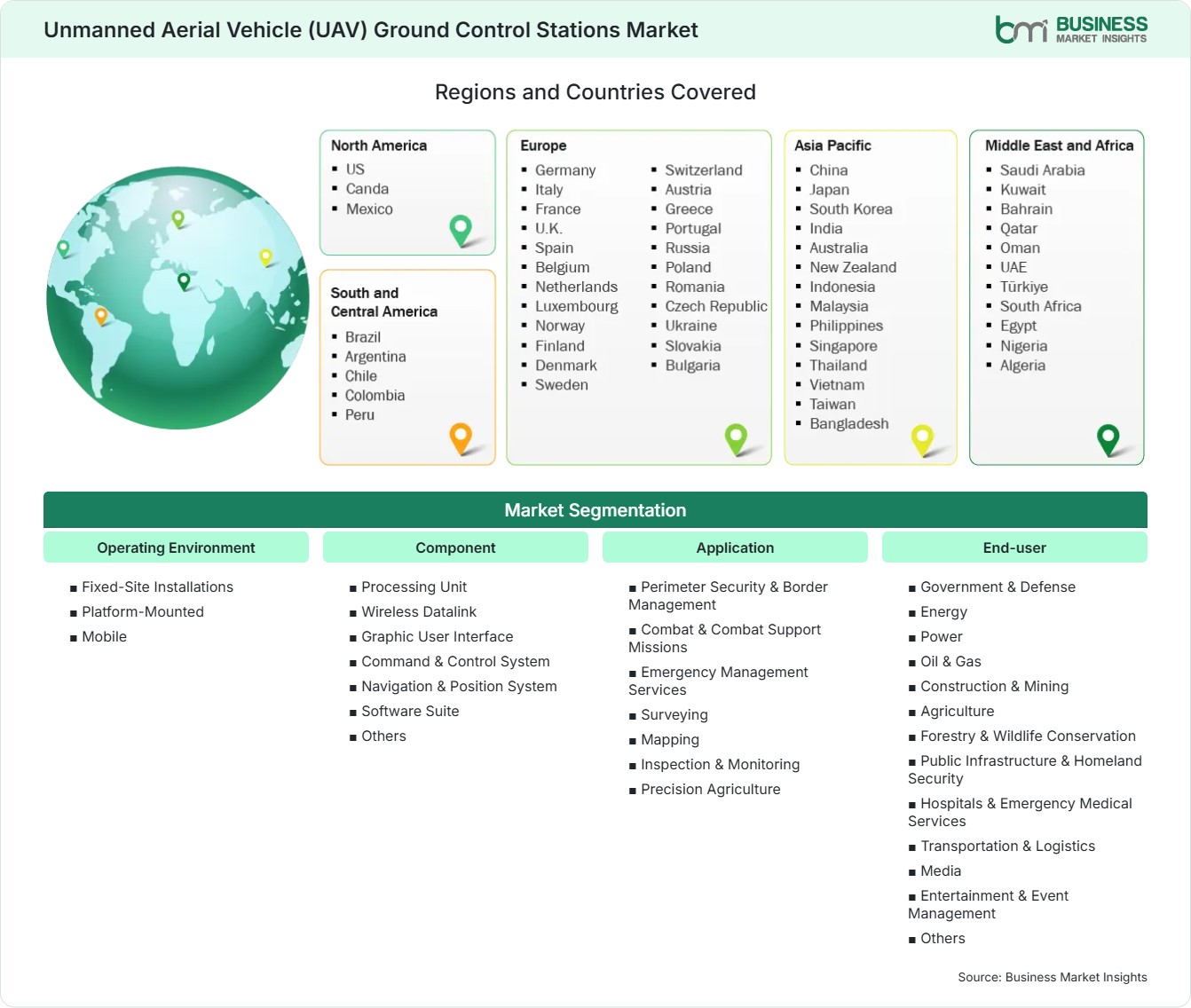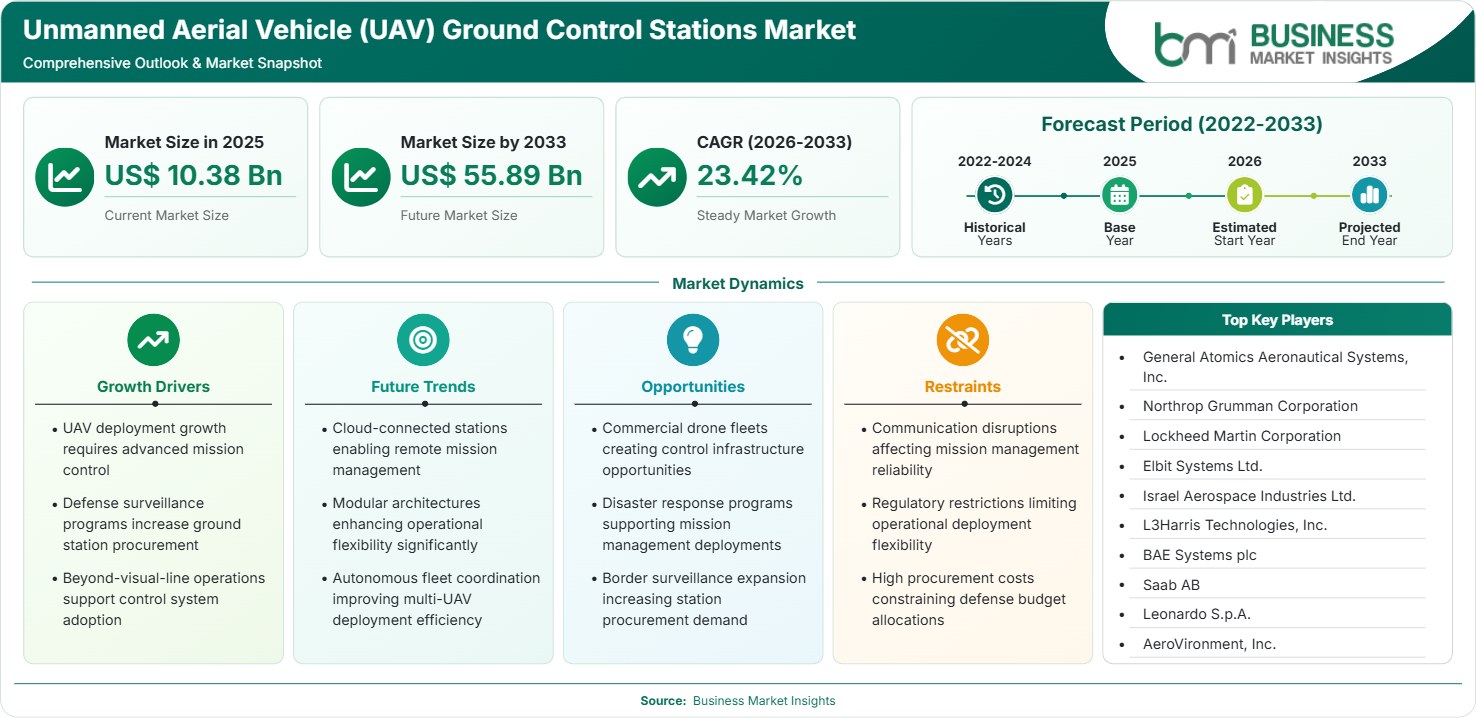
Unmanned Aerial Vehicle (UAV) Ground Control Stations Market Regional Highlights
North America
North America Unmanned Aerial Vehicle Ground Control Stations Market represents a 31%–34% share in 2025 and is projected to grow at a 21%–23% CAGR through 2033. The region combines mature defense procurement, advanced communications, commercial drone ecosystems, and established software capabilities. The market share is reinforced by US military programs and Canadian infrastructure applications.
- US defense buying prefers modular control systems that support different aircraft, payloads, and mission uses. These systems also keep communications secure in tough environments.
- The FAA's rulemaking on BVLOS operations could lead to greater commercial activity and thus raise the demand for remote supervision, automated alerts, operational logging, and scalable fleet management.
- Energy and infrastructure operators are now more frequently linking UAV missions with imagery, analytics, maintenance databases, and compliance workflows.
- Canada offers opportunities in the fields of mining, forestry, wildfire management, and that of remote infrastructure, since UAVs enhance access to monitoring.
US Unmanned Aerial Vehicle Ground Control Stations Market
The US represents 78%–82% of North American demand in 2025 and is projected to grow at a 21.5%–23.5% CAGR through 2033. Federal defense procurement, autonomy development, and commercial airspace reform support demand. The Unmanned Aerial Vehicle Ground Control Stations Market remains concentrated in the US because suppliers can address defense, homeland security, logistics, agriculture, and infrastructure applications through one technology ecosystem.
- When dealing with defense customers, modularity, cyber resilience, software upgrades, training, and lifecycle support are given priority together with aircraft compatibility.
- The use of this technology is being expanded in the fields of inspection, mapping, emergency response, and agriculture, since it enables more frequent data collection.
- The integration between aircraft and ground mission management is advancing within the country's avionics, communications, semiconductor, cloud, and AI sectors.
Europe Unmanned Aerial Vehicle Ground Control Stations Market
Europe holds a 24%–27% share in 2025 and is projected to expand at a 22%–24% CAGR through 2033. Demand reflects defense readiness, border surveillance, maritime security, infrastructure resilience, and airspace integration. Germany, France, Italy, the UK, and Spain are leading markets, while Poland and Nordic countries provide higher-growth opportunities. The Unmanned Aerial Vehicle Ground Control Stations Market share benefits from multinational interoperability requirements and investment in sovereign unmanned capabilities.
- Germany and France are extending their unmanned capabilities as part of their broader defense modernization to ensure secure command, achieve sensor integration, and enable interoperable mission systems.
- Italy and Spain have potential in the areas of maritime surveillance, border monitoring, environmental observation, and the inspection of infrastructure.
- In Poland and in the Nordic countries, there is greater growth potential since higher security requirements are leading to increased adoption of reconnaissance, surveillance, autonomy, and counter-UAS systems.
- The European airspace initiatives promote investment in standardized communication systems, detection-and-avoidance capabilities, and adaptable control structures.
Asia Pacific Unmanned Aerial Vehicle Ground Control Stations Market
Asia Pacific commands a 29%–32% share in 2025 and is projected to expand at a 25%–27% CAGR through 2033, making it the fastest-growing region. China, Japan, India, South Korea, and Australia are major demand centers. India and Southeast Asia offer strong incremental opportunities. The Unmanned Aerial Vehicle Ground Control Stations Market growth reflects border security, defense modernization, precision agriculture, infrastructure inspection, disaster response, and expanding domestic UAV manufacturing.
- China has a large capacity for manufacturing UAVs and uses them in agricultural, mapping, security, and industrial fields, offering networked and portable control systems.
- As India's domestic capacity for unmanned systems grows, it opens up opportunities in the fields of defense, border management, agriculture, railways, mining, and disaster response.
- Both Japan and South Korea place importance on maritime surveillance, the monitoring of infrastructure, autonomy, and advanced communications.
- There is demand in Australia for systems that are mobile and capable of long-range communication, particularly in the fields of defense, mining, environmental monitoring, and operations in remote areas.
Rest of World Unmanned Aerial Vehicle Ground Control Stations Market
South and Central America Unmanned Aerial Vehicle Ground Control Stations Market is developing demand across agriculture, mining, security, environmental monitoring, and disaster response, with Brazil, Mexico, Chile, and Colombia leading commercial opportunities. The combined region represents a 10%–13% share in 2025 and is projected to grow at a 20%–22% CAGR through 2033.
- Brazil provides opportunities in the fields of precision agriculture, forestry, mining, environmental monitoring, and the inspection of infrastructure, all of which are supported by autonomous mission planning.
- Mexico, Chile, and Colombia create demand in the areas of border surveillance, mining, energy, agriculture, and public safety.
- In the Gulf region, emphasis is placed on perimeter security, energy infrastructure, maritime surveillance, and defense applications that require integrated control systems.
- African deployments are now more focused on healthcare logistics, agriculture, conservation, emergency response, and the monitoring of remote areas.