
Ground Support Equipment Market Size, Share, Trends & Forecast Report, 2026–2033

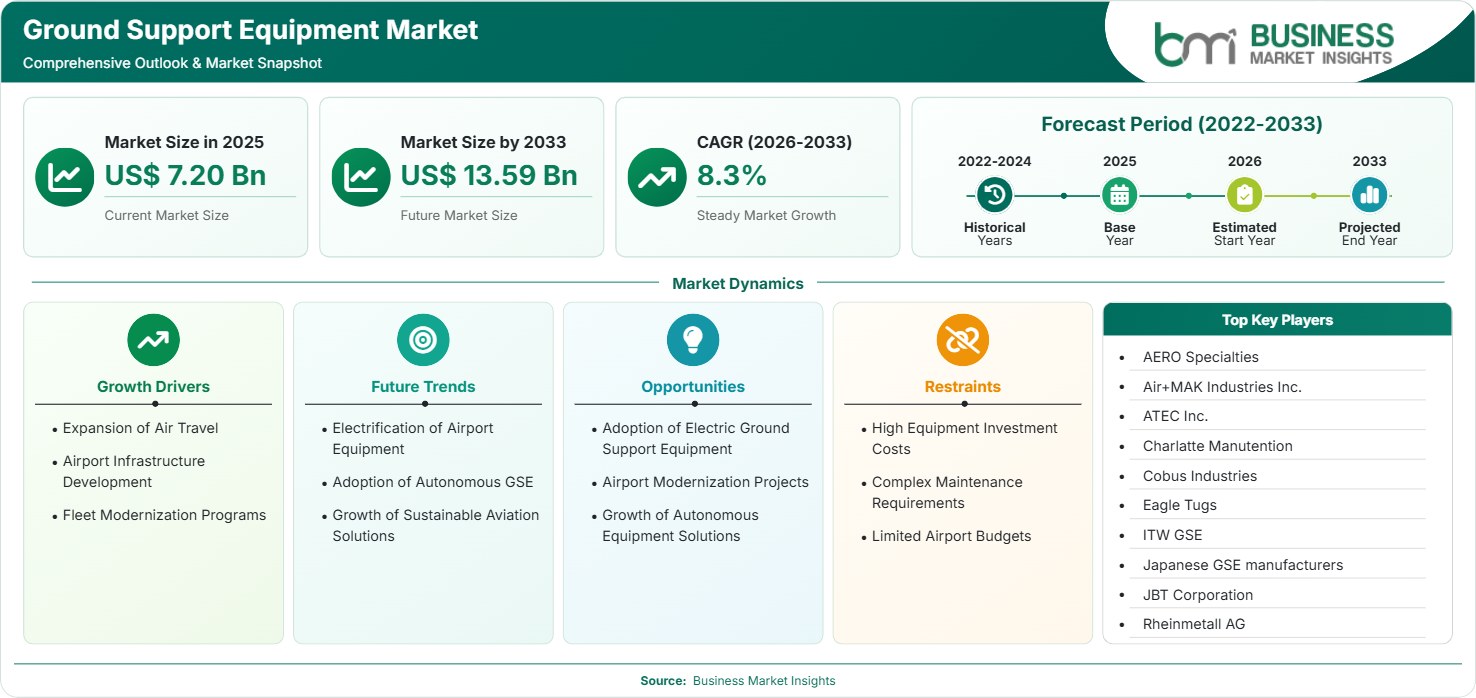
The Ground Support Equipment Market size was valued at US$ 7.20 Billion in 2025 and is projected to reach US$ 13.59 Billion by 2033, growing at a CAGR of 8.3% during 2026–2033, driven by expanding air travel demand, airport infrastructure development, fleet modernization programs, and opportunities in electric equipment adoption and autonomous ground operations.

Report Coverage
  • Type: Tugs & Tractors, Pushback Tractors, Passenger Boarding Lift & Steps, Belt Loader, Hi-Lift Loader, De/Anti Icing Vehicle, Water Service Vehicle, Lavatory Service Vehicle, Air Start Unit, Others
  • Power Source: Non-Electric GSE, Electric GSE, Hybrid GSE, Fuel Cell Vehicle, Advanced GSE
  • Ownership: New Sales, Used Sales, Rental/Lease
US$ 7.20 Bn Market size in 2025
US$ 13.59 Bn Market Size by 2033
8.3% CAGR, 2026 - 2033
2026-2033 Forecast Period

01 AI Overview

Ground Support Equipment Market Summary

  • North America Region: North America holds a market share of 32%–36% in 2025, growing with a CAGR of 7.5%–8.1% influenced by airport upgrades, fleet replacement programs, electric equipment adoption, and operational efficiency initiatives. The US market demonstrates steady growth with a CAGR of 7.6%–8.0% from 2026–2033, supported by major airport modernization projects, airline investments, and demand for advanced ground handling systems.
  • Fastest Growing Region: Asia Pacific holds market share of 28%–32% in 2025, growing with a CAGR of 9.0%–9.6% influenced by airport expansion, increasing passenger traffic, aviation infrastructure investments, and adoption of modern ground handling technologies across emerging economies.
  • Leading Segment: Tugs & Tractors hold market share of 28%–32% in 2025, growing with a CAGR of 7.8%–8.4% influenced by high aircraft movement requirements, baggage operations, cargo handling demand, and airport ground efficiency improvements.
  • High Growth Segment: Electric GSE holds market share of 18%–22% in 2025, growing with a CAGR of 10.0%–10.6% influenced by emission reduction targets, airport sustainability programs, lower operating costs, and increasing electrification initiatives.
  • Key Market Opportunity: Adoption of electric and autonomous ground support equipment, airport modernization programs, and digital fleet management solutions creates opportunities through improved efficiency, reduced emissions, and optimized aircraft turnaround operations.
  • Major Market Players: AERO Specialties, Air+MAK Industries Inc., ATEC Inc., Charlatte Manutention, Cobus Industries, Eagle Tugs, ITW GSE, Japanese GSE manufacturers, JBT Corporation, and Rheinmetall AG.
02 Strategic Insights

Ground Support Equipment Market: Strategic Insights

Ground Support Equipment Market Strategic Framework
FREE PDF
Request your free sample
Request free sample
03 Stakeholder View

Key Takeaways

  • The market ecosystem is evolving through collaboration among equipment manufacturers, airports, airlines, maintenance providers, and technology companies focused on improving aircraft turnaround efficiency and operational reliability.
  • Electric ground support equipment, autonomous vehicles, and smart fleet management systems represent major growth opportunities as airports prioritize sustainability, automation, and reduced operating costs.
  • Technology innovation is shifting toward battery-powered vehicles, connected equipment platforms, predictive maintenance systems, and autonomous navigation capabilities for improved ground operations.
  • Asia Pacific presents strong investment potential due to airport construction, passenger traffic growth, aviation infrastructure expansion, and modernization initiatives across countries including China, India, and Southeast Asian economies.
  • Strategic partnerships, acquisitions, and product portfolio expansion are influencing competitive strategies as companies seek stronger capabilities in electric mobility, automation, and airport service solutions.
  • Sustainability objectives are becoming a key purchasing factor, with airports increasingly evaluating equipment based on emissions reduction, lifecycle costs, energy efficiency, and compatibility with future airport infrastructure.
04 Geographic Outlook

Ground Support Equipment Market Regional Highlights

North America Ground Support Equipment Market

North America Ground Support Equipment Market accounted for a 32%–36% share in 2025 and is projected to expand at a CAGR of 7.5%–8.1% during 2026–2033. The region benefits from advanced airport infrastructure, high aircraft movement volumes, and strong adoption of modernization programs. The US and Canada remain leading markets due to investments in airport efficiency, fleet replacement, and sustainable aviation operations.

  • Airlines and airport operators are replacing aging equipment fleets with advanced vehicles to improve reliability and reduce operational downtime.
  • Electric ground support equipment adoption is increasing due to airport emission reduction targets and sustainability commitments.
  • Large aviation hubs are investing in automated systems and connected technologies to optimize aircraft turnaround processes.
  • Government-supported airport infrastructure upgrades are increasing demand for baggage, cargo, and passenger handling equipment.
  • Maintenance providers are expanding capabilities to support complex equipment requirements and lifecycle management services.

US Ground Support Equipment Market

US Ground Support Equipment Market represented a 27%–31% share in 2025 and is estimated to grow at a CAGR of 7.6%–8.0% between 2026–2033. The country remains a major contributor due to extensive airport networks, high commercial aviation activity, and continuous investments in operational efficiency. Growth is supported by airline fleet modernization, airport upgrades, and increasing interest in sustainable ground operations.

  • Major airports are implementing equipment replacement programs to improve safety, productivity, and operational performance.
  • Airlines are adopting electric and hybrid vehicles to reduce fuel consumption and comply with environmental objectives.
  • Cargo growth is increasing demand for specialized equipment supporting efficient freight handling operations.
  • Digital fleet monitoring systems are being integrated to improve maintenance planning and equipment utilization.

Europe Ground Support Equipment Market

Europe Ground Support Equipment Market share held a 24%–28% share in 2025 and is forecast to register a CAGR of 7.2%–7.8% during 2026–2033. The region benefits from strong environmental regulations, established aviation infrastructure, and increasing investments in sustainable airport operations. Germany, France, the UK, and the Netherlands represent leading markets, while Spain and Nordic countries demonstrate growth potential through electrification initiatives and airport modernization programs.

  • European airports are accelerating electric equipment adoption to meet carbon reduction targets and improve air quality.
  • Germany and France are investing in advanced ground handling solutions for major aviation hubs.
  • The UK market is focusing on operational efficiency through digital airport systems and equipment upgrades.
  • Nordic countries are supporting sustainable aviation infrastructure through low-emission ground operations.
  • Airport operators are collaborating with manufacturers to develop efficient lifecycle management strategies.

Asia Pacific Ground Support Equipment Market

Asia Pacific Ground Support Equipment Market accounted for a 28%–32% share in 2025 and is expected to expand at the fastest CAGR of 9.0%–9.6% between 2026–2033. Rapid passenger traffic growth, airport construction, and aviation infrastructure investments are driving regional expansion. China, India, Japan, South Korea, and Southeast Asian countries represent key markets, with India and Southeast Asia showing strong growth opportunities.

  • New airport construction and terminal expansion projects are increasing demand for modern ground handling equipment.
  • Rising passenger volumes are encouraging airlines and airports to upgrade baggage and aircraft servicing capabilities.
  • China and India are investing in aviation infrastructure to support growing domestic and international connectivity.
  • Electric equipment adoption is increasing as airports focus on sustainable operational practices.
  • Regional manufacturers are expanding production capabilities to serve growing aviation demand.

Rest of World Ground Support Equipment Market

Rest of World Ground Support Equipment Market shares represented a 9%–12% share in 2025 and are projected to grow at a CAGR of 7.8%–8.4% from 2026–2033. Latin America, Middle East, and Africa markets are benefiting from airport expansion, tourism growth, and aviation infrastructure investments. Countries including Brazil, UAE, Saudi Arabia, and South Africa represent important opportunities due to increasing passenger traffic and airport development initiatives.

  • Middle Eastern aviation hubs are investing heavily in airport expansion and advanced ground handling technologies.
  • UAE and Saudi Arabia are developing large-scale aviation projects requiring modern equipment fleets and operational systems.
  • Latin American airports are upgrading ground support capabilities to improve passenger and cargo handling efficiency.
  • African aviation markets are adopting equipment modernization programs to support expanding regional connectivity.
  • International manufacturers are increasing partnerships with airport operators and service providers across emerging regions.
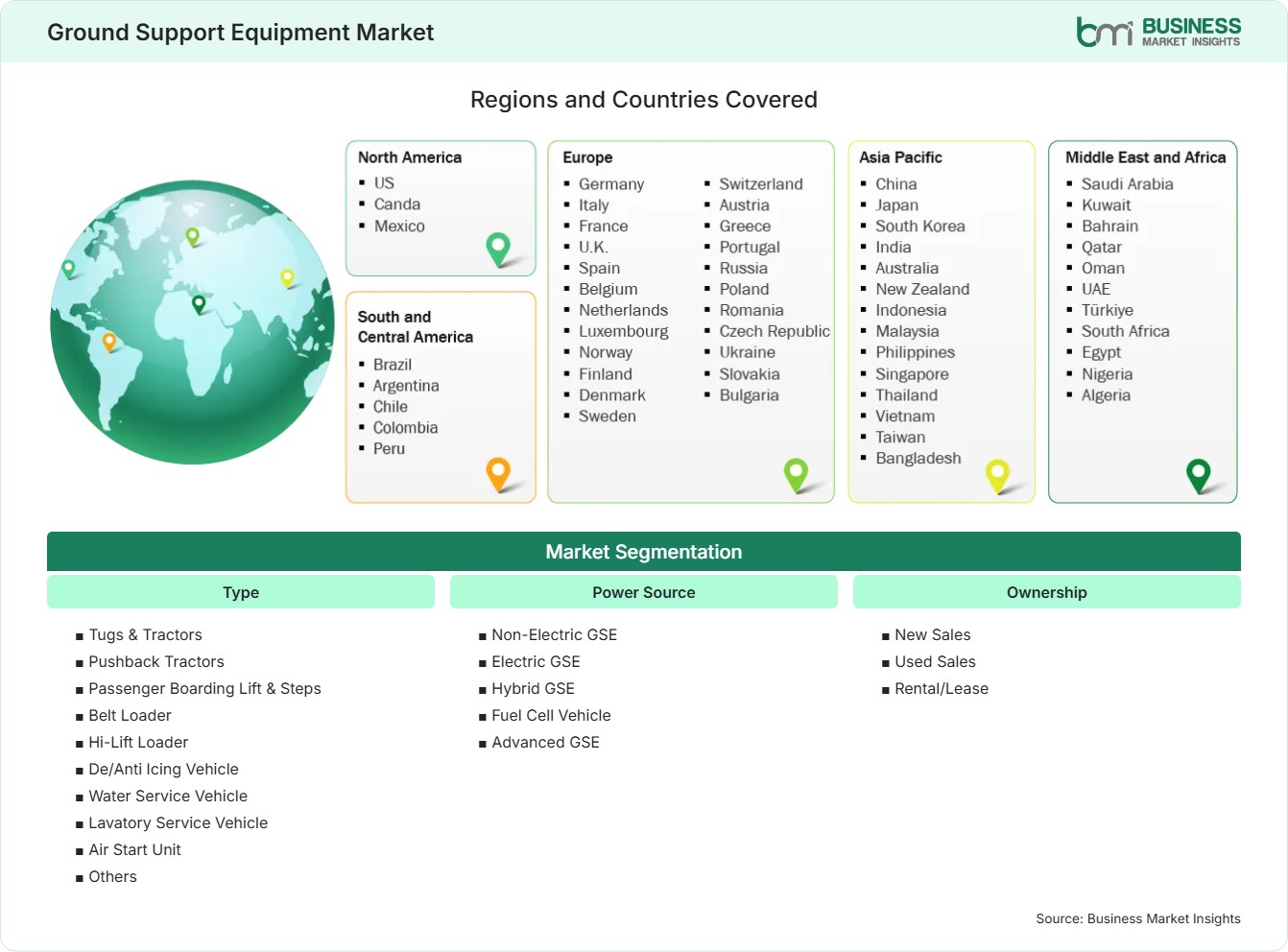
Global Market Geography
FREE PDF
Request your free sample
Request free sample
05 Segment Analysis

Ground Support Equipment Market Segmentation

Type

Type segmentation represents a significant portion of the Ground Support Equipment Market, with tugs and tractors maintaining the leading position in 2025 due to essential aircraft movement and baggage operations. The segment accounted for a 28%–32% share and is expected to grow at a CAGR of 7.8%–8.4% from 2026–2034, supported by airport expansion and fleet modernization requirements.

  • Tugs & Tractors (Baggage and Cargo): Tugs and tractors support aircraft movement, baggage transport, and cargo operations, making them essential for efficient airport ground handling activities.
  • Pushback Tractors (Conventional Tractors and Tow-Bar Less Tractor): Pushback tractors enable aircraft repositioning and improve turnaround efficiency through conventional and advanced towing technologies.
  • Passenger Boarding Lift & Steps: Passenger boarding equipment supports accessibility and efficient aircraft boarding operations across airports with diverse aircraft configurations.
  • Belt Loader: Belt loaders provide efficient baggage transfer between aircraft and terminal systems, supporting faster ground handling processes.
  • Hi-Lift Loader: Hi-lift loaders enable cargo and container handling for wide-body aircraft operations requiring specialized lifting capabilities.
  • De/Anti Icing Vehicle: De/anti icing vehicles support aircraft safety during cold weather operations through specialized treatment applications.
  • Water Service Vehicle: Water service vehicles provide essential aircraft servicing support by maintaining operational requirements during ground turnaround periods.
  • Lavatory Service Vehicle: Lavatory service vehicles support aircraft sanitation operations and maintain passenger service standards at airports.
  • Air Start Unit: Air start units provide pneumatic power support for aircraft operations and reduce dependency on onboard systems.
  • Others: Other equipment includes specialized ground handling solutions designed for specific airport operational requirements.

Power Source

Power source segmentation reflects the transition toward cleaner and more efficient airport operations. Non-electric GSE currently maintains significant adoption due to established infrastructure, while electric solutions are expanding rapidly. The segment is projected to grow at a CAGR of 8.8%–9.4% from 2026–2034, driven by sustainability goals and airport electrification programs.

  • Non-Electric GSE: Non-electric equipment remains widely used due to existing airport infrastructure, reliability, and familiarity among operators.
  • Electric GSE: Electric ground support equipment adoption is increasing through emission reduction goals, lower operating costs, and improved battery technology.
  • Hybrid GSE: Hybrid equipment provides operational flexibility by combining conventional power systems with improved efficiency technologies.
  • Fuel Cell Vehicle: Fuel cell vehicles offer future potential through clean energy operation and extended usage capabilities.
  • Advanced GSE: Advanced GSE includes automated and digitally connected solutions improving efficiency, monitoring, and operational control.

Ownership

Ownership segmentation highlights different acquisition approaches among airlines, airports, and ground handling companies. New sales represent a major share due to modernization requirements and technology upgrades. The segment is expected to grow at a CAGR of 8.0%–8.6% from 2026–2034, supported by replacement programs and sustainability initiatives.

  • New Sales: New equipment sales are increasing through airport expansion projects, fleet modernization programs, and demand for advanced technologies.
  • Used Sales: Used equipment sales provide cost-effective options for operators seeking operational capability with lower initial investment.
  • Rental/Lease: Rental and lease models are expanding as operators seek flexible equipment access without significant capital expenditure.
06 Market Forces

Ground Support Equipment Market Dynamics

Key Market Drivers

Expansion of Air Travel

An increase in the number of flights is creating the need for effective ground handling solutions as the increasing passenger traffic calls for better aircraft turnaround times. Commercial flight traffic is on the rise due to the increasing number of flights and increasing regional connectivity. This is motivating airlines and airports to buy modern equipment. The Ground Support Equipment Market growth includes high aircraft traffic, baggage handling needs, and cargo activities. Trends in the market are moving towards the adoption of efficient tow equipment, passenger handling equipment, and connected technologies.

Airport Infrastructure Development

The growth of airport infrastructure construction drives the need for advanced ground support equipment due to the increased investment in building new terminals, airport upgrades, and development. Increased numbers of passengers and flights call for improvement in the handling of luggage, servicing of aircraft, and cargo handling. Growth drivers of the market include government investments in aviation, capacity increases at airports, and the development of new aviation facilities. The Ground Support Equipment Market trend includes rising preference for electric vehicles and automation of ground support equipment and fleet management.

Fleet Modernization Programs

Modernization projects of fleets have led to increased demands for the replacement of outdated ground equipment by introducing efficient and environmentally friendly solutions. Old equipment tends to have higher maintenance expenses and lower efficiency rates as compared to new equipment. The market has been driven by advancements in electric vehicles, hybrid equipment, and connected equipment systems. Trends in the Ground Support Equipment Market forecast include growing demands for products that have low emission rates, reliable operation, and predictive maintenance features. Modernization programs have helped airports increase their safety levels and improve aircraft turnaround times.

Key Market Opportunities

Adoption of Electric Ground Support Equipment

The adoption of electric ground support equipment presents a significant opportunity for airports and airlines seeking to achieve emissions reduction goals and adopt more sustainable practices. Benefits associated with battery-operated vehicles include lower fuel costs, reduced noise pollution, and improved environmental performance. Vehicle manufacturers are coming up with more innovative electric options in all towing, baggage handling, passenger services, and aircraft servicing categories. Airports are providing themselves with the necessary charging facilities and energy management systems to enable them to embark on the adoption of electric vehicles.

Airport Modernization Projects

Modernization efforts in airports are generating new opportunities through the creation of sophisticated terminals, the extension of runways, and the automation of processes and ground operations. Developing countries are investing in air infrastructure in light of the growing number of travelers. Modern airports need equipment capable of handling greater traffic reliably. Ground support equipment companies can capitalize on their relationships with airport administrations, airlines, and contractors who are implementing modernization projects. The incorporation of technology-based solutions into airport modernization projects is presenting new opportunities for technology-focused manufacturers and solution providers.

Growth of Autonomous Equipment Solutions

The growth in the use of autonomous equipment solutions presents new avenues for enhancing airport efficiency, safety, and operational control. Automated towing equipment, autonomous baggage solutions, and interconnected ground vehicles can help decrease manual effort and optimize equipment usage. Innovations in artificial intelligence, sensor technology, and navigation systems are facilitating smarter airport systems. Airlines and airports have been investigating autonomous solutions to help solve labor-related issues and ensure consistent turnaround times. Firms that develop autonomous solutions, software systems, and remote monitoring solutions stand to gain a competitive advantage from their efforts.

Market Restraints and Challenges

High Equipment Investment Costs

Factor: High equipment investment costs associated with advanced ground support vehicles, electric systems, charging infrastructure, and specialized handling equipment create financial challenges for airports and service providers. Impact: Significant upfront capital requirements can delay fleet upgrades, particularly for smaller operators with limited budgets. Advanced technologies often require additional investments in infrastructure, training, and operational integration. Although modern equipment provides long-term efficiency benefits, initial acquisition costs remain a barrier to rapid adoption. Companies are addressing this challenge through rental models, leasing solutions, and phased modernization strategies that allow operators to access advanced equipment while managing capital expenditure constraints.

Complex Maintenance Requirements

Factor: Complex maintenance requirements for technologically advanced ground support equipment, including electric systems, automated platforms, and specialized vehicles, increase operational challenges. Impact: Higher maintenance complexity can lead to increased service costs, equipment downtime, and the need for skilled technical personnel. Airports require reliable maintenance networks and specialized training programs to support modern equipment fleets. Battery systems, electronic components, and integrated software platforms require different servicing capabilities compared with traditional vehicles. Operators are investing in predictive maintenance technologies and service partnerships to improve equipment reliability, reduce downtime, and optimize long-term operational performance.

07 Company Analysis

Competitive Landscape

The Ground Support Equipment Market analysis highlights competition among aviation equipment manufacturers, airport technology providers, and specialized ground handling solution companies. Players are focusing on electric equipment development, automation capabilities, fleet modernization solutions, and strategic partnerships to strengthen market presence. Competitive advantage is increasingly determined by technology innovation, service support networks, product reliability, and sustainability-focused solutions.

Company Name

Overview

Products and Services relevant to this market

AERO Specialties

Aviation equipment supplier providing ground support solutions for global airports.

Aircraft ground support equipment, maintenance systems, towing equipment, and servicing solutions.

Air+MAK Industries Inc.

Manufacturer specializing in aircraft ground support equipment solutions.

Ground power units, air start units, aircraft servicing equipment, and support systems.

ATEC Inc.

Aviation technology company serving ground operations and airport requirements.

Ground support solutions, aircraft equipment, testing systems, and maintenance products.

Charlatte Manutention

French manufacturer specializing in electric industrial and airport vehicles.

Electric tractors, baggage vehicles, and sustainable ground handling equipment.

Cobus Industries

Global manufacturer focused on airport passenger transport solutions.

Airport buses, passenger transfer vehicles, and ground transportation equipment.

Eagle Tugs

Manufacturer of aircraft towing equipment for aviation operations.

Aircraft tugs, pushback tractors, towing solutions, and ground handling equipment.

ITW GSE

Global provider of aircraft ground power and airport equipment solutions.

Ground power units, pre-conditioned air systems, and airport support equipment.

Japanese GSE manufacturers

Regional manufacturers producing advanced airport support equipment solutions.

Ground vehicles, aircraft servicing equipment, and specialized handling systems.

JBT Corporation

Aviation technology company providing airport equipment and services.

Aircraft handling equipment, cargo systems, deicing equipment, and support technologies.

Rheinmetall AG

Defense and technology company serving specialized mobility markets.

Advanced vehicles, technical systems, and airport-related equipment solutions.

08 Industry Activity

Recent Developments

May 2026

Menzies Aviation announced that it achieved its target of 25% electric ground support equipment (GSE) across its global operations, supported by a reported investment of approximately US$200 million in fleet modernization. The company added more than 620 electric GSE assets during 2025 as part of its emissions-reduction strategy.

April 2026

Veryon launched Veryon Work Center and Veryon GSE, expanding its aviation maintenance software portfolio with dedicated ground support equipment asset-management capabilities. The new solutions support repair stations, FBOs, maintenance providers, and ground operations teams with work orders, inventory management, and GSE tracking functions.

September 2025

Oshkosh AeroTech LLC introduced its Battery-Powered AmpCart Towable Charging Platform at the International GSE Expo 2025. The new electric ground support solution provides mobile charging capability for electric GSE fleets, helping airports expand electrified ramp operations without major fixed charging infrastructure upgrades.

May 2025

AERO Specialties unveiled its new HPU-4 Hydraulic Power Unit at MRO Americas 2025. The upgraded aircraft maintenance ground support equipment features digital controls, data logging capabilities, improved service access, and a redesigned rugged platform for aircraft maintenance operations.

10 Trust & Transparency

Research Methodology

The market analysis combines proprietary research with secondary data from government agencies, company disclosures, regulatory filings, industry databases and expert interviews. Market estimates are validated through data triangulation, cross-market benchmarking and analyst review.

View Full Research Methodology

11 Questions Answered

Frequently Asked Questions

What does the Ground Support Equipment Market Report indicate about future opportunities?

The Report indicates future opportunities in electric equipment adoption, airport modernization projects, autonomous solutions, and digital fleet management systems as aviation infrastructure continues evolving globally.

How are autonomous technologies influencing airport operations?

Autonomous technologies are improving efficiency through automated vehicle movement, digital monitoring, and optimized equipment utilization. These solutions help reduce manual workload, improve safety, and support next-generation smart airport operations.

Which equipment segment holds a leading position in the market?

Tugs and tractors hold a leading position due to their essential role in aircraft movement, baggage transport, and cargo handling operations. Their widespread usage across airports supports consistent demand from airlines and ground handling providers.

Why is electric ground support equipment gaining adoption?

Electric ground support equipment is gaining adoption due to lower emissions, reduced operating costs, quieter operation, and alignment with airport sustainability objectives. Improvements in battery technology and charging infrastructure are supporting wider deployment across airports.

What factors are driving growth in the Ground Support Equipment Market?

Growth is driven by expanding air travel, airport infrastructure development, fleet modernization programs, and increasing demand for efficient aircraft handling operations. Airports and airlines are investing in advanced equipment to improve turnaround times, reduce emissions, and enhance operational reliability.

Access the Full Ground Support Equipment Market Report

Get segment-level forecasts, regional estimates, competitive benchmarking, company profiles and downloadable Excel datasets.

Access the full Ground Support Equipment Market Report
350 pages PDF & Excel | 2026-07-31