
Aircraft Ground Power Unit Market Outlook: Size, Share, Trends, Growth Analysis, Competitive Landscape & Forecast, 2026-2033

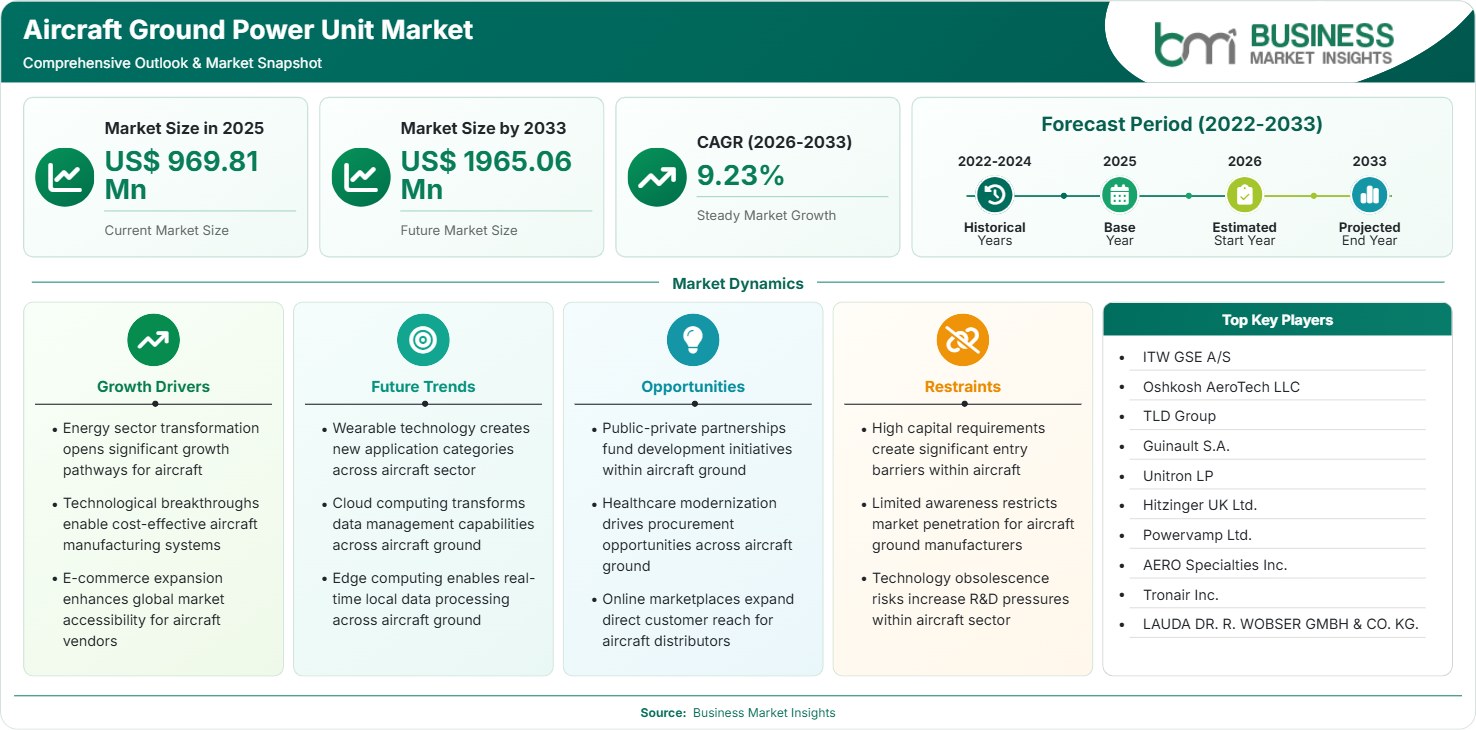
The Aircraft Ground Power Unit Market size was valued at US$ 969.81 Million in 2025 and is projected to reach US$ 1965.06 Million by 2033, growing at a CAGR of 9.23% during 2026–2033. Rising aircraft movements, airport modernization, electrification of ground support equipment, sustainable aviation initiatives, and investments in battery-powered ground infrastructure are accelerating adoption while creating long-term opportunities across commercial, military, and business aviation sectors.

Report Coverage
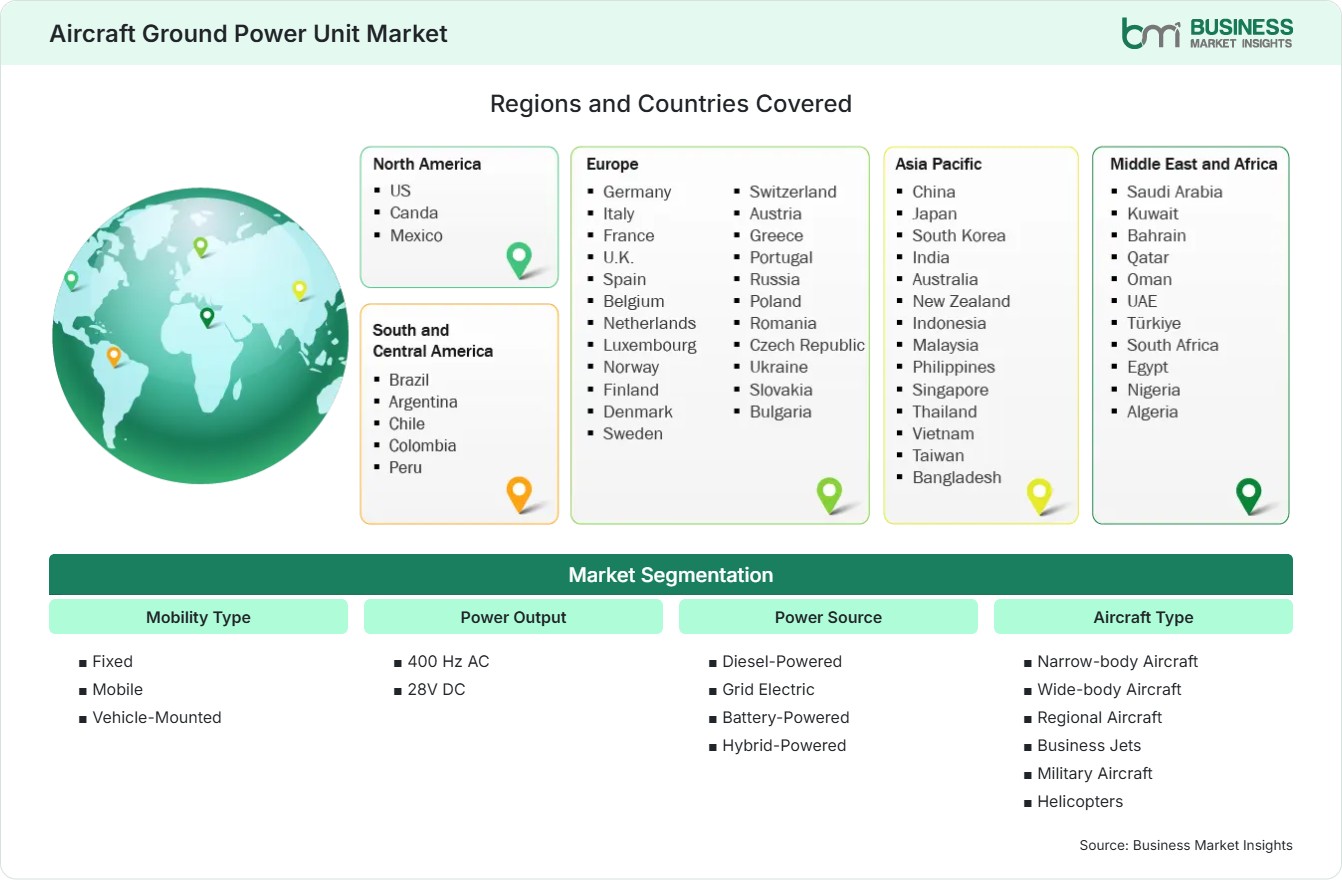
  • Mobility Type: Fixed, Mobile, Vehicle-Mounted
  • Power Output: 400 Hz AC , 28V DC
  • Power Source: Diesel-Powered, Grid Electric, Battery-Powered , Hybrid-Powered
  • Aircraft Type: Narrow-body Aircraft, Wide-body Aircraft, Regional Aircraft, Business Jets, Military Aircraft, Helicopters
  • End User: Airports, Ground Handling Service Providers, Airlines, Others
US$ 969.81 Mn Market size in 2025
US$ 1965.06 Mn Market Size by 2033
9.23% CAGR, 2026 - 2033
2026-2033 Forecast Period

AI Overview

Aircraft Ground Power Unit Market Summary

  • North America Region: North America holds 34%–37% market share in 2025, growing with a CAGR of 8.6%–9.0% during 2026–2033, supported by airport modernization, fleet expansion, defense aviation investments, electrified ground handling infrastructure, sustainability initiatives, advanced maintenance ecosystems, stronger airline capital expenditure, and replacement demand for efficient ground power systems. The U.S. market benefits from extensive commercial aviation infrastructure, continuous airport upgrades, and defense procurement, advancing at a CAGR of 8.7%–9.1% during 2026–2033.
  • Fastest Growing Region: Asia Pacific accounts for 26%–29% market share in 2025 while expanding at a CAGR of 10.6%–11.2% during 2026–2033, driven by airport construction, airline fleet additions, regional connectivity programs, passenger traffic growth, expanding maintenance facilities, government infrastructure investments, and increasing deployment of electric ground support equipment.
  • Leading Segment: Mobile systems represent 43%–46% market share in 2025 and are projected to register a CAGR of 9.1%–9.7% through 2033, supported by operational flexibility, lower installation requirements, compatibility with multiple aircraft categories, rapid turnaround capabilities, and growing demand from expanding commercial airports worldwide.
  • High Growth Segment: Battery-Powered units account for 13%–16% market share in 2025 while advancing at a CAGR of 13.2%–14.0% during 2026–2033, encouraged by emission reduction policies, declining battery costs, airport decarbonization targets, quieter operations, lower maintenance requirements, renewable electricity integration, and government sustainability incentives.
  • Key Market Opportunity: Airport decarbonization programs, expansion of smart apron infrastructure, digital fleet monitoring, renewable-powered charging networks, predictive maintenance technologies, and replacement of diesel-powered equipment collectively create substantial opportunities for manufacturers delivering intelligent, energy-efficient ground power solutions.
  • Major Market Players: ITW GSE A/S, Oshkosh AeroTech LLC, TLD Group, Guinault S.A., Unitron LP, Hitzinger UK Ltd., Powervamp Ltd., AERO Specialties Inc., Tronair Inc., and LAUDA DR. R. WOBSER GMBH & CO. KG.
Strategic Insights

Aircraft Ground Power Unit Market: Strategic Insights

Aircraft Ground Power Unit Market Strategic Framework
FREE PDF
Request your free sample
Request free sample
Stakeholder View

Key Takeaways

  • The industry's value chain is evolving from standalone equipment manufacturing toward integrated energy management ecosystems combining digital monitoring, predictive maintenance, software-enabled fleet management, charging infrastructure, and aftermarket service contracts that generate recurring revenue streams.
  • Battery-powered solutions, hybrid configurations, and high-capacity mobile units present the strongest long-term commercial opportunities as airports prioritize operational flexibility while reducing dependence on fossil-fuel-powered ground support equipment across expanding aircraft fleets.
  • Innovation is increasingly centered on lithium-ion energy storage, IoT-enabled diagnostics, remote equipment monitoring, modular architecture, and intelligent load balancing, enabling improved equipment utilization, reduced maintenance requirements, and enhanced operational reliability.
  • Asia Pacific offers the most attractive investment landscape because of continuous airport construction, regional airline expansion, government-backed aviation infrastructure spending, increasing MRO capacity, and rising demand for efficient apron operations supporting higher aircraft movements.
  • Strategic partnerships between airport operators, airlines, and equipment manufacturers are accelerating product commercialization, while acquisitions and technology collaborations increasingly focus on electrification, automation, and sustainable airport operations that align with global decarbonization objectives.
  • Suppliers capable of delivering comprehensive lifecycle services, rapid spare-parts availability, digital maintenance platforms, and customized power solutions for commercial and military aviation will strengthen competitive positioning as procurement increasingly emphasizes total ownership costs rather than upfront equipment pricing.
Geographic Outlook

Aircraft Ground Power Unit Market Regional Highlights

North America Aircraft Ground Power Unit Market

North America accounted for 34%–37% of the Aircraft Ground Power Unit Market share in 2025 and is projected to expand at a CAGR of 8.6%–9.0% through 2033. The region benefits from extensive airport modernization, high aircraft utilization rates, replacement of aging ground support equipment, and stringent emission reduction targets. Major commercial airports continue investing in fixed electrical ground power infrastructure and battery-powered mobile units to reduce aircraft auxiliary power unit usage. Defense aviation modernization and growing MRO activity further support equipment procurement across the region.

  • Large hub airports are replacing conventional diesel-powered units with electric and hybrid alternatives to reduce apron emissions, improve operational efficiency, and comply with increasingly stringent environmental standards established by federal and regional authorities.
  • Continuous fleet expansion by commercial airlines creates sustained demand for reliable ground power systems capable of supporting narrow-body, wide-body, and regional aircraft while minimizing turnaround times during peak operating schedules.
  • Defense agencies continue upgrading military airbases with advanced mobile power systems capable of supporting multiple aircraft platforms, strengthening procurement opportunities for manufacturers specializing in ruggedized ground equipment.
  • Strong aftermarket demand for maintenance, refurbishment, spare parts, and digital monitoring solutions enables suppliers to generate recurring revenues while extending operational life and improving fleet availability across airport operators.
  • Airport operators increasingly integrate smart apron management platforms with connected ground support equipment, improving energy utilization, predictive maintenance scheduling, and operational visibility across high-traffic aviation facilities.

US Aircraft Ground Power Unit Market

The United States represents approximately 76%–79% of the North American Aircraft Ground Power Unit Market while advancing at a CAGR of 8.7%–9.1% between 2026 and 2033. High passenger traffic, extensive commercial airport infrastructure, defense aviation expenditure, and ongoing investments in airport electrification continue supporting procurement of modern ground power equipment. Federal sustainability initiatives and airline operational efficiency programs further accelerate adoption of low-emission and digitally connected power systems.

  • Large international airports are deploying fixed 400 Hz electrical systems alongside battery-powered mobile units to minimize aircraft fuel burn, reduce emissions, and enhance gate utilization during peak travel periods.
  • Military aviation modernization programs continue creating procurement opportunities for vehicle-mounted and mobile power systems capable of supporting tactical aircraft, helicopters, and transport fleets under demanding operational environments.
  • Major airlines increasingly prioritize lifecycle operating costs, encouraging procurement of intelligent equipment featuring remote diagnostics, predictive maintenance capabilities, and improved energy efficiency across extensive airport networks.
  • Growing investment in airport resilience and infrastructure modernization supports replacement demand for aging ground support equipment while expanding opportunities for advanced hybrid-powered technologies.

Europe Aircraft Ground Power Unit Market

Europe captured 27%–30% Aircraft Ground Power Unit Market share in 2025 and is forecast to record a CAGR of 8.8%–9.3% during 2026–2033. Regional demand is supported by ambitious decarbonization objectives, extensive airport sustainability initiatives, and widespread adoption of electrically powered ground support equipment. Western Europe remains the leading regional market, while Central and Eastern European airports continue increasing infrastructure investments to accommodate growing passenger volumes and aviation connectivity.

  • Germany leads regional demand through airport modernization, industrial manufacturing capabilities, and advanced engineering expertise, while maintaining growth around 8.8%–9.2% during the forecast period.
  • France benefits from strong aerospace manufacturing, expanding airport sustainability projects, and continuous investments in electrified ground handling operations supporting commercial and defense aviation sectors.
  • The United Kingdom records one of the fastest growth trajectories with a 9.4%–9.8% CAGR, supported by airport expansion projects, net-zero aviation initiatives, and increasing replacement of legacy diesel-powered equipment.
  • European Union climate policies encourage deployment of low-emission airport technologies, stimulating procurement of battery-powered and hybrid systems that reduce carbon emissions and operational noise across airport aprons.
  • MRO facilities across Germany, France, and the Netherlands increasingly integrate digital asset management solutions, strengthening demand for intelligent ground power systems featuring predictive maintenance capabilities.

Asia Pacific Aircraft Ground Power Unit Market

Asia Pacific represented 26%–29% of the Aircraft Ground Power Unit Market in 2025 and is expected to achieve the fastest regional expansion with a CAGR of 10.6%–11.2% through 2033. Rapid airport construction, expanding airline fleets, rising passenger traffic, and government-backed aviation infrastructure programs continue accelerating procurement of advanced ground power equipment. The region also benefits from increasing MRO investments and growing adoption of electric ground support technologies across both developed and emerging aviation markets.

  • China remains the largest regional contributor because of continuous airport construction, domestic aircraft fleet expansion, and extensive government investment supporting commercial aviation infrastructure modernization.
  • India is projected to register the highest regional growth at a 11.4%–11.9% CAGR, driven by expanding regional connectivity, new greenfield airports, and rapidly increasing passenger traffic requiring efficient apron operations.
  • Japan continues upgrading airport infrastructure with intelligent energy management technologies and electric ground support systems that improve operational efficiency while supporting national decarbonization objectives.
  • Southeast Asian nations, including Indonesia, Vietnam, and the Philippines, continue investing heavily in airport capacity expansion, generating substantial opportunities for manufacturers supplying mobile and battery-powered equipment.
  • International airlines expanding regional operations increasingly demand flexible ground power solutions capable of supporting mixed aircraft fleets while reducing operating costs and improving turnaround performance.

Rest of World Aircraft Ground Power Unit Market

The Rest of World region accounted for 10%–13% Aircraft Ground Power Unit Market share in 2025 and is anticipated to grow at a CAGR of 9.4%–9.9% through 2033. The Middle East benefits from major airport expansion projects and premium aviation infrastructure investments, while South and Central America experience gradual modernization of airport facilities supporting commercial aviation growth.

Across Africa, increasing international connectivity and airport development initiatives improve long-term demand for efficient ground support equipment. Growing tourism, cargo operations, and airline network expansion encourage procurement of reliable power systems designed for diverse climatic and operational conditions, reinforcing Aircraft Ground Power Unit Market growth across emerging aviation economies.

  • United Arab Emirates leads Middle Eastern demand through world-class airport infrastructure, premium airline operations, and continuous investment in advanced ground handling technologies supporting international aviation hubs.
  • Saudi Arabia records robust expansion with a 10.2%–10.7% CAGR as aviation diversification strategies, airport development programs, and tourism investments accelerate procurement of modern airport equipment.
  • Brazil remains South America's largest market, supported by airport concession investments, airline fleet renewal, and modernization of commercial aviation infrastructure across major metropolitan regions.
  • African airports increasingly adopt energy-efficient equipment through international infrastructure financing programs, creating opportunities for manufacturers offering durable and low-maintenance power solutions suitable for challenging operating environments.
  • Expansion of regional cargo hubs and business aviation facilities strengthens demand for flexible mobile ground power systems capable of supporting mixed aircraft operations with improved operational reliability.
Global Market Geography
FREE PDF
Request your free sample
Request free sample
Segment Analysis

Aircraft Ground Power Unit Market Segmentation

Mobility Type

The mobility type segment accounted for the largest deployment across airport operations, with Mobile systems representing 43%–46% market share in 2025 and the segment advancing at a CAGR of 9.1%–9.7% through 2033. Growing demand for operational flexibility, lower installation costs, and compatibility with multiple aircraft categories continues supporting adoption. The Aircraft Ground Power Unit Market scope continues expanding as airports balance permanent infrastructure investments with portable solutions capable of supporting dynamic gate assignments and remote apron operations.

  • Fixed: Preferred at high-traffic gates where continuous electrical availability, reduced emissions, and integration with passenger boarding bridges improve operational efficiency while minimizing aircraft auxiliary power unit usage.
  • Mobile: Offers superior operational flexibility, enabling rapid deployment across multiple aircraft positions, temporary stands, maintenance facilities, and regional airports with evolving infrastructure requirements.
  • Vehicle-Mounted: Widely adopted by military operators, cargo terminals, and specialized ground handling providers requiring dependable power delivery across dispersed airport environments and remote operational locations.

Power Output

Power output segmentation reflects diverse aircraft electrical requirements, with 400 Hz AC solutions holding 68%–71% Aircraft Ground Power Unit Market share during 2025 and registering a CAGR of 9.3%–9.8% through the forecast period. Increasing electrification of airport operations, fleet modernization, and compatibility with commercial aircraft platforms continue supporting demand. Airports are investing in scalable power systems capable of serving both narrow-body and wide-body aircraft while improving energy efficiency and operational reliability.

  • 400 Hz AC – Below 60kVA: Primarily supports regional aircraft, business jets, and light aviation applications where compact equipment and efficient power delivery remain operational priorities.
  • 400 Hz AC – 60–90 kVA: Serves medium-capacity commercial aircraft, providing balanced performance, improved gate utilization, and dependable electrical supply for routine airport turnaround activities.
  • 400 Hz AC – 90–140 kVA: Commonly installed at major commercial airports supporting high-frequency narrow-body operations requiring stable electrical performance and reduced maintenance interruptions.
  • 400 Hz AC – Above 140 kVA: Designed for wide-body aircraft and high-power aviation platforms demanding continuous electrical support during maintenance, servicing, and passenger boarding operations.
  • 28V DC: Continues serving military aircraft, helicopters, and legacy aviation fleets where direct current systems remain essential for engine starting and onboard electrical support.

Power Source

Power source innovation is reshaping procurement strategies, with Diesel-Powered systems maintaining 41%–44% market share in 2025 while the segment grows at a CAGR of 7.2%–7.8%. However, sustainability initiatives and Aircraft Ground Power Unit Market trends increasingly favor battery-powered and hybrid technologies. Airports seeking lower emissions, quieter operations, and reduced lifecycle costs continue accelerating investment in electrified ground support infrastructure.

  • Diesel-Powered: Maintains demand in remote airports and military environments where dependable operation and limited electrical infrastructure remain important operational considerations.
  • Grid Electric: Gains momentum across modern airports emphasizing lower emissions, stable operating costs, and seamless integration with permanent gate infrastructure.
  • Battery-Powered: Experiences rapid adoption owing to airport decarbonization initiatives, quiet operation, declining battery prices, and advancements in lithium-ion energy storage technologies.
  • Hybrid-Powered: Combines operational flexibility with improved fuel efficiency, supporting airports transitioning gradually from conventional diesel equipment toward cleaner energy solutions.

Aircraft Type

Aircraft type segmentation remains closely aligned with global fleet composition, with Narrow-body Aircraft accounting for 49%–52% share of the Aircraft Ground Power Unit Market in 2025 and recording a CAGR of 9.5%–10.0% through 2033. Rising short-haul travel, fleet expansion, and increasing aircraft utilization continue strengthening equipment demand across commercial aviation. Airports prioritize versatile ground power solutions capable of supporting diverse aircraft sizes while optimizing turnaround performance.

  • Narrow-body Aircraft: Represents the largest application owing to extensive global deployment across domestic and regional commercial airline operations.
  • Wide-body Aircraft: Requires higher-capacity power systems supporting long-haul international operations and complex airport servicing requirements.
  • Regional Aircraft: Benefits from expanding regional connectivity programs and modernization of secondary airport infrastructure across emerging aviation markets.
  • Business Jets: Generates steady demand from fixed-base operators emphasizing premium service quality, operational flexibility, and rapid aircraft turnaround.
  • Military Aircraft: Supports defense aviation through durable mobile power systems engineered for challenging operational environments and mission-critical applications.
  • Helicopters: Requires compact and specialized power solutions serving emergency response, offshore transportation, defense missions, and utility aviation operations.

End User

End-user demand remains concentrated among airport operators, with Airports representing 45%–48% market share in 2025 while the segment advances at a CAGR of 9.0%–9.5% during the Aircraft Ground Power Unit Market forecast period. Airport modernization, sustainability objectives, and infrastructure expansion continue driving procurement. Airlines and specialized ground handling companies increasingly invest in intelligent equipment that improves fleet utilization while lowering operating costs and maintenance requirements.

  • Airports: Continue leading procurement through infrastructure upgrades, gate electrification projects, and sustainability-focused investment programs.
  • Ground Handling Service Providers: Expand equipment fleets to improve operational efficiency, service quality, and aircraft turnaround across multiple airline customers.
  • Airlines: Invest directly in advanced ground support equipment to reduce fuel consumption, improve operational reliability, and strengthen long-term maintenance planning.
Market Forces

Aircraft Ground Power Unit Market Dynamics

Key Market Drivers

Airport Electrification and Sustainable Ground Operations

Airport owners throughout the world have intensified efforts toward the electrification of their ground facilities for the sake of cutting emissions, fuel use, and costs. The IATA and the airport sustainability initiatives keep promoting the substitution of diesel-fueled vehicles with electric and hybrid ones. The less need to use the aircraft auxiliary power units means lower costs. This transition directly supports Aircraft Ground Power Unit Market growth, particularly at high-traffic international airports where environmental compliance is becoming a procurement priority. Airfield equipment manufacturers are coming up with battery-powered and digital solutions to increase efficiency, improve asset utilization, and generate value in line with the airport decarbonization strategy.

Growth in Commercial Aviation and Airport Infrastructure

Passenger traffic recovery, increasing aircraft deliveries, and ongoing airport expansion are strengthening demand for advanced ground support equipment worldwide. Based on forecasts from the aviation industry, it is clear that the number of passengers globally is moving past pre-COVID-19 numbers and prompting airport authorities to increase their terminal and gate capabilities. With the opening up of new airports and renovations in Asia Pacific, Middle East, and North America, it is imperative to have ground power systems for handling various aircraft types. This, coupled with increased utilization of fleets, more frequent flights, and the need for efficient turnarounds, creates steady demand.

Digitalization of Ground Support Equipment

IoT-equipped ground handling equipment is gaining ground with such capabilities as predictive maintenance, remote diagnostics, and real-time tracking. The digital capabilities enhance equipment availability while ensuring no unforeseen downtime and maintenance costs. Manufacturers integrate cloud connectivity, energy management software, and intelligent diagnostics to optimize operational performance across multiple airport locations. Such technological innovation complements evolving Aircraft Ground Power Unit Market trends, enabling airport operators to improve asset utilization, schedule maintenance proactively, reduce operating costs, and support data-driven infrastructure management without compromising operational reliability.

Key Market Opportunities

Expansion of Battery-Powered and Hybrid Solutions

Ground power units based on battery energy and hybrid technology offer one of the best options for investment in light of airport preference for environmentally friendly technologies. The falling cost of lithium-ion batteries, increasing use of renewable energy sources, and governmental green investments will enable a quick implementation. Equipment suppliers investing in modular battery technologies, fast-charging capabilities, and intelligent energy management systems are well positioned to benefit from Aircraft Ground Power Unit Market Forecasts that emphasize airport electrification. Replacement of the traditional diesel fleets in the long run would offer recurring revenue generation from the sale of equipment, software, maintenance, and battery replacement services.

Airport Development Across Emerging Economies

Emerging aviation markets continue investing heavily in airport construction, regional connectivity, and maintenance facilities. Developing countries such as India, Indonesia, Saudi Arabia, Vietnam, and Brazil are building airport facilities to cope with increased air traffic. This trend is fueling the need for power supply systems for aircrafts used for commercial flights, regional airlines, and military purposes. Firms that can provide efficient and environment-friendly equipment have an edge in winning contracts for developing infrastructure funded by national and international bodies.

Integration with Smart Airport Ecosystems

Smart airports increasingly connect ground support equipment with centralized digital platforms managing gates, aircraft movements, maintenance scheduling, and energy consumption. Integration allows for predictive servicing, optimal asset management, and increased operational visibility. Suppliers of interoperable systems, remote monitoring, and smart charging systems will be able to develop sustainable business relationships with airports. They also offer scope for revenue generation through subscription-based services apart from selling equipment.

Market Restraints and Challenges

High Capital Investment Requirements

Factor: Ground power systems that are electric, hybrid and digitally connected entail significant initial investment in the form of machinery, charging facilities and software integration.

Impact: Small airports, regional airlines, and private handling agents tend to put off modernization efforts due to financial constraints and extended payback period. Buying decisions tend to weigh immediate cost-saving aspects over sustainability gains and hence the replacement of conventional equipment is not undertaken.

Infrastructure Compatibility and Operational Complexity

Factor: Airport terminals use a range of aircrafts, old electrical systems, and equipment supplied by various manufacturers, which results in some difficulties in modernization processes.

Impact: These issues complicate implementation, installation, operator training, and maintenance plans. Airports might delay a large-scale implementation until their facilities have been upgraded. This will weaken the momentum of the acquisition process despite the rising demand for aircraft ground power systems.

Company Analysis

Competitive Landscape

The competitive environment is characterized by established manufacturers focusing on electrification, digital diagnostics, modular product platforms, and global aftermarket support. The Aircraft Ground Power Unit Market analysis indicates that suppliers are strengthening their positions through airport infrastructure partnerships, expanded service networks, battery-powered product development, and customized solutions for commercial, military, and business aviation customers.

Company Name

Overview

Products and Services relevant to this market

ITW GSE A/S

Denmark-based manufacturer specializing in advanced airport ground support equipment with a strong global service and distribution network.

Fixed and mobile 400 Hz ground power units, battery-powered GPUs, pre-conditioned air systems, digital monitoring solutions, and airport support services.

Oshkosh AeroTech LLC

U.S.-based airport equipment provider delivering integrated ground support technologies for commercial and military aviation customers worldwide.

Mobile ground power units, gate equipment, airport automation systems, maintenance support, and integrated airport infrastructure solutions.

TLD Group

France-headquartered manufacturer with extensive expertise in airport ground support equipment serving international airports and airlines.

Diesel, electric, and hybrid ground power units, aircraft servicing equipment, baggage handling equipment, and maintenance services.

Guinault S.A.

French company recognized for manufacturing environmentally efficient airport support equipment emphasizing operational reliability and low emissions.

Diesel and electric GPUs, air start units, pre-conditioned air equipment, and customized airport energy solutions.

Unitron LP

U.S.-based specialist delivering engineered power conversion systems for commercial, defense, and industrial aviation applications.

Frequency converters, 400 Hz power supplies, fixed ground power systems, and customized electrical solutions.

Hitzinger UK Ltd.

Power engineering company providing high-performance electrical power systems across aviation, defense, and industrial markets.

Static frequency converters, ground power systems, customized electrical equipment, and engineering services.

Powervamp Ltd.

United Kingdom manufacturer specializing in aviation electrical support technologies with emphasis on portable and battery-powered systems.

Battery-powered GPUs, aircraft starting systems, portable aviation power equipment, chargers, and maintenance accessories.

AERO Specialties Inc.

U.S. manufacturer supplying diversified airport ground support equipment to airlines, airports, military operators, and MRO providers.

Mobile ground power units, towbars, maintenance stands, aircraft servicing equipment, and airport support products.

Tronair Inc.

Established U.S. supplier offering comprehensive aircraft ground support equipment across commercial and business aviation markets.

Ground power units, hydraulic servicing equipment, aircraft jacks, towbars, maintenance tools, and aviation accessories.

LAUDA DR. R. WOBSER GMBH & CO. KG

German engineering company providing advanced thermal management and specialized industrial systems supporting aviation applications.

Thermal management solutions, cooling technologies, customized industrial systems, and support equipment for aviation operations.

Trust & Transparency

Research Methodology

The market analysis combines proprietary research with secondary data from government agencies, company disclosures, regulatory filings, industry databases and expert interviews. Market estimates are validated through data triangulation, cross-market benchmarking and analyst review.

View Full Research Methodology

Questions Answered

Frequently Asked Questions

How does this Aircraft Ground Power Unit Market Report support business decisions?

The report provides strategic insights into market sizing, regional opportunities, technology evolution, competitive positioning, segmentation trends, investment priorities, and future demand patterns, enabling manufacturers, investors, suppliers, and airport operators to make informed decisions.

Which end users generate the highest procurement demand?

Airports remain the largest purchasers because infrastructure modernization, gate electrification, sustainability investments, and increasing aircraft traffic require reliable ground power equipment supporting diverse commercial and military aircraft.

Why are mobile ground power units widely adopted?

Mobile units provide operational flexibility by serving multiple aircraft positions without permanent installation. They are particularly valuable for expanding airports, remote stands, maintenance facilities, and temporary operational requirements.

Which power source category is expected to experience the fastest expansion?

Battery-powered systems are expected to register the fastest growth because airports increasingly prioritize zero-emission operations, quieter equipment, lower maintenance costs, and compliance with evolving environmental regulations.

What factors are driving demand for aircraft ground power units?

Demand is primarily supported by airport modernization, fleet expansion, sustainability initiatives, replacement of diesel-powered equipment, increasing aircraft movements, and the need to reduce auxiliary power unit fuel consumption and emissions during ground operations.

Access the Full Aircraft Ground Power Unit Market Report

Get segment-level forecasts, regional estimates, competitive benchmarking, company profiles and downloadable Excel datasets.

Access the full Aircraft Ground Power Unit Market Report
350 pages PDF & Excel | 2026-08-31