
Aircraft Auxiliary Power Unit Market Outlook: Size, Share, Trends, Growth Analysis, Competitive Landscape & Forecast, 2026-2033

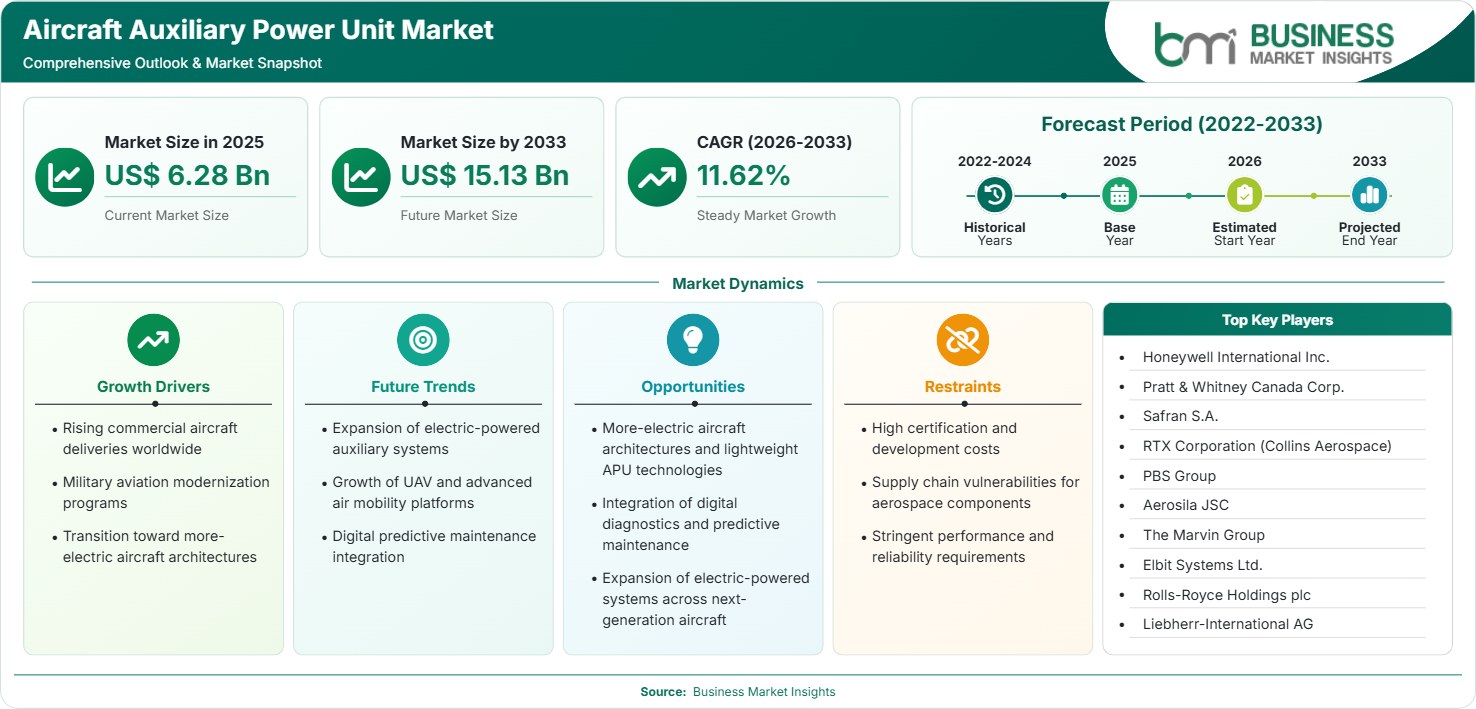
The Aircraft Auxiliary Power Unit Market size was valued at US$ 6.28 Billion in 2025 and is projected to reach US$ 15.13 Billion by 2033, growing at a CAGR of 11.62% during 2026–2033. Growth is supported by expanding commercial aircraft deliveries, fleet modernization programs, rising demand for fuel-efficient APUs, military aviation upgrades, and accelerating adoption of hybrid-electric onboard power architectures.

Report Coverage
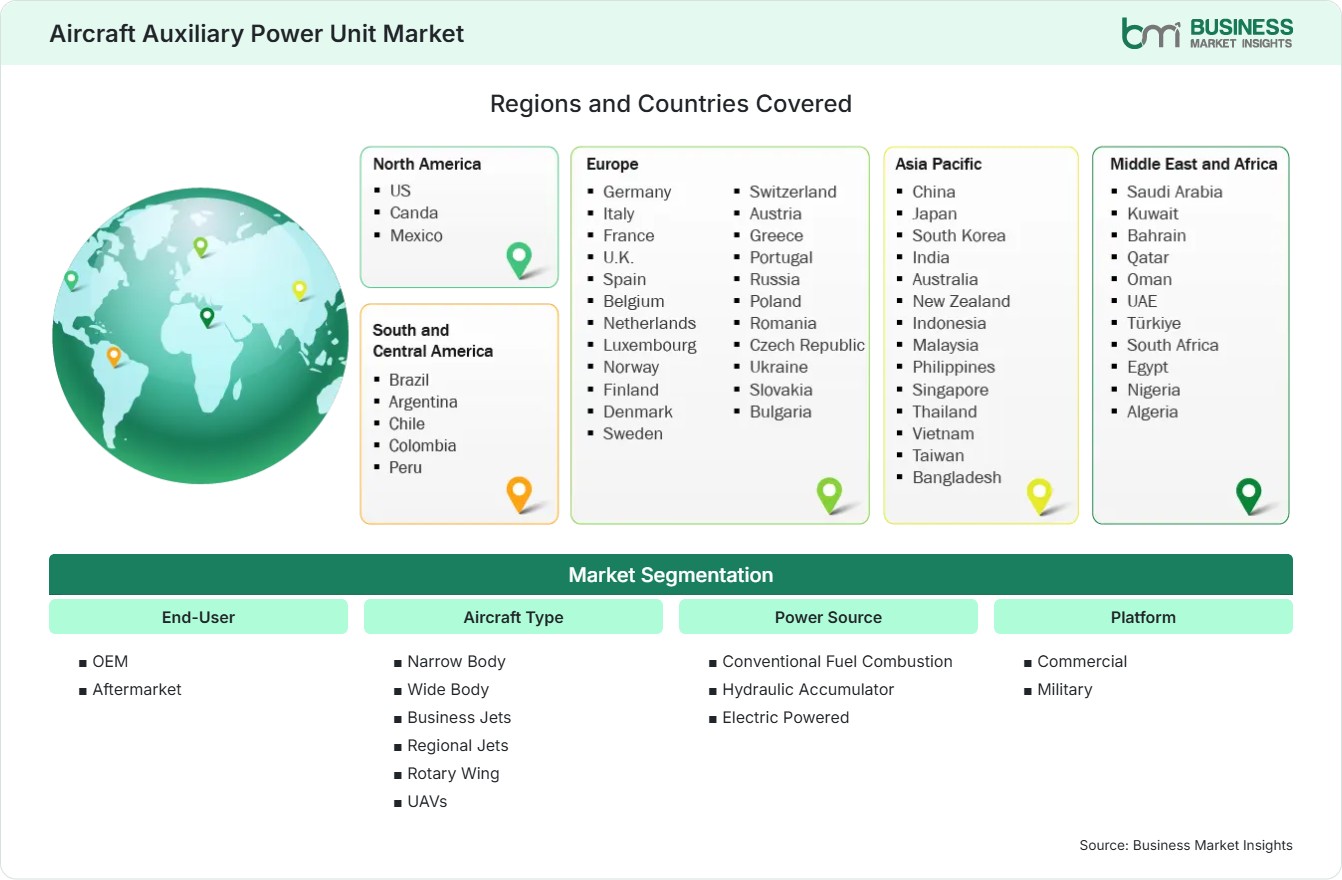
  • End-User: OEM, Aftermarket
  • Aircraft Type: Narrow Body, Wide Body, Business Jets, Regional Jets, Rotary Wing, UAVs
  • Power Source: Conventional Fuel Combustion, Hydraulic Accumulator, Electric Powered
  • Platform: Commercial, Military
US$ 6.28 Bn Market size in 2025
US$ 15.13 Bn Market Size by 2033
11.62% CAGR, 2026 - 2033
2026-2033 Forecast Period

AI Overview

Aircraft Auxiliary Power Unit Market Summary

  • North America Region: Holds a market share of 34%–37% in 2025, growing at a 10.2%–11.1% CAGR during 2026–2033. Growth is driven by aircraft production strength, defense procurement, fleet replacement cycles, advanced avionics integration, electrification initiatives, growing MRO demand, sustainability investments, and rising aftermarket service requirements. Brief U.S. market analysis: strong OEM presence and military procurement support expansion at 10.5%–11.5% CAGR.
  • Fastest Growing Region: Asia Pacific accounts for 25%–28% share in 2025 and advances at a 12.8%–13.8% CAGR. Growth stems from expanding airline fleets, airport infrastructure investment, indigenous aircraft programs, increased defense aviation spending, regional connectivity, MRO development, industrial partnerships, and aviation manufacturing localization.
  • Leading Segment: Commercial platform represents 58%–62% share in 2025 and expands at 11.0%–12.0% CAGR. Demand is supported by narrow-body aircraft deliveries, rising air passenger traffic, fleet utilization optimization, ongoing retrofit programs, fuel-efficiency requirements, airline reliability targets, and expanding global maintenance networks.
  • High Growth Segment: Electric-powered systems hold a 12%–15% share of the Aircraft Auxiliary Power Unit Market in 2025 and grow at 14.5%–15.5% CAGR. Expansion is supported by aircraft electrification, emissions reduction goals, next-generation propulsion concepts, improved battery technologies, hybrid architectures, reduced maintenance requirements, operational efficiency benefits, and sustainability initiatives.
  • Key Market Opportunity: Growing adoption of more-electric aircraft architectures creates demand for lighter, lower-emission auxiliary power technologies, enabling suppliers to expand aftermarket revenue, develop advanced systems, support decarbonization objectives, and strengthen OEM partnerships.
  • Major Market Players: Honeywell International Inc., Pratt & Whitney Canada Corp., Safran S.A., RTX Corporation (Collins Aerospace), PBS Group, Aerosila JSC, The Marvin Group, Elbit Systems Ltd., Rolls-Royce Holdings plc, and Liebherr-International AG.
Strategic Insights

Aircraft Auxiliary Power Unit Market: Strategic Insights

Aircraft Auxiliary Power Unit Market Strategic Framework
FREE PDF
Request your free sample
Request free sample
Stakeholder View

Key Takeaways

  • The value chain remains closely linked to aircraft production cycles, turbine technology suppliers, electronic controls manufacturers, and global MRO networks, creating substantial aftermarket revenue streams.
  • Electric-powered and UAV-related applications offer some of the strongest medium-term opportunities as aviation platforms require compact, lightweight, and efficient auxiliary power solutions.
  • Innovation is increasingly focused on digital diagnostics, predictive maintenance algorithms, lightweight materials, and reduced-emission power generation systems.
  • Asia Pacific presents an attractive investment destination due to expanding airline fleets, domestic aircraft manufacturing initiatives, and rapidly growing aviation infrastructure.
  • Strategic partnerships between OEMs and component suppliers are accelerating product development while strengthening long-term service agreements and recurring revenue models.
  • Defense modernization programs continue supporting demand through rotorcraft upgrades, military transport aircraft procurement, and enhanced onboard power requirements.
Geographic Outlook

Aircraft Auxiliary Power Unit Market Regional Highlights

North America Aircraft Auxiliary Power Unit Market

North America accounted for approximately 34%–37% of the Aircraft Auxiliary Power Unit Market share in 2025 and is projected to expand at a 10.2%–11.1% CAGR through 2033. Strong regional performance is supported by established aerospace manufacturing ecosystems, sustained defense budgets, large commercial airline fleets, and substantial aftermarket activity. Major aircraft OEMs and system suppliers continue investing in efficiency-focused technologies. Fleet renewal programs and increasing aircraft utilization strengthen replacement demand, while growing digital maintenance adoption improves operational reliability across both commercial and military platforms.

  • Commercial fleet modernization programs drive demand for fuel-efficient auxiliary systems and advanced diagnostics.
  • Strong defense procurement supports installations across transport aircraft, helicopters, and special mission platforms.
  • Mature MRO infrastructure increases overhaul and replacement demand for aging auxiliary power equipment.
  • Research investments accelerate development of lightweight and lower-emission power systems.

US Aircraft Auxiliary Power Unit Market

The United States represents around 78%–82% of regional revenue and is forecast to grow at 10.5%–11.5% CAGR. Aerospace manufacturing leadership, defense spending, and extensive airline networks make the country the primary demand center. Aircraft delivery backlogs and modernization initiatives sustain long-term requirements. Continued innovation in digital monitoring systems, predictive maintenance, and electrification technologies strengthens supplier competitiveness across commercial and military aviation applications.

  • Defense aviation upgrades continue generating demand for advanced onboard auxiliary power technologies.
  • Airline fleet expansion and replacement cycles create recurring OEM and aftermarket opportunities.
  • Electrification initiatives encourage deployment of next-generation power management architectures.
  • High concentration of aerospace suppliers supports innovation and product commercialization.

Europe Aircraft Auxiliary Power Unit Market

Europe held approximately 26%–29% share in 2025 and is expected to achieve 10.8%–11.8% CAGR through 2033. Regional growth benefits from strong aircraft manufacturing capabilities, sustainability targets, and advanced aerospace research investments. Germany and France remain leading markets, while Eastern European aerospace development supports additional demand. Environmental regulations encourage adoption of efficient technologies that reduce fuel burn and emissions while supporting next-generation aircraft programs.

  • France remains a leading aviation manufacturing hub supported by major aerospace suppliers.
  • Germany benefits from engineering expertise and growing demand for efficient aircraft systems.
  • Sustainability policies stimulate investment in lower-emission auxiliary technologies.
  • Expansion of defense and space programs provides additional application opportunities.

Asia Pacific Aircraft Auxiliary Power Unit Market

Asia Pacific accounted for a 25%–28% share in 2025 and represents the fastest-growing region with 12.8%–13.8% CAGR of the Aircraft Auxiliary Power Unit Market. Strong passenger traffic growth, airline fleet expansion, and government-backed aerospace initiatives are supporting demand. China leads regional revenue generation, while India demonstrates the strongest growth outlook. Investments in airport infrastructure, regional connectivity, indigenous aircraft programs, and maintenance capabilities continue strengthening regional competitiveness and long-term procurement activity.

  • China benefits from large aircraft procurement programs and domestic aerospace development.
  • India records rapid growth through aviation infrastructure expansion and fleet additions.
  • Regional airlines increasingly prioritize efficient systems to reduce operating expenditure.
  • MRO investments support aftermarket demand and lifecycle service opportunities.
  • Defense modernization programs contribute to diversified application growth.

Rest of World Aircraft Auxiliary Power Unit Market

Rest of World accounted for 10%-13% in 2025 and is projected to register 11.5%-12.5% CAGR. The Middle East is benefiting from airline expansion, premium aviation growth, and fleet upgrades. South & Central America are bolstered by the commercial aviation recovery and need for fleet replacement. Governments in the region continue to develop airports and defense capabilities, presenting opportunities for both OEMs and aftermarket support services.

  • Gulf countries support demand through major airline fleet expansion strategies.
  • Brazil remains a leading aerospace market within South & Central America.
  • Growing defense procurement strengthens military aircraft-related demand.
  • Airport infrastructure investments improve long-term aviation sector prospects.
Global Market Geography
FREE PDF
Request your free sample
Request free sample
Segment Analysis

Aircraft Auxiliary Power Unit Market Segmentation

End-User

The OEM segment had a market share of around 52%-55% in 2025, with a CAGR estimated at 11.3%-12.1%. Growth is driven by aircraft production volumes, deliveries, and modernization. The Aircraft Auxiliary Power Unit Market scope continues to expand due to enhanced lifecycle management capabilities among suppliers and cost-cutting measures among airline operators.

  • OEM: Demand is closely linked to aircraft production schedules, technology upgrades, and integration of advanced power systems across commercial and military platforms.
  • Aftermarket: Fleet aging, maintenance cycles, overhaul requirements, and increasing aircraft utilization support recurring replacement and service revenue opportunities.

Aircraft Type

Fixed Wing aircraft dominate with a 68%–72% share in 2025 and are expected to expand at 11.0%–11.8% CAGR. Commercial aviation growth, airline fleet replacement, and high utilization rates continue supporting demand across major aircraft categories.

  • Narrow Body: Strong airline procurement activity and short-haul route expansion support sustained installation demand.
  • Wide Body: Long-haul fleet modernization and international traffic recovery encourage advanced auxiliary power adoption.
  • Business Jets: Corporate aviation expansion increases requirements for compact and efficient onboard power systems.
  • Regional Jets: Fleet upgrades and regional connectivity initiatives strengthen demand across developing aviation markets.
  • Rotary Wing: Defense and emergency service applications create stable demand for reliable power solutions.
  • UAVs: Expanding unmanned operations encourage development of lightweight, high-efficiency auxiliary systems.

Power Source

Conventional Fuel Combustion remains the largest category with a 60%–64% share in 2025, while the segment grows at 10.4%–11.2% CAGR. The transition toward alternative architectures is creating significant innovation activity across aviation power solutions.

  • Conventional Fuel Combustion: Established reliability, infrastructure compatibility, and proven performance sustain widespread deployment.
  • Hydraulic Accumulator: Specialized aircraft applications benefit from dependable backup power and operational support.
  • Electric Powered: The Aircraft Auxiliary Power Unit Market trends increasingly favor this category due to electrification and sustainability priorities.

Platform

Commercial platforms hold 58%–62% share in 2025 and are projected to grow at 11.0%–12.0% CAGR. Rising passenger demand, increasing aircraft deliveries, and airline efficiency targets support adoption worldwide.

  • Commercial: Fleet expansion, operational efficiency requirements, and maintenance optimization remain primary growth catalysts.
  • Military: Modernization programs, mission readiness priorities, and enhanced onboard systems support procurement activity.
Market Forces

Aircraft Auxiliary Power Unit Market Dynamics

Key Market Drivers

Rising Commercial Aircraft Deliveries Worldwide

The recovery in global airline traffic and aircraft order backlogs continues to fuel demand for auxiliary power units. Various industry bodies, like IATA, have been emphasizing long-term passenger traffic growth, which has been driving fleet additions and renewals. Airlines need robust onboard power systems to enhance turnaround times, environmental control system operations, and maintenance efficiency. New aircraft deliveries will drive demand, while increased fleet utilization will create aftermarket opportunities. Procurement of narrow-body and wide-body aircraft continues to drive revenue for suppliers, maintenance companies, and part makers across the globe.

Military Aviation Modernization Programs

Defense establishments in North America, Europe, Asia Pacific, and the Middle East are purchasing transport aircraft, helicopters, and aircraft dedicated to specific missions. The modernized electronic systems, communication equipment, and mission capabilities require a reliable onboard auxiliary power system. Military organizations are becoming increasingly concerned with system reliability and readiness, as well as efficient maintenance. These factors promote the use of updated power systems with improved control capabilities. Increased military budgets and multi-year procurement strategies provide long-term visibility for the suppliers.

Transition Toward More-Electric Aircraft Architectures

Further developments in electric technology by aerospace companies increase efficiency and reduce emissions. This makes a need for the development of new auxiliary power sources that can deliver more electrical power while being lightweight. Digital control systems, better heat management, and the use of advanced materials make this even stronger. Manufacturers that invest in electrification-focused technology development are likely to capitalize on integration opportunities in future aerospace projects. The shift encourages innovation in both commercial and defense aviation markets while supporting broader sustainability objectives and improvements in operational efficiency.

Key Market Opportunities

Expansion of Electric-Powered Auxiliary Systems

In future aircraft design programs, electrically driven systems will become more prevalent, reducing dependence on conventional pneumatic systems. Suppliers will also benefit from the development of smaller, more efficient systems that produce less pollution. Advances in batteries, energy storage systems, and power electronics are behind this commercial viability. Airlines and OEMs seeking a sustainable competitive advantage are expected to drive investment. Long-Term Aircraft Auxiliary Power Unit Market Forecasts show potential for electric power systems in all aircraft categories, strengthening growth opportunities throughout the value chain.

Growth of UAV and Advanced Air Mobility Platforms

Applications for power generation systems will emerge from unmanned aircraft and advanced air mobility ecosystems. The systems will need to be lightweight, efficient, and highly reliable. Government and aerospace companies' investments, along with increased testing, improve market prospects. Suppliers that can customize solutions for new mobility stand to gain lucrative contracts. Efforts in different parts of the world are expanding applications beyond fixed-wing and rotary-wing aviation.

Digital Predictive Maintenance Integration

The advent of data analytics and connected aircraft solutions presents chances to revolutionize maintenance systems. Predictive diagnostics allow airlines to detect component deterioration before any operational disruption. Increased reliability saves time and reduces maintenance costs. Suppliers are making remote diagnostic capabilities an essential feature of their system design, generating additional revenue streams. Demand for operational efficiency and life-cycle visibility makes digital maintenance integration a significant area for future monitoring and investment.

Market Restraints and Challenges

High Certification and Development Costs

Factor: Requirements for aviation certification necessitate extensive testing and documentation for all new auxiliary power technologies developed. Impact: Development periods are extended, and investment requirements are rising significantly. The entry of smaller companies is hampered because the innovation process may be slowed by complex regulations. Additional requirements for certification in different regions consume additional resources and technical competencies. Such aspects may hamper the commercialization process and pose product development risks, especially for emerging electric/hybrid technologies in a highly regulated aerospace environment.

Supply Chain Vulnerabilities for Aerospace Components

Factor: Aircraft manufacturing requires specific materials, precision components, and suppliers worldwide. Impact: These disruptions might affect the production schedule, increase supply purchasing costs, and delay delivery deadlines. The engine components, electronic components, and advanced alloys remain especially vulnerable to supply chain disruptions. The shortage will cause uncertainty in the operations of OEMs and aftermarket manufacturers. The suppliers must make the necessary investments to ensure strong performance and customer satisfaction across increasingly complex aviation programs.

Company Analysis

Competitive Landscape

The ongoing Aircraft Auxiliary Power Unit Market analysis indicates competition is driven by technological innovation, installed base strength, aftermarket capabilities, certification expertise, and long-term OEM relationships.

Company Name

Overview

Products and Services relevant to this market

Honeywell International Inc.

Global aerospace leader with one of the industry's largest installed APU bases.

Commercial and military APUs, maintenance services, digital diagnostics, retrofit solutions.

Pratt & Whitney Canada Corp.

Established aviation propulsion specialist with strong auxiliary power portfolio.

APS series APUs, aircraft power systems, engineering support, maintenance programs.

Safran S.A.

Major aerospace systems manufacturer serving commercial and defense sectors.

Aircraft power systems, electrical equipment, support services, technology integration.

RTX Corporation (Collins Aerospace)

Diversified aerospace technology provider with global aviation presence.

Power generation systems, aircraft components, lifecycle services, avionics integration.

PBS Group

Specialist producer focused on compact aerospace propulsion technologies.

Small turbine APUs, UAV solutions, aviation power systems.

Aerosila JSC

Aerospace equipment supplier with expertise in aviation auxiliary systems.

Auxiliary power units, aerospace support equipment, maintenance services.

The Marvin Group

Defense-oriented aerospace engineering and manufacturing company.

Aircraft subsystem manufacturing, power-related aerospace solutions.

Elbit Systems Ltd.

Advanced defense technology company supporting military aviation programs.

Aircraft support systems, defense avionics, integrated platform solutions.

Rolls-Royce Holdings plc

Global propulsion and aerospace systems manufacturer.

Aviation power technologies, support services, integrated aerospace solutions.

Liebherr-International AG

Engineering group supplying critical aerospace equipment.

Aircraft systems, environmental control equipment, aerospace support technologies.

Trust & Transparency

Research Methodology

The market analysis combines proprietary research with secondary data from government agencies, company disclosures, regulatory filings, industry databases and expert interviews. Market estimates are validated through data triangulation, cross-market benchmarking and analyst review.

View Full Research Methodology

Questions Answered

Frequently Asked Questions

What does the Aircraft Auxiliary Power Unit Market Report typically evaluate?

The report examines technology evolution, regional demand patterns, competitive positioning, segment performance, investment opportunities, supply chain developments, and long-term industry outlooks.

Which region presents the strongest future growth potential?

Asia Pacific offers the highest growth potential because of expanding fleets, aviation infrastructure development, indigenous aerospace programs, and increasing airline investments.

How does military aviation contribute to market demand?

Military aircraft require reliable onboard power for communications, navigation, surveillance, and mission systems, supporting both procurement and long-term maintenance spending.

What is the most important end-user category in this industry?

OEM demand currently leads due to aircraft production activity, fleet modernization initiatives, and installation requirements associated with new aircraft deliveries globally.

What factors are accelerating adoption of electric aircraft auxiliary power systems?

Electrification initiatives, emissions reduction targets, lightweight designs, and improvements in power electronics are encouraging airlines and OEMs to evaluate electric-powered auxiliary technologies for future aircraft platforms.

Access the Full Aircraft Auxiliary Power Unit Market Report

Get segment-level forecasts, regional estimates, competitive benchmarking, company profiles and downloadable Excel datasets.

Access the full Aircraft Auxiliary Power Unit Market Report
350 pages PDF & Excel | 2026-09-02