
ASU Powered Ground Support Vehicles Market Outlook: Size, Share, Trends, Growth Analysis, Competitive Landscape & Forecast, 2026-2033

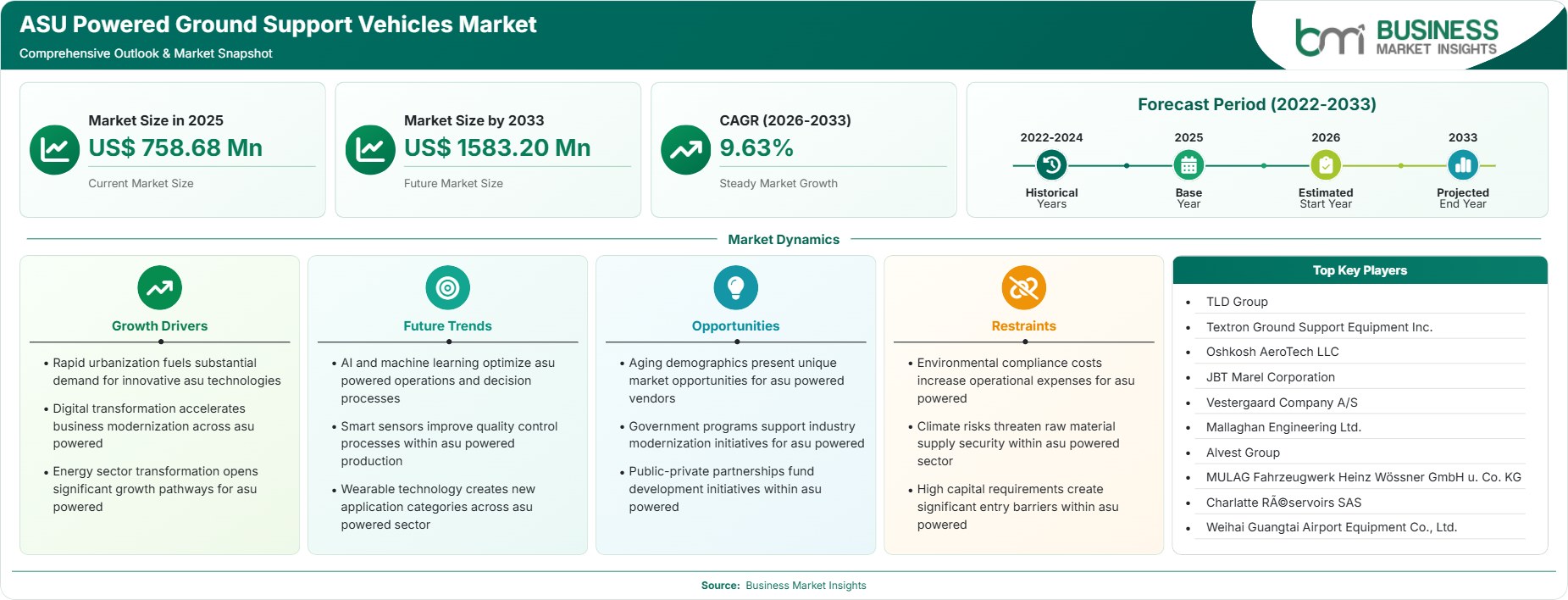
The ASU Powered Ground Support Vehicles Market size was valued at US$ 758.68 Million in 2025 and is projected to reach US$ 1583.2 Million by 2033, growing at a CAGR of 9.63% during 2026–2033. Growth is supported by airport modernization programs, rising aircraft movements, fleet electrification initiatives, autonomous vehicle adoption, and increasing investments in sustainable airside operations.

Report Coverage
  • Product Type: Aircraft Handling Vehicles, Passenger Handling Vehicles, Baggage & Cargo Handling Vehicles, Aircraft Servicing Vehicles, Aircraft Maintenance & MRO Support Vehicles
  • Capacity: Light-duty Units, Medium-duty Units, Heavy-duty Units, Specialized Heavy-duty Units
  • Powertrain: Diesel-powered Vehicles, Battery-Electric Vehicles , Hybrid-electric Vehicles , Hydrogen Fuel Cell Vehicles , Gasoline/LPG/CNG Vehicles
US$ 758.68 Mn Market size in 2025
US$ 1583.20 Mn Market Size by 2033
9.63% CAGR, 2026 - 2033
2026-2033 Forecast Period

AI Overview

ASU Powered Ground Support Vehicles Market Summary

  • North America Region: North America holds a 34%–37% share in 2025, growing at a CAGR of 8.4%–9.0% during 2026–2033. Demand is driven by airport infrastructure upgrades, aviation decarbonization targets, electric vehicle deployment, autonomous ramp operations, airline fleet expansion, cargo growth, operational efficiency programs, safety compliance requirements, digital fleet management, and funding support. US market remains dominant due to large commercial airports, expanding electric fleets, and 8.5%–9.1% CAGR.
  • Fastest Growing Region: Asia Pacific holds a 26%–29% share in 2025, growing at a CAGR of 11.0%–11.8% during 2026–2033. Expansion of airports, rising passenger traffic, new terminal construction, increasing airline fleets, government aviation investments, cargo handling requirements, sustainability initiatives, equipment modernization programs, local manufacturing expansion, and technology adoption accelerate demand.
  • Leading Segment: Aircraft Handling Vehicles account for 31%–34% of the ASU Powered Ground Support Vehicles Market share in 2025 and are projected to advance at 8.8%–9.5% CAGR. High utilization rates, aircraft turnaround requirements, towbarless technologies, productivity improvements, airline operational optimization, airport expansion projects, maintenance efficiency needs, automation integration, fleet replacement cycles, and safety enhancements sustain leadership.
  • High Growth Segment: Battery-Electric Vehicles (BEV) represent a 22%–25% share in 2025 and are expected to expand at 13.0%–14.0% CAGR. Carbon reduction goals, lower lifecycle costs, airport electrification investments, charging infrastructure deployment, emission regulations, quieter operation advantages, renewable energy integration, technology maturation, incentive programs, and operator sustainability commitments accelerate adoption.
  • Key Market Opportunity: Large-scale conversion of diesel-powered airport support fleets to electric and connected platforms creates opportunities for manufacturers delivering energy-efficient, telematics-enabled, low-maintenance solutions integrated with digital airport ecosystems globally.
  • Major Market Players: TLD Group, Textron Ground Support Equipment Inc., Oshkosh AeroTech LLC, JBT Marel Corporation, Vestergaard Company A/S, Mallaghan Engineering Ltd., Alvest Group, MULAG Fahrzeugwerk Heinz Wössner GmbH u. Co. KG, Charlatte Réservoirs SAS, Weihai Guangtai Airport Equipment Co., Ltd.
Strategic Insights

ASU Powered Ground Support Vehicles Market: Strategic Insights

ASU Powered Ground Support Vehicles Market Strategic Framework
FREE PDF
Request your free sample
Request free sample
Stakeholder View

Key Takeaways

  • Airport operators are placing greater emphasis on integrated equipment ecosystems where vehicles, charging infrastructure, telematics platforms, and maintenance services are procured as connected operational solutions.
  • Electrified aircraft servicing and baggage handling fleets provide the strongest medium-term revenue opportunities as sustainability-driven replacement cycles accelerate across major international airports.
  • Innovation is shifting toward autonomous navigation, collision-avoidance technologies, remote diagnostics, battery optimization systems, and AI-based fleet scheduling capabilities.
  • Asia Pacific offers a compelling investment case due to ongoing airport construction programs, expanding airline fleets, and government-backed aviation infrastructure development.
  • Strategic partnerships, fleet service contracts, and acquisitions are becoming more common as suppliers seek broader product portfolios and recurring service revenues.
  • Hydrogen fuel-cell platforms remain at the pilot stage but could become important in heavy-duty airside applications requiring longer operating durations and faster refueling.
Geographic Outlook

ASU Powered Ground Support Vehicles Market Regional Highlights

North America ASU Powered Ground Support Vehicles Market

North America accounts for 34%–37% of global revenue in 2025 and is expected to record an 8.4%–9.0% CAGR through 2033. The region benefits from extensive airport infrastructure, significant replacement demand, and aggressive sustainability targets. The ASU Powered Ground Support Vehicles Market share remains highest in this region because airlines and airport authorities continue investing in electric vehicle deployments, digital fleet management, and autonomous ground operations. Cargo traffic growth and airport modernization programs further stimulate procurement across major aviation hubs.

  • Large hub airports continue transitioning from diesel fleets to electric equipment, supported by federal sustainability funding and corporate emissions-reduction commitments.
  • Fleet-management software adoption is improving utilization rates and maintenance planning, supporting higher operational efficiency across ground handling operations.
  • Cargo airport expansion projects create additional demand for baggage, cargo-handling, and servicing vehicles with advanced connectivity features.
  • Airlines increasingly prefer low-noise, low-emission equipment to support environmental reporting and airport community engagement goals.

US ASU Powered Ground Support Vehicles Market

The U.S. accounts for the majority of ASU Powered Ground Support Vehicles market demand in the region, at 74% - 78%, and is forecast to experience a CAGR of 8.5% - 9.1%. The country’s vibrant commercial aviation sector, continued development of airport terminals, and investments in electrification help drive procurement trends. Leading airports across the nation are embracing the integration of connected fleets, electric charging, and maintenance technology to improve ramp operations. Growth continues to be bolstered by aircraft fleet growth and environmental targets.

  • Infrastructure modernization programs at major airports support fleet replacement strategies emphasizing connected and electric platforms.
  • Ground handlers increasingly deploy telematics-enabled equipment to monitor vehicle performance, utilization, and maintenance requirements.
  • Cargo-driven airports generate sustained demand for specialized heavy-duty equipment supporting freight operations.
  • Public and private partnerships continue supporting deployment of charging networks necessary for vehicle electrification.

Europe ASU Powered Ground Support Vehicles Market

Europe holds 24%–27% of the ASU Powered Ground Support Vehicles market share in 2025 and is projected to expand at 8.8%–9.6% CAGR. There is significant pressure on regulations regarding emissions reduction and airport sustainability, which encourages the electrification of vehicles. Germany leads the region in demand, while Eastern European countries grow at an accelerated pace, close to double digits. Lifecycle emissions are considered by airport operators during the procurement process. Electrification mandates and climate-oriented aviation policies create favorable conditions for the deployment of advanced vehicles.

  • European airports remain among the earliest adopters of fully electric support fleets and associated charging infrastructure.
  • Sustainability procurement frameworks increasingly prioritize carbon reduction, energy efficiency, and lifecycle operating costs.
  • Germany leads equipment demand, while Poland and Romania display stronger growth due to airport expansion projects.
  • Advanced safety standards encourage investment in digitally integrated vehicles featuring driver-assistance technologies.
  • Public climate financing mechanisms support procurement of low-emission airport equipment.

Asia Pacific ASU Powered Ground Support Vehicles Market

Asia Pacific contributes 26% to 29% of total revenue in 2025 and is considered the fastest-growing region, with a CAGR of 11.0% to 11.8%. China is the largest contributor to demand for the installed fleet. India has the highest regional growth rate owing to growth in airport infrastructure and the expansion of passenger traffic. Growth in airport construction, airline fleet additions, and cargo traffic contributes to procurement. Government support for sustainable transportation technologies further strengthens regional adoption across major aviation centers.

  • China remains the largest purchaser due to extensive airport networks and domestic manufacturing capabilities.
  • India shows high investment momentum driven by airport expansion, new terminal projects, and airline growth.
  • Southeast Asian airports increasingly modernize ground handling fleets to improve service quality and operational efficiency.
  • Regional manufacturers are enhancing competitiveness through electric powertrain development and localized production.
  • Sustainability agendas encourage adoption of battery-electric technologies across major aviation hubs.

Rest of World ASU Powered Ground Support Vehicles Market

Rest of World holds a 11%–14% share in 2025 and is expected to record 9.5%–10.4% CAGR. Demand in the Middle East region from aviation centers is driven by growth in airports and the premium passenger segment.

South and Central America show consistent demand growth as airport developments continue. Saudi Arabia and the UAE are dominant investors, while Brazil shows healthy growth driven by increased air traffic and infrastructure improvements.

  • Gulf-region megaprojects create demand for technologically advanced and environmentally sustainable airport vehicle fleets.
  • Saudi Arabia and UAE airport expansions support procurement across servicing, handling, and passenger-assistance categories.
  • Brazil remains a key Latin American market due to modernization of airport infrastructure and traffic recovery.
  • Emerging African aviation hubs generate opportunities for cost-efficient fleet modernization initiatives.
  • Cargo handling improvements support demand for specialized heavy-duty operational vehicles.
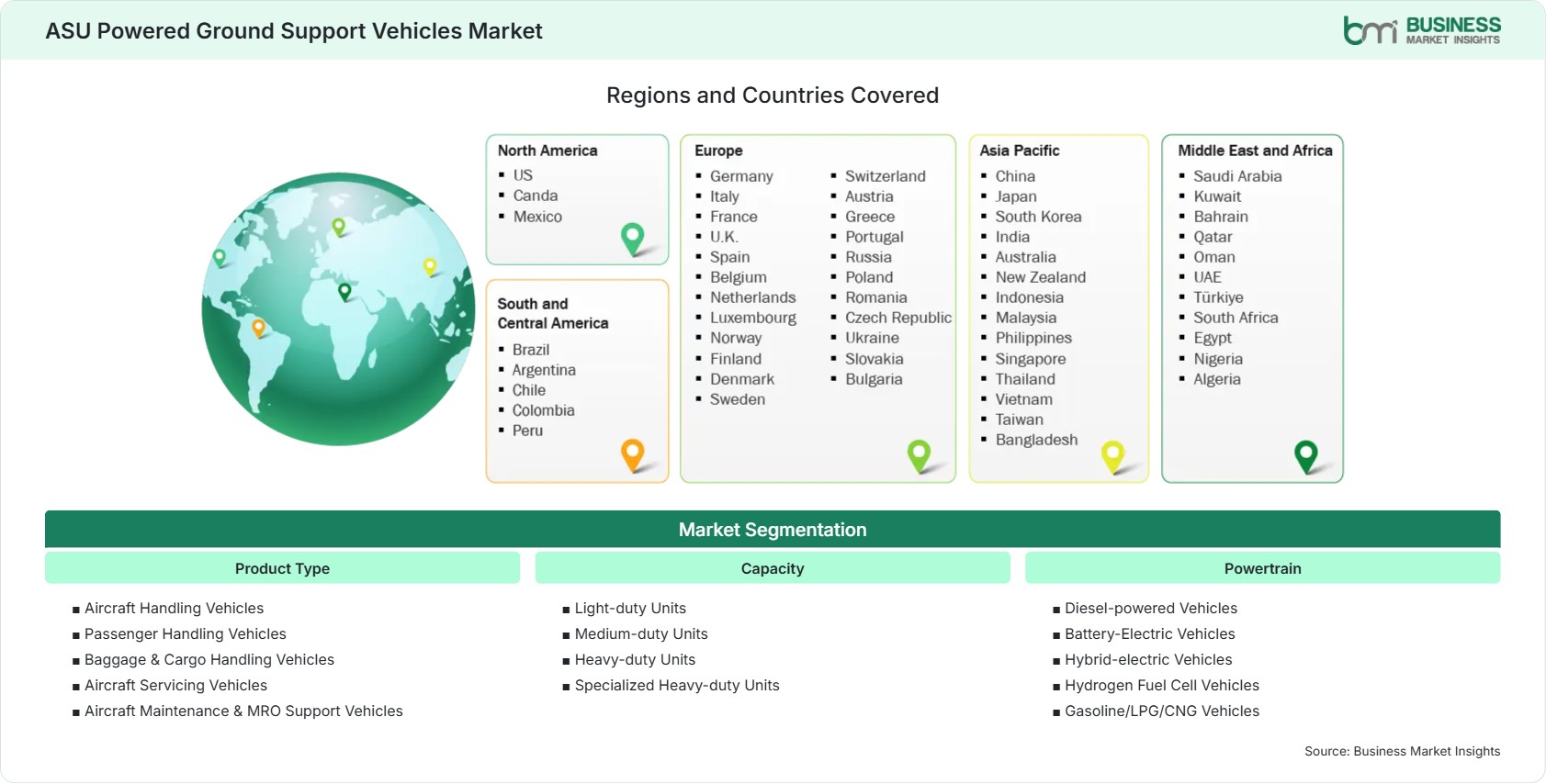
Global Market Geography
FREE PDF
Request your free sample
Request free sample
Segment Analysis

ASU Powered Ground Support Vehicles Market Segmentation

Product Type

This segment accounts for around 30%–33% of market share in 2025 and is projected to grow at a 9.2%–9.9% CAGR. The scope of the ASU Powered Ground Support Vehicles Market is continually expanding due to increased adoption by airports, driven by aircraft movement, passenger movement, maintenance, and servicing activities. Higher utilization requirements and airport capacity expansion remain core drivers of demand.

  • Aircraft Handling Vehicles: Critical for aircraft movement and turnaround efficiency. Adoption benefits from automation initiatives, increased aircraft movements, safety enhancements, and operational productivity requirements across commercial and cargo airports.
  • Passenger Handling Vehicles: Demand grows alongside passenger traffic volumes, terminal expansion projects, accessibility requirements, and airport service-quality improvement initiatives worldwide.
  • Baggage & Cargo Handling Vehicles: Supported by e-commerce growth, air cargo expansion, baggage automation programs, and airport logistics optimization activities.
  • Aircraft Servicing Vehicles: Increasingly equipped with digital monitoring tools, supporting fuel efficiency, maintenance planning, and turnaround optimization objectives.
  • Aircraft Maintenance & MRO Support Vehicles: Demand rises with fleet expansion, maintenance outsourcing, and increasing investment in airport-based MRO facilities.

Capacity

Capacity-based deployments depend on the level of operational complexity and the airport's size. This category accounts for 25% to 29% of the ASU Powered Ground Support Vehicles Market share in 2025 and grows at a rate of 9.0% to 9.8% CAGR. Equipment selection increasingly depends on fleet utilization levels, cargo volumes, aircraft categories, and infrastructure requirements across airports.

  • Light-duty Units: Preferred for routine airport support activities requiring maneuverability, lower operating costs, and operational flexibility.
  • Medium-duty Units: Widely used across commercial airports where balanced payload capability and operational efficiency are essential.
  • Heavy-duty Units: Support larger aircraft operations and demanding cargo-handling environments requiring enhanced performance capabilities.
  • Specialized Heavy-duty Units: Designed for high-capacity or mission-critical applications, including wide-body aircraft servicing and complex logistics activities.

Powertrain

The powertrain options are undergoing rapid changes owing to airports' push towards sustainability. The ASU Powered Ground Support Vehicles Market trends reflect a shift towards emissions-reducing powertrains. This market has a market share of 22%- 25%, with the fastest rate of development at a CAGR of 13.0% - 14.0% for leading electrified technologies.

  • Diesel-powered Vehicles: Remain common in legacy fleets due to proven reliability, operational familiarity, and established refueling infrastructure.
  • Battery-Electric Vehicles (BEV): Adoption accelerates through falling battery costs, emissions targets, charging-network investments, and lifecycle cost advantages.
  • Hybrid-electric Vehicles (HEV/PHEV): Provide transitional solutions where full electrification remains operationally challenging.
  • Hydrogen Fuel Cell Vehicles (FCEV): Attract interest for heavy-duty applications requiring longer runtime and rapid refueling capability.
  • Gasoline/LPG/CNG Vehicles: Continue serving selected airport operations seeking cost-effective alternatives to conventional diesel platforms.
Market Forces

ASU Powered Ground Support Vehicles Market Dynamics

Key Market Drivers

Airport Electrification and Decarbonization Programs

The adoption of decarbonization roadmaps has begun at all major airports, aligned with their aviation sustainability initiatives. According to industry associations such as IATA and Airports Council International, there is an ongoing trend toward continued operational reductions of emissions through electric fleet management at airports. Such solutions decrease fuel, maintenance, and emission costs for airports while helping them achieve ESG goals. Nowadays, many major airports incorporate low-emission policies into their procurement frameworks, thereby promoting the modernization of older fleets. This process will also have positive effects on airports' cost savings. These factors create a durable equipment replacement cycle that strengthens long-term demand across commercial airports, cargo hubs, and aviation support facilities.

Rising Global Air Passenger and Cargo Traffic

Growing passenger traffic and freight activity contribute to increased use of support vehicle fleets. High aircraft handling activity necessitates an efficient handling process to sustain turnaround efficiency and quality. There is considerable investment in high-performance vehicles that allow greater efficiency without any operating restrictions. Growth in airport infrastructure in developing countries adds another dimension to the purchase of new vehicles. Higher freight volumes from international commerce and e-commerce place greater demands on baggage and freight-handling processes. Such demands drive the need for new equipment across several airside operations.

Digital Fleet Management and Automation Adoption

Telematics, predictive maintenance systems, sensor technology, and fleet management software are revolutionizing the way airside vehicles are used at airports. Data-driven insights into equipment performance, usage, and maintenance are becoming more important to operators. Technology increases asset efficiency by reducing downtime and maintenance costs. Autonomous features and driver assistance make airport ramp operations safer. Integrating the technology with airport operational control systems adds further efficiency benefits. In the wake of digital transformation becoming a business priority, investments in technologically enabled airside vehicles are growing fast.

Key Market Opportunities

Expansion of Emerging Airport Infrastructure Projects

Airport projects in the construction and upgrade phases across Asia, the Middle East, Africa, and Latin America present significant purchasing opportunities. New airport facilities need more sophisticated fleet management right from the start. Airports require machines that meet their sustainability, intelligent airport, and operational efficiency requirements. Manufacturers of comprehensive solutions that combine hardware, software, and services can benefit from these trends. Investment plans for the next decade mean equipment purchases will continue for several more years. Such a procurement environment creates good opportunities for those who develop production capacities.

Transition Toward Autonomous Airside Operations

Autonomous driving technology can be used to increase productivity, safety, and staffing efficiency. Automated tractors, automated towing, and other automated vehicles operating in confined areas are being piloted at airports. The successful implementation of such a system could help overcome labor shortages and increase operational consistency. Rapid developments in sensors, AI, and connectivity increase the potential for commercial applications of autonomous driving technology. Equipment manufacturers that adopt such innovations may gain a competitive advantage.

Fleet Replacement Supported by ASU Powered Ground Support Vehicles Market Forecasts

A large amount of legacy equipment has been kept in use at airports around the world. Replacements offer multiple chances for suppliers of eco-friendly and digital systems. Purchase decisions now favor total cost of ownership over purchase cost alone. It stimulates the development of electric, connected, and modular vehicles. Financing, leasing, and combined service solutions additionally help customers embrace innovations. In the case of accelerated modernization cycles, suppliers who can deliver sustainability advantages and operational gains will reap the benefits.

Market Restraints and Challenges

High Acquisition Costs and Infrastructure Requirements

Factor: Advanced electric and autonomous vehicle platforms typically involve significantly higher upfront costs than conventional equipment. Impact: Budget-constrained airports and handlers may delay procurement despite long-term operating benefits. Additional expenses related to charging infrastructure, energy management systems, technician training, and maintenance adaptation increase implementation complexity. Smaller airports particularly face capital allocation challenges. Uncertainty regarding technology evolution also encourages cautious purchasing behavior. While total ownership economics often improve over time, initial investment requirements remain a key obstacle affecting adoption speed in several developing regions and secondary airports.

Operational Reliability Concerns in Intensive Applications

Factor: Battery performance limitations, charging availability, and technology integration challenges continue affecting some operational environments. Impact: Airports operating around-the-clock require high equipment availability and may hesitate to transition critical functions too rapidly. Extreme climates, peak traffic periods, and specialized heavy-duty tasks can create operational concerns. Integration with existing airport systems also requires technical expertise and investment. These factors may prolong reliance on conventional powertrains for selected applications, slowing complete fleet transformation despite strong sustainability and efficiency incentives.

Company Analysis

Competitive Landscape

The ASU Powered Ground Support Vehicles Market analysis reflects competition centered on electrification, automation, lifecycle services, and global airport partnerships.

Company Name

Overview

Products and Services relevant to this market

TLD Group

Global airport equipment manufacturer with extensive international presence and strong focus on sustainable ground operations.

Aircraft tractors, baggage tractors, loaders, electric support vehicles, maintenance services, and fleet solutions.

Textron Ground Support Equipment Inc.

Provides airport support equipment through established aviation and industrial technology expertise.

Ground power units, tow tractors, baggage vehicles, servicing equipment, and support systems.

Oshkosh AeroTech LLC

Major provider of airport technologies focused on operational efficiency and airside productivity.

Pushback tractors, cargo loaders, passenger boarding systems, and connected airport solutions.

JBT Marel Corporation

Diversified industrial company supplying airport and logistics handling technologies globally.

Cargo loaders, transporters, deicers, gate equipment, and airport automation systems.

Vestergaard Company A/S

Specialist manufacturer known for high-performance airport servicing vehicles.

Deicers, lavatory service vehicles, water service units, and electric servicing platforms.

Mallaghan Engineering Ltd.

Airport equipment manufacturer serving airlines, handlers, and airports worldwide.

Passenger stairs, catering vehicles, ambulifts, belt loaders, and electric variants.

Alvest Group

International provider of innovative airport ground support technologies and services.

Aircraft tractors, refueling support equipment, electric handling vehicles, and fleet management tools.

MULAG Fahrzeugwerk Heinz Wössner GmbH u. Co. KG

German specialist focused on customized airport vehicle engineering.

Tow tractors, aircraft servicing vehicles, cargo equipment, and electric platforms.

Charlatte Réservoirs SAS

Established supplier with expertise in airport towing and baggage transport systems.

Baggage tractors, towing vehicles, electric airport transport equipment, and service solutions.

Weihai Guangtai Airport Equipment Co., Ltd.

Leading Asian airport equipment manufacturer with broad international reach.

Aircraft servicing vehicles, cargo systems, handling equipment, and electric airport vehicles.

Trust & Transparency

Research Methodology

The market analysis combines proprietary research with secondary data from government agencies, company disclosures, regulatory filings, industry databases and expert interviews. Market estimates are validated through data triangulation, cross-market benchmarking and analyst review.

View Full Research Methodology

Questions Answered

Frequently Asked Questions

What insights does the ASU Powered Ground Support Vehicles Market Report provide?

The report evaluates market size, technology transitions, competitive positioning, regional demand patterns, growth opportunities, investment trends, and strategic developments shaping industry expansion through 2033.

How are digital technologies influencing procurement decisions?

Airports increasingly prioritize vehicles equipped with telematics, predictive maintenance tools, utilization analytics, and safety monitoring capabilities to improve operational efficiency.

Which product category generates the highest revenue contribution?

Aircraft handling vehicles remain the leading category because they are essential for aircraft movement, turnaround efficiency, and high-frequency airport operations.

Which region presents the strongest long-term growth potential?

Asia Pacific offers the strongest growth outlook due to airport expansion programs, rising passenger traffic, airline fleet additions, and government investment in aviation infrastructure.

What is driving adoption of electric airport support vehicles?

Lower operating costs, airport sustainability targets, stricter emissions policies, quieter operation, and advances in battery technology are encouraging fleet electrification across major aviation hubs.

Access the Full ASU Powered Ground Support Vehicles Market Report

Get segment-level forecasts, regional estimates, competitive benchmarking, company profiles and downloadable Excel datasets.

Access the full ASU Powered Ground Support Vehicles Market Report
350 pages PDF & Excel | 2026-08-31