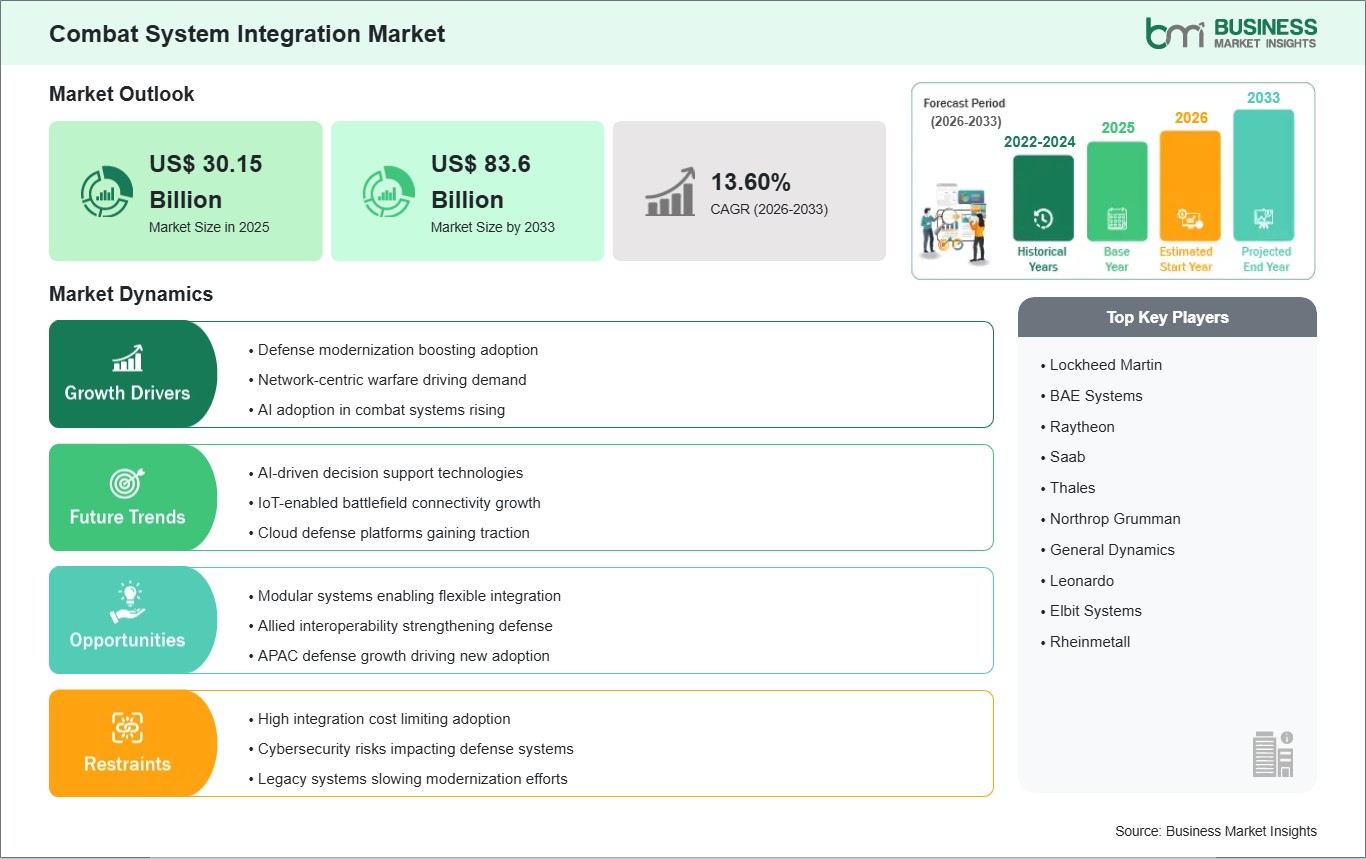
The Combat System Integration Market size is expected to reach US$ 83.6 Billion by 2033 from US$ 30.15 Billion in 2025.The market is estimated to record a CAGR of 13.60% from 2026 to 2033.
The combat systems integration market is primarily concerned with the creation and integration of various defense technologies into a single platform, aimed at boosting battlefield awareness, mission coordination, and combat capabilities. Such systems integrate sensors, radars, communications, electronic warfare technologies, weapon control systems, command and control software, and surveillance technologies in navy, air, and ground defense systems. This market is growing because of the need for interoperability among different kinds of military forces operating within complex battlefield environments.
BAE Systems plc in 2024 updated that the company progressed further in the development of advanced combat management systems aimed at improving the detection and coordination capabilities within the naval environment. In addition, defense contractors are increasingly collaborating with government organizations in order to achieve better integration between existing military systems and new ones.
Incorporation of cyber defense and electronic warfare functionalities into a centralized combat system framework becomes one of the main factors that differentiate today's defense technology vendors from each other. Nevertheless, the sector has to deal with several barriers such as technological complexity, integration expenses, cyber threats, and lack of interoperability between defense systems.
Increasing geopolitical tensions, security threats across borders, and modernization of militaries have become major factors contributing to the rising demand for integrated combat systems globally. Military organizations are looking for network centric warfighting technologies, which allow faster decisions, targeting, and responses by providing visibility through a centralized network system. Contemporary warships, fighters, armors, and missile defense systems require combat integration systems, which can integrate various sensors and weapons into an operational network system. Increasing usage of artificial intelligence technology for analysis on battlefields is another trend impacting the market.

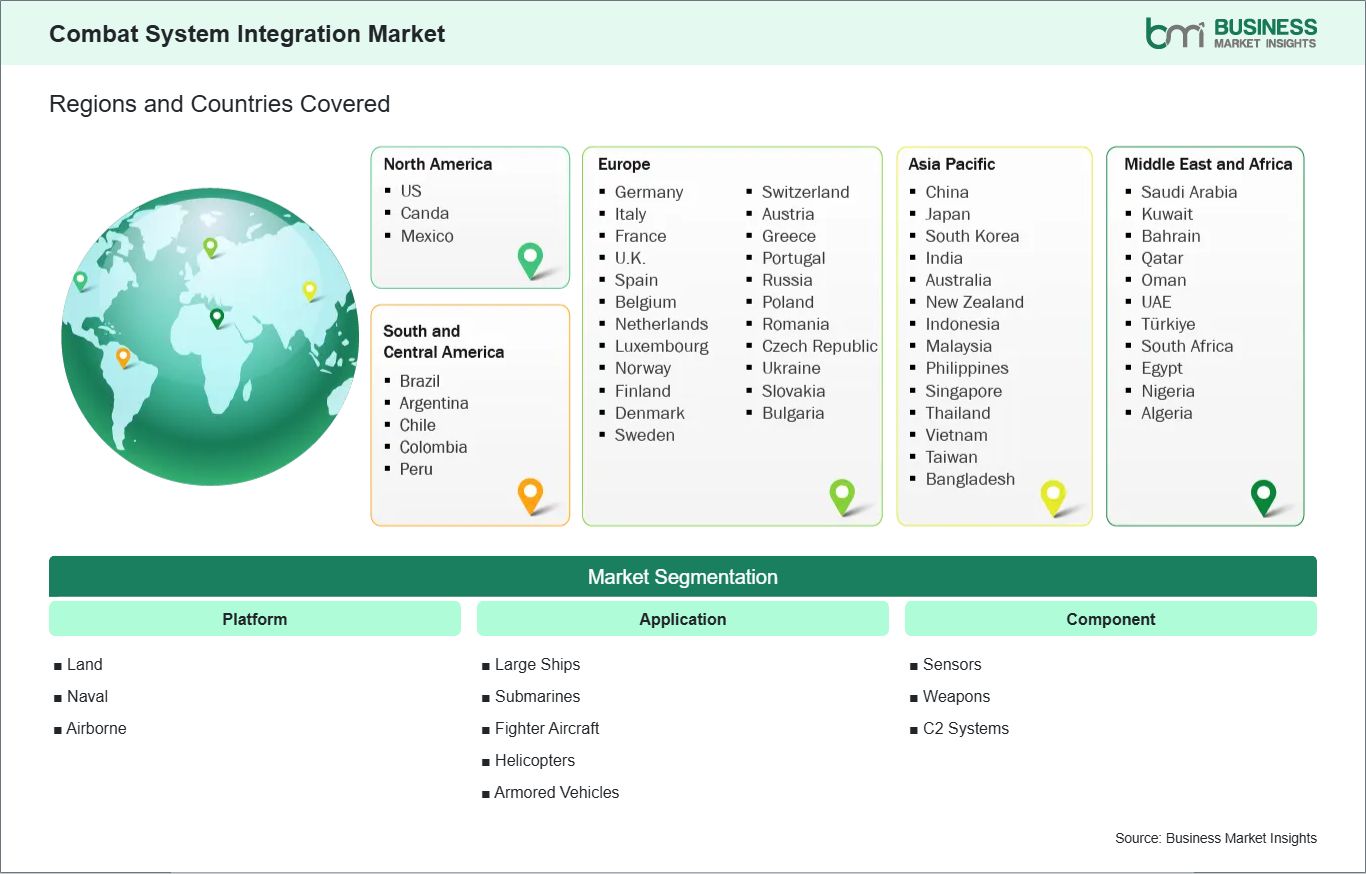
The combat system integration market is segmented based on platform, application, and component, reflecting the increasing need for interoperable, network-centric warfare systems that enhance situational awareness, decision-making, and mission effectiveness across defense domains.
The integration market for global combat system is growing as there is increasing modernization of defense systems by military forces in response to the changing demands of multidomain warfare. Modernization initiatives in the defense sector are emphasizing on the integration of sensor suites, weapon systems, communication networks, and electronic warfare systems within a single command structure. This is necessitated due to the requirement for faster decision making and coordination across all battlefields.
The modern military platforms have evolved in such a way that their design is no longer independent but is rather a component of a much bigger and interconnected system of military infrastructure. Therefore, there is a growing need for modern methods of integration, which would facilitate the communication between radars, fire control systems, unmanned vehicles, and command centers. Another benefit of integrating modern combat systems with older platforms is their ability to serve as an affordable substitute for replacing a whole fleet of military equipment.
In addition, the evolution of modern technology and the development of battlefield digital technologies contribute to the rapid spread of integration in militaries across the world. Military organizations are actively involved in developing highly integrated combat management systems that provide accurate information about the location and movements of potential threats through the integration of various kinds of sensors and communication technologies.
The development of modular combat system architectures has created many opportunities for the combat system integration market because of the increased adaptability of defense solutions that result from them. Modular systems make it possible for defense systems to integrate or change some elements, like sensors, weapons modules, and communications, without having to design an entirely new platform. The ability to do so is more necessary today due to the ever-changing security environment.
The development of open architecture standards has made interoperability easier and thus has had a positive impact on joint operations. Joint missions require interoperability among equipment manufactured by different companies. Modular combat system integration allows defense systems to undergo upgrades gradually rather than completely replacing the existing system, which lowers costs.
Moreover, the requirement for unmanned systems and autonomous systems has increased demands on modular integration systems. Drones, unmanned ground vehicles, and autonomous naval systems need plug-and-play combat systems that can be modified for reconnaissance, surveillance, and even combat applications. The flexibility that such an application offers is prompting defense companies to design systems that provide maximum flexibility during integration. In order to be more agile and flexible in the future, defense systems may benefit from this growth driver in the coming years.
The Combat System Integration Market is projected to grow from US$ 30.15 Billion in 2025 to US$ 83.6 Billion by 2033 , registering a CAGR of 13.60% from 2026 to 2033.
By Platform, naval dominate the market due to the rising deployment of advanced combat management systems on large warships and submarines. These platforms require highly integrated sensor-to-shooter networks for multi-domain threat detection, target tracking, and coordinated weapon engagement in complex maritime environments.
By Application, large ships dominate the market as they serve as primary command hubs equipped with advanced combat systems for multi-threat engagement and fleet coordination. Their size and mission complexity necessitate extensive integration of sensors, weapons, and communication systems.
By Component, command and control (C2) systems dominate the market as they act as the central decision-making backbone, integrating sensors and weapons into a unified operational picture. Increasing demand for real-time battlefield awareness and rapid response capabilities further strengthens their dominance.
| Report Attribute | Details |
|---|---|
| Market size in 2025 | US$ 30.15 Billion |
| Market Size by 2033 | US$ 83.6 Billion |
| Global CAGR (2026 - 2033) | 13.60% |
| Historical Data | 2022-2024 |
| Forecast period | 2026-2033 |
| Segments Covered | By Platform
|
|
Regions and Countries Covered
| |
| North America | US, Canada, Mexico |
| Europe | Germany, Italy, France, U.K., Spain, Belgium, Netherlands, Luxembourg, Norway, Finland, Denmark, Sweden, Switzerland, Austria, Greece, Portugal, Russia, Poland, Romania, Czech Republic, Ukraine, Slovakia, Bulgaria |
| Asia-Pacific | China, Japan, South Korea, India, Australia, New Zealand, Indonesia, Malaysia, Philippines, Singapore, Thailand, Vietnam, Taiwan, Bangladesh |
| South and Central America | Brazil, Argentina, Chile, Colombia, Peru |
| Middle East and Africa | Saudi Arabia, United Arab Emirates, Kuwait, Bahrain, Qatar, Oman, Turkiye, South Africa, Egypt, Nigeria, Algeria |
| Market leaders and key company profiles |
|
The "Combat System Integration Market Size and Forecast (2022 and 2033)" report provides a detailed analysis of the market covering below areas:
The market for combat system integration is expanding continuously owing to the growing modernization trends in defense, increased demands for network centric warfare, and coordination between advanced defense platforms and weapons systems. This involves the integration of sensors, communication systems, surveillance technologies, weapons, and command and control platforms in order to enhance the efficiency of operations. The increase in the complexities associated with contemporary warfare operations and digitalization in defense are fueling the growth in the demand for combat system integration solutions.
North America continues to be an important market for combat system integration because of significant military expenditure, sophisticated military infrastructure, and superior technological advancements. There is considerable investment in the region from countries like the US and Canada on integrated warfare solutions, future generation communication systems, missile defenses, and combat technologies empowered by AI. Defense agencies in North America are engaged in making military interoperable, enhancing real-time data transfer and cyber-secured military operations. The existence of leading defense companies and constant investments on naval fleet modernization, autonomous systems, and electronic warfare solutions are propelling growth prospects in this market.
The Asia-Pacific market is experiencing rapid growth on account of escalating geopolitical tensions, expanding defense budgets, and active modernization of militaries. Countries like China, India, Japan, South Korea, and Australia are modernizing their militaries with the use of integrated combat systems, including advanced radars, electronic warfare solutions, unmanned platforms, and integrated command platforms. This region has made its focus on maritime security, border surveillance, and multi-domain preparedness, resulting in enhanced deployments of combat systems on naval ships, fighter planes, armor carriers, and missile defense systems. Investments made towards indigenous manufacturing and defense technology innovations have been driving growth prospects in this market.
The combat system integration market will be influenced by the development of technologies in digital warfare, focus on multi-domain operations, and need for real-time situational awareness and defense capabilities, where North America will dominate in terms of technology used in defense integration, while Asia Pacific region will experience rapid growth because of its military modernization programs.

The combat system integration market is evaluated by gathering qualitative and quantitative data post primary and secondary research, which includes important corporate publications, association data, and databases. A few of the key developments in the combat system integration market are:
The Combat System Integration Market is valued at US$ 30.15 Billion in 2025, it is projected to reach US$ 83.6 Billion by 2033.
As per our report Combat System Integration Market, the market size is valued at US$ 30.15 Billion in 2025, projecting it to reach US$ 83.6 Billion by 2033. This translates to a CAGR of approximately 13.60% during the forecast period.
The Combat System Integration Market report typically cover these key segments-
The historic period, base year, and forecast period can vary slightly depending on the specific market research report. However, for the Combat System Integration Market report:
The Combat System Integration Market is populated by several key players, each contributing to its growth and innovation. Some of the major players include:
The Combat System Integration Market report is valuable for diverse stakeholders, including:
Essentially, anyone involved in or considering involvement in the Combat System Integration Market value chain can benefit from the information contained in a comprehensive market report.
Please tell us your area of interest
(Market Segments/ Regions and Countries/ Companies)