
Torpedo Market Outlook: Size, Share, Trends, Growth Analysis, Competitive Landscape & Forecast, 2026-2033

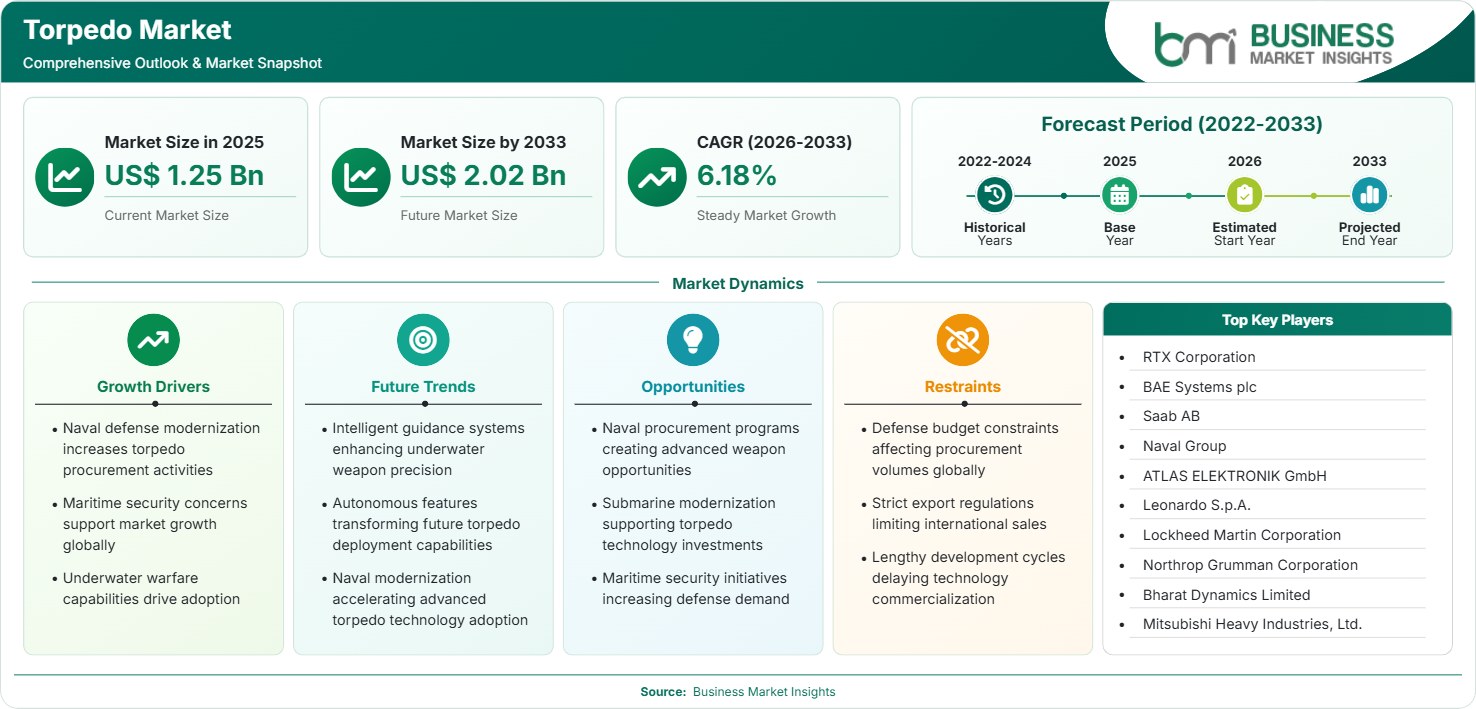
The Torpedo Market size was valued at US$ 1.25 Billion in 2025 and is projected to reach US$ 2.02 Billion by 2033, growing at a CAGR of 6.18% during 2026–2033, driven by submarine fleet modernization, rising anti-submarine warfare investments, underwater deterrence programs, advanced guidance technologies, and procurement opportunities across Indo-Pacific, Europe, and Middle Eastern naval forces.

Report Coverage
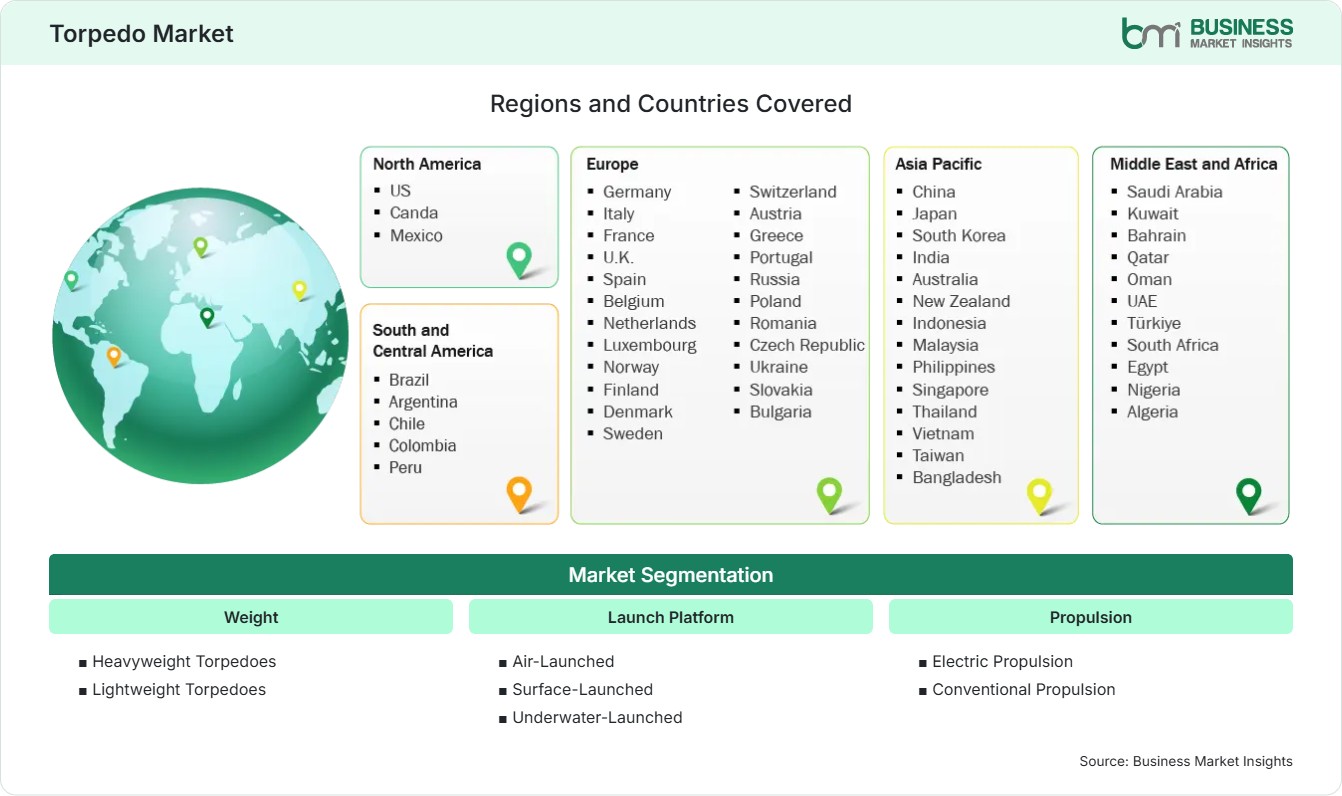
  • Weight: Heavyweight Torpedoes, Lightweight Torpedoes
  • Launch Platform: Air-Launched, Surface-Launched, Underwater-Launched
  • Propulsion: Electric Propulsion, Conventional Propulsion
US$ 1.25 Bn Market size in 2025
US$ 2.02 Bn Market Size by 2033
6.18% CAGR, 2026 - 2033
2026-2033 Forecast Period

AI Overview

Torpedo Market Summary

  • North America Region: Holds a 36%–39% Torpedo Market share in 2025, growing at a CAGR of 5.4%–5.8% during 2026–2033. Growth is supported by submarine sustainment spending, underwater warfare modernization, advanced torpedo upgrades, fleet readiness programs, maritime deterrence requirements, and enhanced naval surveillance integration across strategic defense initiatives. The U.S. benefits from continuous Mk 48 modernization, submarine expansion initiatives, and underwater combat investments, advancing at a CAGR of 5.5%–5.9%.
  • Fastest Growing Region: Asia Pacific accounts for a 26%–29% share in 2025 and is projected to expand at a CAGR of 7.4%–7.9% during 2026–2033. Regional expansion is supported by submarine acquisitions, indigenous weapon development, maritime security concerns, naval deterrence programs, defense industrial investments, growing underwater warfare capabilities, and procurement diversification strategies.
  • Leading Segment: Heavyweight Torpedoes represent 58%–62% of revenue in 2025 and are expected to advance at a CAGR of 6.0%–6.4% through 2033. Demand remains supported by submarine deployment growth, long-range engagement requirements, improved acoustic homing systems, modernization programs, enhanced lethality expectations, and strategic underwater combat readiness objectives.
  • High Growth Segment: Electric Propulsion captures 42%–46% of the Torpedo Market share in 2025 and is forecast to grow at a CAGR of 7.0%–7.5% through 2033. Adoption is accelerating through reduced acoustic signatures, superior energy management, improved stealth performance, lower maintenance requirements, technological innovation, and increasing next-generation naval weapon development investments.
  • Key Market Opportunity: Expansion of autonomous underwater operations creates opportunities for next-generation intelligent torpedoes featuring network-enabled targeting, adaptive navigation algorithms, enhanced seeker technologies, and interoperability with unmanned maritime defense ecosystems globally.
  • Major Market Players: RTX Corporation, BAE Systems plc, Saab AB, Naval Group, ATLAS ELEKTRONIK GmbH, Leonardo S.p.A., Lockheed Martin Corporation, Northrop Grumman Corporation, Bharat Dynamics Limited, Mitsubishi Heavy Industries, Ltd.
Strategic Insights

Torpedo Market: Strategic Insights

Torpedo Market Strategic Framework
FREE PDF
Request your free sample
Request free sample
Stakeholder View

Key Takeaways

  • The value chain is extremely concentrated around the propulsion specialists, the sonar people, the guidance system people, the naval integrators, and the various government procurement agencies. It's a very closed chain with huge barriers to entry, and that in turn creates very strong long-term supplier relationships.
  • Electric propulsion and the more advanced submarine-launched platforms represent the biggest commercial upside. As navies continue to focus on stealth, endurance and effectiveness in the face of modern anti-submarine countermeasures, these systems are going to be the ones that really deliver.
  • Innovation is moving in the direction of AI-assisted target recognition, digital acoustic processing, fiber optic guidance and network-enabled engagement capabilities for the contested maritime environment.
  • Asia-Pacific is one of the most attractive investment cases with growing submarine fleets, indigenous defense programs, regional security issues and a strong drive to modernize the fleet.
  • Strategic defense co-operation, joint development agreements and technology transfer arrangements are increasingly important as countries look to develop domestic manufacturing capability and secure supply chains.
  • Lifecycle support, modernization contracts and upgrade programs are becoming a source of stable revenue and, in many cases, are able to extend the life of the product well beyond the initial deployment cycle.
Geographic Outlook

Torpedo Market Regional Highlights

North America Torpedo

North America accounts for approximately 36%–39% of global Torpedo Market revenue in 2025 and is projected to expand at a CAGR of 5.4%–5.8% through 2033. Regional demand is supported by sustained naval modernization programs, submarine fleet upgrades, anti-submarine warfare readiness, and continued investment in advanced underwater weapons.

  • The submarine force modernization program is still the major driver of procurement, with the focus being on advanced guidance, better seekers, and improved resistance to both electronic and acoustic ECM.
  • Fleet readiness strategies are all about lifecycle upgrades and sustainment contracts, which in turn create a continuous requirement for replacement systems and for the modernization of the deployed underwater weapon inventory.
  • Governments are increasingly funding programs in underwater warfare with a view to innovation in propulsion efficiency, autonomous targeting and advanced acoustic processing.
  • Defense contractors are increasingly integrating digital architectures to enable interoperability between subsurface platforms, sensors and the C2 networks that underpin naval operations.
  • Training and operational readiness exercises across the allied navies are continuing to underline the demand for advanced underwater engagement capability and modern combat systems.

US Torpedo

The United States represents 82%–86% of regional Torpedo Market revenue within North America and is forecast to grow at a CAGR of 5.5%–5.9% through 2033. Ongoing submarine modernization, strategic deterrence requirements, and extensive naval procurement budgets support market expansion.

  • The ongoing modernization of the attack submarine fleet is in support of the long-term requirement for advanced heavyweight systems and the associated sustainment programs.
  • Research funding is focused on improvements in acoustic discrimination, target tracking accuracy and advanced CCM (counter-countermeasure) capability in a contested maritime environment.
  • Domestic industrial capability allows for efficient integration, testing, qualification and lifecycle support of complex underwater weapon systems.
  • Strategic maritime priorities drive the development of interoperable systems to support multi-domain naval operations and future force structures.

Europe Torpedo

Europe holds approximately 24%–27% of global Torpedo Market revenue in 2025 and is expected to register a CAGR of 5.9%–6.4% through 2033. Regional growth is supported by rising defense budgets, submarine modernization initiatives, and increased maritime security priorities.

  • European naval modernization programs are increasingly focused on underwater deterrence, ASW (anti-submarine warfare) capability, and the protection of maritime infrastructure.
  • Cross-border defense co-operation is facilitating technology sharing, industrial partnerships, and co-developed capability activities between the various nations.
  • Domestic manufacturing ecosystems enhance supply chain resilience and, in the process, promote investment in propulsion and advanced seeker systems.
  • Greater naval presence in key waterways is having an effect on procurement and is helping to maintain the demand for next-generation undersea weapons.
  • Governments are still backing the research into low signature propulsion and increased operational endurance.

Asia Pacific Torpedo

Asia Pacific represents 26%–29% of global Torpedo Market revenue in 2025 and is projected to expand at the fastest CAGR of 7.4%–7.9% through 2033. Regional growth reflects expanding submarine fleets, maritime security concerns, and growing indigenous defense manufacturing capabilities.

  • Regional governments are ramping up their submarine acquisition programs to enhance their naval power projection and maritime security capabilities.
  • Indigenous production programs reduce our reliance on imports and increase our technological self-reliance and long-term defense sustainability.
  • The intensifying geopolitical competition is fuelling investment in ASW (anti-submarine warfare) systems and in advanced underwater combat systems.
  • Public/private defense partnerships are supporting the development of next-generation propulsion, guidance and mission management capability.
  • Naval modernization programs are increasingly focused on interoperability between undersea weapons and the new generation of unmanned maritime systems.

Rest of World Torpedo

Rest of World contributes approximately 10%–13% of global Torpedo Market revenue in 2025 and is anticipated to expand at a CAGR of 6.3%–6.8% through 2033. South and Central American demand is supported by maritime surveillance requirements, fleet upgrades, and coastal security investments. Brazil remains the leading market with a CAGR of 6.4%–6.8%.

  • Maritime security issues in key shipping lanes are continuing to drive the expansion of naval capability and investment in undersea defense.
  • Regional governments are increasingly adopting modernization strategies which involve the introduction of imported technology and, at the same time, the requirement for local industrial participation.
  • Coastal surveillance and EEZ protection remain key procurement drivers for the emerging naval operators.
  • Strategic infrastructure protection programs generate the need for sophisticated undersea deterrence and response capabilities.
  • Defense cooperation agreements facilitate technology transfer, training and wider access to modern undersea warfare solutions.
Global Market Geography
FREE PDF
Request your free sample
Request free sample
Segment Analysis

Torpedo Market Segmentation

Weight

The weight category remains a critical classification segment, reflecting operational requirements across diverse naval platforms. Heavyweight systems account for 58%–62% of revenue in 2025 and are expected to grow at a CAGR of 6.0%–6.4% through 2033. The overall Torpedo Market scope continues to expand as modernization programs increase adoption across advanced naval forces.

  • Heavyweight Torpedoes: Widely deployed from submarines for long-range engagements, these systems provide superior endurance, payload capacity, and deep-water operational performance, supporting strategic naval missions and underwater deterrence requirements.
  • Lightweight Torpedoes: Primarily used in anti-submarine warfare operations from helicopters, aircraft, and surface vessels, benefiting from rapid response capabilities, deployment flexibility, and expanding maritime surveillance integration.

Launch Platform

Launch platforms directly influence procurement priorities, deployment doctrines, and operational effectiveness. Surface-launched systems represent the largest portion of demand in 2025 with an estimated Torpedo Market share of 38%–42%, while the segment is projected to expand at a CAGR of 5.8%–6.3% through 2033.

  • Air-Launched: Increasingly integrated with maritime patrol aircraft and naval helicopters, offering rapid deployment capabilities and improved responsiveness against emerging underwater threats in broad operational environments.
  • Surface-Launched: Favored by naval fleets seeking flexible anti-submarine warfare capabilities through destroyers, frigates, and patrol vessels equipped with modern combat management systems.
  • Underwater-Launched: Essential for submarine operations requiring stealth, extended engagement range, and strategic deterrence effectiveness in contested maritime environments.

Propulsion

Propulsion technologies significantly influence stealth, endurance, and operational effectiveness. Conventional systems maintain the largest installed base, holding a 54%–58% share in 2025 and rising at a CAGR of 5.5%–6.0%. However, evolving Torpedo Market trends increasingly favor quieter and more efficient electric systems. Investments in energy storage, power management, and acoustic signature reduction are reshaping future product development strategies across leading manufacturers.

  • Electric Propulsion: Gains momentum through low acoustic signatures, improved operational stealth, enhanced efficiency, and compatibility with next-generation underwater warfare requirements.
  • Conventional Propulsion: Continues serving numerous naval inventories due to proven performance, operational familiarity, and strong suitability for diverse mission profiles.
Market Forces

Torpedo Market Dynamics

Key Market Drivers

Rising Global Submarine Procurement and Naval Modernization

Growing investments in submarine fleets remain a fundamental catalyst for underwater weapons demand. More than 40 countries currently operate submarines, while numerous defense ministries are expanding undersea warfare budgets to address strategic maritime security concerns. This environment directly supports Torpedo Market growth by stimulating fresh acquisitions, upgrade programs, integration contracts, and long-term sustainment agreements among established naval operators and emerging maritime powers.

Advancements in Guidance, Seeker, and Acoustic Technologies

Modern undersea warfare is very much a game of precision target acquisition and robust navigation. The weapons being developed are increasingly reliant on digital signal processing, sophisticated sonar seekers, AI-assisted target classification, fiber optic guidance links, and a whole host of counter-countermeasure capabilities. The result is improved ability to discriminate between threat and background noise and a significantly increased level of mission effectiveness in the most challenging undersea environments. The navies are looking at weapons capable of operating in the most contested maritime environments, where there is heavy electronic and acoustic interference.

Expansion of Maritime Security and Anti-Submarine Warfare Missions

Protection of strategic shipping routes, naval bases, offshore energy assets and critical maritime infrastructure has become a key defense priority. Naval forces are ramping up their ASW (anti-submarine warfare) capability in the face of more sophisticated undersea threats. The requirement for integrated maritime surveillance, patrol aircraft, and advanced combat management systems all point to the need for effective solutions to the underwater engagement problem. The increasing concern over contested sea lanes is driving governments to maintain a high level of operational readiness and deterrence.

Key Market Opportunities

Integration with Autonomous and Unmanned Maritime Systems

The rapid rise of UUVs and autonomous maritime platforms is creating huge commercial potential for industry. Future naval concepts are all about networked operations with autonomous assets performing the roles of surveillance, intelligence collection, and target tracking. The ability to deploy advanced underwater weapons that can share data with a network of platforms will obviously improve engagement effectiveness and overall operational efficiency.

Indigenous Defense Manufacturing and Technology Transfer Programs

Many governments are pursuing domestic production capabilities to strengthen supply security and reduce dependence on imported defense systems. Technology-transfer agreements, local assembly initiatives, and collaborative development programs are becoming increasingly common in procurement frameworks. Consequently, suppliers capable of supporting indigenous manufacturing objectives may benefit from long-term contracts, recurring partnerships, and enhanced positioning in future acquisition programs and Torpedo Market Forecasts.

Development of Next-Generation Electric Propulsion Platforms

Demand for low-signature underwater weapons is driving investment in next-generation electric propulsion architectures. The improvements in battery technology, energy density, thermal management and power control all point to the potential for increased endurance and improved performance. The navies are seeking solutions that enable them to operate with a very low acoustic signature, and the research programs in this area are clearly aimed at providing that capability. This is a clear route to future product differentiation and the potential for premium pricing.

Market Restraints and Challenges

High Development Costs and Lengthy Acquisition Cycles

Factor: The development of advanced undersea weapons involves a massive outlay of funds on R&D, testing, certification, integration, and qualification. Impact: The high cost of development will inevitably lead to higher procurement costs and reduced flexibility in acquiring such systems for defense organizations operating within tight budgets. The sheer volume of testing required will also result in longer program times and delayed commercialization. Government procurement regimes can involve a number of approval stages, technical reviews and operational evaluations prior to a contract being awarded.

Export Restrictions and Sensitive Technology Regulations

Factor: Underwater weapons are highly sensitive military tech which is subject to stringent export controls, regulatory requirements and security considerations. Impact: The compliance obligations can limit the addressable market and slow down cross-border transactions. Manufacturers will often be subject to licensing reviews, technology transfer restrictions, and various geopolitical constraints, which will in turn affect their commercial opportunities. Regulatory complexity can also lead to longer procurement cycles and increased administrative costs for international sales.

Company Analysis

Competitive Landscape

The competitive environment is characterized by established defense contractors, naval systems integrators, and specialized underwater warfare technology providers. Ongoing Torpedo Market analysis indicates that innovation in guidance, propulsion, and seeker technologies remains a major differentiator among manufacturers.

Company Name

Overview

Products and Services relevant to this market

RTX Corporation

Major U.S. defense contractor with extensive expertise in advanced naval and underwater warfare technologies.

Mk 48 torpedo programs, guidance systems, underwater weapon integration, sustainment and modernization services.

BAE Systems plc

Global defense company serving naval customers through advanced maritime combat and mission systems.

Underwater warfare technologies, naval system integration, combat management capabilities, and support services.

Saab AB

Leading Nordic defense company with strong underwater warfare and maritime security expertise.

Lightweight torpedoes, naval combat systems, underwater warfare solutions, training and lifecycle support.

Naval Group

French defense prime contractor focused on submarines and naval combat capabilities.

F21 heavyweight torpedoes, submarine integration, mission systems, and naval support services.

ATLAS ELEKTRONIK GmbH

Specialized provider of maritime defense and underwater warfare technologies.

SeaHake torpedoes, sonar systems, combat integration, underwater mission technologies.

Leonardo S.p.A.

European aerospace and defense firm active across naval electronics and underwater systems.

Black Shark torpedoes, naval sensors, underwater combat technologies, and upgrade services.

Lockheed Martin Corporation

Major defense technology provider supporting advanced maritime and naval programs.

Naval integration systems, sensors, combat solutions, and underwater mission support technologies.

Northrop Grumman Corporation

Defense contractor with capabilities spanning sensors, electronics, and mission systems.

Naval electronics, guidance support technologies, mission computing, and underwater warfare solutions.

Bharat Dynamics Limited

Indian defense manufacturer supporting indigenous weapon development programs.

Heavyweight torpedo production, assembly, integration, and sustainment support.

Mitsubishi Heavy Industries, Ltd.

Japanese industrial and defense supplier supporting advanced naval modernization initiatives.

Underwater weapon technologies, naval integration systems, and maritime defense support services.

Trust & Transparency

Research Methodology

The market analysis combines proprietary research with secondary data from government agencies, company disclosures, regulatory filings, industry databases and expert interviews. Market estimates are validated through data triangulation, cross-market benchmarking and analyst review.

View Full Research Methodology

Questions Answered

Frequently Asked Questions

What insights does the Torpedo Market Report provide for stakeholders?

The Torpedo Market Report delivers analysis of regional opportunities, segment performance, competitive positioning, technology trends, procurement priorities, growth prospects, and strategic developments shaping future industry direction.

How does regional defense spending affect industry performance?

Increased naval budgets directly support procurement, modernization, testing, integration, and sustainment activities. Long-term defense planning often creates multi-year demand visibility for manufacturers and technology suppliers.

Why are electric propulsion technologies gaining popularity?

Electric systems provide lower acoustic signatures, improved stealth characteristics, reduced maintenance requirements, and compatibility with next-generation operational concepts focused on survivability in contested maritime environments.

Which launch platform category generates the highest demand?

Surface-launched configurations currently account for the largest demand base because they support broad deployment across frigates, destroyers, corvettes, and other naval platforms involved in anti-submarine warfare missions.

What factors are most influencing procurement decisions for advanced underwater weapons?

Modern procurement programs increasingly prioritize stealth performance, counter-countermeasure effectiveness, digital guidance systems, lifecycle support capabilities, and interoperability with evolving naval combat architectures. Operational flexibility and upgrade potential also influence acquisition strategies.

Access the Full Torpedo Market Report

Get segment-level forecasts, regional estimates, competitive benchmarking, company profiles and downloadable Excel datasets.

Access the full Torpedo Market Report
350 pages PDF & Excel | 2026-11-10
Similar Research

Related Market Reports