Market Summary
Executive Summary and Global Market Analysis
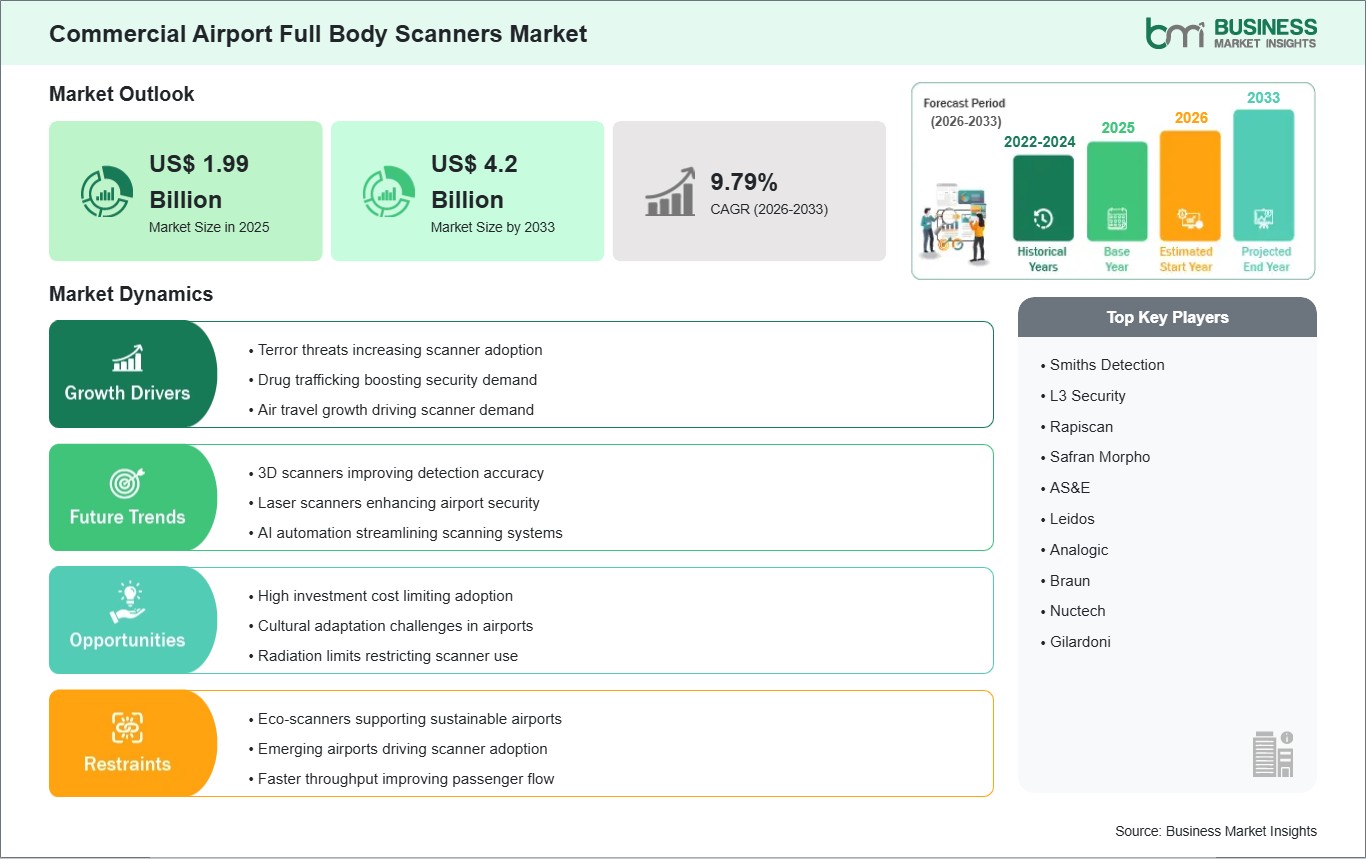
The commercial airport full body scanners market is concerned with innovative security screening technologies employed in commercial airports to detect any threat concealed from the body of the passengers and cargo. Imaging technologies and detecting algorithms are combined to enhance the airport security screening process without impacting the effectiveness of passenger movement through the security checkpoint.
The growth in the market is driven by increased efforts towards securing the aviation industry, along with improved processing rates of passengers. Modern full-body scanners facilitate the achievement of standardization in the inspection process while minimizing the manual screening process at airport security checkpoints. Growing air traffic in the world is also stimulating the use of these scanning systems.
The diversity in segmentation can be seen as a reflection of technological preferences in the airports. Millimeter wave scanners are used because of their non-invasive nature, whereas backscatter X-ray system finds its applications when the highest level of accuracy in imaging is needed. In terms of application, passenger screening prevails because of high passenger volumes in the security checkpoint process.
The advancements in the technological front involve higher imaging resolutions, faster scanning times, and integration of automated threat recognition capabilities. Artificial intelligence-driven analytics and advanced sensor fusion systems are gradually making threat detection more consistent. These improvements are helping airports move towards creating digital security environments for their passengers.
The competitive environment within the industry indicates ongoing innovations in terms of improved threat detection capabilities and increased efficiencies. Manufacturers are concentrating on developing small sizes, faster processes, and networked airport security systems. It appears that the industry is gradually moving in the direction of scalable technology solutions compatible with airports of all sizes.
Segment Analysis
Commercial Airport Full Body Scanners Market Segmentation
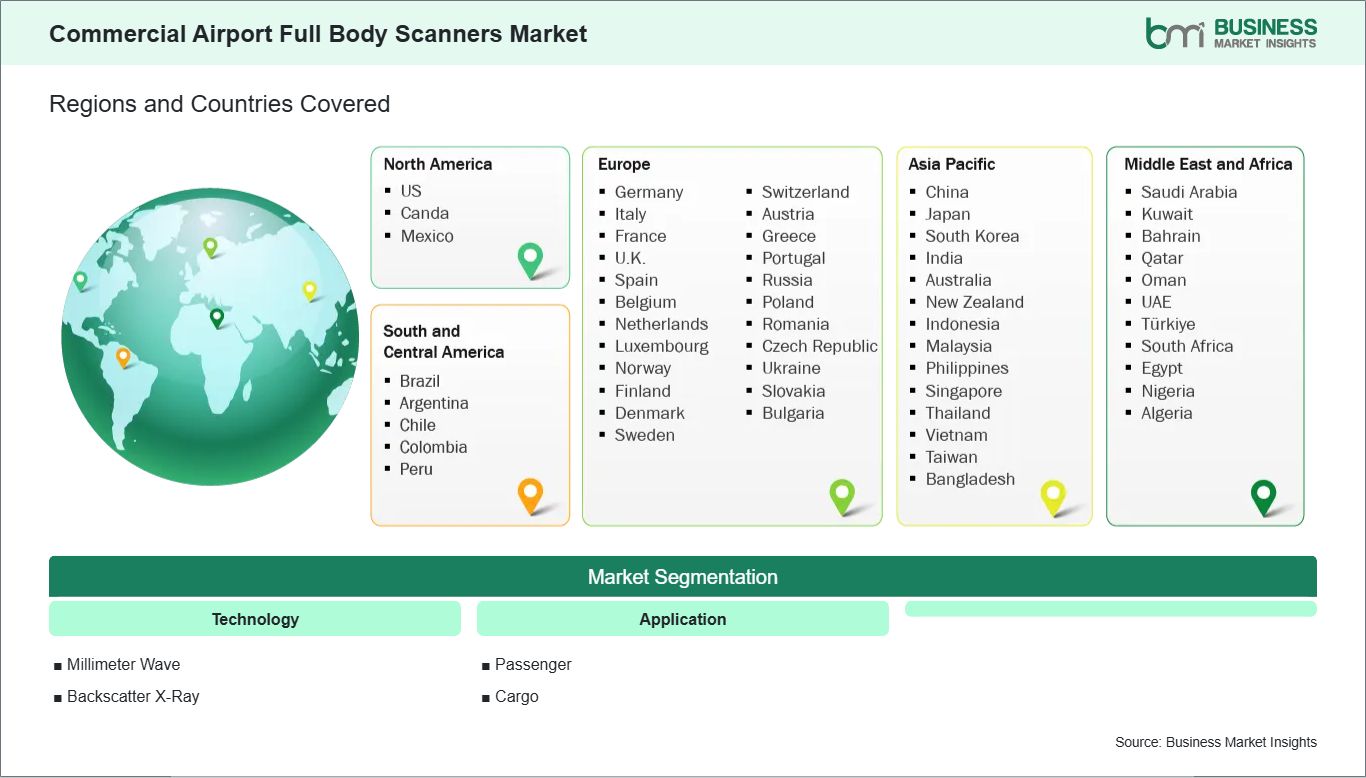
The commercial airport full body scanners market is segmented based on technology and application, reflecting the aviation security industry's transition toward advanced passenger and cargo screening systems integrated with modern airport infrastructure and safety protocols.
By Technology
- Millimeter Wave: Non-invasive imaging improves passenger screening efficiency and enhances detection accuracy.
- Backscatter X-Ray: High-resolution imaging supports detailed identification of concealed objects during security checks.
By Application
- Passenger: High-throughput screening supports efficient security clearance at airport checkpoints.
- Cargo: Advanced scanning ensures threat detection in freight and logistics handling processes.
Market Forces
Commercial Airport Full Body Scanners Market Drivers and Opportunities
Terror threats increasing scanner adoption
Increased security challenges faced by the worldwide aviation network are making it mandatory to use sophisticated screening systems in airports. The full body scanners aid in detecting any kind of danger from within without physically touching anyone, making sure that there is safety even during the heavy flow of passengers through airports. Airport security measures are making use of this system to create more effective barriers against any potential dangers while keeping the airport operations smooth.
Stricter mandates for screening in airports are being established in order to tackle emerging security threats. This has made the application of scanning technologies increasingly popular in airports both nationally and internationally. The regulatory focus on fast detection and standardized processes has made the millimeter wave scanners and X-ray scanners an integral part of airport security technology.
Eco-scanners supporting sustainable airports
Eco-friendly approaches to scanning at airports will lead to the emergence of energy-saving scanners. In fact, full-body eco-friendly scanners are currently being produced that will allow saving electricity without compromising scanning efficiency. This trend fits well within the framework of sustainable development initiatives that have recently been implemented in aviation facilities by optimizing the process of operating airports through minimizing energy consumption.
Further development of technology may result in the widespread adoption of such products in new facilities. Energy-saving scanners and components made from environmentally friendly materials are among the priorities of sustainable facility modernization. In the long run, innovation will contribute to the creation of more sustainable airport ecosystems while ensuring high security and cost savings.
Size and Share Analysis
Commercial Airport Full Body Scanners Market Size and Share Analysis
The Commercial Airport Full Body Scanners Market is projected to grow from US$ 1.99 Billion in 2025 to US$ 4.2 Billion by 2033 , registering a CAGR of 9.79% from 2026 to 2033.
By technology, millimeter wave accounts for a significant share due to its non-ionizing nature, making it safer for frequent passenger screening compared to X-ray-based systems. It offers high-resolution imaging, rapid scanning, and strong detection accuracy for concealed threats, while also addressing privacy concerns, leading to widespread adoption across global airport security infrastructures.
By application, passenger dominates because full body scanners are primarily deployed at airport security checkpoints to screen travelers efficiently and ensure aviation safety. Increasing global air passenger traffic, stringent security regulations, and the need for faster yet more accurate screening processes drive large-scale installation in passenger terminals worldwide.
Report Coverage
Commercial Airport Full Body Scanners Market Report Coverage and Deliverables
The "Commercial Airport Full Body Scanners Market Size and Forecast (2022-2033)" report provides a detailed analysis of the market covering below areas:
- The market size and forecast at global, regional, and country levels for all market segments covered under the scope
- The market trends, as well as drivers, restraints, and opportunities
- The market analysis covering key trends, global and regional framework, major players, regulations, and recent developments
- Industry landscape and competition analysis covering market concentration, heat map analysis, prominent players, and recent developments for the market
- Detailed company profiles, including SWOT analysis
Geographic Insights
Commercial Airport Full Body Scanners Market Geographic Insights
The commercial airport full body scanners market exhibits varied adoption trends, determined by the extent of modernization efforts in aviation security, airport facilities, and passenger traffic management in various airport centers around the world. Adoption rates vary according to regulation intensity, the number of airports in each region, and the capacity for investment in new screening equipment. The industry generally indicates a trend towards the adoption of standard digital security systems that operate within the airport facility.
There is an intense rate of adoption in North America, characterized by advanced airport facilities and high levels of security in terms of policies. Among other regions, the United States has taken the lead in full-body scanner installations in important international airports such as those in Atlanta, Los Angeles, and New York.
Asia Pacific is developing into a fast-growing market due to extensive growth in airport infrastructure and air passenger traffic. Asian nations like China, India, and Japan are working on building new airport facilities along with improving security systems due to increased passenger traffic at airports. The modernization of Indian airports, such as Delhi Airport and Mumbai Airport, is driving the installation of scanners, whereas China is witnessing continuous infrastructural expansion within the domestic and international aviation sectors.
Europe enjoys stable adoption rates due to stringent aviation security laws and well-coordinated policies among nations like Germany, France, and the UK. High focus on screening technologies within European nations ensures consistency in aviation security standards. Similarly, the adoption rate in emerging regions of the Middle East and Latin America is growing slowly. Nations like the UAE and Brazil are increasingly focusing on the development of airports, along with implementing passenger safety technologies.
Industry Activity
Recent Developments
The commercial airport full body scanners market is evaluated by gathering qualitative and quantitative data post primary and secondary research, which includes important corporate publications, association data, and databases. A few of the key developments in the commercial airport full body scanners market are:
- In April 2024, Smiths Detection announced that it would supply HI-SCAN 6040 CTiX computed tomography scanners and iLane A20SC automated tray return systems to Belfast International Airport, supporting UK-wide rollout of advanced 3D passenger screening technology aligned with government CT X-ray mandates for airport security modernization.
- In February 2023, Leidos announced that it had deployed its ClearScan CT passenger screening system at Frankfurt Airport, enabling advanced computed tomography-based security screening that improves threat detection and passenger throughput in airport checkpoint lanes.
Trust & Transparency
Research Methodology
The market analysis combines proprietary research with secondary data from government agencies, company disclosures, regulatory filings, industry databases and expert interviews. Market estimates are validated through data triangulation, cross-market benchmarking and analyst
review.
View Full Research Methodology
Key Sources Referred:
Transportation Security Administration (TSA) European Union Aviation Safety Agency (EASA) European Civil Aviation Conference (ECAC) International Civil Aviation Organization (ICAO) UK Department for Transport (DfT) UK Civil Aviation Authority (UK CAA) Civil Aviation Administration of China (CAAC) Transport Canada Security Screening Program U.S. Customs and Border Protection (CBP) National Institute of Standards and Technology (NIST) European Committee for Standardization (CEN) Company Websites Company Annual Reports Company Investor Presentations