
Body Armor Market Outlook: Size, Share, Trends, Growth Analysis, Competitive Landscape & Forecast, 2026-2033

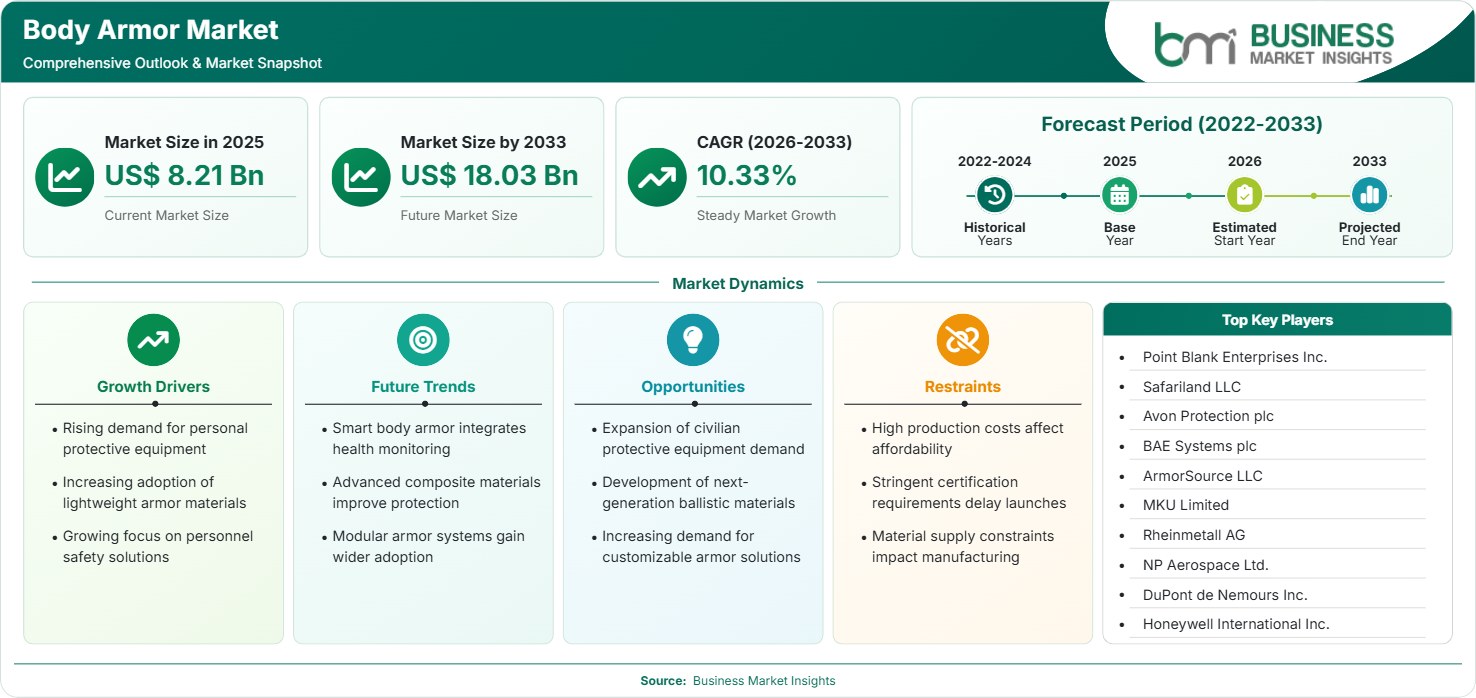
The Body Armor Market size was valued at US$ 8.21 billion in 2025 and is projected to reach US$ 18.03 billion by 2033, growing at a CAGR of 10.33% during 2026–2033. Rising demand for personal protective equipment, increasing adoption of lightweight armor materials, growing focus on personnel safety solutions, expanding defense modernization initiatives, and continuous innovation in ballistic protection technologies are creating significant growth opportunities across military and law enforcement applications.

Report Coverage
  • Application: Air Force, Army, Navy
  • Material: Soft Armor, Hard Armor, Concealed Vest, Full Body Tactical Armor, Bulletproof Military Vest, Others
US$ 8.21 Bn Market size in 2025
US$ 18.03 Bn Market Size by 2033
10.33% CAGR, 2026 - 2033
2026-2033 Forecast Period

AI Overview

Body Armor Market Summary

  • North America Region: North America holds 38%–41% body armor market share in 2025 and is expected to grow at a CAGR of 9.8%–10.2% during 2026–2033. Sustained defense spending, modernization of military equipment, expanding law enforcement procurement, and increasing adoption of advanced ballistic protection systems continue supporting regional leadership. The United States remains the largest contributor with an estimated CAGR of 9.9%–10.3%, driven by continuous investments in soldier modernization and advanced protective technologies.
  • Fastest Growing Region: Asia Pacific accounts for 24%–27% market share in 2025 and is projected to register a CAGR of 11.5%–12.0% during 2026–2033. Rising defense modernization programs, expanding domestic manufacturing capabilities, increasing border security investments, and growing procurement of advanced protective equipment continue accelerating regional demand.
  • Leading Segment: Army represents 48%–51% market share in 2025 and is forecast to expand at a CAGR of 10.2%–10.6% during 2026–2033. Ongoing military modernization, increasing procurement of advanced personal protective equipment, and rising operational safety requirements continue supporting segment leadership.
  • High Growth Segment: Hard Armor accounts for 37%–40% market share in 2025 and is anticipated to grow at a CAGR of 11.0%–11.5% during 2026–2033. Increasing demand for enhanced ballistic resistance, lightweight composite materials, multi-threat protection, and advanced ceramic technologies continues strengthening segment expansion.
  • Key Market Opportunity: Continuous innovation in ultra-lightweight ballistic composites, modular protection systems, advanced ceramic materials, and customizable armor platforms is creating substantial commercial opportunities while improving mobility, survivability, and operational efficiency.
  • Major Market Players: Point Blank Enterprises, Inc., Safariland, LLC, Avon Protection plc, BAE Systems plc, ArmorSource, LLC, MKU Limited, Rheinmetall AG, NP Aerospace Ltd., DuPont de Nemours, Inc., and Honeywell International Inc.
Strategic Insights

Body Armor Market: Strategic Insights

Body Armor Market Strategic Framework
FREE PDF
Request your free sample
Request free sample
Stakeholder View

Key Takeaways

  • The value chain continues evolving through stronger collaboration among ballistic material suppliers, fiber manufacturers, ceramic producers, armor integrators, and defense contractors, enabling improved product quality, manufacturing efficiency, and faster commercialization of advanced protective solutions.
  • Military modernization programs remain the largest source of long-term revenue opportunities as armed forces increasingly prioritize lightweight, high-performance protective equipment that improves soldier mobility without compromising ballistic protection.
  • Product innovation is increasingly focused on advanced composite materials, ultra-high molecular weight polyethylene fibers, modular armor systems, ergonomic designs, and smart wearable technologies capable of improving protection, comfort, and operational effectiveness.
  • Asia Pacific is becoming an attractive investment destination due to expanding domestic defense manufacturing, rising military expenditure, increasing border security requirements, and supportive government initiatives promoting indigenous production of advanced protective equipment.
  • Strategic acquisitions, technology partnerships, long-term defense procurement contracts, and collaborative research initiatives continue strengthening competitive positioning while enabling manufacturers to expand global distribution networks and diversify advanced body armor portfolios.
  • Sustainability initiatives are gradually influencing product development through recyclable composite materials, resource-efficient manufacturing processes, longer product service life, and environmentally responsible production technologies that support operational performance while reducing lifecycle costs.
Geographic Outlook

Body Armor Market Regional Highlights

North America Body Armor Market

North America accounted for 38%–41% of the Body Armor Market Share in 2025 and is projected to expand at a CAGR of 9.8%–10.2% during 2026–2033. The region benefits from sustained defense budgets, continuous military modernization, extensive procurement by law enforcement agencies, and strong domestic manufacturing capabilities. Increasing investments in advanced ballistic materials, modular protective systems, and next-generation soldier protection programs continue supporting regional leadership while strengthening long-term demand for high-performance personal protective equipment.

  • Defense modernization programs continue encouraging procurement of lightweight ballistic protection systems that improve soldier mobility, operational efficiency, and survivability across diverse combat environments.
  • Federal and state law enforcement agencies increasingly adopt advanced body armor solutions featuring improved ballistic resistance, ergonomic designs, and enhanced wearer comfort for extended operational use.
  • Domestic manufacturers continue investing in advanced composite materials, ceramic technologies, and high-performance fibers to improve product durability while reducing overall system weight.
  • Continuous collaboration among defense organizations, research institutions, and material science companies accelerates commercialization of innovative ballistic protection technologies.
  • Increasing replacement cycles for aging protective equipment continue supporting recurring procurement opportunities across military and public safety organizations.

US Body Armor Market

The United States represented 33%–36% of global revenue in 2025 and is forecast to register a CAGR of 9.9%–10.3% through 2026–2033. Strong government procurement, advanced defense manufacturing capabilities, continuous research in ballistic materials, and extensive investments in soldier modernization programs continue maintaining the country's leadership in protective equipment innovation.

  • The U.S. Department of Defense continues prioritizing modernization initiatives emphasizing lightweight, modular, and high-performance protective equipment for combat personnel.
  • Leading manufacturers strengthen domestic production through investments in automation, advanced material engineering, and scalable manufacturing capabilities supporting national security requirements.
  • Expanding law enforcement modernization programs continue driving procurement of advanced protective vests meeting evolving ballistic threat standards.
  • Strong collaboration between government agencies, defense contractors, and research organizations accelerates innovation in next-generation body armor technologies.

Europe Body Armor Market

Europe held 27%–30% market share during 2025 and is anticipated to grow at a CAGR of 9.5%–9.9% through 2026–2033. Rising defense spending, expanding military modernization initiatives, increasing geopolitical security concerns, and advanced material engineering capabilities continue supporting regional expansion. Germany remains the leading market with a CAGR of 9.6%–10.0%, while Poland records the fastest regional growth at 10.7%–11.1% due to increasing defense procurement.

  • Germany maintains regional leadership through strong defense manufacturing capabilities, advanced engineering expertise, and sustained investment in next-generation soldier protection systems.
  • Poland continues expanding military procurement programs while strengthening domestic defense production and modernization of armed forces.
  • European defense collaborations encourage standardized procurement of advanced protective equipment, supporting greater adoption of modern ballistic technologies.
  • Manufacturers increasingly focus on lightweight ceramic armor, advanced composite materials, and modular systems designed to improve operational flexibility.
  • Growing investments in homeland security and border protection continue creating additional commercial opportunities for advanced body armor suppliers.

Asia Pacific Body Armor Market

Asia Pacific accounted for 24%–27% of industry revenue in 2025 and is projected to record the highest CAGR of 11.5%–12.0% during 2026–2033. Increasing defense expenditure, indigenous military manufacturing initiatives, expanding security infrastructure, and rising procurement of advanced personal protective equipment continue strengthening regional demand. China leads regional revenue with a CAGR of 11.4%–11.8%, while India is projected to register the fastest growth at 12.0%–12.5%.

  • China continues expanding advanced defense manufacturing capabilities through investments in ballistic materials, high-performance fibers, and protective equipment production.
  • India benefits from defense modernization programs, indigenous manufacturing initiatives, and increasing procurement of advanced protective solutions for military personnel.
  • Japan and South Korea continue investing in advanced material science research supporting innovation in lightweight ballistic protection technologies.
  • Expanding regional border security initiatives encourage procurement of modular protective equipment designed for diverse operational environments.
  • Rising collaboration between domestic manufacturers and international defense companies strengthens technology transfer and product development capabilities.

Rest of World Body Armor Market

The Rest of World accounted for 8%–10% market share in 2025 and is expected to register a CAGR of 10.0%–10.5% during 2026–2033. South & Central America continue improving military capabilities through modernization initiatives and expanding procurement of protective equipment.

The Middle East & Africa are witnessing increasing investments in defense infrastructure, homeland security, and tactical modernization programs. Brazil leads South & Central America with a CAGR of 10.1%–10.5%, while Saudi Arabia records the highest regional growth at 10.8%–11.2% through sustained military modernization and strategic defense investments.

  • Brazil continues strengthening military modernization while expanding procurement of advanced ballistic protection systems supporting armed forces and public security organizations.
  • Saudi Arabia continues investing in advanced soldier protection equipment through large-scale defense modernization and national security initiatives.
  • Expanding homeland security requirements across the Middle East encourage wider adoption of lightweight, multi-threat ballistic protection systems.
  • International defense collaborations improve technology transfer while strengthening manufacturing capabilities across emerging defense markets.
  • Increasing procurement by law enforcement agencies supports long-term demand for advanced body armor products across developing economies.
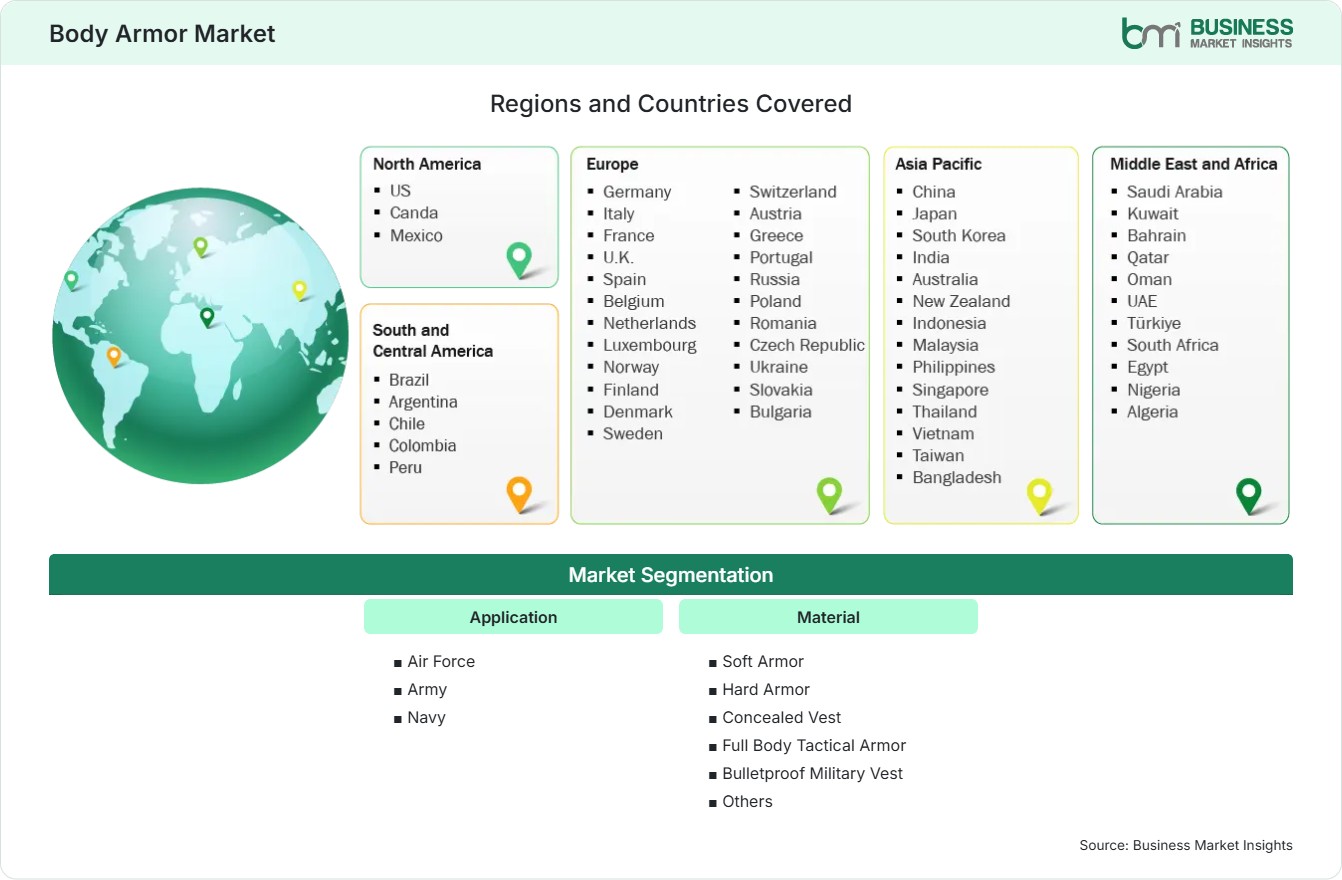
Global Market Geography
FREE PDF
Request your free sample
Request free sample
Segment Analysis

Body Armor Market Segmentation

Application

The Application segment accounted for 51%–54% of the market in 2025 and is projected to expand at a CAGR of 10.4%–10.8% during 2026–2033. Continuous defense modernization, rising procurement of advanced protective equipment, and expanding operational safety requirements continue driving segment growth. The Body Armor Market Forecasts indicate sustained investments in military protection systems as governments prioritize personnel survivability and mission effectiveness.

  • Air Force: Increasing adoption of lightweight ballistic protection supports personnel operating in high-risk environments while improving comfort, mobility, and mission readiness during tactical operations.
  • Army: Represents the largest application owing to extensive procurement of advanced protective equipment, modernization initiatives, and continuous investment in next-generation soldier protection systems.
  • Navy: Growing maritime security operations and naval modernization programs continue increasing demand for specialized body armor capable of providing protection under diverse operational conditions.

Material

The Material segment represented 46%–49% market share during 2025 and is expected to register a CAGR of 10.8%–11.2% during 2026–2033. Continuous advances in ballistic materials, lightweight composites, and ergonomic protective systems continue driving innovation. The Body Armor Market Trends increasingly emphasize enhanced mobility, modularity, and multi-threat protection through advanced material engineering.

  • Soft Armor: Widely adopted by law enforcement personnel due to lightweight construction, flexibility, enhanced comfort, and effective protection against handgun threats during routine operational duties.
  • Hard Armor: Experiences strong demand owing to superior ballistic resistance, ceramic plate integration, and capability to withstand higher-caliber projectile threats across military operations.
  • Concealed Vest: Increasingly preferred by security personnel and law enforcement officers requiring discreet protection while maintaining mobility and professional appearance during daily assignments.
  • Full Body Tactical Armor: Supports specialized military operations requiring comprehensive ballistic coverage, modular attachments, and enhanced protection against multiple operational threats.
  • Bulletproof Military Vest: Continues serving as a standard protective solution for combat personnel by combining ballistic resistance, ergonomic design, and compatibility with modern tactical equipment.
  • Others: Includes specialized ballistic protection systems designed for niche defense, security, and tactical applications requiring customized performance characteristics.
Market Forces

Body Armor Market Dynamics

Key Market Drivers

Rising demand for personal protective equipment

Increasing geopolitical tensions, military modernization initiatives, and expanding law enforcement operations continue driving demand for advanced personal protective equipment worldwide. Governments are strengthening investments in soldier survivability by procuring next-generation ballistic protection systems that improve operational effectiveness and mobility. The increasing involvement of security personnel in border protection, counterterrorism activities, and peacekeeping missions is another factor driving the Body Armor Market Growth. This is because these advancements will encourage manufacturers to increase their production capabilities and innovate new technologies in the field of body armor.

Increasing adoption of lightweight armor materials

Manufacturers are increasingly utilizing ultra-high molecular weight polyethylene fibers, aramid fibers, advanced ceramic composites, and hybrid ballistic materials to reduce armor weight without compromising protection. Lightweight body armor improves wearer comfort, endurance, and operational efficiency during prolonged missions. Advancements in materials sciences and manufacturing technologies facilitate the creation of protective systems that are more flexible and durable, as well as resistant to multiple threats. Such advancements make it possible to enhance the differentiation of products and also expand their application.

Growing focus on personnel safety solutions

Defense organizations and security agencies continue prioritizing comprehensive personnel protection strategies that integrate advanced body armor with modern tactical equipment. Procurement programs increasingly emphasize enhanced ballistic resistance, ergonomic design, modular protection, and compatibility with mission-specific equipment. The increasing concern about occupational safety among members of the military and police forces facilitates the use of modern safety equipment, which replaces obsolete equipment. The sustained effort on research and development also aids in commercializing the protection technology.

Key Market Opportunities

Expansion of civilian protective equipment demand

Growing demand from private security firms, critical infrastructure operators, journalists, emergency responders, and high-risk professionals is expanding the commercial market for advanced protective equipment. The manufacturers are creating lightweight and ergonomically designed products that will comply with civilian protection needs without compromising on ballistic effectiveness. The Body Armor Market Forecasts suggest that there is going to be continued long-term potential due to growing awareness about personal safety and workplace security.

Development of next-generation ballistic materials

Continuous advances in nanotechnology, composite engineering, advanced ceramics, graphene-based materials, and ultra-lightweight fibers are creating opportunities for manufacturers to develop more effective ballistic protection systems. Research institutions and defense agencies still work together to improve resistance to impacts, to lighten the load and increase durability of the equipment. Technology development contributes to the commercialization of advanced protective devices that will be able to satisfy future needs.

Increasing demand for customizable armor solutions

Defense agencies increasingly require modular protective equipment that can be configured according to mission requirements, operational environments, and threat levels. The manufacturers are countering through the use of scalable armor systems, replaceable ballistic plates, adjustable load-bearing devices, and mission-specific attachments. Personalized options enhance tactical agility while increasing the purchase value and long-term customer relationship.

Market Restraints and Challenges

High production costs affect affordability

Factor: Advanced ballistic protection systems rely on premium ceramic materials, aramid fibers, high-performance polyethylene, and complex manufacturing processes that significantly increase production expenses. Impact: Elevated product costs reduce affordability for budget-constrained defense organizations and commercial customers, particularly across developing economies. Manufacturers must balance continuous innovation with competitive pricing to sustain long-term market penetration while maintaining product quality and profitability.

Stringent certification requirements delay launches

Factor: Body armor products must comply with rigorous national and international ballistic protection standards before commercialization, requiring extensive laboratory testing and certification procedures. Impact: Lengthy approval timelines increase development costs, delay product launches, and slow revenue generation for manufacturers introducing innovative protective technologies. Regulatory complexity also creates barriers for smaller companies seeking entry into highly competitive defense procurement markets.

Company Analysis

Competitive Landscape

The competitive environment is characterized by continuous innovation in ballistic materials, lightweight protective systems, and modular armor technologies. Leading manufacturers are strengthening production capabilities, expanding defense partnerships, and investing in research to improve ballistic performance, ergonomics, and durability. Strategic collaborations and advanced material engineering continue supporting comprehensive Body Armor Market Analysis across military, homeland security, and law enforcement applications.

Company Name

Overview

Products and Services Relevant to this Market

Point Blank Enterprises, Inc.

Leading manufacturer of ballistic protection solutions serving military, law enforcement, corrections, and security organizations globally.

Soft armor, hard armor, tactical vests, ballistic shields, protective helmets, and body armor systems.

Safariland, LLC

Global provider of protective equipment and duty gear for military, law enforcement, and first responders.

Body armor, tactical carriers, ballistic protection systems, duty equipment, and protective accessories.

Avon Protection plc

International defense company specializing in advanced respiratory and ballistic protection solutions.

Ballistic helmets, body armor systems, protective equipment, respiratory protection, and integrated soldier systems.

BAE Systems plc

Global defense contractor providing advanced military technologies and soldier survivability solutions.

Body armor technologies, combat protection systems, defense equipment, armored solutions, and military support services.

ArmorSource, LLC

Manufacturer specializing in advanced ballistic protection equipment for military and law enforcement customers.

Ballistic helmets, armor systems, protective accessories, tactical equipment, and integrated protection solutions.

MKU Limited

Defense equipment manufacturer focused on lightweight ballistic protection and soldier modernization products.

Bulletproof jackets, ballistic helmets, hard armor plates, tactical vests, and customized protection systems.

Rheinmetall AG

International defense technology company delivering advanced protection systems and military equipment.

Personal protection systems, ballistic armor, soldier modernization equipment, tactical systems, and defense technologies.

NP Aerospace Ltd.

Defense engineering company specializing in lightweight composite armor and vehicle protection solutions.

Ballistic body armor, hard armor plates, protective equipment, composite armor systems, and defense engineering services.

DuPont de Nemours, Inc.

Global materials science company supplying advanced fibers used in high-performance ballistic protection.

Kevlar® aramid fibers, advanced protective materials, ballistic composites, and high-strength material technologies.

Honeywell International Inc.

Diversified technology company providing advanced high-performance fibers for ballistic protection applications.

Spectra® fiber technologies, ballistic materials, composite solutions, personal protective materials, and defense-grade fibers.

Trust & Transparency

Research Methodology

The market analysis combines proprietary research with secondary data from government agencies, company disclosures, regulatory filings, industry databases and expert interviews. Market estimates are validated through data triangulation, cross-market benchmarking and analyst review.

View Full Research Methodology

Questions Answered

Frequently Asked Questions

What does the Body Armor Market Report include?

The Market Report provides comprehensive insights into market size, regional analysis, competitive landscape, segmentation, technology developments, growth drivers, restraints, opportunities, recent industry developments, and future strategic outlook.

What are the major opportunities for market participants?

Opportunities include the development of next-generation ballistic materials, expansion of civilian protective equipment demand, increasing adoption of customizable armor solutions, and growing investments in lightweight modular protection technologies.

Which application segment holds the largest market share?

The Army segment accounts for the largest share owing to continuous military modernization, high procurement volumes, increasing operational deployments, and growing investments in advanced personal protection systems.

Which region dominates the Body Armor Market?

North America leads the global market due to sustained defense expenditure, advanced ballistic technology development, extensive procurement by military and law enforcement agencies, and the presence of major protective equipment manufacturers.

What is driving the Market?

The market is primarily driven by increasing defense modernization programs, rising demand for personal protective equipment, growing investments in lightweight ballistic materials, and continuous emphasis on enhancing soldier and law enforcement personnel safety.

Access the Full Body Armor Market Report

Get segment-level forecasts, regional estimates, competitive benchmarking, company profiles and downloadable Excel datasets.

Access the full Body Armor Market Report
350 pages PDF & Excel | 2026-08-05