
Thermal Management System Market Outlook: Size, Share, Trends, Growth Analysis, Competitive Landscape & Forecast, 2026-2033

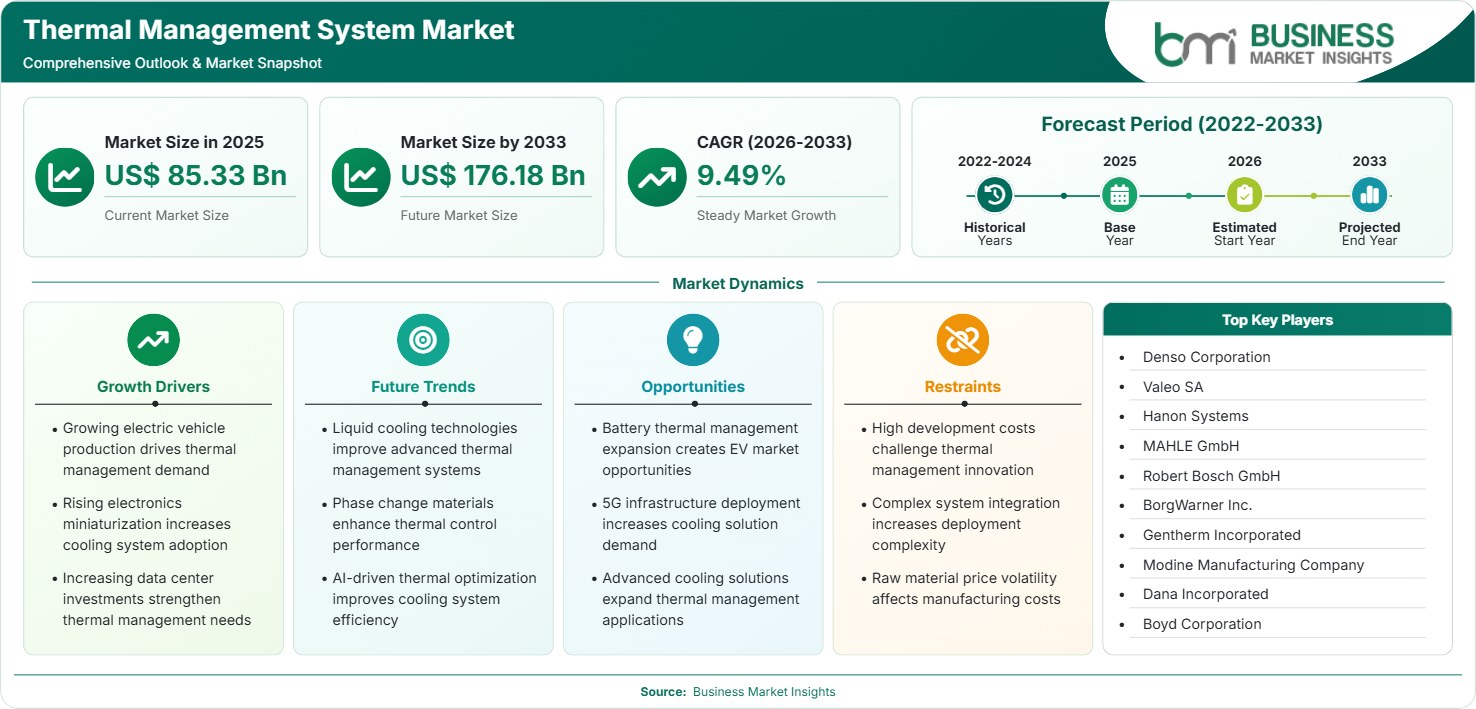
The Thermal Management System Market size was valued at US$ 85.33 billion in 2025 and is projected to reach US$ 176.18 billion by 2033, growing at a CAGR of 9.49% during 2026–2033. Rising electrification across transportation, expanding semiconductor applications, and increasing demand for energy-efficient cooling technologies are accelerating adoption. Continuous innovation in battery cooling, liquid cooling, and advanced thermal materials is creating significant long-term opportunities.

Report Coverage
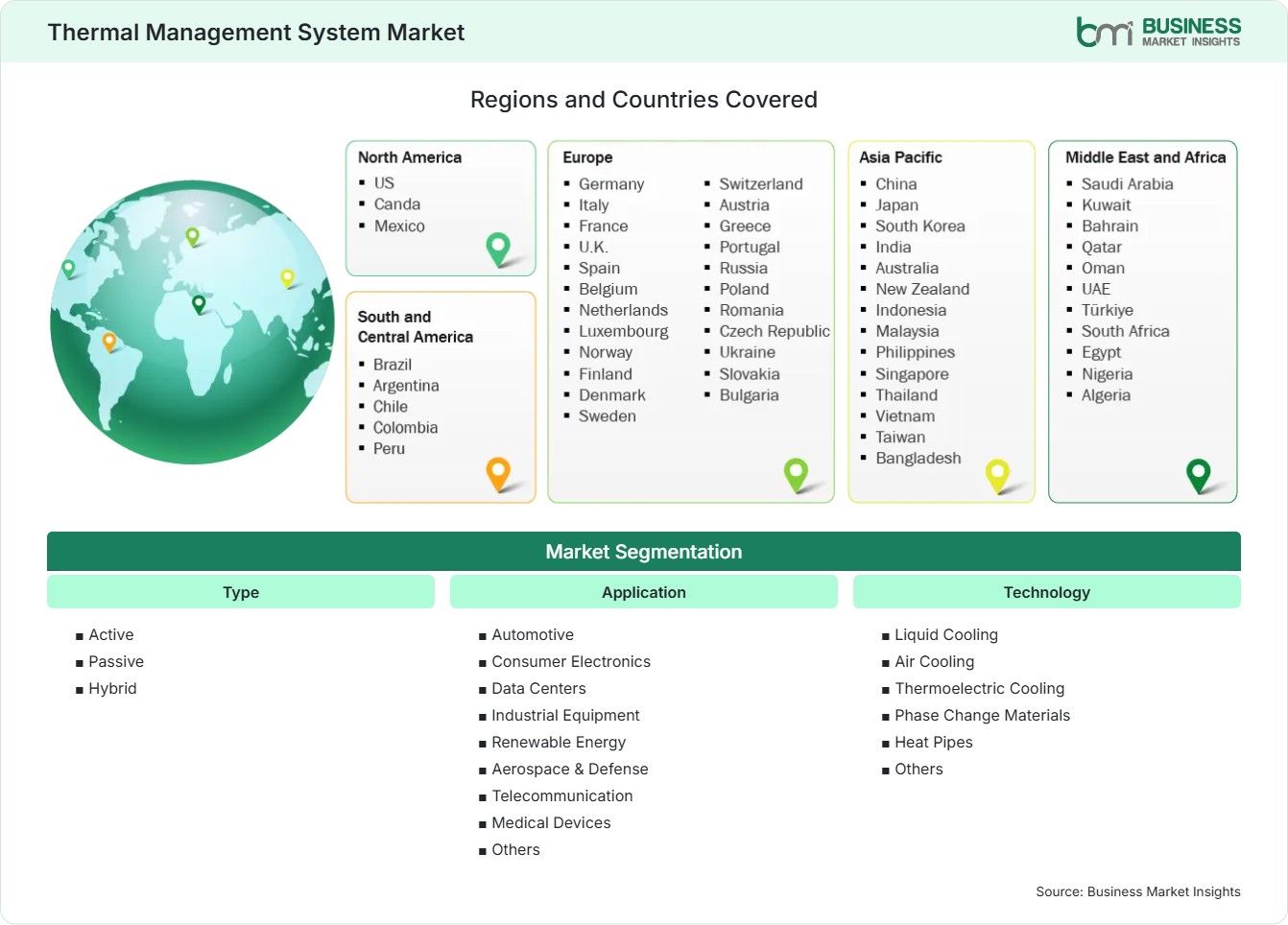
  • Type: Active, Passive, Hybrid
  • Application: Automotive, Consumer Electronics, Data Centers, Industrial Equipment, Renewable Energy, Aerospace & Defense, Telecommunication, Medical Devices, Others
  • Technology: Liquid Cooling, Air Cooling, Thermoelectric Cooling, Phase Change Materials, Heat Pipes, Others
US$ 85.33 Bn Market size in 2025
US$ 176.18 Bn Market Size by 2033
9.49% CAGR, 2026 - 2033
2026-2033 Forecast Period

AI Overview

Thermal Management System Market Summary

  • North America Region: North America accounted for 31%–34% of global revenue in 2025 and is projected to grow at a CAGR of 9.0%–9.5% during 2026–2033. Strong electric vehicle production, rapid hyperscale data center expansion, and increasing semiconductor investments continue supporting regional demand. The United States contributes approximately 82%–85% of regional revenue and is expected to register a CAGR of 9.1%–9.6% through expanding AI infrastructure and battery manufacturing.
  • Fastest Growing Region: Asia Pacific represented 38%–41% of global revenue in 2025 and is projected to expand at the highest CAGR of 10.3%–10.8% owing to large-scale electric vehicle manufacturing, electronics production, renewable energy deployment, and industrial automation.
  • Leading Segment: Automotive accounted for 34%–37% of market revenue in 2025 and is forecast to grow at a CAGR of 9.8%–10.3% supported by increasing adoption of electric vehicles, battery systems, and advanced vehicle electronics.
  • High Growth Segment: Liquid Cooling represented 27%–30% of global revenue in 2025 and is anticipated to register a CAGR of 10.8%–11.3% owing to growing deployment in electric vehicles, AI servers, high-performance computing, and hyperscale data centers.
  • Key Market Opportunity: Expanding electrification, AI computing infrastructure, advanced battery technologies, and high-performance electronic systems continue creating attractive opportunities for next-generation thermal solutions.
  • Major Market Players: Denso Corporation, Valeo SA, Hanon Systems, MAHLE GmbH, Robert Bosch GmbH, BorgWarner Inc., Gentherm Incorporated, Modine Manufacturing Company, Dana Incorporated, Boyd Corporation
Strategic Insights

Thermal Management System Market: Strategic Insights

Thermal Management System Market Strategic Framework
FREE PDF
Request your free sample
Request free sample
Stakeholder View

Key Takeaways

  • The industry is increasingly integrating advanced cooling technologies with intelligent monitoring systems to improve efficiency, operational reliability, and product lifecycle performance.
  • The strongest Thermal Management System Market Growth opportunities continue emerging from electric vehicles, AI data centers, battery systems, and renewable energy infrastructure.
  • Manufacturers are prioritizing liquid cooling technologies, lightweight materials, and advanced thermal interface solutions to meet increasing power density requirements.
  • Asia Pacific remains the most attractive investment destination due to its leadership in electronics manufacturing, battery production, and electric vehicle assembly.
  • Strategic partnerships between automotive manufacturers, semiconductor companies, and thermal solution providers continue accelerating product innovation and commercialization.
  • Companies investing in sustainable cooling technologies and integrated thermal platforms are expected to strengthen long-term competitive positioning.
Geographic Outlook

Thermal Management System Market Regional Highlights

North America Thermal Management System Market

North America represented 31%–34% of global revenue in 2025 and is projected to expand at a CAGR of 9.0%–9.5% during the forecast period. Strong investments in electric mobility, semiconductor fabrication, cloud computing infrastructure, and aerospace manufacturing continue supporting regional leadership. The Thermal Management System Market Share remains substantial due to increasing deployment of advanced cooling systems across automotive, industrial, and digital infrastructure applications.

  • The United States dominates regional demand through electric vehicle production, AI data centers, semiconductor manufacturing, and advanced industrial automation.
  • Canada continues strengthening market demand through clean energy investments, battery manufacturing projects, and expanding technology infrastructure.
  • Hyperscale cloud providers continue increasing investment in energy-efficient cooling systems for next-generation computing facilities.
  • Government incentives supporting electric mobility and domestic semiconductor manufacturing continue strengthening long-term market demand.

US Thermal Management System Market

The United States accounted for approximately 82%–85% of North American revenue in 2025 and is expected to register a CAGR of 9.1%–9.6% during 2026–2033. Increasing electric vehicle production, AI infrastructure expansion, battery manufacturing investments, and advanced electronics development continue driving sustained adoption of sophisticated thermal management technologies.

  • Growing AI server deployments continue accelerating demand for precision liquid cooling technologies across hyperscale facilities.
  • Battery manufacturing investments strengthen demand for advanced thermal systems supporting electric mobility and energy storage applications.
  • Aerospace and defense industries continue adopting lightweight thermal technologies to improve equipment performance and operational reliability.

Europe Thermal Management System Market

Europe accounted for 24%–27% of global revenue in 2025 and is projected to expand at a CAGR of 9.1%–9.6% during 2026–2033. Strong automotive electrification, industrial automation, renewable energy deployment, and strict energy efficiency regulations continue supporting regional demand. Germany remains the largest regional market, while the United Kingdom is expected to register the fastest growth with a CAGR of 9.8%–10.3% due to increasing investments in electric mobility and advanced electronics manufacturing.

  • Germany maintains regional leadership through automotive manufacturing, industrial equipment production, and strong investments in battery technologies.
  • The United Kingdom continues expanding demand through electric vehicle adoption, semiconductor innovation, and digital infrastructure investments.
  • France strengthens market growth through renewable energy projects and increasing deployment of advanced industrial cooling systems.
  • European manufacturers increasingly invest in sustainable thermal technologies that improve energy efficiency and reduce carbon emissions.
  • Expansion of battery gigafactories continues generating long-term demand for advanced thermal management solutions.

Asia Pacific Thermal Management System Market

Asia Pacific represented 38%–41% of global revenue in 2025 and is forecast to register the highest CAGR of 10.3%–10.8% during the forecast period. Large-scale electronics manufacturing, expanding electric vehicle production, semiconductor investments, and industrial modernization continue supporting regional leadership. China remains the largest regional market, while India is projected to record the fastest growth with a CAGR of 10.7%–11.2% owing to expanding manufacturing capacity and government-supported industrial initiatives.

  • China leads regional demand through integrated electronics production, electric vehicle manufacturing, and battery supply chain development.
  • India continues expanding adoption through domestic manufacturing initiatives, renewable energy investments, and rapid industrial automation.
  • Japan strengthens demand through advanced automotive technologies, robotics, and high-performance electronic manufacturing.
  • South Korea continues investing in semiconductor fabrication and advanced battery technologies requiring sophisticated thermal solutions.
  • Regional manufacturers increasingly commercialize liquid cooling and high-efficiency heat dissipation technologies for multiple industries.

Rest of World Thermal Management System Market

The Rest of World accounted for 8%–10% of global revenue in 2025 and is projected to expand at a CAGR of 9.2%–9.7% during the forecast period. South & Central America together with the Middle East & Africa continue benefiting from industrial development, renewable energy deployment, telecommunications expansion, and increasing investments in digital infrastructure.

Growing electrification, industrial modernization, and data center development continue creating favorable long-term opportunities across emerging economies.

  • Brazil remains the leading South & Central American market through industrial manufacturing, automotive production, and renewable energy investments.
  • Saudi Arabia continues expanding advanced cooling requirements through smart infrastructure and industrial diversification initiatives.
  • The United Arab Emirates strengthens market demand through hyperscale data center development and digital transformation investments.
  • South Africa supports gradual adoption through mining automation, industrial modernization, and expanding telecommunications infrastructure.
  • International technology providers continue strengthening regional partnerships to expand advanced cooling solution availability.
Global Market Geography
FREE PDF
Request your free sample
Request free sample
Segment Analysis

Thermal Management System Market Segmentation

Type

The Type segment accounted for 45%–48% of market revenue in 2025 and is projected to register a CAGR of 9.6%–10.1% during the forecast period. Increasing demand for efficient heat dissipation, battery protection, and electronic reliability continues supporting technology adoption across multiple industries. The Thermal Management System Market Scope continues expanding as manufacturers integrate intelligent thermal control with energy-efficient cooling architectures.

  • Active: Active systems dominate advanced applications through pumps, fans, sensors, and electronically controlled cooling mechanisms that improve thermal efficiency.
  • Passive: Passive systems remain widely utilized in compact electronics, industrial equipment, and consumer devices requiring reliable heat dissipation without external power.
  • Hybrid: Hybrid technologies combine active and passive cooling approaches to optimize thermal performance across high-power and mission-critical applications.

Application

The Application segment represented 34%–37% of total revenue in 2025 and is forecast to expand at a CAGR of 9.8%–10.3% through increasing electrification, digitalization, and industrial automation. The Thermal Management System Market Trends indicate continued diversification across transportation, computing, healthcare, and energy applications.

  • Automotive: Electric vehicles, battery packs, power electronics, and autonomous driving technologies continue driving sustained thermal solution demand.
  • Consumer Electronics: Smartphones, laptops, gaming devices, wearables, and high-performance processors require increasingly efficient cooling technologies.
  • Data Centers: AI computing, cloud services, and hyperscale facilities continue accelerating adoption of advanced thermal management solutions.
  • Industrial Equipment: Automation systems, robotics, heavy machinery, and manufacturing equipment require efficient thermal regulation for operational reliability.
  • Renewable Energy: Solar inverters, battery storage systems, and wind power electronics increasingly utilize advanced cooling technologies.
  • Aerospace & Defense: High-performance avionics, radar systems, defense electronics, and aerospace platforms require reliable thermal protection.
  • Telecommunication: Expansion of 5G infrastructure and edge computing continues increasing thermal management requirements.
  • Medical Devices: Diagnostic equipment, imaging systems, and portable healthcare electronics require precision thermal regulation for consistent performance.

Technology

The Technology segment accounted for 41%–44% of global revenue in 2025 and is projected to register a CAGR of 10.0%–10.5% throughout the assessment period owing to continuous innovation in advanced cooling technologies.

  • Liquid Cooling: Liquid cooling delivers superior thermal efficiency for electric vehicles, AI servers, and high-density computing infrastructure.
  • Air Cooling: Air cooling remains widely adopted because of cost-effectiveness, operational simplicity, and broad industrial applicability.
  • Thermoelectric Cooling: Thermoelectric systems provide precise temperature regulation for electronics, healthcare equipment, and specialty industrial applications.
  • Phase Change Materials: Phase change materials improve thermal energy storage and stabilize operating temperatures across advanced electronic systems.
  • Heat Pipes: Heat pipe technologies enable highly efficient passive heat transfer in compact electronic devices and industrial equipment.
Market Forces

Thermal Management System Market Dynamics

Key Market Drivers

Growing electric vehicle production drives thermal management demand

Manufacturing of electric cars has been on the rise due to government initiatives towards reducing emissions as well as an increasing battery-electric vehicle range by the car makers. Thermal management is crucial in keeping the batteries in good condition, ensuring efficiency in battery performance, and ensuring safe operation of the vehicle. Increase in use of electric buses, commercial and passenger vehicles is also another factor that increases demand for thermal management technology.

Rising electronics miniaturization increases cooling system adoption

The constant reduction of size in electronic products has greatly increased the power density of these products. This means that effective cooling is necessary to ensure their optimal performance and reliability. The latest generation of processors, power modules, wearables, automation machines, and communication gadgets needs an effective method of cooling in order to get rid of excess heat without adding to the size of the product.

Increasing data center investments strengthen thermal management needs

Growth in the use of cloud computing services, artificial intelligence applications, and high-performance computing systems continues to fuel the need for investment in both hyperscale and enterprise data centers around the globe. These data centers have to adopt thermal management systems that will help dissipate the ever-increasing processor heat while reducing energy usage.

Key Market Opportunities

Battery thermal management expansion creates EV market opportunities

Increased investments in electric mobility led to increased demands for complex battery thermal management systems that will not only help improve the performance but also increase the battery life and enable ultra-fast charging capacity. In order to improve the efficiency of the battery as well as ensure safety for the vehicles, automobile companies are making investments in efficient cooling systems.

5G infrastructure deployment increases cooling solution demand

Deployment of 5G communication networks will necessitate efficient thermal management systems that can support the functionality of base stations, edge computing systems, network devices, and communications electronics in harsh environments. The continued growth in network densification and bandwidth will keep presenting opportunities in this domain.

Advanced cooling solutions expand thermal management applications

Advancement in technology is continually widening the applications of thermal management within aerospace, industrial automation, health care, renewable energy, defense, and computing industries. Companies are developing lightweight materials, intelligent sensors, phase change materials, and liquid coolants to be able to provide thermal solutions to meet more sophisticated thermal management needs while saving energy.

Market Restraints and Challenges

High development costs challenge thermal management innovation

Factor: Designing advanced thermal solutions requires substantial investment in research, engineering, simulation software, specialized materials, and product validation across multiple operating environments.

Impact: High development costs can delay commercialization, increase product pricing, and limit adoption among cost-sensitive customers. Smaller manufacturers may face additional barriers when competing with established suppliers possessing larger research and development capabilities.

Complex system integration increases deployment complexity

Factor: Modern thermal management systems must integrate seamlessly with batteries, electronic controls, communication networks, industrial equipment, and mechanical systems while meeting strict performance and safety standards.

Impact: Integration complexity increases engineering effort, extends product development timelines, and raises implementation costs. Manufacturers increasingly collaborate with original equipment manufacturers to deliver customized thermal solutions that improve compatibility and long-term operational performance.

Company Analysis

Competitive Landscape

Competition is driven by technological innovation, integrated engineering capabilities, automotive electrification, and expansion into advanced electronics and industrial applications. The Thermal Management System Market Analysis indicates that leading manufacturers continue investing in liquid cooling technologies, battery thermal management platforms, lightweight materials, and intelligent thermal control systems to strengthen their global market position.

Company Name

Overview

Products and Services relevant to this market

Denso Corporation

Global automotive technology supplier specializing in advanced mobility and thermal solutions.

Automotive HVAC systems, battery cooling technologies, thermal modules, compressors, and integrated vehicle thermal systems.

Valeo SA

International automotive supplier focused on electrification and energy-efficient technologies.

Thermal management modules, HVAC systems, battery cooling solutions, compressors, and electronic cooling technologies.

Hanon Systems

Global supplier of automotive thermal and energy management technologies.

Vehicle thermal management systems, compressors, HVAC modules, battery cooling, and heat pump solutions.

MAHLE GmbH

Engineering company delivering thermal technologies for automotive and industrial sectors.

Thermal management modules, cooling systems, heat exchangers, battery cooling, and engine thermal solutions.

Robert Bosch GmbH

Global engineering company serving automotive, industrial, and mobility industries.

Electric cooling systems, thermal controllers, automotive electronics, sensors, and integrated mobility technologies.

BorgWarner Inc.

Mobility technology company supporting vehicle electrification worldwide.

Battery thermal management systems, cooling technologies, electric propulsion components, and powertrain solutions.

Gentherm Incorporated

Developer of advanced thermal technologies for automotive and medical applications.

Thermal comfort systems, battery thermal management, electronic cooling, and temperature control technologies.

Modine Manufacturing Company

Manufacturer specializing in thermal management technologies across industrial sectors.

Heat exchangers, liquid cooling systems, HVAC technologies, data center cooling, and industrial thermal solutions.

Dana Incorporated

Global supplier of drivetrain and thermal technologies for mobility applications.

Thermal management systems, battery cooling solutions, sealing technologies, and drivetrain components.

Boyd Corporation

Engineering company providing advanced thermal technologies for electronics and mobility.

Liquid cooling systems, thermal interface materials, engineered cooling components, and precision thermal solutions.


Trust & Transparency

Research Methodology

The market analysis combines proprietary research with secondary data from government agencies, company disclosures, regulatory filings, industry databases and expert interviews. Market estimates are validated through data triangulation, cross-market benchmarking and analyst review.

View Full Research Methodology

Questions Answered

Frequently Asked Questions

How do market forecasts support strategic planning?

Thermal Management System Market Forecasts help manufacturers, investors, and technology providers evaluate future demand, optimize product development, identify emerging investment opportunities, strengthen supply chains, and support long-term business expansion strategies.

What does the market report include?

The Thermal Management System Market Report provides detailed insights covering market size, competitive landscape, regional outlook, segmentation, technological developments, investment trends, growth opportunities, and future industry prospects.

Why is liquid cooling gaining rapid adoption?

Liquid cooling provides higher heat transfer efficiency than conventional air cooling, making it highly suitable for electric vehicle batteries, AI servers, hyperscale data centers, high-performance computing systems, and advanced industrial equipment.

Which region is expected to witness the highest growth?

Asia Pacific is projected to record the fastest growth during the forecast period due to expanding electric vehicle manufacturing, semiconductor production, electronics manufacturing, renewable energy deployment, and industrial automation investments.

Which application dominates the Thermal Management System Market?

Automotive remains the leading application owing to rising electric vehicle production, increasing electronic content in vehicles, battery cooling requirements, and continuous adoption of advanced thermal management technologies.

Access the Full Thermal Management System Market Report

Get segment-level forecasts, regional estimates, competitive benchmarking, company profiles and downloadable Excel datasets.

Access the full Thermal Management System Market Report
350 pages PDF & Excel | 2026-08-06
Similar Research

Related Market Reports