
Thermal Imaging Market Outlook: Size, Share, Trends, Growth Analysis, Competitive Landscape & Forecast, 2026-2033

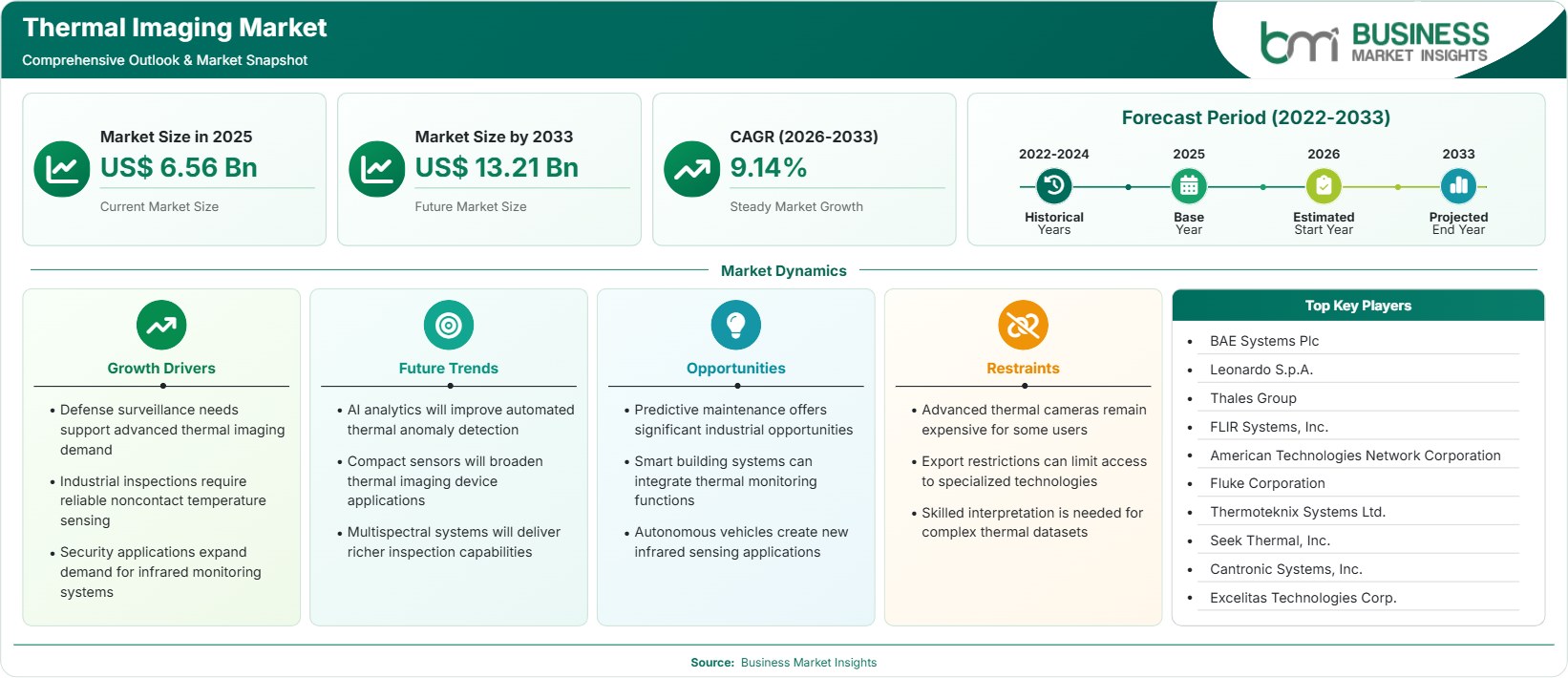
The Thermal Imaging Market size was valued at USD 6.56 Billion in 2025 and is projected to reach USD 13.21 Billion by 2033, growing at a CAGR of 9.14% during 2026–2033. Increasing defense modernization programs, wider adoption of predictive maintenance solutions, expansion of intelligent surveillance systems, and rising healthcare screening applications are creating substantial growth opportunities across developed and emerging economies.

Report Coverage
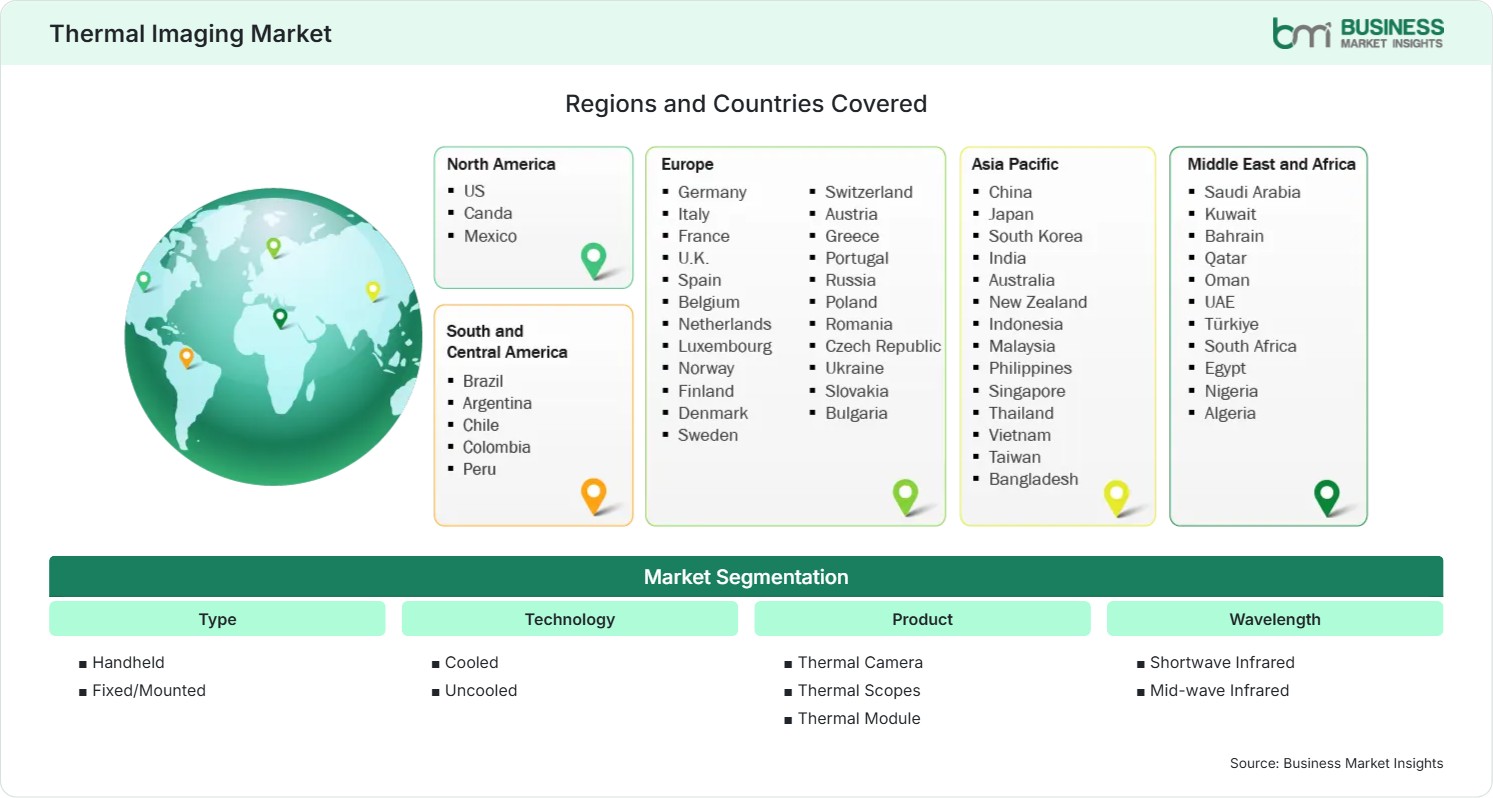
  • Type: Handheld, Fixed/Mounted
  • Technology: Cooled, Uncooled
  • Product: Thermal Camera, Thermal Scopes, Thermal Module
  • Wavelength: Shortwave Infrared, Mid-wave Infrared
  • Application: Border Surveillance and Vehicle Targeting, C-UAS
US$ 6.56 Bn Market size in 2025
US$ 13.21 Bn Market Size by 2033
9.14% CAGR, 2026 - 2033
2026-2033 Forecast Period

01 AI Overview

Thermal Imaging Market Summary

  • North America Region: North America holds a market share of 36%–39% in 2025, growing at a CAGR of 8.2%–8.8% during 2026–2033. Strong defense spending, industrial automation investments, infrastructure monitoring initiatives, and expanding public safety deployments support adoption. Opportunities emerge from smart factories, border security modernization, critical infrastructure monitoring, and advanced aerospace applications globally.
  • Brief U.S. analysis: The U.S. dominates regional demand through defense procurement programs, aerospace innovation, and industrial inspection adoption, advancing at a CAGR of 8.4%–8.9%.
  • Fastest Growing Region: Asia Pacific accounts for 24%–27% Thermal Imaging Market share in 2025 and is projected to expand at a CAGR of 10.5%–11.3% during 2026–2033. Industrialization, manufacturing modernization, smart city deployment, defense procurement growth, and automotive technology investments create substantial opportunities across regional economies and technology ecosystems.
  • Leading Segment: Uncooled Technology represents 61%–64% share in 2025 and is expected to grow at a CAGR of 8.8%–9.5%. Cost efficiency, compact design, reduced maintenance requirements, improved detector capabilities, and deployment flexibility support widespread adoption across industrial, security, healthcare, and commercial applications globally.
  • High Growth Segment: Healthcare Vertical accounts for 10%–13% share in 2025 and is forecast to register a CAGR of 10.8%–11.6%. Rising fever screening applications, non-invasive diagnostics, telehealth integration, hospital monitoring needs, and increasing investments in healthcare technologies strengthen market expansion opportunities worldwide.
  • Key Market Opportunity: Integration of thermal sensors with artificial intelligence, autonomous monitoring platforms, industrial analytics systems, and edge computing architectures enables predictive insights, operational efficiency improvements, and scalable deployment opportunities across multiple industries.
  • Major Market Players: BAE Systems plc, Leonardo S.p.A., Thales S.A., Teledyne FLIR LLC, American Technologies Network Corporation, Fluke Corporation, Thermoteknix Systems Ltd., Seek Thermal, Inc., Cantronic Systems Inc., Excelitas Technologies Corp.
02 Strategic Insights

Thermal Imaging Market: Strategic Insights

Thermal Imaging Market Strategic Framework
FREE PDF
Request your free sample
Request free sample
03 Stakeholder View

Key Takeaways

  • Value chain for the industry is moving from individual imaging technologies to hardware/software combination that incorporates infrared technology, analytics, connectivity and decision making support systems.
  • Healthcare screening, industrial predictive maintenance, and intelligent border monitoring applications offer some of the strongest long-term revenue opportunities across end-use sectors.
  • Innovation is shifting toward lightweight uncooled detectors, AI-powered analytics, edge processing capabilities, and multisensor fusion platforms that improve operational efficiency.
  • Asia Pacific is one of the most attractive investment regions owing to growing manufacturing capacity, rising defense spending, and accelerated development of smart infrastructure.
  • Strategic acquisitions continue to focus on detector technologies, software analytics capabilities, and specialized infrared component providers to strengthen product portfolios.
  • Competitive advantage is becoming ever more dependent on the ability to incorporate cybersecurity measures, interoperability, and advanced analytical capabilities.
04 Geographic Outlook

Thermal Imaging Market Regional Highlights

North America Thermal Imaging Market

North America represents the largest regional market with a Thermal Imaging Market share of 36%–39% in 2025 and a projected CAGR of 8.2%–8.8% during 2026–2033. Modernization of defense systems, adherence to safety requirements in industry, and spending on monitoring infrastructure ensure constant demand. The region is advantaged by having well-established technology vendors, efficient manufacturing facilities, and wide use of thermal technologies in various fields of activity.

  • Modern defense surveillance technologies are still contributing to the growing demands for state-of-the-art infrared detectors in military, border security, and critical infrastructure protection scenarios.
  • Thermal systems are being incorporated by aerospace suppliers into navigational, surveillance, and situational awareness technologies to increase the effectiveness of their operation.
  • Industrial users deploy advanced monitoring systems to reduce downtime, improve preventive maintenance efficiency, and strengthen asset management capabilities.
  • Public safety agencies adopt thermal monitoring platforms for emergency response, search and rescue operations, and law enforcement situational awareness initiatives.

US Thermal Imaging Market

The United States accounts for approximately 78%–82% of regional revenue within North America and is expected to expand at a CAGR of 8.4%–8.9% through 2033. Defense procurement, infrastructure security programs, and industrial digitalization initiatives continue supporting adoption. Growing investments in AI-enabled imaging and autonomous monitoring systems are expanding commercial opportunities across multiple sectors.

  • Federal defense programs remain major procurement drivers, encouraging deployment of sophisticated infrared imaging solutions across land, air, and maritime operations.
  • Utility operators increasingly deploy thermal inspection systems to improve reliability, identify equipment failures, and support grid modernization initiatives.
  • Smart manufacturing investments are expanding deployment across production facilities seeking improved operational visibility and maintenance efficiency.
  • Healthcare institutions continue evaluating non-contact temperature assessment and monitoring technologies within broader digital health frameworks.

Europe Thermal Imaging Market

Europe maintains a share of 27%–30% in 2025 and is expected to register a CAGR of 8.7%–9.3% during 2026–2033. Strong industrial automation activity, defense investments, and energy-efficiency initiatives support regional expansion. Germany leads regional adoption, while Eastern European countries represent high-growth destinations due to security modernization programs and industrial infrastructure upgrades.

  • Germany remains the leading national market, supported by manufacturing excellence and advanced industrial inspection requirements.
  • Poland and neighboring Eastern European markets demonstrate faster adoption as defense and surveillance investments accelerate.
  • Energy efficiency regulations continue encouraging deployment for infrastructure inspection and thermal performance assessment applications.
  • Automotive innovation programs increasingly use infrared technologies to enhance safety systems and autonomous mobility capabilities.

Asia Pacific Thermal Imaging Market

Asia Pacific holds 24%–27% share in 2025 and records the fastest Thermal Imaging Market growth, advancing at 10.5%–11.3% CAGR during 2026–2033. Manufacturing expansion, defense modernization, and smart city investments drive regional demand. China leads total revenue generation, while India records the highest growth rates due to infrastructure development and increasing technology adoption.

  • China continues leading regional deployment through industrial production, security infrastructure expansion, and electronics manufacturing capabilities.
  • India demonstrates strong growth as defense procurement and industrial modernization programs expand technology utilization.
  • Smart city projects encourage wider deployment of monitoring systems across transportation and public infrastructure networks.
  • Semiconductor and electronics manufacturing growth promotes integration within quality inspection and process monitoring environments.
  • Healthcare infrastructure investment creates new opportunities for diagnostic and monitoring applications across urban centers.

Rest of World Thermal Imaging Market

Rest of World accounts for 8%–11% Thermal Imaging Market share in 2025 and is forecast to grow at 9.0%–9.8% CAGR during 2026–2033. The Middle East benefits from security investments and energy-sector demand, while South and Central America increasingly adopt infrared technologies for industrial maintenance and public safety applications. Regional opportunities continue expanding alongside infrastructure modernization initiatives.

  • Saudi Arabia leads Middle Eastern adoption through infrastructure security and industrial development investments.
  • United Arab Emirates records notable growth supported by smart city and airport security initiatives.
  • Brazil remains the largest South American market due to industrial monitoring and public safety requirements.
  • Mining operations increasingly deploy infrared technologies for asset management and operational risk reduction.
  • Energy sector investments create opportunities across pipeline monitoring, facility inspection, and infrastructure reliability applications.
Global Market Geography
FREE PDF
Request your free sample
Request free sample
05 Segment Analysis

Thermal Imaging Market Segmentation

Type

The type segment is led by handheld solutions, accounting for approximately 56%–59% market share in 2025 and expanding at 8.8%–9.4% CAGR. Adoption is supported by portability, operational flexibility, and broad usage across inspection, maintenance, security, and medical applications. The Thermal Imaging Market scope continues expanding as end users prioritize mobility and rapid field deployment.

  • Handheld: Portable systems are widely used across inspections, public safety, healthcare screening, and maintenance activities due to flexibility, ease of deployment, and operational convenience.
  • Fixed/Mounted: Permanent installations support infrastructure monitoring, industrial process control, perimeter surveillance, and continuous asset protection across critical operational environments.

Technology

Uncooled technology dominates with 61%–64% share in 2025 and is expected to grow at 8.8%–9.5% CAGR. Lower ownership costs, compact construction, and simplified maintenance requirements enhance utilization across commercial and industrial applications. Continued detector improvements strengthen adoption across a broad range of end-use environments.

  • Cooled: High-performance detectors deliver superior sensitivity and range, supporting demanding aerospace, defense, scientific, and long-distance surveillance applications requiring exceptional image quality.
  • Uncooled: Cost-effective solutions support widespread deployment across industrial inspections, security monitoring, healthcare screening, and commercial imaging requirements.

Product

Thermal cameras remain the largest product category with 52%–55% share in 2025 and projected growth of 9.0%–9.6% CAGR. Their versatility across numerous applications, combined with ongoing feature enhancements, supports sustained demand. Increasing connectivity and analytics integration further improve adoption prospects.

  • Thermal Camera: Broad utilization across maintenance, security, safety monitoring, and diagnostics supports consistent demand across industries and public sector organizations.
  • Thermal Scopes: Frequently used within defense, law enforcement, wildlife observation, and specialized monitoring activities requiring enhanced visibility capabilities.
  • Thermal Module: Compact components enable integration within drones, industrial systems, autonomous platforms, and custom imaging solutions.

Wavelength

MWIR solutions account for 54%–57% Thermal Imaging Market share in 2025 and register 9.1%–9.7% CAGR owing to performance advantages in surveillance and defense environments. Continued application expansion improves long-term demand prospects across mission-critical industries.

  • Shortwave Infrared (SWIR): Applications include semiconductor inspection, machine vision, scientific imaging, and quality control activities requiring enhanced material visibility.
  • Mid-wave Infrared (MWIR): Widely utilized within defense, aerospace, surveillance, and long-range monitoring environments due to strong detection capabilities.

Application

Border surveillance and vehicle targeting remain the dominant application category with 58%–61% share in 2025 and anticipated 8.9%–9.5% CAGR. Security priorities, geopolitical developments, and defense modernization efforts contribute significantly to deployment growth.

  • Border Surveillance and Vehicle Targeting: Governments increasingly adopt advanced monitoring systems to strengthen situational awareness and operational effectiveness across security environments.
  • C-UAS: Counter-unmanned aerial system deployments leverage infrared sensing to improve drone detection, tracking, and response capabilities.

Vertical

Aerospace and Defense leads with 38%–41% share in 2025 and a CAGR of 8.6%–9.2%. Persistent investment in surveillance, targeting, navigation, and reconnaissance technologies supports demand. Healthcare records the highest growth profile among industry verticals.

  • Aerospace and Defense: Continuous procurement activity and modernization programs sustain leadership across high-performance thermal applications.
  • Law Enforcement: Agencies deploy thermal systems for surveillance, search operations, crowd management, and public safety initiatives.
  • Healthcare: The Thermal Imaging Market trends indicate rising adoption for non-contact screening, diagnostics support, and patient monitoring activities.
  • Automotive: Advanced driver assistance systems and autonomous mobility platforms increasingly incorporate infrared sensing capabilities.
06 Market Forces

Thermal Imaging Market Dynamics

Key Market Drivers

Defense surveillance needs support advanced thermal imaging demand

Rising geopolitical tensions and expanding defense modernization programs are increasing investments in infrared surveillance technologies. Military organizations need better night vision, target recognition, perimeter security, and situation awareness solutions. Agencies responsible for border security have been adopting sensing technologies to enhance threat detection in difficult conditions. The purchasing trends are now emphasizing the use of imaging systems that integrate thermal sensing along with analytics and autonomous surveillance capabilities. This trend keeps increasing the demand for land, air, and naval defense systems. Increased integration in unmanned systems is another factor that improves operational flexibility.

Industrial inspections require reliable noncontact temperature sensing

Industrial operators increasingly adopt thermal technologies to enhance equipment reliability, minimize unplanned downtime, and improve maintenance efficiency. Thermal inspection is critical for manufacturing plants, utilities, and energy producers to spot abnormalities before any breakdowns take place. Increasing initiatives for asset monitoring facilitate business continuity and better safety outcomes for employees. The digitalization efforts result in the increased adoption of such solutions in the production environment as they allow one to see the status of machinery in real time. This makes infrared technology a powerful tool to optimize operations, increase productivity, and manage assets efficiently.

Security applications expand demand for infrared monitoring systems

Commercial and public-sector organizations continue increasing investments in security and surveillance infrastructure. Thermal surveillance systems offer advantages for low-visibility operations, perimeter security, intruder detection, and critical infrastructure protection. The transport centers, utilities, industries, and government organizations are deploying more systems in order to improve their security robustness. Image resolution improvements and advanced analytics capabilities contribute to better performance of the systems. Modern security officers need integrated systems that can help manage incidents proactively and perform monitoring automatically. Threats to critical infrastructure security and public safety ensure continued high demand for infrared security systems worldwide.

Key Market Opportunities

Predictive maintenance offers significant industrial opportunities

The implementation of predictive maintenance is one of the best possible areas for growth in the future. Businesses are becoming more inclined to invest in systems capable of detecting machine failures before the actual disruption takes place. Thermal monitoring can offer diagnosis in many sectors like manufacturing, power lines, utility companies, and even transportation. Thermal Imaging Market Forecasts indicate substantial opportunity from digital transformation programs prioritizing reliability and efficiency. Growing interest in asset optimization, energy management, and operational resilience will likely support expanded implementation across industrial sectors seeking measurable productivity improvements and lower maintenance costs.

Smart building systems can integrate thermal monitoring functions

Smart buildings increasingly require integrated monitoring technologies that support energy efficiency, occupant safety, and infrastructure reliability. Thermal detection allows facility managers to detect energy losses, maintenance issues, safety concerns, and process inefficiencies. Increased use of automation systems provides new chances for infrared solutions to add value within interconnected buildings. The owners of commercial real estate properties keep focusing on their sustainability goals and process optimization approaches. With the increased complexity of building management systems, the need for advanced monitoring systems is likely to increase.

Autonomous vehicles create new infrared sensing applications

Autonomous mobility development is expanding the addressable market for infrared sensing technologies. Thermal imaging extends visibility beyond standard camera technology and helps detect obstacles in challenging environmental conditions. The automobile industry continues to experiment with multisensory techniques using radar, lidar, visible imaging, and infrared technologies. With the rise in complexity in autonomous technology, the need for different sensor technologies will become higher. Usage in commercial transportation, logistics automation, and mobility devices may generate many possibilities for solution providers.

Market Restraints and Challenges

Advanced thermal cameras remain expensive for some users

Factor: High-performance systems often require specialized detectors, advanced optics, and sophisticated processing capabilities that increase total ownership costs. Impact: Small and medium-sized companies might defer purchase or opt for more economical options. Financial constraints may limit the extent of deployment in noncritical applications and in developing countries. Even though technology prices will keep improving, high-end products can still be prohibitively expensive for certain end users. Other expenses associated with deployment and maintenance might also play a role in the buying decision process.

Export restrictions can limit access to specialized technologies

Factor: Regulatory controls governing advanced infrared technologies can restrict cross-border product transfers and market participation. Impact: Restrictions may be placed upon manufactures when catering to some regions or working on projects related to the defense industry. Compliance with such regulations could lead to additional complications in administration and extended sales process. International businesses will have to deal with different regulations according to the country where they are operating. Such issues may make supply chain management complicated if there are restricted components in the product line.

07 Company Analysis

Competitive Landscape

The competitive environment remains characterized by innovation, detector advancements, software integration, and strategic partnerships. The following Thermal Imaging Market analysis highlights leading participants.

Company Name

Overview

Products and Services relevant to this market

BAE Systems plc

Global defense contractor focused on advanced sensing, surveillance, and mission technologies serving military and security customers worldwide.

Thermal weapon sights, infrared sensors, surveillance solutions, defense imaging systems, and integrated situational awareness technologies.

Leonardo S.p.A.

Aerospace and defense company with extensive experience in electro-optics and advanced surveillance platforms.

Thermal imaging payloads, targeting systems, infrared surveillance equipment, and defense sensing technologies.

Thales S.A.

International technology provider serving aerospace, defense, transportation, and security sectors with advanced sensing capabilities.

Thermal cameras, electro-optical systems, surveillance equipment, and integrated security solutions.

Teledyne FLIR LLC

Leading thermal imaging manufacturer recognized for broad commercial, industrial, and defense product portfolios.

Thermal cameras, detector modules, surveillance systems, industrial inspection devices, and analytics solutions.

American Technologies Network Corporation

Developer of precision optics and thermal imaging products for commercial and tactical users.

Thermal scopes, night vision equipment, infrared observation systems, and related optics products.

Fluke Corporation

Industrial technology company known for testing, measurement, and maintenance solutions.

Thermal inspection cameras, diagnostic tools, predictive maintenance systems, and industrial monitoring solutions.

Thermoteknix Systems Ltd.

Specialist infrared technology company serving defense, industrial, and security applications.

Thermal imaging cameras, weapon sights, driver vision systems, and infrared sensing technologies.

Seek Thermal, Inc.

Provider of compact and affordable thermal imaging solutions for consumers and professionals.

Mobile thermal cameras, industrial imaging systems, fire service tools, and inspection products.

Cantronic Systems Inc.

Technology company supporting surveillance and industrial monitoring applications.

Infrared monitoring equipment, thermal surveillance systems, and integrated security technologies.

Excelitas Technologies Corp.

Advanced technology manufacturer with expertise in sensing, imaging, and photonic solutions.

Infrared detectors, thermal modules, optoelectronic components, and imaging technologies.


10 Trust & Transparency

Research Methodology

The market analysis combines proprietary research with secondary data from government agencies, company disclosures, regulatory filings, industry databases and expert interviews. Market estimates are validated through data triangulation, cross-market benchmarking and analyst review.

View Full Research Methodology

11 Questions Answered

Frequently Asked Questions

What does a Thermal Imaging Market Report typically evaluate?

A Market Report generally assesses competitive positioning, technology adoption, regional demand patterns, regulatory influences, application trends, and future growth opportunities.

What makes healthcare an attractive segment?

Growing utilization for non-contact monitoring, diagnostic support, infection screening, and patient assessment drives strong healthcare adoption momentum.

Which technology category dominates adoption?

Uncooled thermal imaging systems lead due to lower ownership costs, compact designs, broad commercial applicability, and easier deployment across industries.

Which region leads the industry?

North America holds the largest regional position due to strong defense spending, industrial automation investments, and mature technology adoption across commercial and government sectors.

What is driving demand for thermal imaging technologies?

Rising deployment in defense surveillance, predictive maintenance, infrastructure monitoring, healthcare screening, and security applications continues driving demand across global markets.

Access the Full Thermal Imaging Market Report

Get segment-level forecasts, regional estimates, competitive benchmarking, company profiles and downloadable Excel datasets.

Access the full Thermal Imaging Market Report
350 pages PDF & Excel | 2026-08-20