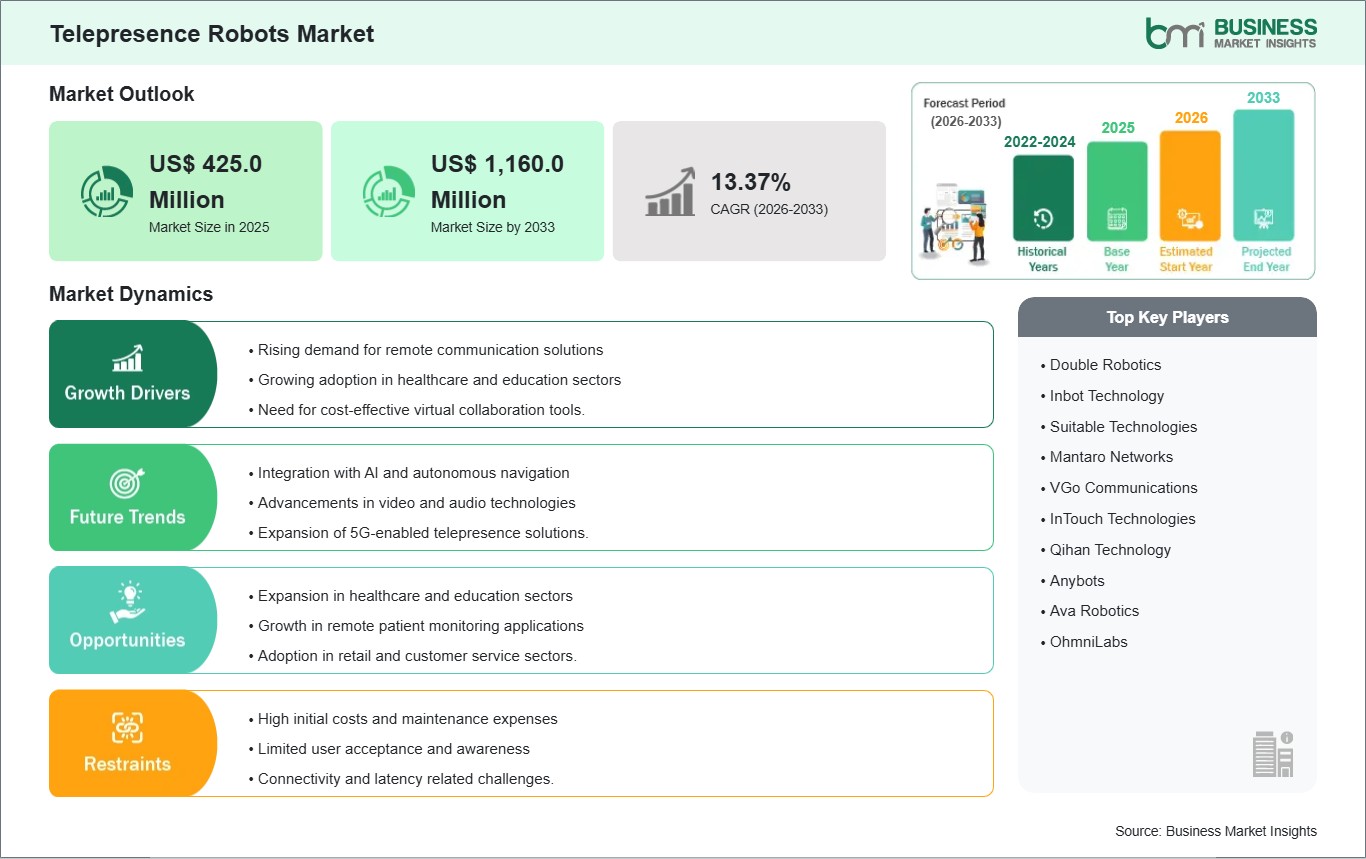
The Telepresence Robots Market size is expected to reach US$ 1,160. million by 2033 from US$ 425. million in 2025. The market is estimated to record a CAGR of 13.37% from 2026 to 2033.
The global telepresence robots market is experiencing strong growth because organizations need better ways to connect with remote workers and improve their operational efficiency. Telepresence robots use real-time audio-video communication together with mobility features and collaborative interfaces to support remote workers, healthcare professionals and educators who need to connect with others in physical spaces without being present. Recent technological advancements, which include AI-powered navigation and autonomous obstacle avoidance and improved video streaming capabilities, have brought substantial progress to system operations through efficient and dependable performance. Organizations can use cloud-based control platforms to manage their entire system through one location while performing software updates from remote locations and collecting system performance data, which enables them to expand their operations to both business and institutional environments.
Organizations that require their employees to work on-site throughout the day but deal with operational restrictions or logistical challenges have adopted this technology in their healthcare delivery systems, manufacturing processes, and educational facilities. Telepresence robots have expanded their capabilities with new features that enable gesture recognition and multiple users to work together while their battery systems provide extended power, and their modular designs permit different industries to create customized solutions. The system faces multiple challenges because it requires a significant initial financial commitment, along with protection against cyber threats, and users must undergo training for effective system usage. Organizations can use telepresence robots as essential tools for their remote work operations and their remote service delivery systems because these robots help preserve operational continuity while increasing stakeholder engagement and decreasing expenses related to travel.

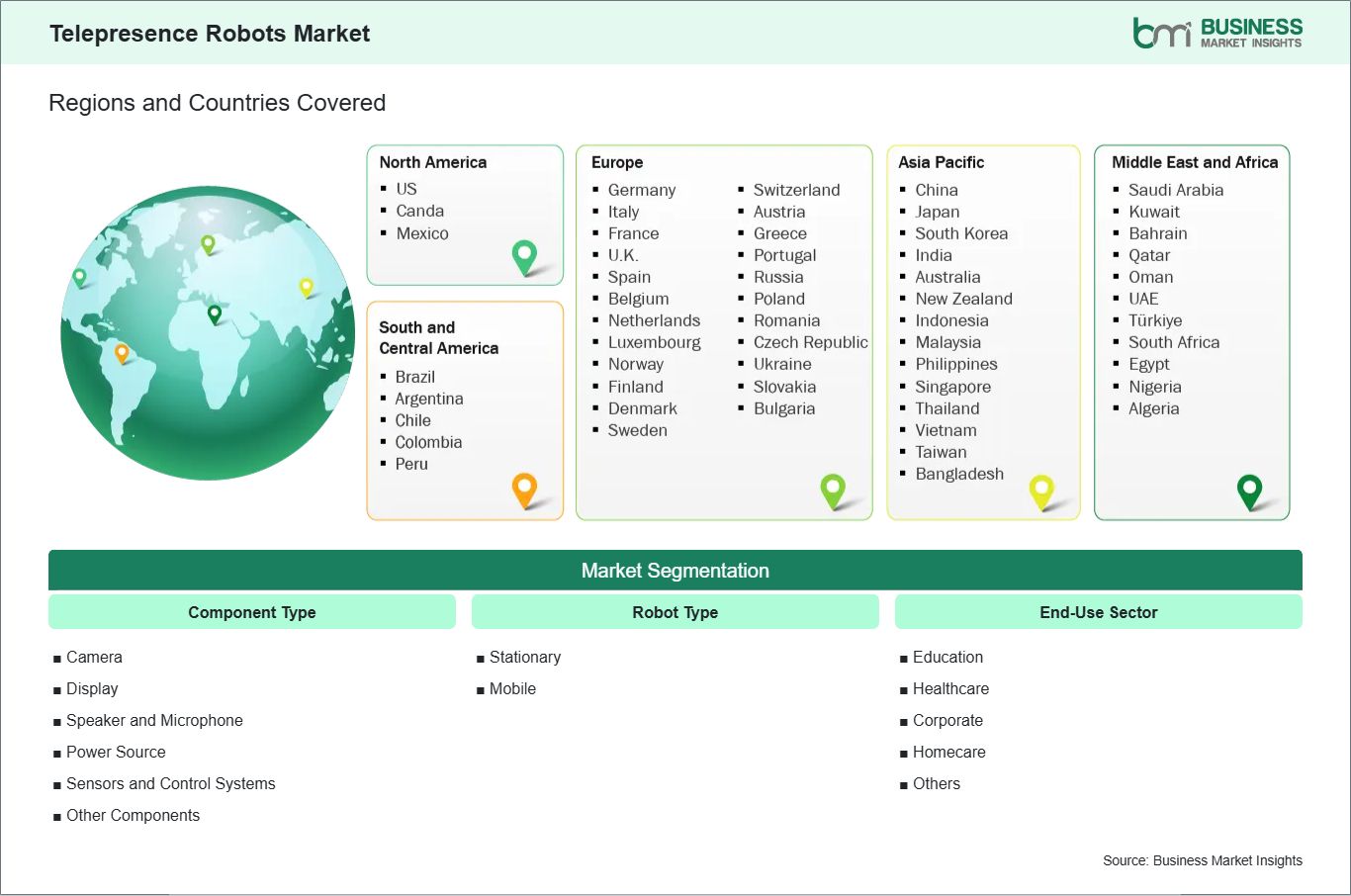
Key segments that contributed to the derivation of the telepresence robots market analysis are component type, robot type, and end‑use sector.
The global telepresence robots market is being driven by rising demand for remote communication solutions across industries. Businesses, corporations and enterprises are starting to use these robots because they want to establish virtual attendance at meetings, site inspections and collaborative workspaces. Telepresence robots enable employees to communicate with each other in real time without needing to travel, which helps organizations save money and improve their work performance. The growing need for remote work solutions has increased demand because organizations require better methods to support team collaboration. Telepresence robots enable users to navigate through workspaces while they interact with their coworkers and join meetings. The robots enable people who cannot attend in-person events to participate in conferences, trade shows and other events. Organizations use telepresence robots because they combine mobility with live video and interactive features to deliver dependable real-time communication across distances.
Telepresence robots are being adopted quickly in healthcare. They support remote patient consultations, virtual rounds, and monitoring. Hospitals and care facilities use these robots to improve access to medical specialists, lower in-person visits, and boost patient safety. They are especially helpful for patients with mobility or health issues to maintain care continuity. In education, telepresence robots allow students to join classrooms virtually. This overcomes challenges like distance, health problems, or accessibility. The robots enable real-time interaction with teachers and classmates, making remote learning more engaging and effective. Educational institutions also use telepresence robots for remote demonstrations, virtual labs, and group projects. Outside of healthcare and education, these robots are being included in training programs, workshops, and community outreach efforts. By giving people remote access to experts and instructors, telepresence robots help share knowledge and support professional development. They are an important tool for improving connectivity and learning around the world.
The Telepresence Robots Market demonstrates steady growth, with size and share analysis highlighting evolving trends and competitive dynamics among key players. The report examines subsegments categorized within component type, robot type, and end‑use sector, offering insights into their contribution to overall market performance.
By Component Type, the camera subsegment dominated the market in 2025, driven by the need for high-quality video communication and real-time interaction capabilities.
Based on Robot Type, the mobile subsegment dominated the market in 2025, owing to its flexibility, enhanced mobility, and wider deployment across different environments.
On the Basis of End‑Use Sector, the healthcare subsegment dominated the market in 2025, propelled by the rising demand for telemedicine, remote patient monitoring, and hospital automation solutions.
| Report Attribute | Details |
|---|---|
| Market size in 2025 | US$ 425.0 Million |
| Market Size by 2033 | US$ 1,160.0 Million |
| Global CAGR (2026 - 2033) | 13.37% |
| Historical Data | 2022-2024 |
| Forecast period | 2026-2033 |
| Segments Covered | By Component Type
|
|
Regions and Countries Covered
| |
| North America | US, Canada, Mexico |
| Europe | Belgium, Austria, Finland, Denmark, Greece, Poland, Romania, Russia, Ukraine, Czech Republic, Slovakia, Bulgaria, Italy, Luxembourg, Germany, Switzerland, France, Netherlands, Norway, Portugal, Spain, Sweden, United Kingdom |
| Asia-Pacific | Australia, China, India, Japan, South Korea, Indonesia, Malaysia, Philippines, Singapore, Thailand, Vietnam, Bangladesh, New Zealand, Taiwan |
| South and Central America | Brazil, Argentina, Peru, Chile, Colombia |
| Middle East and Africa | Bahrain, Kuwait, Oman, Qatar, Saudi Arabia, United Arab Emirates, Turkiye, South Africa, Egypt, Algeria, Nigeria |
| Market leaders and key company profiles |
|
The "Telepresence Robots Market Size and Forecast (2022 - 2033)" report provides a detailed analysis of the market covering below areas:
The geographical scope of the Telepresence Robots Market report is divided into North America, Asia Pacific, Europe, Middle East & Africa, and South & Central America. North America held the largest share in 2025.
Regional adoption of telepresence robots reflects differences in technological infrastructure, workforce distribution, and sector-specific needs. North America leads in early adoption, driven by a strong focus on hybrid workplace models, advanced healthcare facilities, and robust robotics research, with enterprises leveraging telepresence robots for remote collaboration and executive mobility.
Europe emphasizes deployment in healthcare and education sectors, integrating robots into hospitals and classrooms to address workforce shortages and improve accessibility in urban and rural environments.
Asia Pacific is witnessing accelerated adoption due to rapid industrial automation, expanding IT infrastructure, and increased investment in digital learning platforms; the region also sees innovative applications in customer engagement, hospitality, and retail settings.
Middle East & Africa is gradually adopting telepresence robots for remote monitoring, education, and corporate communication, particularly in regions where geographic dispersion or security considerations limit frequent travel.
South & Central America demonstrates a growing interest in telepresence solutions to support multinational operations, virtual conferences, and remote healthcare delivery, often focusing on cost-effective models adaptable to limited infrastructure environments.
Across regions, factors such as local regulatory frameworks, internet connectivity, cultural acceptance of robotics, and sector-specific requirements shape how telepresence robots are deployed and integrated into daily operations, highlighting the need for regionally customized solutions.

The Telepresence Robots Market is evaluated by gathering qualitative and quantitative data post primary and secondary research, which includes important corporate publications, association data, and databases. A few of the key developments in the spatial light Modulator market are:
The Telepresence Robots Market is valued at US$ 425.0 Million in 2025, it is projected to reach US$ 1,160.0 Million by 2033.
As per our report Telepresence Robots Market, the market size is valued at US$ 425.0 Million in 2025, projecting it to reach US$ 1,160.0 Million by 2033. This translates to a CAGR of approximately 13.37% during the forecast period.
The Telepresence Robots Market report typically cover these key segments-
The historic period, base year, and forecast period can vary slightly depending on the specific market research report. However, for the Telepresence Robots Market report:
The Telepresence Robots Market is populated by several key players, each contributing to its growth and innovation. Some of the major players include:
The Telepresence Robots Market report is valuable for diverse stakeholders, including:
Essentially, anyone involved in or considering involvement in the Telepresence Robots Market value chain can benefit from the information contained in a comprehensive market report.
Please tell us your area of interest
(Market Segments/ Regions and Countries/ Companies)