Market Summary
Executive Summary and Global Market Analysis
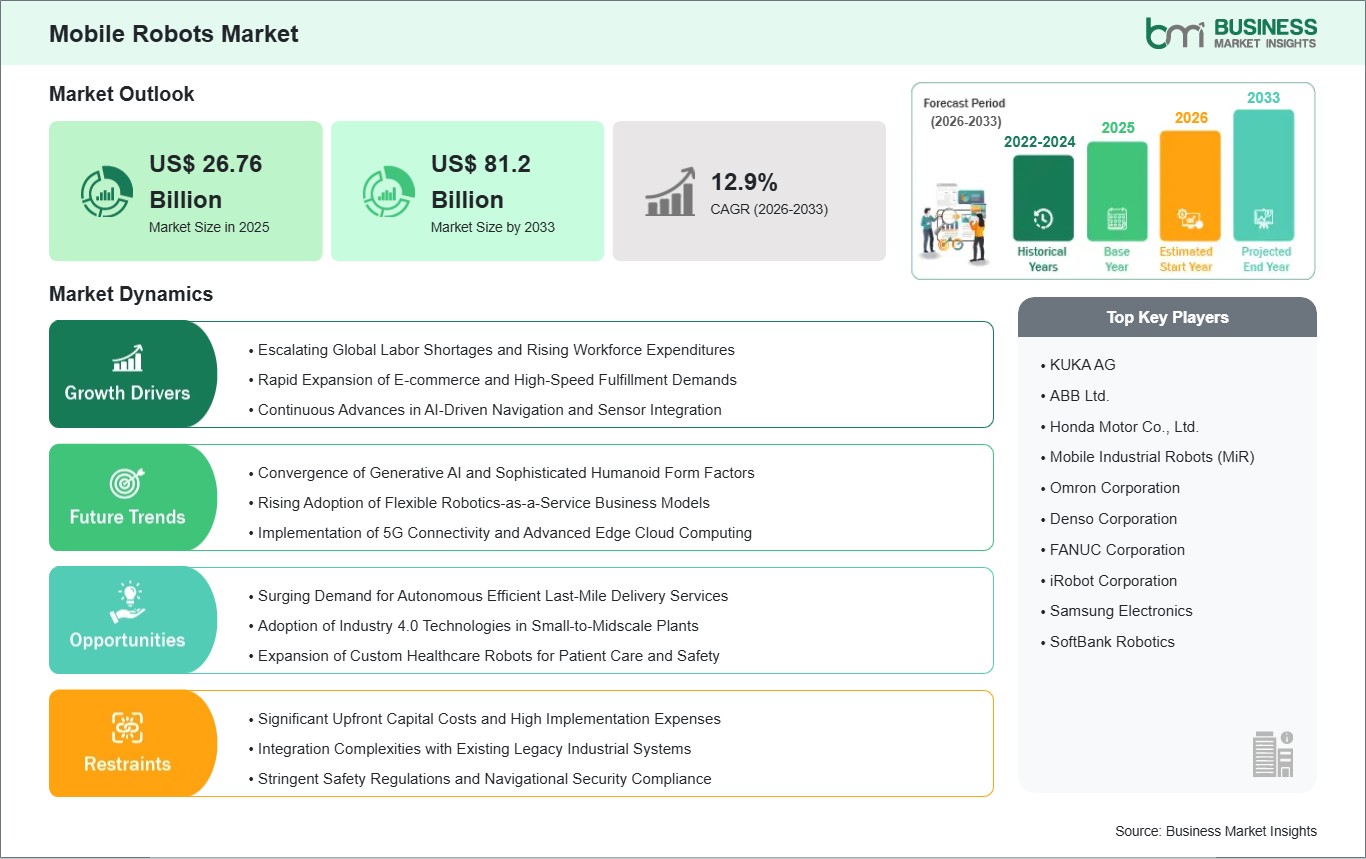
Mobile robots are programmable, autonomous, or semi-autonomous machines designed to navigate and perform tasks across various environments without the need for fixed physical infrastructure. They are becoming indispensable across several sectors, including manufacturing, logistics, healthcare, and domestic services. These robots provide critical advantages such as enhanced operational efficiency, reduced human error, and the ability to operate in hazardous or repetitive environments. The market is being propelled by the global push for Industry 4.0, the explosive growth of e-commerce, and the increasing integration of Artificial Intelligence (AI) and Machine Learning (ML) into robotic navigation. Furthermore, rising labor costs and a shrinking workforce in major economies are accelerating the transition toward mobile automation.
However, several challenges can restrain market growth, such as high initial acquisition costs, the complexity of multi-robot fleet orchestration, and stringent safety regulations regarding robot-human interaction. The industry is also facing technical hurdles related to battery life and the need for standardized communication protocols like 5G. Despite these hurdles, the market holds significant opportunities driven by the rise of Robotics-as-a-Service (RaaS) models, the development of green robotics powered by sustainable energy, and the expanding field of humanoid mobile robots for professional services. Investment in high-precision sensors and edge computing is expected to further broaden the scope of mobile robot applications in unstructured environments.
Segment Analysis
Mobile Robots Market Segmentation
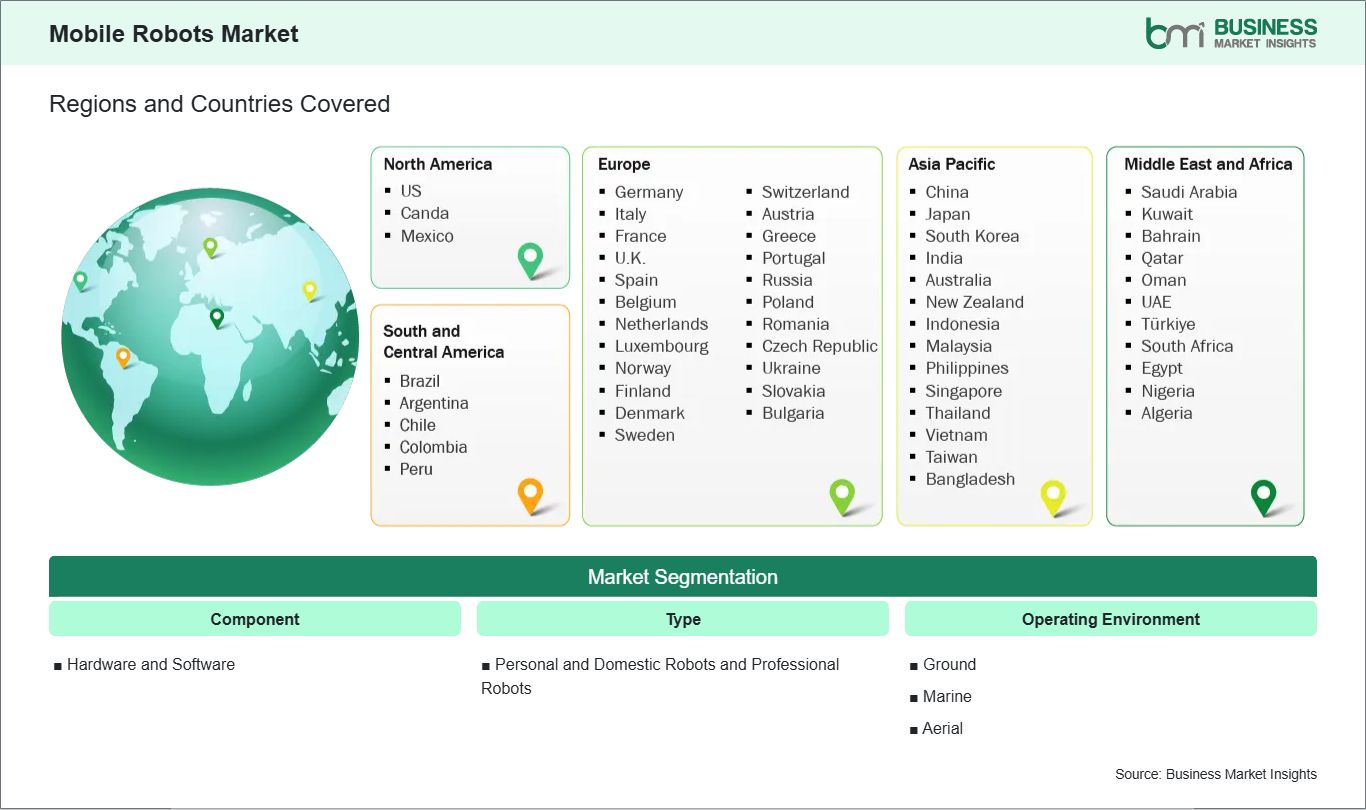
Key segments that contributed to the derivation of the Mobile Robots market analysis are component, type, and operating environment.
- By Component, the market is segmented into Hardware and Software.
- By Type, the market is divided into Personal and Domestic Robots and Professional Robots.
- By Operating Environment, the market is categorized into Ground, Marine, and Aerial.
Market Forces
Mobile Robots Market Drivers and Opportunities
Escalating Labor Shortages and Rising Global Workforce Expenditures
The mobile robots market is fundamentally driven by the widening gap in global labor availability, particularly for repetitive, physically demanding, or hazardous tasks. Developed nations are currently grappling with aging populations and a significant decline in the number of workers willing to enter manual labor sectors such as warehousing, manufacturing, and agriculture.
Mobile robots can be the ideal solution in this regard by working uninterruptedly, thus reducing the dependency of operations on manual labor to a considerable extent. In this regard, robots will help in eliminating the "dirty, dull, and dangerous" part of the total tasks, thus enabling the organization to acquire a stable output with reduced effects of increased manual wages. Moreover, the effects of fatigue errors in the machines will also be null, thus enabling the generation of higher levels of safety as well as lower insurance costs in dangerous environments. In light of the above, the requirement for the use of robotic systems as the major force to replace labor in the upcoming "lights out" operations will remain dominant.
Emerging Delivery Demands Drive Growth in Autonomous Urban Solutions
As global e-commerce volumes continue to swell, with B2C revenues expected to exceed traditional delivery infrastructures are becoming increasingly congested and inefficient. This bottleneck in "last-mile" delivery, which often accounts for more than 50% of total shipping costs, has created a lucrative opening for autonomous delivery robots. These small-scale ground and aerial units are designed to navigate complex urban environments, sidewalks, and residential zones to provide contactless, energy-efficient transport for food, groceries, and small parcels.
Beyond logistics, the opportunity includes the restaurant and healthcare industries, where mobile robots are already being used for serving meals to hotel rooms and for transporting healthcare materials within the building. The development of Smart City projects further promotes the adoption of mobile robots because city planners are designing special paths and nodes for the robots to navigate through. This ability to leverage Autonomous Mobile Robots (AMRs) for shorter-range delivery can significantly cut carbon footprints and costs for companies. Furthermore, the creation of modular robots enables one robot to be converted for multiple applications for shorter-range periods of street sweeper robots or security surveillance systems when they are not delivering products.
Size and Share Analysis
Mobile Robots Market Size and Share Analysis
The mobile robots market demonstrates steady growth, with size and share analysis revealing evolving trends and competitive positioning among key players. The report further examines subsegments categorized within component, type, and operating environment, offering insights into their contribution to overall market performance.
Based on type, professional robots are typically used for high-value applications like defense and healthcare, where precision is paramount. Conversely, the Personal and Domestic sub-segment is seeing rapid expansion as consumer robots like autonomous vacuums and lawnmowers become more affordable and feature-rich.
In terms of operating environments, Aerial robots (Drones) are experiencing significant growth in monitoring and last-mile delivery, while Marine robots (AUVs and USVs) are gaining traction in offshore energy and environmental research.
Report Coverage
Mobile Robots Market Report Coverage and Deliverables
The "Mobile Robots Market Size and Forecast (2022 - 2033)" report provides a detailed analysis of the market covering below areas:
- Mobile Robots market size and forecast at global, regional, and country levels for all the key market segments covered under the scope
- Mobile Robots market trends, as well as market dynamics such as drivers, restraints, and key opportunities
- Mobile Robots market analysis covering key market trends, global and regional framework, major players, regulations, and recent market developments
- Industry landscape and competition analysis covering market concentration, heat map analysis, prominent players, and recent developments for the Mobile Robots market
- Detailed company profiles, including SWOT analysis
Geographic Insights
Mobile Robots Market Geographic Insights
The geographical scope of the Mobile Robots market report is divided into five regions: North America, Asia Pacific, Europe, Middle East &Africa, and South &Central America.
The Asia-Pacific Mobile Robots market is experiencing the most robust growth globally, driven by China's aggressive robotics initiative and the region's massive manufacturing hubs in Japan, South Korea, and India. The region is witnessing a rapid transition toward "Smart Factories" and the widespread adoption of 5G infrastructure, which facilitates low-latency fleet orchestration.
In North America, the U.S. leads the market due to the early adoption of advanced technologies by giants like Amazon and FedEx. The region is characterized by high R&D spending and a strong presence of key players like Boston Dynamics and Locus Robotics. Europe follows closely, with Germany's Industry 4.0 framework fostering significant growth in industrial AMRs. Despite strict safety regulations, the European market is fueled by a desperate need to combat a shrinking labor force and high manufacturing costs.
Meanwhile, the Middle East &Africa and South &Central America are emerging as opportunistic markets, particularly in sectors like offshore oil and gas monitoring (marine robots) and large-scale agricultural automation.
Industry Activity
Recent Developments
The Mobile Robots market is evaluated by gathering qualitative and quantitative data post primary and secondary research, which includes important corporate publications, association data, and databases. A few of the key developments in the mobile robots market are:
- In January 2026, Boston Dynamics unveiled the product version of its new Atlas® robot at the Consumer Electronics Show in Las Vegas. The fully electric humanoid was revealed during Hyundai's global CES media day presentation, which also featured a live stage demonstration of the prototype version of Atlas, in addition to a rousing dance performance by a troupe of its famous Spot® robots.
- In June 2025, KUKA announced to offer a versatile autonomous mobile robot (AMR) as a variant for intelligent use in cleanrooms for the 11- and 15-kilogram payload categories. The cleanroom models have been certified by the Fraunhofer Institute and meet ISO cleanroom class 3 requirements.
Trust & Transparency
Research Methodology
The market analysis combines proprietary research with secondary data from government agencies, company disclosures, regulatory filings, industry databases and expert interviews. Market estimates are validated through data triangulation, cross-market benchmarking and analyst
review.
View Full Research Methodology
Key Sources Referred:
World Bank - Global Trade Indicators World Trade Organization (WTO) International Monetary Fund (IMF) International Trade Administration (ITA) Company website Company annual reports Company investor presentations