Market Summary
Executive Summary and Global Market Analysis
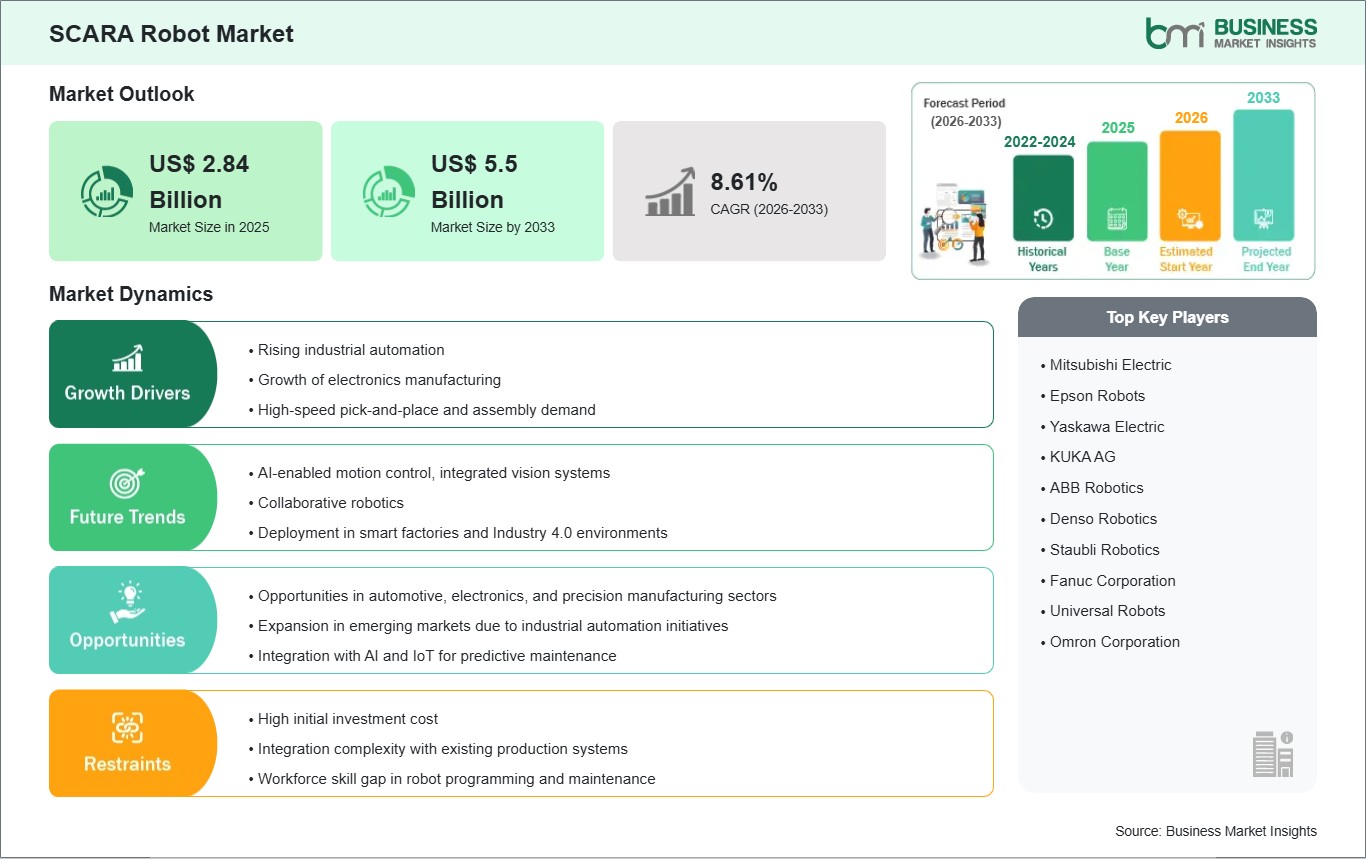
The global SCARA robot market is experiencing substantial growth as industries increasingly adopt automation to improve productivity, precision, and operational efficiency. SCARA (Selective Compliance Assembly Robot Arm) robots are widely recognized for their high speed, repeatability, and ability to perform precise assembly and handling tasks in compact workspaces. Their design allows horizontal flexibility while maintaining vertical rigidity, making them ideal for fast-paced manufacturing environments.
Manufacturers across industries are integrating SCARA robots into production lines to support high-volume manufacturing and reduce dependency on manual labor. The increasing need for consistent quality, reduced cycle times, and enhanced workplace safety is driving the demand for advanced robotic solutions. SCARA robots are particularly valued for their efficiency in pick-and-place operations, assembly processes, and small component handling.
Technological advancements are also shaping the competitive landscape of the SCARA robot market. Companies are developing robots with enhanced payload capacity, improved motion control, and integrated vision systems. Additionally, the growing adoption of collaborative robotics and digital factory ecosystems is expanding the role of SCARA robots within modern manufacturing systems.
The rising implementation of Industry 4.0 initiatives and smart manufacturing strategies is further accelerating market growth. Organizations are investing in automated production systems that combine robotics, data analytics, and connected devices to enhance efficiency and reduce operational costs. As industrial automation becomes a core component of manufacturing strategies, SCARA robots are expected to play a critical role in enabling flexible and scalable production environments.
Segment Analysis
SCARA Robot Market Segmentation
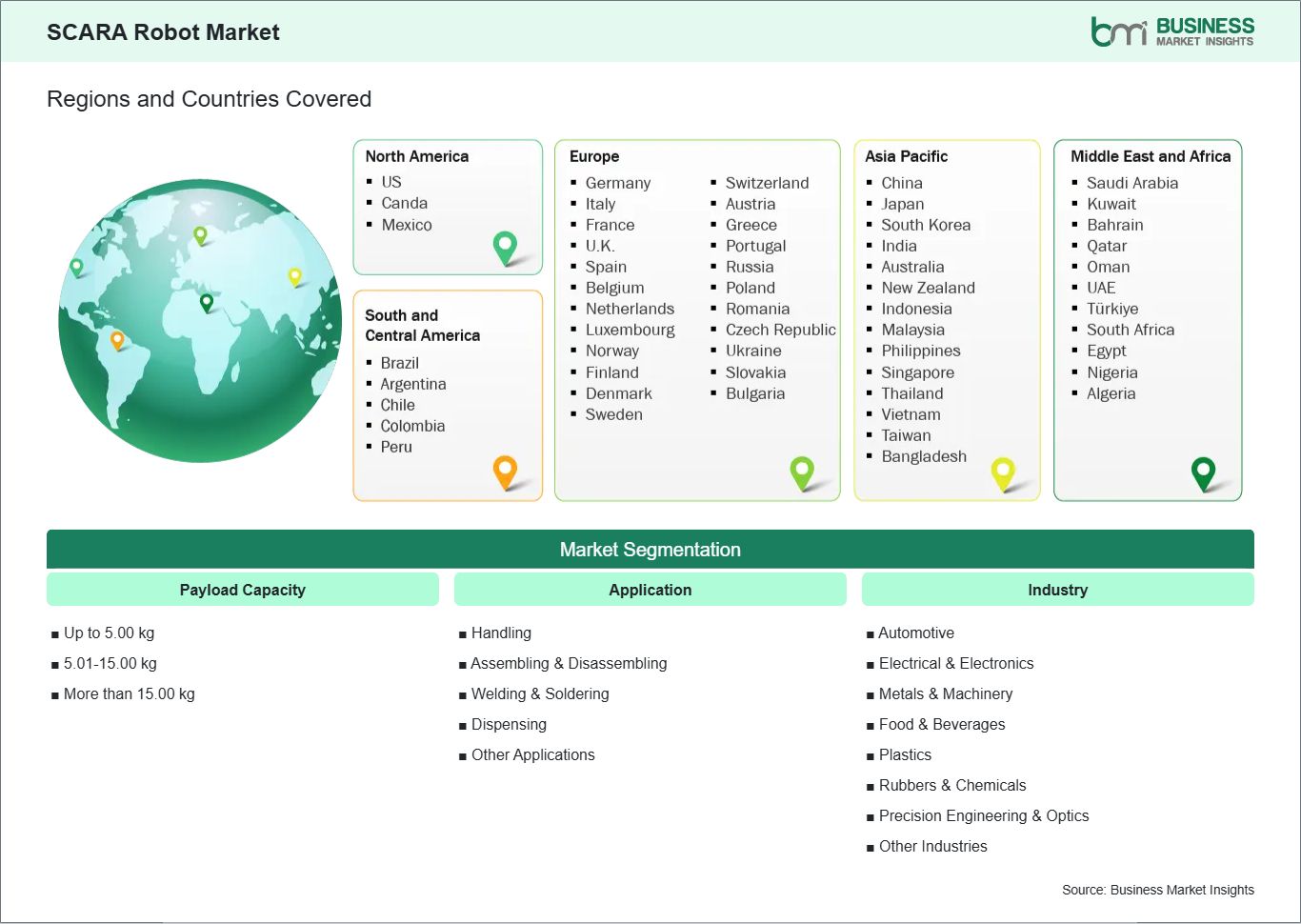
Key segments that contributed to the derivation of the SCARA robot market analysis are payload capacity, application, and industry.
- By payload capacity, the market is segmented into up to 5.00 kg, 5.01–15.00 kg, and more than 15.00 kg. The 5.01–15.00 kg segment dominated in 2025.
- By application, the market is segmented into handling, assembling & disassembling, welding & soldering, dispensing, and other applications. The assembling & disassembling segment dominated in 2025.
- By industry, the market is segmented into automotive, electrical & electronics, metals & machinery, food & beverages, plastics, rubbers & chemicals, precision engineering & optics, and other industries. The electrical & electronics segment dominated in 2025.
Market Forces
SCARA Robot Market Drivers and Opportunities
Rising Industrial Automation Driving SCARA Robot Adoption
Increasing adoption of automation across manufacturing sectors is driving the SCARA robot market. These robots enhance productivity, reduce human error, and improve operational efficiency, especially for repetitive, high-speed tasks.
Growth of Electronics Manufacturing
The electronics manufacturing industry’s demand for precision assembly and fast throughput is expanding SCARA robot deployment. SCARA robots are ideal for PCB assembly, semiconductor packaging, and placement of small components.
Technological Advancements and Industry 4.0 Integration
Innovations such as AI-enabled motion control, machine vision integration, and collaborative robotics are increasing the SCARA robot’s role in modern, connected manufacturing environments.
Size and Share Analysis
SCARA Robot Market Size and Share Analysis
The SCARA Robot Market demonstrates steady growth, with size and share analysis highlighting evolving trends and competitive dynamics among key players. The report examines subsegments categorized within payload capacity, application, and industry, offering insights into their contribution to overall market performance.
By payload capacity, the 5.01 - 15.00 kg segment dominated the market in 2025, driven by the optimal balance between payload capability and operational flexibility for a wide range of industrial applications.
Based on application, the assembling & disassembling segment dominated the market in 2025, driven by the growing use of automated assembly systems in electronics, automotive, and consumer goods manufacturing.
In terms of industry, the electrical & electronics segment dominated the market in 2025, driven by the rapid growth of semiconductor manufacturing and electronic component production globally.
Report Coverage
SCARA Robot Market Report Coverage and Deliverables
The "SCARA Robot Market Size and Forecast (2022 - 2033)" report provides a detailed analysis of the market covering below areas:
- SCARA Robot Market size and forecast at global, regional, and country levels for all the key market segments covered under the scope
- SCARA Robot Market trends, as well as drivers, restraints, and opportunities
- SCARA Robot Market analysis covering key trends, global and regional framework, major players, regulations, and recent developments
- Industry landscape and competition analysis covering market concentration, heat map analysis, prominent players, and recent developments for the SCARA Robot Market
- Detailed company profiles, including SWOT analysis
Geographic Insights
SCARA Robot Market Geographic Insights
The geographical scope of the SCARA Robot Market report is divided into North America, Asia Pacific, Europe, Middle East & Africa, and South & Central America. North America held the largest share in 2025.
North America represents a significant market driven by advanced manufacturing infrastructure and increasing investments in automation. Companies in the United States and Canada are adopting robotics solutions to enhance productivity, address labor shortages, and maintain global competitiveness. The region also benefits from strong technological innovation and early adoption of Industry 4.0 solutions.
Asia Pacific also dominates the market due to the presence of large manufacturing hubs in countries such as China, Japan, South Korea, and Taiwan. The region’s strong electronics and semiconductor industries drive significant demand for high-speed assembly robots. Government initiatives promoting smart manufacturing and industrial automation are also accelerating the adoption of robotics technologies across the region.
Europe is another prominent market supported by the presence of established automotive and industrial machinery manufacturers. Countries such as Germany, Italy, and France are integrating robotics into production systems to improve efficiency and maintain high manufacturing standards.
Emerging markets in Latin America and the Middle East & Africa are witnessing gradual adoption of SCARA robots as industrial sectors modernize and automation investments increase. Government initiatives supporting manufacturing growth and foreign investments are expected to further encourage the deployment of industrial robotics across these regions.
Industry Activity
Recent Developments
The SCARA Robot Market is evaluated by gathering qualitative and quantitative data post primary and secondary research, which includes important corporate publications, association data, and databases. A few of the key developments in the SCARA robot market are:
- In April 2025, Mitsubishi Electric introduced an advanced SCARA robot series designed for high-speed assembly and pick-and-place operations in electronics manufacturing, featuring enhanced motion control and integrated vision compatibility.
- In April 2025, Epson Robots launched a new compact SCARA robot platform with improved payload capacity and energy-efficient operation, aimed at supporting flexible automation in electronics and precision manufacturing industries.
Trust & Transparency
Research Methodology
The market analysis combines proprietary research with secondary data from government agencies, company disclosures, regulatory filings, industry databases and expert interviews. Market estimates are validated through data triangulation, cross-market benchmarking and analyst
review.
View Full Research Methodology
Key Sources Referred:
International Federation of Robotics (IFR)World Economic Forum (WEF)Organisation for Economic Cooperation and Development (OECD)The World Bank GroupInternational Trade Administration (ITA)Manufacturing InstituteRobotics Industries Association (RIA)