Market Summary
Executive Summary and Global Market Analysis
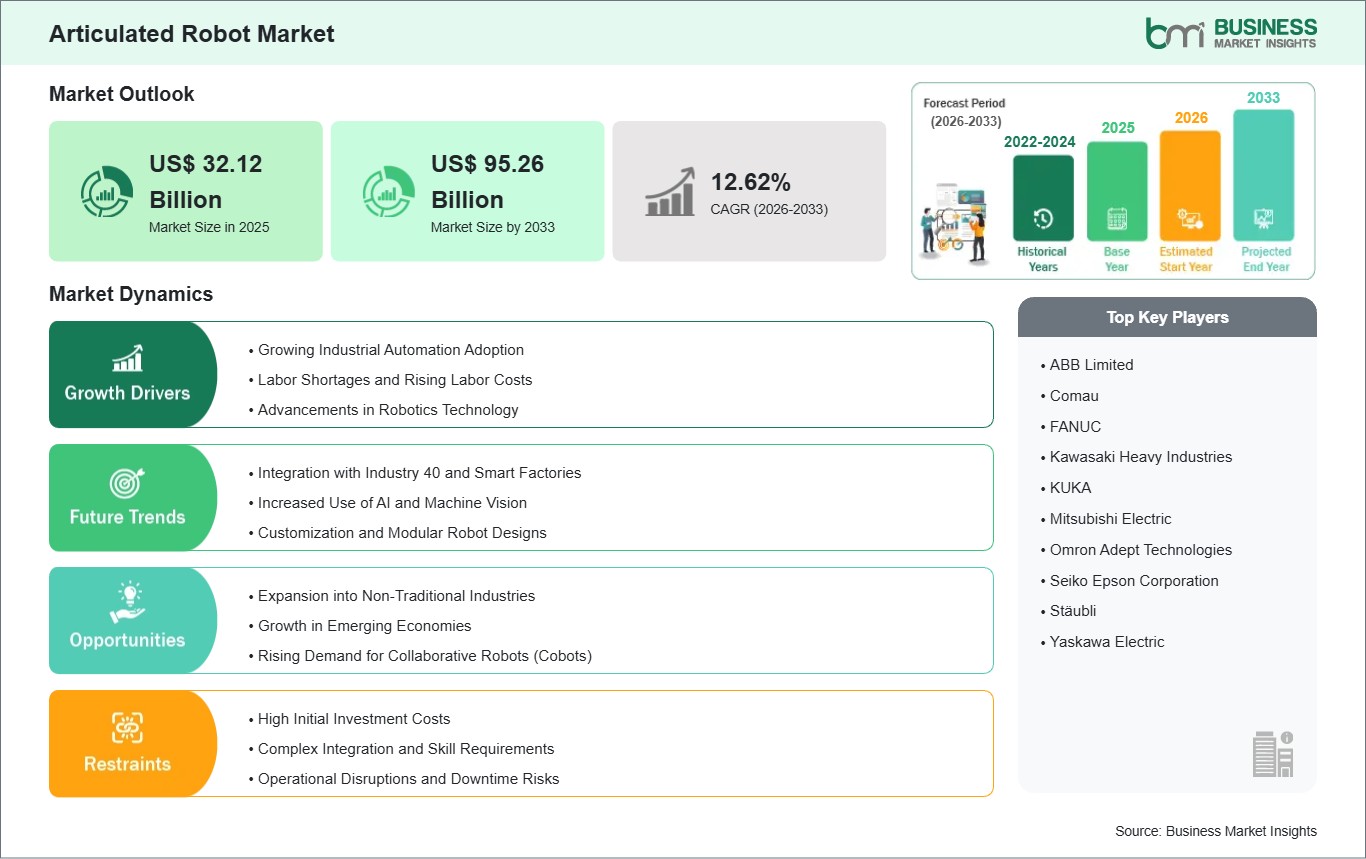
Articulated robots are a type of industrial robot characterized by rotary joints that mimic the motion of a human arm, typically featuring multiple axes (commonly 4–6 or more) to offer a wide range of motion and flexibility. These robots deliver high precision, adaptability, and reach, making them ideal for complex tasks in automated environments. Key benefits include increased productivity, improved consistency and quality, enhanced safety by taking on hazardous jobs, and reduced operational costs over time. They are widely used in industries such as automotive manufacturing (welding, painting, assembly), electronics production, material handling, packaging, food & beverage processing, pharmaceuticals, and warehousing. Within this segment, variations include 4-axis, 5-axis, and 6-axis articulated robots, with higher-axis systems providing greater dexterity for intricate tasks, as well as collaborative versions designed to work safely alongside human operators.
From a market analysis perspective, the articulated robot market growth is propelled by accelerating industrial automation trends driven by labor cost pressures, the need for improved manufacturing efficiency, and strong demand across major production sectors like automotive and electronics. Adoption is also being supported by technological enhancements such as AI, advanced sensors, and connectivity with Industry 4.0 systems. Furthermore, emerging applications in logistics and e-commerce fulfilment present new opportunities as companies automate warehousing and handling processes.
Segment Analysis
Articulated Robot Market Segmentation
Key segments that contributed to the derivation of the virtual private network market analysis are Application and Industry.
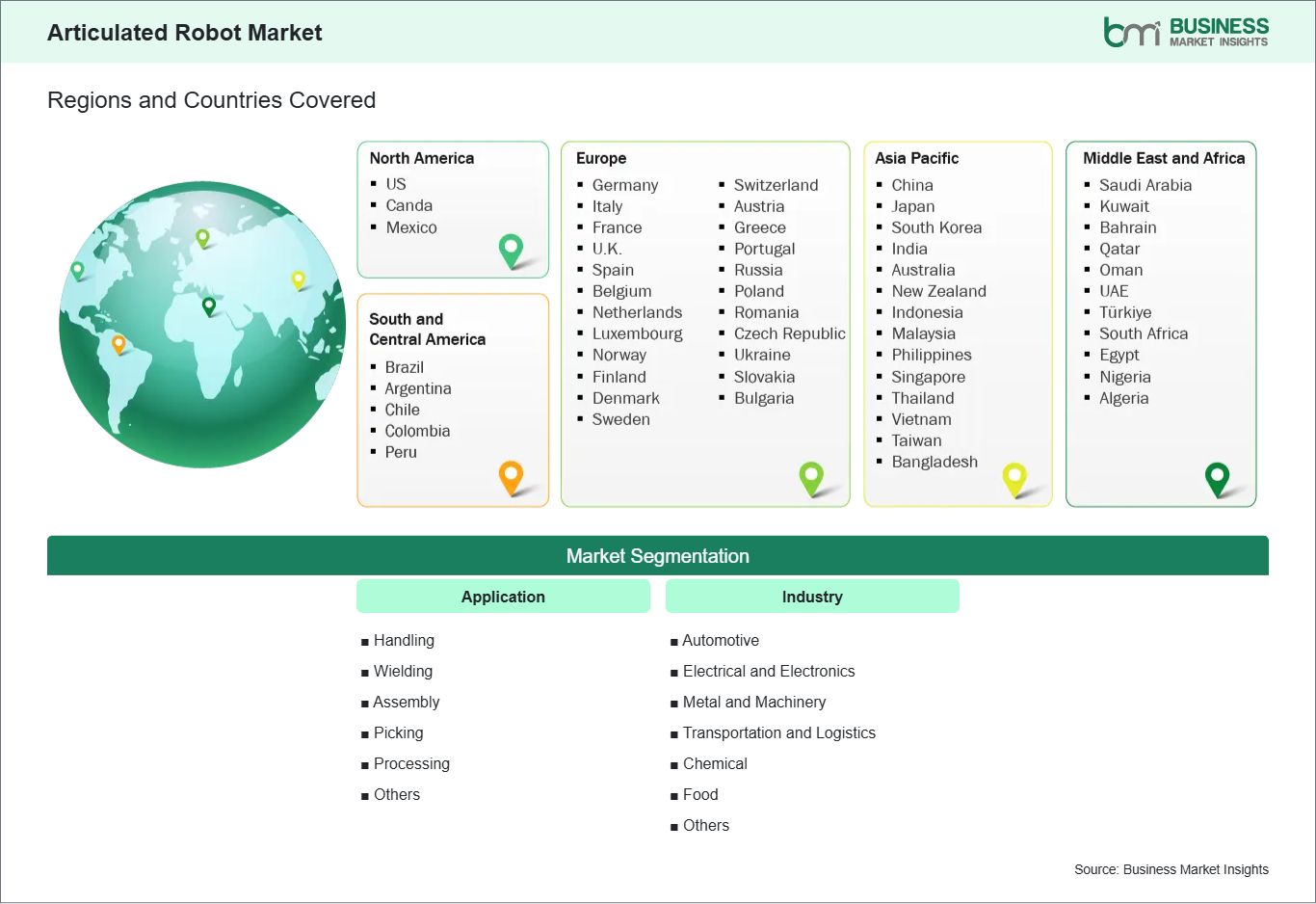
- By Application, the Articulated robot market is segmented into Handling, Wielding, Assembly, Picking, Processing, and Others. The Handling segment dominated the market in 2024.
- By Industry, the Articulated robot market is segmented into Automotive, Electrical and Electronics, Metal and Machinery, Transportation and Logistics, Chemical, Food, and Others. The Automotive segment dominated the market in 2024.
Market Forces
Articulated Robot Market Drivers and Opportunities
Rising Demand for Industrial Automation
The growing need for industrial automation is a key driver of the articulated robot market. Manufacturers across industries such as automotive, electronics, and metal fabrication are under pressure to increase productivity, maintain consistent quality, and reduce operational costs. Articulated robots enable high-speed, precise, and repeatable operations, making them ideal for tasks like welding, assembly, and material handling. Additionally, labor shortages, rising wages, and workplace safety concerns are accelerating the shift toward automation. As companies pursue smart factories and Industry 4.0 initiatives, articulated robots play a central role in optimizing production efficiency and ensuring long-term competitiveness.
Expansion of Robotics Adoption in Emerging Industries
The expanding adoption of robotics in emerging industries presents a significant opportunity for the articulated robot market. Beyond traditional automotive manufacturing, sectors such as food & beverage, pharmaceuticals, logistics, and e-commerce are increasingly investing in automation to improve throughput and accuracy. Articulated robots are being adapted for hygienic handling, packaging, palletizing, and order fulfillment tasks. Advancements in collaborative robotics, vision systems, and AI are making these robots easier to integrate and more affordable for new users. This broadening application scope is expected to unlock untapped demand and support sustained market growth.
Size and Share Analysis
Articulated Robot Market Size and Share Analysis
By Application, the market is segmented into Handling, Wielding, Assembly, Picking, Processing, and Others. The Handling segment dominated the market in 2024. The handling segment is a key application area in the articulated robot market, involving tasks such as picking, placing, palletizing, and material transfer. Articulated robots are widely used for handling due to their high payload capacity, flexibility, and precision. They help improve operational efficiency, reduce manual labor, and ensure consistent performance across manufacturing and logistics environments.
By Industry, the market is segmented into Automotive, Electrical and Electronics, Metal and Machinery, Transportation and Logistics, Chemical, Food, and Others. The Automotive segment held the largest share of the market in 2024. The automotive Industry represents a major segment of the articulated robot market, driven by extensive automation across production lines. Articulated robots are widely used for welding, painting, assembly, and material handling due to their precision and reliability. Their ability to operate continuously enhances productivity, ensures consistent quality, and supports high-volume vehicle manufacturing.
Report Coverage
Articulated Robot Market Report Coverage and Deliverables
The "Articulated Robot Market Size and Forecast (2022–2033)" report provides a detailed analysis of the market covering below areas:
- Articulated robot market size and forecast at global, regional, and country levels for all the key market segments covered under the scope
- Articulated robot market trends, as well as market dynamics such as drivers, restraints, and key opportunities
- Articulated robot market analysis covering key market trends, global and regional framework, major players, regulations, and recent market developments
- Industry landscape and competition analysis covering market concentration, heat map analysis, prominent players, and recent developments for the Articulated robot market
- Detailed company profiles, including SWOT analysis
Geographic Insights
Articulated Robot Market Geographic Insights
The geographical scope of the Articulated robot market report is divided into five regions: North America, Asia Pacific, Europe, Middle East & Africa, and South & Central America. The Articulated robot market in Asia Pacific is expected to grow significantly during the forecast period.
The Asia-Pacific Articulated robot market is segmented into China, Japan, South Korea, India, Australia, New Zealand, Indonesia, Malaysia, the Philippines, Singapore, Thailand, Vietnam, Taiwan, Bangladesh, and the Rest of Asia. The Asia Pacific articulated robot market is the world’s most dominant and fastest-growing regional segment, driven by robust manufacturing expansion, rapid automation adoption, and strong government support for smart factory initiatives. Countries like China, Japan, and South Korea lead in articulated robot deployments, supported by substantial industrial bases in automotive, electronics, and semiconductor production. China alone accounts for a significant portion of global robot installations, reflecting its scale and strategic focus on automation.
Regional growth is further propelled by technology innovation and rising demand for high-precision operations in diverse sectors. Emerging markets such as India, Thailand, and Vietnam are gaining traction as manufacturing hubs attract foreign investment and local automation initiatives. Increasing labor costs and workforce shortages are also motivating companies to invest in articulated robots to enhance productivity and operational efficiency.
Industry Activity
Recent Developments
The Articulated robot market is evaluated by gathering qualitative and quantitative data post primary and secondary research, which includes important corporate publications, association data, and databases. A few of the key developments in the Articulated robot market are:
- In August 2024, Mitsubishi Electric Corporation introduced its RV-35/50/80FR robot series, engineered to support heavier payloads and deliver a longer operating range than earlier models. Offering a maximum reach of 2,100 mm and a payload capacity of up to 80 kg, the new robots are well-suited for applications such as palletizing and machine tending. The series is designed for seamless integration with Mitsubishi Electric’s factory automation solutions and incorporates advanced safety features, including position and speed monitoring, to enhance operational efficiency and workplace safety.
- In May 2024, Fanuc Corporation launched the CRX-10iA/L Paint, recognized as the world’s first globally certified explosion-proof collaborative paint robot. Developed for industrial painting, coating, and powder applications, the cobot complies with strict explosion-protection standards, including ATEX and IECEx, making it suitable for hazardous environments worldwide. It offers a 10 kg payload capacity and an extended reach of 1,418 mm, enabling accurate coating of large components while ensuring operator safety. Additionally, the CRX-10iA/L Paint features user-friendly, intuitive programming that allows operators to easily teach motion paths, simplifying deployment and improving automation efficiency.
Trust & Transparency
Research Methodology
The market analysis combines proprietary research with secondary data from government agencies, company disclosures, regulatory filings, industry databases and expert interviews. Market estimates are validated through data triangulation, cross-market benchmarking and analyst
review.
View Full Research Methodology
Key Sources Referred:
World Bank – Global Trade IndicatorsWorld Trade Organization (WTO)International Monetary Fund (IMF)International Trade Administration (ITA)Company websiteCompany annual reportsCompany investor presentations