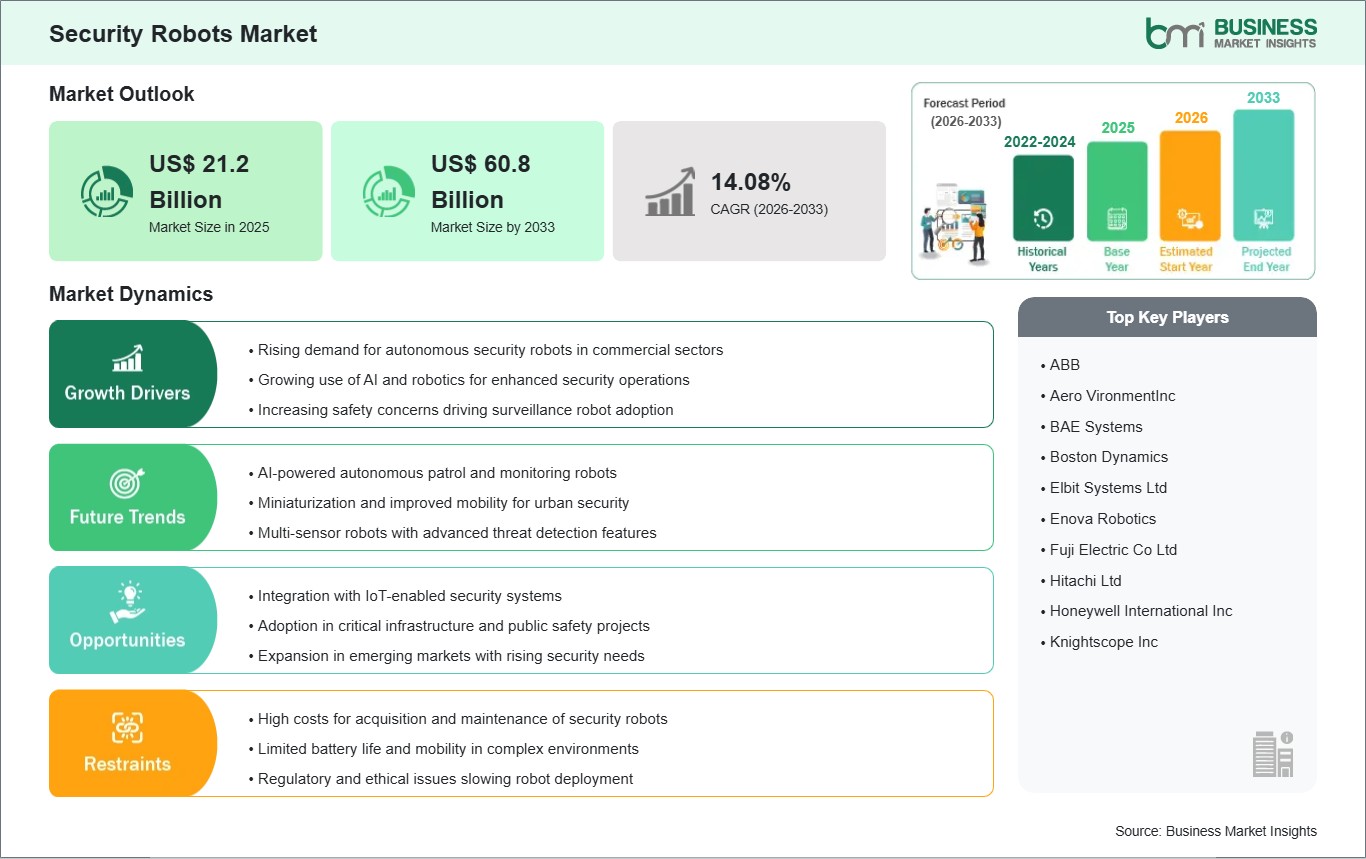
The Security Robots Market size is expected to reach US$ 60.8 billion by 2033 from US$ 21.2 billion in 2025. The market is estimated to record a CAGR of 14.08% from 2026 to 2033.
The global market for security robots is changing quickly as more organizations move from traditional, human-monitored surveillance to automated, technology-based solutions. Security robotssuch as wheeled, tracked, and aerial modelsare now used for tasks like routine patrols, perimeter checks, emergency response, and detecting hazardous materials. The rise of AI-powered analytics, more sensors, and better autonomous navigation is changing how robots work. These advances let robots operate on their own and stay efficient. Unlike older security systems, they can cover large areas with little human help, which makes them useful in high-risk or hard-to-reach places. The market is also growing because companies want to manage security teams more efficiently, there are more cases of vandalism and theft in cities and industries, and there is a push for 'smart' infrastructure where robots are part of IoT-connected security networks.
Robots are becoming more popular because they can do boring or risky jobs. This gives people more time to make important choices and handle urgent problems. Still, there are challenges, like complicated technology, high starting costs, and online security risks.robots. Some organizations are hesitant to move away from traditional security methods, and the public may be uneasy about robots monitoring sensitive areas. Still, ongoing improvements, better compatibility, and stronger sensing abilities are making security robots a key part of future global security plans.

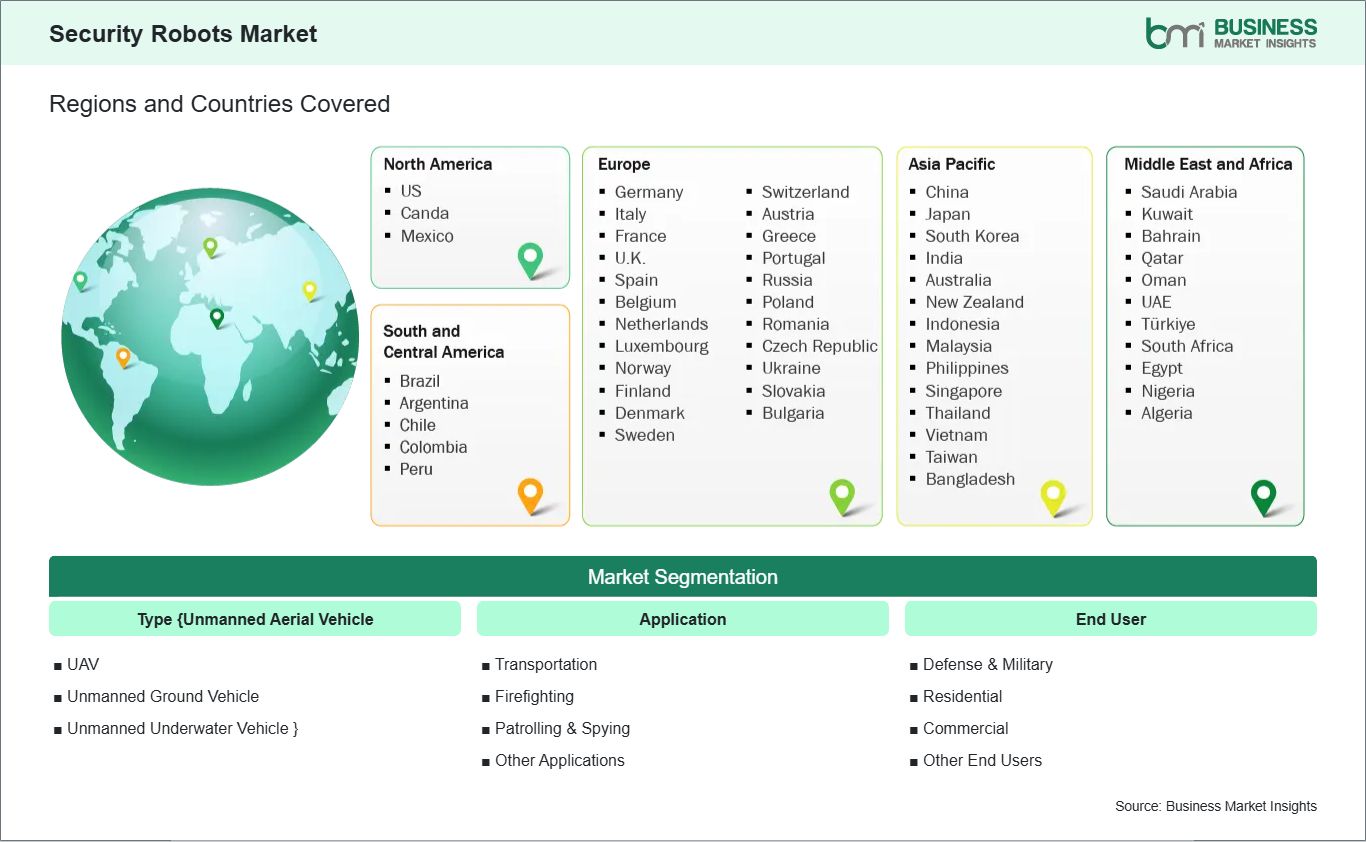
Key segments that contributed to the derivation of the security robots market analysis are type, application, and end user.
Autonomous security robots have become an important part of commercial security around the world. Many businesses use them to cover large areas, rely less on human patrols, and respond faster to incidents. These robots use advanced cameras, sensors, and navigation tools to monitor perimeters, warehouses, and office buildings at any time. They send real-time alerts and keep detailed records. As more companies use them, it is clear that businesses want reliable and cost-effective security that works all day, especially in large or complex spaces.
In North America, big distribution centers and retail stores are some of the first to use robotic security. Many places in the United States and Canada now rely on self-driving robots to watch over loading areas, parking lots, and the edges of their property after hours. These robots help prevent theft and vandalism, and they also create digital records and analytics to support human security teams. Most businesses use robots to make their security staff stronger, not to replace them, so people can focus on more important work.
The Asia-Pacific region is also quickly adopting commercial security robots, especially as cities grow and buildings become more mixed-use. In places like Singapore, South Korea, and parts of Southeast Asia, property managers are adding autonomous patrol robots to large office, retail, and residential buildings. These robots can move through elevators, hallways, and open areas, using infrared and LiDAR to keep watch even when lighting is poor. As buildings get bigger and more complex, the demand for flexible, automated security is rising in this region.
The combination of autonomous security robots and IoT-enabled platforms is transforming how organizations monitor and protect their assets. IoT networks connect cameras, sensors, and access controls to provide a unified view of security operations. When robots are integrated into these networks, they function as mobile data collectors, feeding real-time information to centralized dashboards. This connectivity allows security teams to detect threats faster, automate responses, and maintain a high level of situational awareness across complex facilities.
In Western Europe, where smart buildings and digital infrastructure projects are widespread, autonomous robots are increasingly deployed as part of integrated IoT security systems. Cities such as Amsterdam and Munich have experimented with robots that patrol commercial sites while linking directly to building management systems. These units can trigger automated alerts, such as activating lighting or locking access points, whenever unusual activity is detected during nighttime patrols. This integration enhances both preventative and reactive security measures, ensuring seamless coverage across large commercial facilities.
Emerging regions, including Latin America and the Middle East, are also adopting IoT-integrated robotic security solutions to enhance commercial site protection. In Brazil, corporate campuses and logistics hubs are combining autonomous patrols with connected cameras and access control systems to strengthen perimeter security. In the United Arab Emirates, robots coordinate with digital signage, alarms, and centralized monitoring platforms to ensure rapid response across large commercial zones. In these markets, the synergy between IoT connectivity and robotic mobility is improving efficiency, flexibility, and the overall effectiveness of modern security infrastructures.

The security robots market is experiencing steady growth, with market size and share analysis reflecting evolving treatment preferences and competitive dynamics among key players. The report evaluates important subsegments categorized within type, application, and end user, highlighting their respective contributions to overall market performance.
By type, the unmanned aerial vehicle (UAV) subsegment dominated the Security Robots market in 2025. This is driven by the increasing need for versatile and remotely operated robotic platforms capable of surveillance, reconnaissance, and rapid response in complex environments, making UAVs a key revenue driver for manufacturers and ensuring consistent adoption across defense and security operations.
In terms of application, the patrolling & spying subsegment dominated the market in 2025. The leadership of this application is attributed to rising security concerns, the need for continuous monitoring of critical infrastructures, and the effectiveness of security robots in providing real-time intelligence, reducing human risk, and enhancing operational efficiency during patrols and surveillance missions.
Based on end user, the defense & military subsegment dominated the market in 2025. Defense and military organizations maintain a stronghold due to their extensive investments in advanced robotic systems, requirement for remote operations in hazardous zones, and the ability of security robots to support strategic missions while minimizing personnel exposure to potential threats
| Report Attribute | Details |
|---|---|
| Market size in 2025 | US$ 21.2 Billion |
| Market Size by 2033 | US$ 60.8 Billion |
| Global CAGR (2026 - 2033) | 14.08% |
| Historical Data | 2022-2024 |
| Forecast period | 2026-2033 |
| Segments Covered | By Type {Unmanned Aerial Vehicle
|
|
Regions and Countries Covered
| |
| North America | US, Canada, Mexico |
| Europe | Belgium, Austria, Finland, Denmark, Greece, Poland, Romania, Russia, Ukraine, Czech Republic, Slovakia, Bulgaria, Italy, Luxembourg, Germany, Switzerland, France, Netherlands, Norway, Portugal, Spain, Sweden, United Kingdom |
| Asia-Pacific | Australia, China, India, Japan, South Korea, Indonesia, Malaysia, Philippines, Singapore, Thailand, Vietnam, Bangladesh, New Zealand, Taiwan |
| South and Central America | Brazil, Argentina, Peru, Chile, Colombia |
| Middle East and Africa | Bahrain, Kuwait, Oman, Qatar, Saudi Arabia, United Arab Emirates, Turkiye, South Africa, Egypt, Algeria, Nigeria |
| Market leaders and key company profiles |
|
The "Security Robots Market Size and Forecast (2022 - 2033)" report provides a detailed analysis of the market covering below areas:
The geographical scope of the Security Robots market report is divided into five regions: North America, Asia Pacific, Europe, Middle East & Africa, and South & Central America. The Security Robots market in North America is expected to grow during the forecast period.
North America leads the security robots market, driven by early adoption of advanced technologies, substantial investments in security infrastructure, and a strong emphasis on automation to enhance safety. The region has seen widespread deployment of robotic systems across airports, corporate campuses, educational institutions, and industrial facilities, where constant monitoring and rapid threat detection are essential. Unlike many other regions, North America prioritizes not just surveillance but actionable intelligence, integrating security robots with analytics platforms to identify patterns, flag anomalies, and support human personnel during critical situations.
The region benefits from a robust ecosystem of robotics and AI research, combined with active collaboration between technology providers and government agencies, which accelerates the development of autonomous navigation, obstacle detection, and interactive functionalities. Modern North American security robots often feature modular designs, allowing customization for specific tasks such as perimeter patrol, hazardous material inspection, or coordination with both aerial and ground unmanned systems. Ensuring regulatory compliance in public surveillance, preparing personnel to work alongside robotic systems, and safeguarding connected devices against cyber threats remain top concerns. Emphasis on privacy-conscious design, fail-safe protocols, and secure operations is essential, particularly in urban and commercial environments. The region’s commitment to technological innovation and proactive security strategies continues to cement its leadership in the global security robots market.

The security robots market is evaluated by gathering qualitative and quantitative data post primary and secondary research, which includes important corporate publications, association data, and databases. A few of the key developments in the security robots market are:
The Security Robots Market is valued at US$ 21.2 Billion in 2025, it is projected to reach US$ 60.8 Billion by 2033.
As per our report Security Robots Market, the market size is valued at US$ 21.2 Billion in 2025, projecting it to reach US$ 60.8 Billion by 2033. This translates to a CAGR of approximately 14.08% during the forecast period.
The Security Robots Market report typically cover these key segments-
The historic period, base year, and forecast period can vary slightly depending on the specific market research report. However, for the Security Robots Market report:
The Security Robots Market is populated by several key players, each contributing to its growth and innovation. Some of the major players include:
The Security Robots Market report is valuable for diverse stakeholders, including:
Essentially, anyone involved in or considering involvement in the Security Robots Market value chain can benefit from the information contained in a comprehensive market report.
Please tell us your area of interest
(Market Segments/ Regions and Countries/ Companies)