Market Summary
Executive Summary and Global Market Analysis
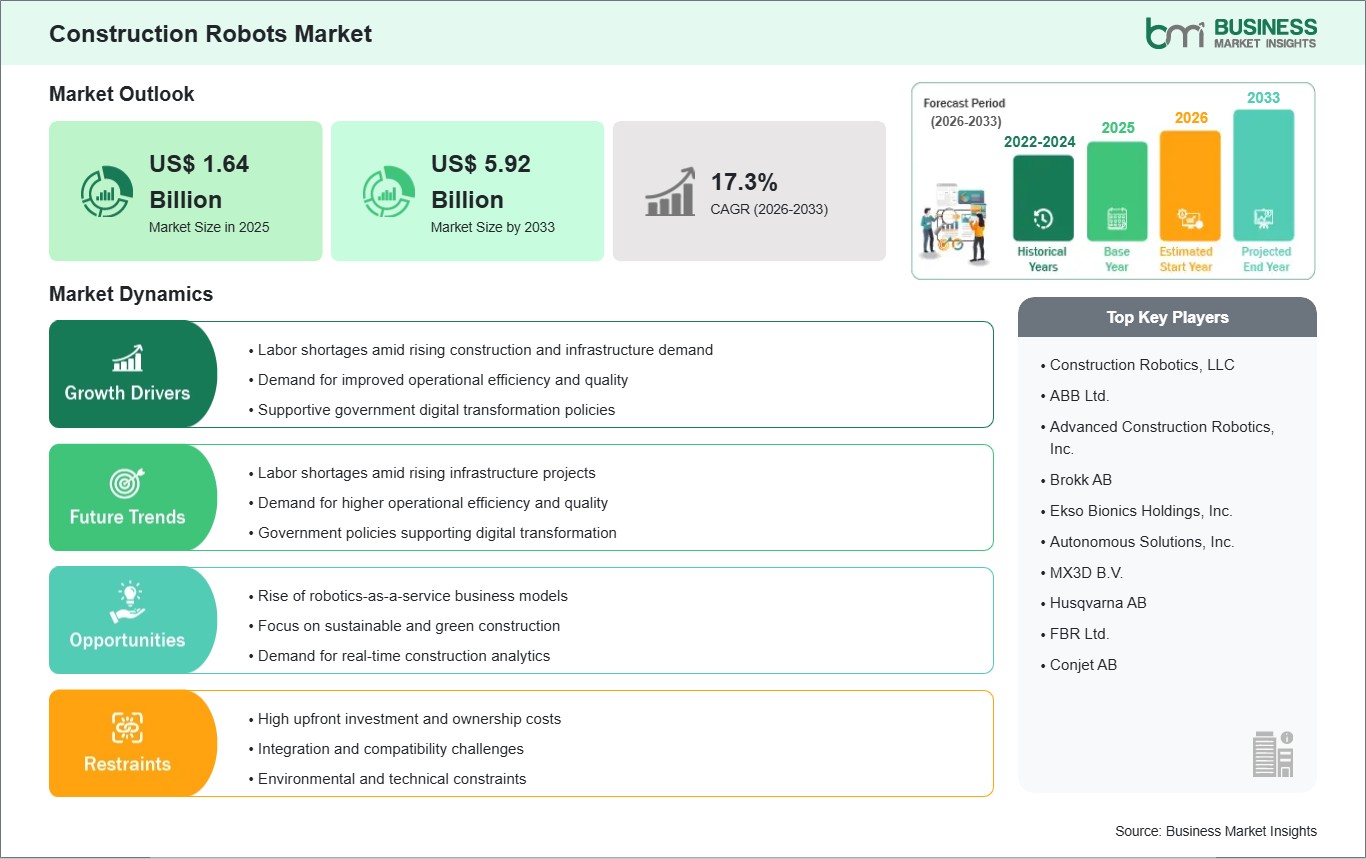
Construction robots are automated machines designed to perform tasks traditionally handled by human labor in the construction industry, such as bricklaying, concrete dispensing, demolition, welding, and site inspection. Their usage enhances efficiency, safety, and precision while reducing labor costs and project timelines. For example, robotic bricklayers can work continuously with consistent quality, and drones or autonomous vehicles can monitor large construction sites effectively. The demand for construction robots is driven by several factors: the shortage of skilled labor, rising labor costs, increasing construction activities worldwide, and the growing emphasis on safety and sustainability. Additionally, advancements in artificial intelligence, robotics, and sensor technology have made these machines more reliable and cost-effective. Urbanization and infrastructure development in emerging economies further fuel the market. Overall, construction robots are increasingly seen as a solution to modern construction challenges, balancing productivity, safety, and innovation in the evolving industry landscape.
Segment Analysis
Construction Robots Market Segmentation
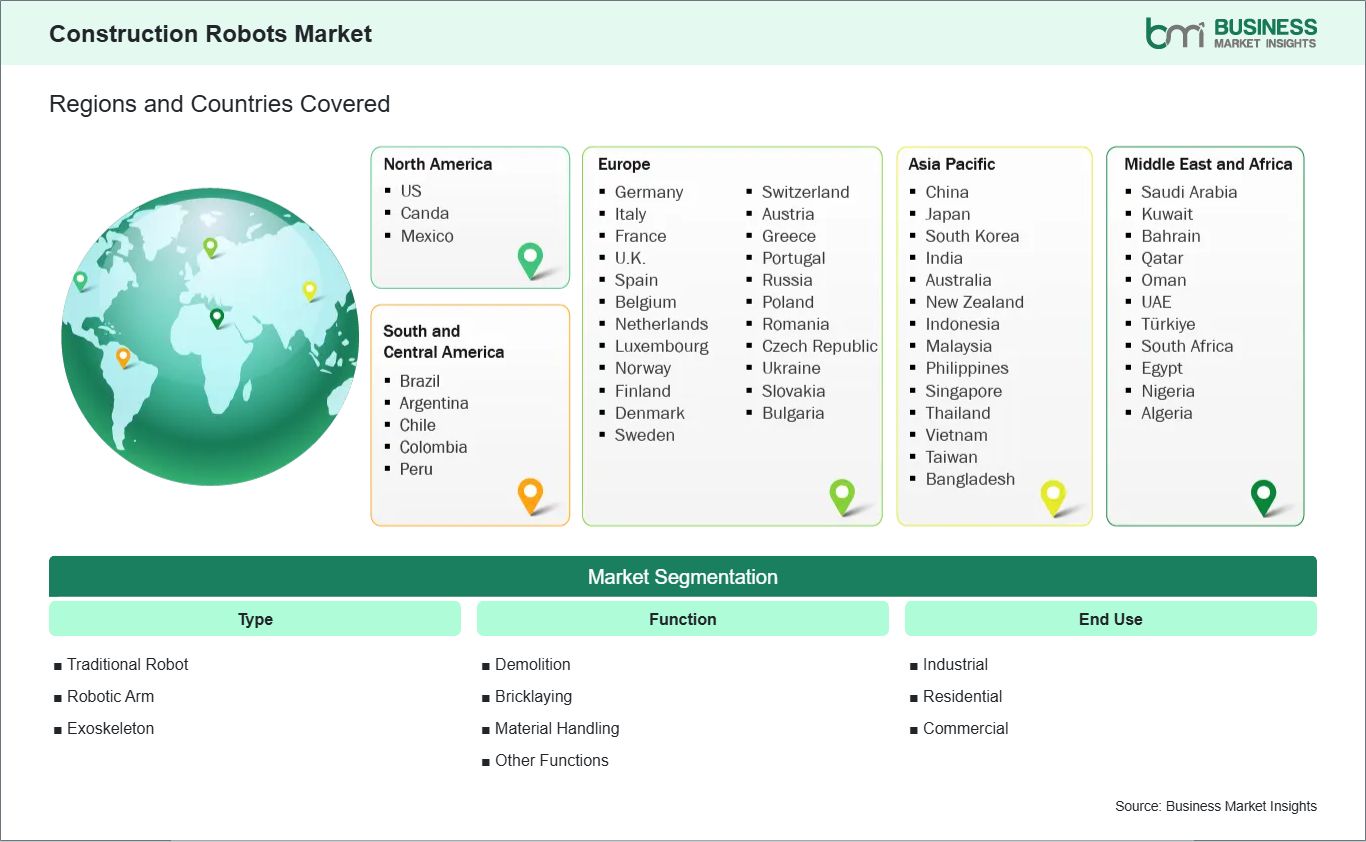
Key segments that contributed to the derivation of the construction robots market analysis are type, function, and end use.
- By type, the market is segmented into traditional robot, robotic arm, and exoskeleton. The robotic arm segment held the largest share of the market in 2025.
- By function, the market is segmented into demolition, bricklaying, material handling, and others. The material handling segment held the largest share of the market in 2025.
- By end use, the market is segmented into industrial, residential, and commercial. The industrial segment held the largest share of the market in 2025.
Market Forces
Construction Robots Market Drivers and Opportunities
Labor Shortages and Increasing Construction Demand
One of the key drivers positively impacting the construction robots market is the global shortage of skilled labor combined with rising demand for construction projects. The construction industry faces significant challenges in recruiting and retaining workers, particularly in specialized trades such as masonry, welding, and concrete placement. This shortage has led companies to adopt automation and robotics to maintain productivity and meet project deadlines. Construction robots, including bricklaying robots, autonomous drones, and concrete 3D printers, help fill labor gaps, reduce dependency on manual labor, and improve worksite safety by performing hazardous or repetitive tasks. Additionally, rapid urbanization and infrastructure development in emerging markets have increased construction demand, compelling companies to embrace robotic solutions for faster and more efficient project delivery. By addressing labor constraints and increasing efficiency, construction robots are becoming indispensable tools, driving the market’s steady growth worldwide.
Technological Advancements in Robotics and AI
A major opportunity shaping the growth of the construction robots market lies in ongoing technological advancements in robotics and artificial intelligence (AI). Innovations in machine learning, computer vision, and autonomous navigation enable construction robots to perform complex tasks with greater precision and efficiency than ever before. For instance, AI-powered drones can conduct real-time site inspections, monitor progress, and detect structural issues, significantly reducing human error. Similarly, autonomous construction machinery and robotic bricklaying systems are becoming more adaptable, capable of operating in varied site conditions while ensuring consistent quality. As technology evolves, the cost of advanced robotic systems is expected to decrease, making them accessible to small and medium-sized construction firms. This creates a significant opportunity for market expansion by integrating smarter, more efficient, and cost-effective robotic solutions into everyday construction processes, driving productivity and transforming traditional construction practices globally.
Size and Share Analysis
Construction Robots Market Size and Share Analysis
By type, the market is segmented into visible and non-visible. The robotic arm segment held the largest share of the market in 2025. Robotic arms are versatile and can perform multiple tasks such as lifting, welding, 3D printing, painting, and bricklaying. They’re popular because of their adaptability and effectiveness in complex, repetitive jobs.
By function, the market is segmented in demolition, bricklaying, material handling, and others. The material handling segment held the largest share of the market in 2025. Robots for material handling are widely used to transport heavy construction materials, improve workplace safety, reduce labor costs, and boost productivity — making them essential on construction sites globally.
By end use, the market is segmented industrial, residential, and commercial. The industrial segment held the largest share of the market in 2025. Industrial construction projects (e.g., power plants, manufacturing facilities, large warehouses) have high demand for automation to meet precision, safety, and schedule pressure, which supports adoption of robotic solutions.
Report Coverage
Construction Robots Market Report Coverage and Deliverables
The "Construction Robots Market Size and Forecast (2022 - 2033)" report provides a detailed analysis of the market covering below areas:
- Construction robots market size and forecast at global, regional, and country levels for all the key market segments covered under the scope
- Construction robots market trends, as well as market dynamics such as drivers, restraints, and key opportunities
- Construction robots market analysis covering key market trends, global and regional framework, major players, regulations, and recent market developments
- Industry landscape and competition analysis covering market concentration, heat map analysis, prominent players, and recent developments for the air circuit breaker market
- Detailed company profiles, including SWOT analysis
Geographic Insights
Construction Robots Market Geographic Insights
The geographical scope of the construction robots market report is divided into five regions: North America, Asia Pacific, Europe, Middle East & Africa, and South & Central America. The construction robots market in North America is expected to grow significantly during the forecast period.
The Asia Pacific construction robots market is segmented into China, Japan, South Korea, India, Australia, New Zealand, Indonesia, Malaysia, the Philippines, Singapore, Thailand, Vietnam, Taiwan, Bangladesh, and the Rest of Asia Pacific. Rapid urbanization and large-scale infrastructure development projects across countries such as China, India, and Japan are creating a strong demand for automation to enhance efficiency and reduce labor costs. Labor shortages and rising wages are further encouraging construction companies to adopt robotic solutions for repetitive and hazardous tasks like bricklaying, welding, and concrete dispensing.
Technological advancements, including AI, machine learning, and IoT integration, are improving the precision, adaptability, and safety of construction robots, making them more attractive to industry players. Additionally, government initiatives promoting smart cities and sustainable construction practices are accelerating the adoption of robotics to improve productivity while reducing environmental impact. As these factors converge, the Asia Pacific construction robots market is poised for robust growth, driven by the need for efficiency, safety, and cost-effective construction solutions.
Industry Activity
Recent Developments
The construction robots market is evaluated by gathering qualitative and quantitative data post primary and secondary research, which includes important corporate publications, association data, and databases. A few of the key developments in the construction robots market are:
- In August 2025, ABB Robotics is enabling faster, safer and more cost-effective rebuilding in areas devastated by the 2025 Southern Californian wildfires through a collaboration with Cosmic Buildings - a leading construction technology company that uses proprietary mobile robotic microfactories. After the wildfires burned thousands of acres, destroying homes, infrastructure, and natural habitats, this pioneering initiative will deploy the microfactory in Pacific Palisades, California, to build modular structures onsite, offering a glimpse into the future of affordable housing construction.
- In March 2023, Advanced Construction Robotics (ACR) launch its second product, IronBOT, during ConExpo, the largest gathering of construction professionals in North America, held in Las Vegas, Nevada. IronBOT augments construction crews by lifting, carrying, and placing up to 5,000-pound bundles of rebar in a transverse or longitudinal orientation without the need for heavy lifting from crewmembers.
Trust & Transparency
Research Methodology
The market analysis combines proprietary research with secondary data from government agencies, company disclosures, regulatory filings, industry databases and expert interviews. Market estimates are validated through data triangulation, cross-market benchmarking and analyst
review.
View Full Research Methodology
Key Sources Referred:
World Bank - Global Trade Indicators World Trade Organization (WTO) International Monetary Fund (IMF) International Trade Administration (ITA) Company website Company annual reports Company investor presentations