Market Summary
Executive Summary and Global Market Analysis
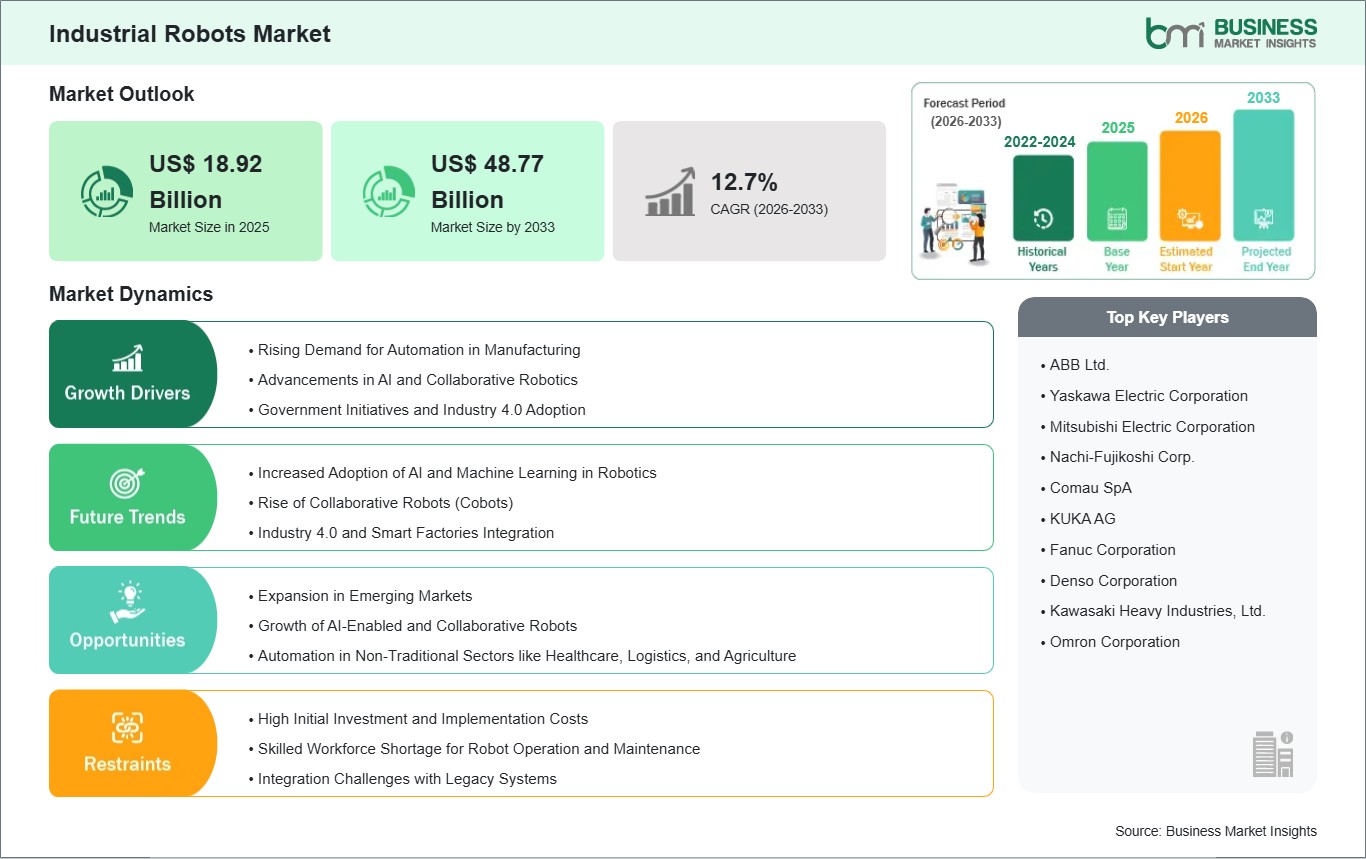
The market for industrial robots is expanding rapidly due to rising automation in the manufacturing, automotive, electronics, and logistics industries. Robots are being used by businesses to lower labor costs and human error while increasing productivity, accuracy, and operational efficiency. Smarter, safer, and more adaptable operations are made possible by developments in AI, machine learning, and collaborative robot technologies. Additionally, industries are being forced to incorporate robotic solutions due to the growing demand for high-quality manufacturing and shorter production cycles.
The market for industrial robots is growing quickly worldwide, with Asia-Pacific leading due to robust industrialization, especially in China, Japan, and South Korea. To increase productivity and stay competitive, North America and Europe are concentrating on replacing outdated systems with cutting-edge robotic solutions. In order to modernize manufacturing processes, emerging economies in South & Central America, the Middle East, and Africa are progressively implementing robots. Innovation, customization, and technology integration are important differentiators among suppliers in the market, which is still very competitive.
Segment Analysis
Industrial Robots Market Segmentation
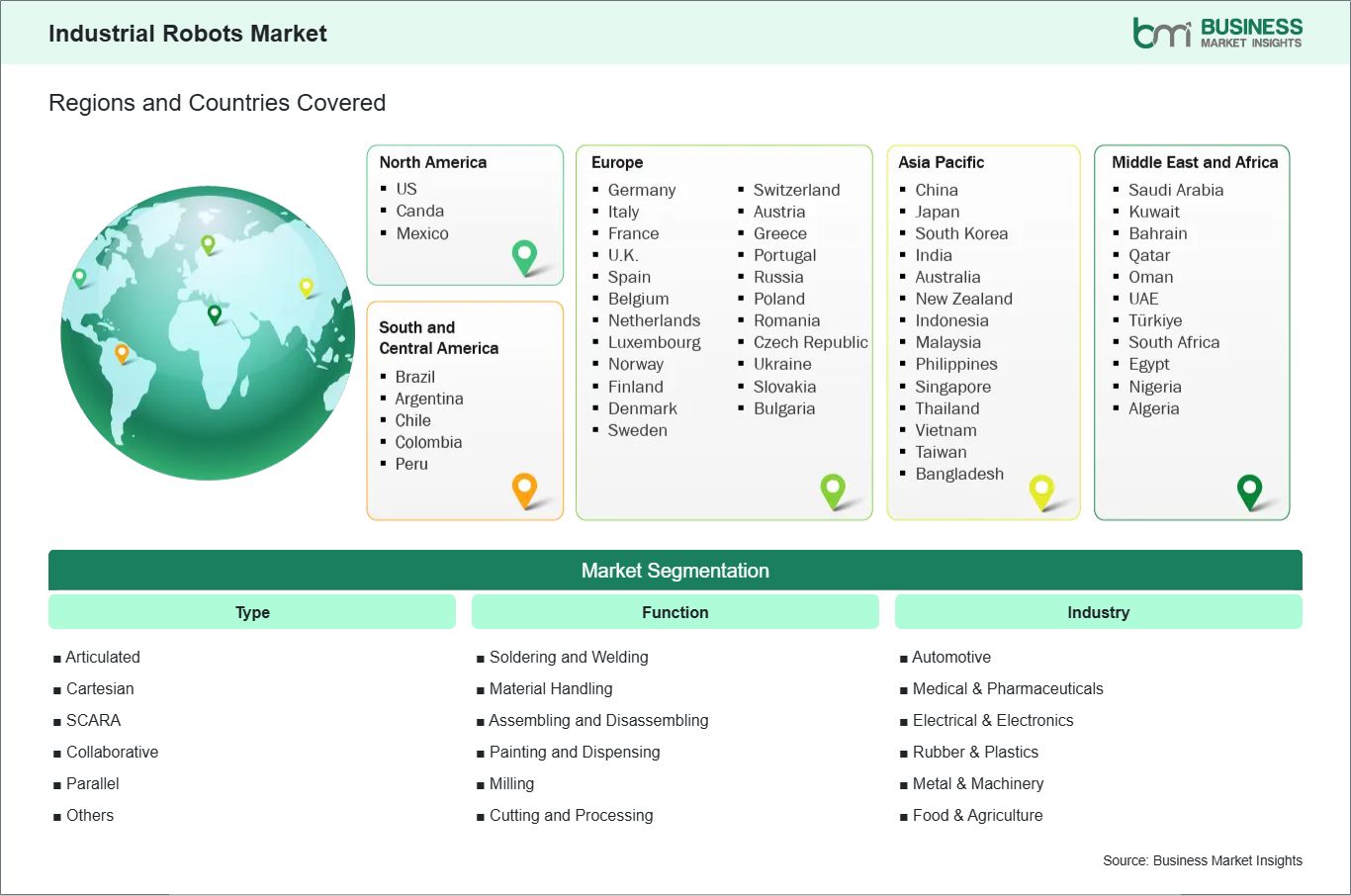
Key segments that contributed to the derivation of the industrial robots market analysis are type, function, and industry.
- By type, the industrial robots market is segmented into articulated, cartesian, SCARA, collaborative, parallel, and others. The articulated segment dominated the market in 2024.
- By function, the market is segmented into soldering and welding, material handling, assembling and disassembling, painting and dispensing, milling, and cutting and processing. The material handling segment held the largest share of the market in 2024.
- By industry, the industrial robots market is segmented into automotive, medical & pharmaceuticals, electrical & electronics, rubber & plastics, metal & machinery, and food & agriculture. The agriculture segment dominated the market in 2024.
Market Forces
Industrial Robots Market Drivers and Opportunities
Increasing Automation in Manufacturing
The increasing need for automation in manufacturing sectors to improve productivity, efficiency, and product quality is the main driver of the industrial robots market. Robots are being used by industries like automotive, electronics, and logistics to cut labour costs, minimise errors, and produce consistent results. Businesses are being encouraged to incorporate robotic solutions due to the growing demand for high-precision manufacturing and quicker production cycles. Widespread adoption is further supported by technological developments like AI, machine learning, and cooperative robots. Manufacturers are also pushed towards robotic automation by safety and quality regulations.
Adoption of Collaborative and AI-Enabled Robots
The market for industrial robots has a lot of potential due to the expanding trend of AI-enabled robotic systems and collaborative robots, or cobots. Cobots increase production process flexibility by enabling safe collaboration between humans and robots. Predictive maintenance, real-time process optimisation, and intelligent decision-making are made possible by the integration of AI and machine learning, increasing operational effectiveness. Additionally, because robots are more affordable and easier to use, small and medium-sized businesses are using them more frequently. Growth potential is further expanded by entering emerging markets and developing new industry applications.
Size and Share Analysis
Industrial Robots Market Size and Share Analysis
By type, the industrial robots market is segmented into articulated, cartesian, SCARA, collaborative, parallel, and others. The articulated segment dominated the market in 2024 due to its high flexibility, wide range of motion, and suitability for complex tasks across multiple industries.
By function, the market is segmented into soldering and welding, material handling, assembling and disassembling, painting and dispensing, milling, and cutting and processing. The material handling segment held the largest share of the market in 2024 because it improves operational efficiency, reduces labor costs, and is widely applicable across manufacturing and logistics processes.
By industry, the industrial robots market is segmented into automotive, medical & pharmaceuticals, electrical & electronics, rubber & plastics, metal & machinery, and food & agriculture. The agriculture segment dominated the market in 2024 owing to the increasing adoption of automation for planting, harvesting, sorting, and packaging to address labor shortages and improve productivity.
Report Coverage
Industrial Robots Market Report Coverage and Deliverables
The Industrial Robots Market Size and Forecast (2022–2033) report provides a detailed analysis of the market covering below areas:
- Industrial Robots market size and forecast at global, regional, and country levels for all the key market segments covered under the scope
- Industrial Robots market trends, as well as market dynamics such as drivers, restraints, and key opportunities
- Industrial Robots market analysis covering key market trends, global and regional framework, major players, regulations, and recent market developments
- Industry landscape and competition analysis covering market concentration, heat map analysis, prominent players, and recent developments for the Industrial Robots market
- Detailed company profiles, including SWOT analysis
Geographic Insights
Industrial Robots Market Geographic Insights
The geographical scope of the industrial robots market report is divided into five regions: North America, Asia Pacific, Europe, Middle East & Africa, and South & Central America. The industrial robots market in Asia Pacific is expected to grow significantly during the forecast period.
The industrial robots market is expanding rapidly across the globe, driven by rising demand for automation, efficiency, and smart manufacturing solutions. Asia-Pacific leads the market, supported not only by rapid industrialization and strong manufacturing infrastructure in China, Japan, and South Korea, but also by government incentives and a high concentration of electronics and automotive production. North America maintains steady growth, with the automotive and electronics sectors increasingly adopting AI-enabled and collaborative robots to improve flexibility and productivity.
Europe is focused on modernizing legacy systems with energy-efficient and high-precision robots, leveraging Industry 4.0 initiatives to enhance competitiveness and meet stringent quality standards. Meanwhile, Latin America, the Middle East, and Africa are emerging markets, gradually embracing industrial robots for modernization, with opportunities in automotive, logistics, and resource-based industries. Additionally, countries with high robot density, like South Korea and Germany, illustrate that advanced robotics adoption correlates strongly with industrial efficiency and global competitiveness.
Industry Activity
Recent Developments
The Industrial Robotsmarket is evaluated by gathering qualitative and quantitative data post primary and secondary research, which includes important corporate publications, association data, and databases. A few of the key developments in the Industrial Robots market are:
- In November 2025, Agile Robots launched its first humanoid industrial robot, Agile ONE, designed to work safely and efficiently alongside humans and other robotic systems in industrial settings. The robot features highly dexterous hands, an AI model trained on real‑world industrial data, and advanced human‑robot interaction capabilities. Full production of Agile ONE is planned to begin in early 2026 at its new facility in Bavaria, Germany.
- In 24 June 2025, ABB expanded its large industrial robot portfolio with the launch of three new models: IRB 6730S, IRB 6750S, and IRB 6760, adding to its next‑generation lineup now comprising 11 robot families with 60 variants. The new robots, powered by ABB’s OmniCore™ controllers, deliver enhanced flexibility, performance, and sustainability benefits, including increased payload capacity and energy efficiency. These robots are designed for applications such as die casting, injection molding, press tending, and general manufacturing, helping companies improve productivity and address labor challengesks.
Trust & Transparency
Research Methodology
The market analysis combines proprietary research with secondary data from government agencies, company disclosures, regulatory filings, industry databases and expert interviews. Market estimates are validated through data triangulation, cross-market benchmarking and analyst
review.
View Full Research Methodology
Key Sources Referred:
International Federation of Robotics (IFR)
OECD – Industrial Robotics and the Global Organisation of Production
World Bank – Global Trade Indicators
International Trade Administration (ITA)
Company website
Company annual reports
Company investor presentations