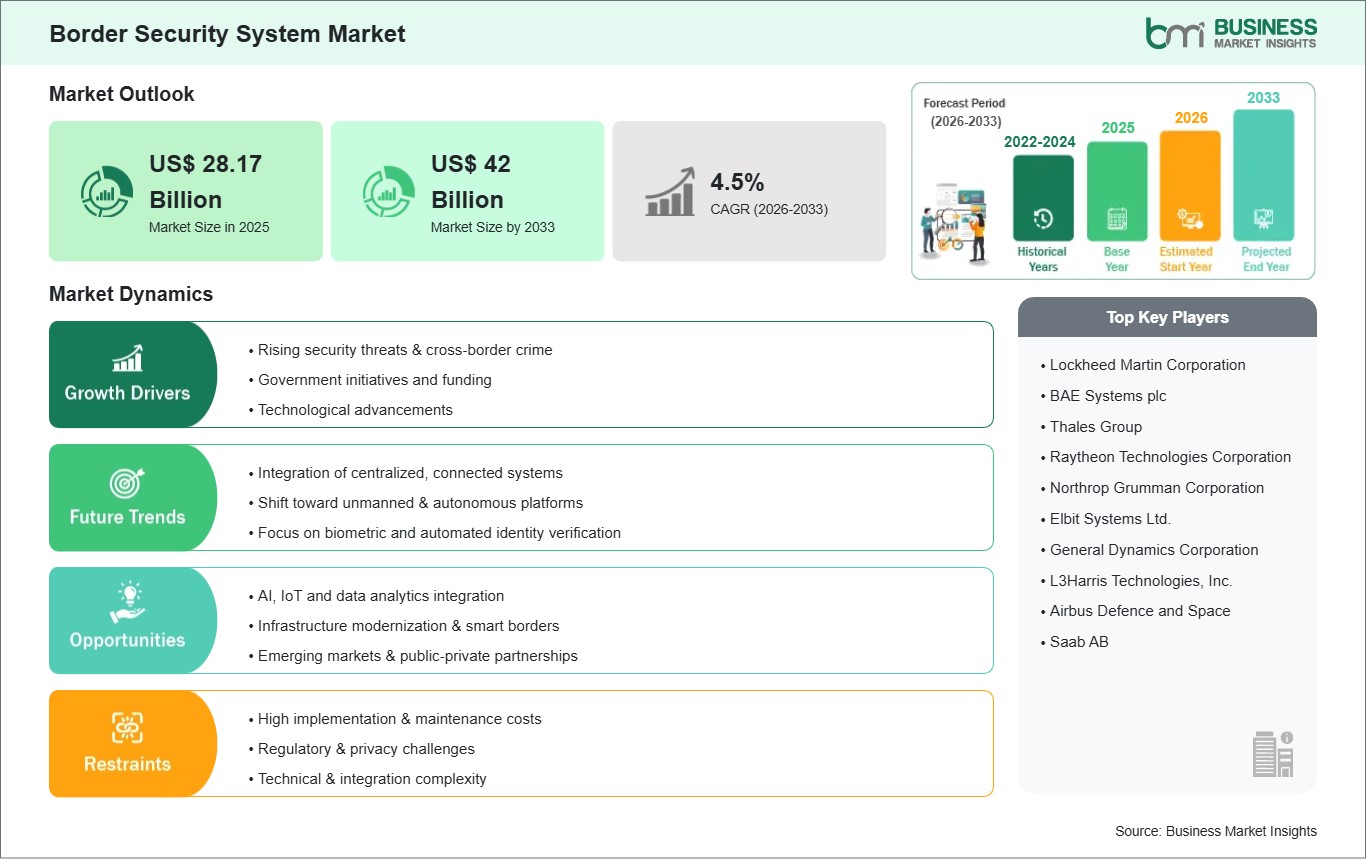
The border security system market size is expected to reach US$42.0 billion by 2033 from US$28.17 billion in 2025. The market is estimated to record a CAGR of 4.47% from 2026 to 2033.
The global border security system market is witnessing steady growth driven by rising cross-border threats, illegal migration, smuggling, and geopolitical tensions. Governments worldwide are prioritizing advanced border management solutions to enhance national security and safeguard critical infrastructure. Technological advancements such as AI-enabled surveillance, integrated command and control systems, drones, radar, and biometric identification are transforming traditional border security into smart, network-centric ecosystems. Increasing defense budgets, especially in emerging economies, along with the modernization of legacy systems in developed regions, are further accelerating market adoption. The demand spans land, maritime, and airborne domains, reflecting the need for comprehensive, multi-layered security coverage.
Additionally, collaboration between defense agencies and private technology providers is fostering innovation. As borders become more complex to monitor, integrated and interoperable security systems are becoming essential, positioning the market for sustained long-term expansion. The market is also shaped by regulatory mandates and international security cooperation aimed at combating terrorism and transnational crime. Homeland security agencies are increasingly adopting data-driven and real-time monitoring solutions to improve situational awareness and response times. New installations account for a significant share, particularly in developing regions, while upgrades dominate mature markets seeking enhanced capabilities.

Key segments that contributed to the derivation of the Border security system market analysis are Type, Deployment, and Application.
The increasing frequency of cross-border threats such as illegal immigration, human trafficking, drug smuggling, arms trading, and terrorism is a major driver of the global border security system market. Geopolitical instability, regional conflicts, and porous borders have heightened security risks for many nations, compelling governments to strengthen border control mechanisms. Traditional border monitoring methods are no longer sufficient to detect sophisticated and organized threats. As a result, countries are investing heavily in advanced surveillance, detection, and command-and-control systems that provide real-time intelligence and rapid response capabilities. The growing need to safeguard national sovereignty, protect citizens, and secure critical infrastructure continues to push demand for integrated and technologically advanced border security solutions worldwide.
The integration of artificial intelligence, machine learning, and advanced data analytics presents a significant growth opportunity for the border security system market. AI-powered systems can process vast amounts of surveillance data to detect anomalies, predict threats, and reduce false alarms, thereby improving operational efficiency. Advanced analytics enable real-time decision-making and proactive threat mitigation rather than reactive responses. Additionally, AI-driven automation reduces manpower requirements and operational costs, making large-scale border monitoring more feasible. As governments move toward smart border initiatives, vendors offering AI-enabled, interoperable, and scalable solutions can gain a competitive advantage. This technological evolution is expected to reshape border security strategies and unlock long-term market potential.
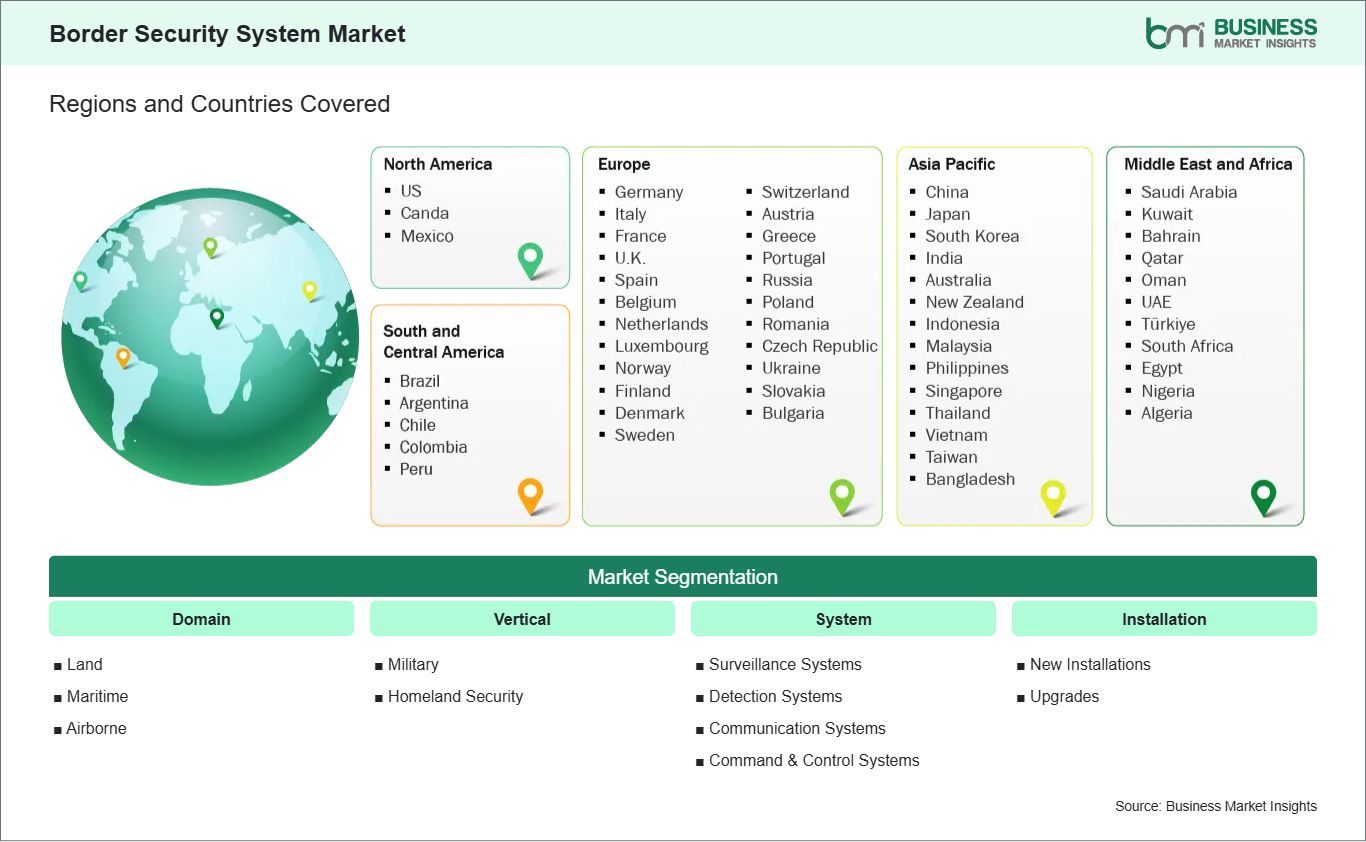
By Domain, the market is segmented into Land, Maritime, and Airborne. The Land segment dominated the market in 2025. Land-based border security dominates the market due to the extensive land borders shared by many countries and the high frequency of illegal crossings, smuggling, and infiltration attempts. Governments prioritize land borders for deploying surveillance towers, sensors, radars, and intelligent fencing. Persistent threats and easier accessibility make land borders the primary focus of security investments.
By Vertical, the market is segmented into Military, Homeland Security. The Homeland Security segment held the largest share of the market in 2025. Homeland security is the leading vertical as civilian border protection, immigration control, and counter-terrorism fall primarily under national security agencies. Increasing migration pressures and transnational crime have pushed governments to strengthen border monitoring and response capabilities. Homeland security agencies drive demand for integrated, real-time, and intelligence-led border security solutions globally.
By System, the market is segmented into Surveillance Systems, Detection Systems, Communication Systems, and Command & Control Systems. The Surveillance Systems segment held the largest share of the market in 2025. Surveillance systems hold the largest market share due to their critical role in continuous border monitoring. Technologies such as CCTV, thermal cameras, UAVs, and ground sensors enable early threat detection and situational awareness. Their scalability, compatibility with AI analytics, and ability to operate across land, air, and maritime domains make them indispensable.
By Installation, the market is segmented into New Installations, Upgrades. The New Installations segment held the largest share of the market in 2025. New installations dominate the market, particularly in developing and emerging economies where border infrastructure is still evolving. Countries are establishing entirely new security frameworks to address modern threats. These projects involve large-scale deployment of surveillance, detection, and command systems, contributing significantly to overall market revenues.

| Report Attribute | Details |
|---|---|
| Market size in 2025 | US$ 28.17 Billion |
| Market Size by 2033 | US$ 42 Billion |
| Global CAGR (2026 - 2033) | 4.5% |
| Historical Data | 2022-2024 |
| Forecast period | 2026-2033 |
| Segments Covered | By Domain
|
| Regions and Countries Covered | North America
|
| Market leaders and key company profiles |
|
The "Border Security System Market Size and Forecast (2022–2033)" report provides a detailed analysis of the market covering below areas:
The geographical scope of the Border security system market report is divided into five regions: North America, Asia Pacific, Europe, Middle East & Africa, and South & Central America. The Border security system market in Asia Pacific is expected to grow significantly during the forecast period.
The Asia-Pacific Border security system market is segmented into China, Japan, South Korea, India, Australia, New Zealand, Indonesia, Malaysia, the Philippines, Singapore, Thailand, Vietnam, Taiwan, Bangladesh, and the Rest of Asia. The Asia Pacific region represents a high-growth market for border security systems due to rising geopolitical tensions, territorial disputes, and increasing cross-border movement. Countries such as China, India, Japan, and Australia are investing heavily in modern border surveillance and monitoring technologies to safeguard land and maritime boundaries. Expanding defense budgets, long land borders, and coastal vulnerabilities are driving demand for advanced surveillance, detection, and command systems.
Additionally, government-led modernization programs and smart border initiatives are accelerating the adoption of AI-enabled surveillance, drones, and integrated security platforms, positioning the Asia Pacific as a key contributor to future market growth.

The Border security system market is evaluated by gathering qualitative and quantitative data post primary and secondary research, which includes important corporate publications, association data, and databases. A few of the key developments in the Border security system market are:
The Border Security System Market is valued at US$ 28.17 Billion in 2025, it is projected to reach US$ 42 Billion by 2033.
As per our report Border Security System Market, the market size is valued at US$ 28.17 Billion in 2025, projecting it to reach US$ 42 Billion by 2033. This translates to a CAGR of approximately 4.5% during the forecast period.
The Border Security System Market report typically cover these key segments-
The historic period, base year, and forecast period can vary slightly depending on the specific market research report. However, for the Border Security System Market report:
The Border Security System Market is populated by several key players, each contributing to its growth and innovation. Some of the major players include:
The Border Security System Market report is valuable for diverse stakeholders, including:
Essentially, anyone involved in or considering involvement in the Border Security System Market value chain can benefit from the information contained in a comprehensive market report.
Please tell us your area of interest
(Market Segments/ Regions and Countries/ Companies)