Market Summary
Executive Summary and Global Market Analysis
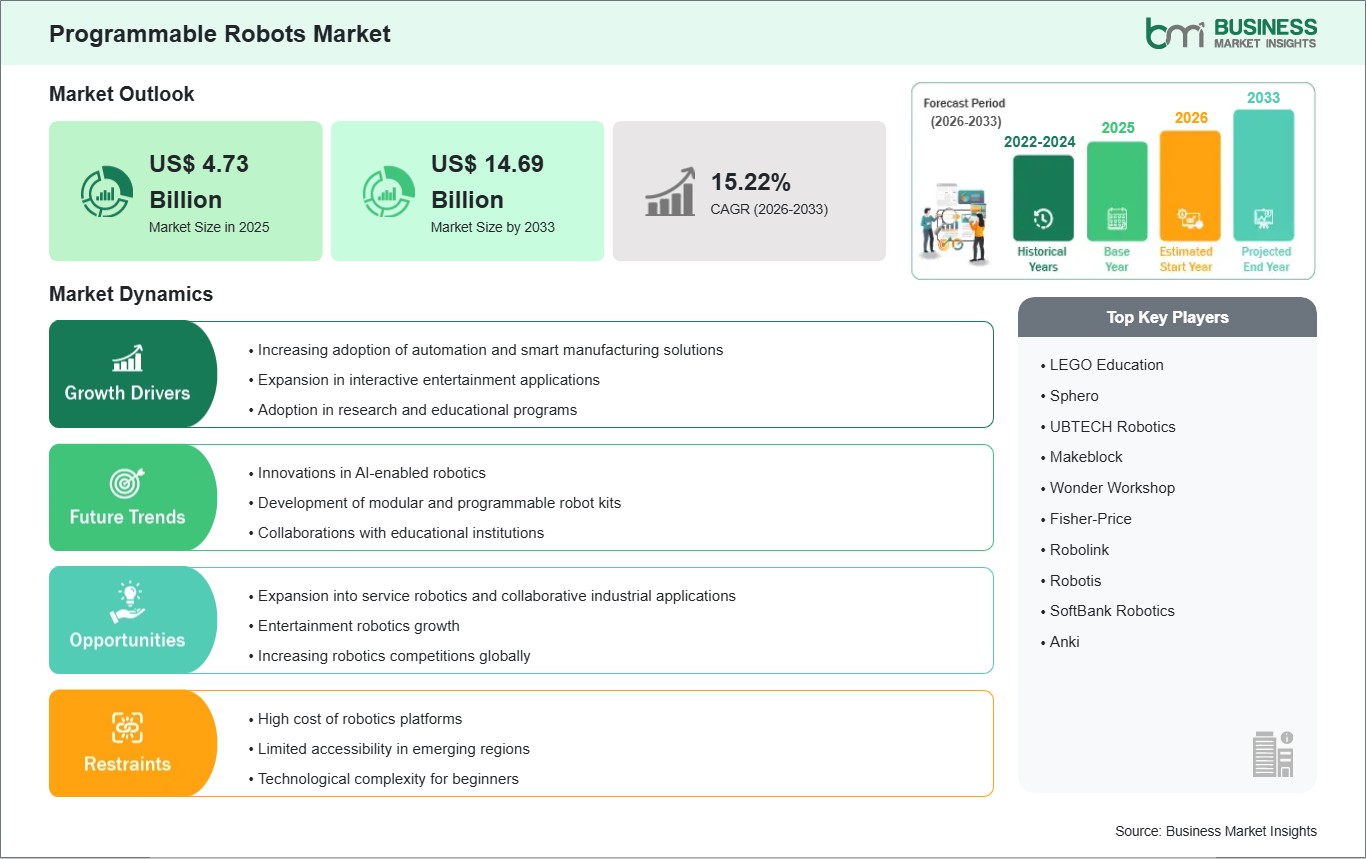
The global programmable robots market is witnessing substantial growth as robotics technologies become increasingly integrated into education, research, and interactive entertainment applications. Programmable robots are robotic systems that can be programmed using various coding languages or software platforms, allowing users to control their behavior, movement, and functionality. These robots are widely used in educational institutions, robotics competitions, research laboratories, and consumer entertainment products.
The growing emphasis on STEM (science, technology, engineering, and mathematics) education has significantly accelerated the adoption of programmable robots in schools and universities. Educational institutions are increasingly incorporating robotics kits and programmable robot platforms into their curricula to enhance students’ coding skills, problem-solving abilities, and hands-on learning experiences. These robots provide an interactive way for students to understand programming concepts and engineering principles.
Technological advancements in artificial intelligence, machine learning, and sensor technologies are further enhancing the capabilities of programmable robots. Modern programmable robots are equipped with advanced sensors, cameras, and wireless connectivity, enabling them to perform complex tasks and interact with their environments more effectively. These innovations have expanded their applications beyond education into research and entertainment sectors.
The competitive landscape of the programmable robots market is characterized by continuous product innovation and strategic partnerships between robotics companies, educational institutions, and technology providers. Manufacturers are focusing on developing user-friendly programming interfaces, modular robot platforms, and cloud-based programming tools that make robotics accessible to beginners and advanced users alike. As digital learning and robotics education continue to expand globally, programmable robots are expected to play an increasingly important role in technology-driven learning environments.
Segment Analysis
Programmable Robots Market Segmentation
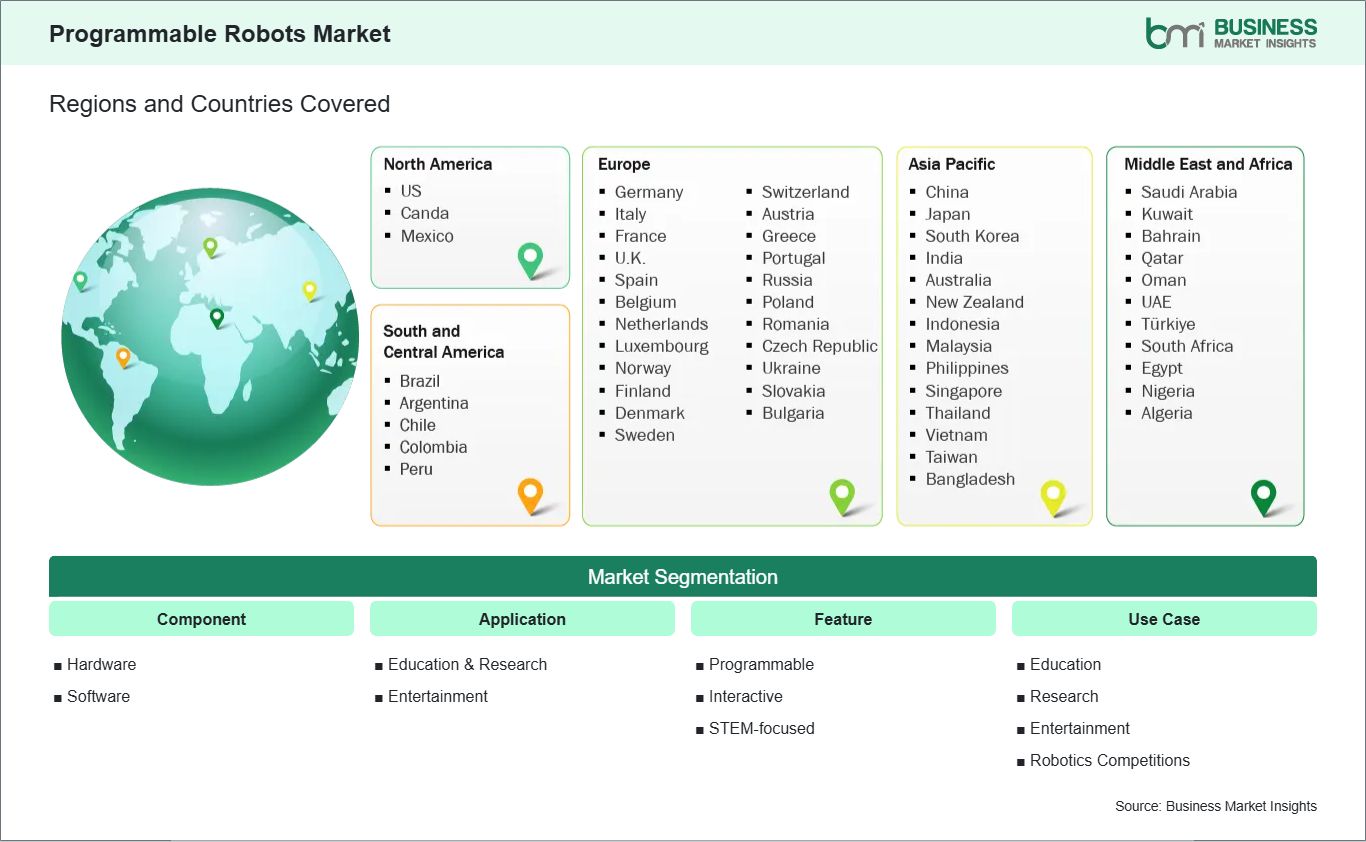
Key segments that contributed to the derivation of the programmable robots market analysis are component and application.
- By component, the programmable robots market is segmented into hardware and software. The hardware segment dominated the market in 2025.
- In terms of application, the market is segmented into education & research and entertainment. The education & research segment dominated the market in 2025.
Market Forces
Programmable Robots Market Drivers and Opportunities
Growing Emphasis on STEM Education
The increasing focus on STEM education worldwide is one of the major factors driving the growth of the programmable robots market. Educational institutions are integrating robotics and programming into their curricula to help students develop practical technical skills. Programmable robots provide an interactive learning environment where students can experiment with coding, engineering design, and robotics principles.
These robots allow learners to build, program, and control robotic systems using visual programming languages or text-based coding platforms. This hands-on approach improves engagement and helps students better understand complex technical concepts. Robotics competitions and innovation programs organized by educational institutions and technology organizations are also encouraging students to explore robotics technologies.
Governments and educational organizations across many countries are investing in digital learning infrastructure and robotics education initiatives. These programs aim to prepare students for careers in technology-driven industries by developing skills related to automation, artificial intelligence, and programming.
Expanding Entertainment and Consumer Robotics Applications
The expansion of entertainment robotics and consumer robotics applications is creating new opportunities for the programmable robots market. Programmable robots are increasingly being used as interactive toys, gaming devices, and entertainment platforms. These robots allow users to program movements, perform tasks, and interact with digital applications, creating engaging experiences for users of all ages.
Advancements in robotics hardware and software technologies are enabling the development of highly interactive and customizable robot platforms equipped with sensors, cameras, and wireless connectivity.
Programmable robots are also being used in theme parks, exhibitions, and educational entertainment programs where their ability to perform programmed actions and interact with audiences creates engaging experiences.
Size and Share Analysis
Programmable Robots Market Size and Share Analysis
The Programmable Robots Market demonstrates steady growth, with size and share analysis highlighting evolving trends and competitive dynamics among key players. The report examines subsegments categorized within component and application.
By component, the hardware subsegment dominated the market in 2025, driven by the high demand for programmable robot kits, control boards, sensors, and mechanical components required for robot assembly and operation.
In terms of application, the education & research subsegment dominated the market in 2025, driven by increasing adoption of robotics education programs and expanding research initiatives focused on robotics and automation technologies.
Report Coverage
Programmable Robots Market Report Coverage and Deliverables
The "Programmable Robots Market Size and Forecast (2022 - 2033)" report provides a detailed analysis of the market covering below areas:
- Programmable Robots Market size and forecast at global, regional, and country levels for all key market segments covered under the scope
- Programmable Robots Market trends, drivers, restraints, and opportunities
- Programmable Robots Market analysis covering key trends, global and regional framework, major players, regulations, and recent developments
- Industry landscape and competition analysis covering market concentration, heat map analysis, and prominent players
- Detailed company profiles including SWOT analysis
Geographic Insights
Programmable Robots Market Geographic Insights
The geographical scope of the Programmable Robots Market report is divided into North America, Asia Pacific, Europe, Middle East & Africa, and South & Central America. North America held the largest share in 2025.
North America is a leading region due to the strong presence of robotics companies, advanced educational institutions, and widespread adoption of technology-driven learning programs. Schools and universities in the United States and Canada are increasingly integrating robotics platforms into STEM education initiatives.
Asia Pacific represents another rapidly growing region as countries such as China, Japan, and South Korea invest heavily in robotics research and education programs to strengthen their technological capabilities.
Europe is also witnessing strong growth supported by government initiatives promoting digital education and robotics innovation in countries such as Germany, the United Kingdom, and France.
Meanwhile, emerging markets in Latin America and the Middle East & Africa are gradually adopting programmable robotics technologies in educational institutions and entertainment applications.
Industry Activity
Recent Developments
The Programmable Robots Market is evaluated by gathering qualitative and quantitative data post primary and secondary research. A few of the key developments in the programmable robots market are,
- In March 2024, LEGO Education introduced new programmable robotics learning kits designed to support coding and robotics education in classrooms.
- In January 2024, Sphero launched an upgraded programmable robot platform designed for STEM education programs with enhanced sensors and improved coding capabilities.
Trust & Transparency
Research Methodology
The market analysis combines proprietary research with secondary data from government agencies, company disclosures, regulatory filings, industry databases and expert interviews. Market estimates are validated through data triangulation, cross-market benchmarking and analyst
review.
View Full Research Methodology
Key Sources Referred:
International Federation of Robotics (IFR)International Trade AdministrationUNESCOInternational Bar AssociationInternational Trade Administration