Market Summary
Executive Summary and Global Market Analysis
Military robots are advanced autonomous and semi-autonomous systems designed to support defense and security operations across land, airborne, and marine environments. These robotic systems play a critical role in modern military operations by enabling intelligence gathering, surveillance, reconnaissance, combat support, logistics transportation, explosive ordnance disposal (EOD), and mission-critical tactical operations while minimizing risks to human soldiers. Military robots integrate advanced technologies such as artificial intelligence (AI), machine learning, sensors, computer vision, autonomous navigation, robotic arms, and secure communication systems to operate effectively in complex and hostile battlefield conditions.
The market is experiencing substantial growth due to rising global defense spending, increasing geopolitical conflicts, and growing demand for force modernization across major military powers. Governments worldwide are increasingly investing in unmanned and robotic systems to improve operational efficiency, enhance battlefield awareness, and reduce human casualties during high-risk military missions. The rapid adoption of unmanned ground vehicles (UGVs), unmanned aerial vehicles (UAVs), autonomous underwater systems, and robotic combat platforms is significantly accelerating market expansion. In addition, advancements in AI-enabled autonomy, edge computing, swarm robotics, and sensor fusion technologies are supporting the development of next-generation military robots capable of operating in multi-domain warfare environments.
However, market growth is constrained by several technological, operational, and regulatory challenges. Military robots require high investments in research, testing, system integration, and deployment, creating procurement barriers for budget-constrained defense organizations. Autonomous robotic systems also face operational limitations related to cybersecurity vulnerabilities, communication disruptions, navigation accuracy, and reliability in harsh combat conditions. Furthermore, ethical concerns surrounding autonomous weapons systems, stringent defense regulations, export restrictions, and dependence on advanced semiconductor and sensor technologies may create deployment delays and supply chain complexities for manufacturers and military agencies.
Despite these challenges, the market outlook remains highly positive due to continuous innovation in autonomous defense technologies and increasing military modernization initiatives worldwide. Emerging opportunities are being created through the development of AI-powered combat robots, autonomous drone swarms, robotic logistics vehicles, and underwater surveillance systems. The growing focus on border security, counterterrorism operations, urban warfare capabilities, and integrated battlefield management systems is expected to create long-term demand for advanced military robots. Additionally, increasing investments in autonomous navigation, collaborative robotics, and multi-domain military operations are accelerating the adoption of intelligent robotic systems capable of supporting future defense mission requirements.
Segment Analysis
Military Robots Market Segmentation
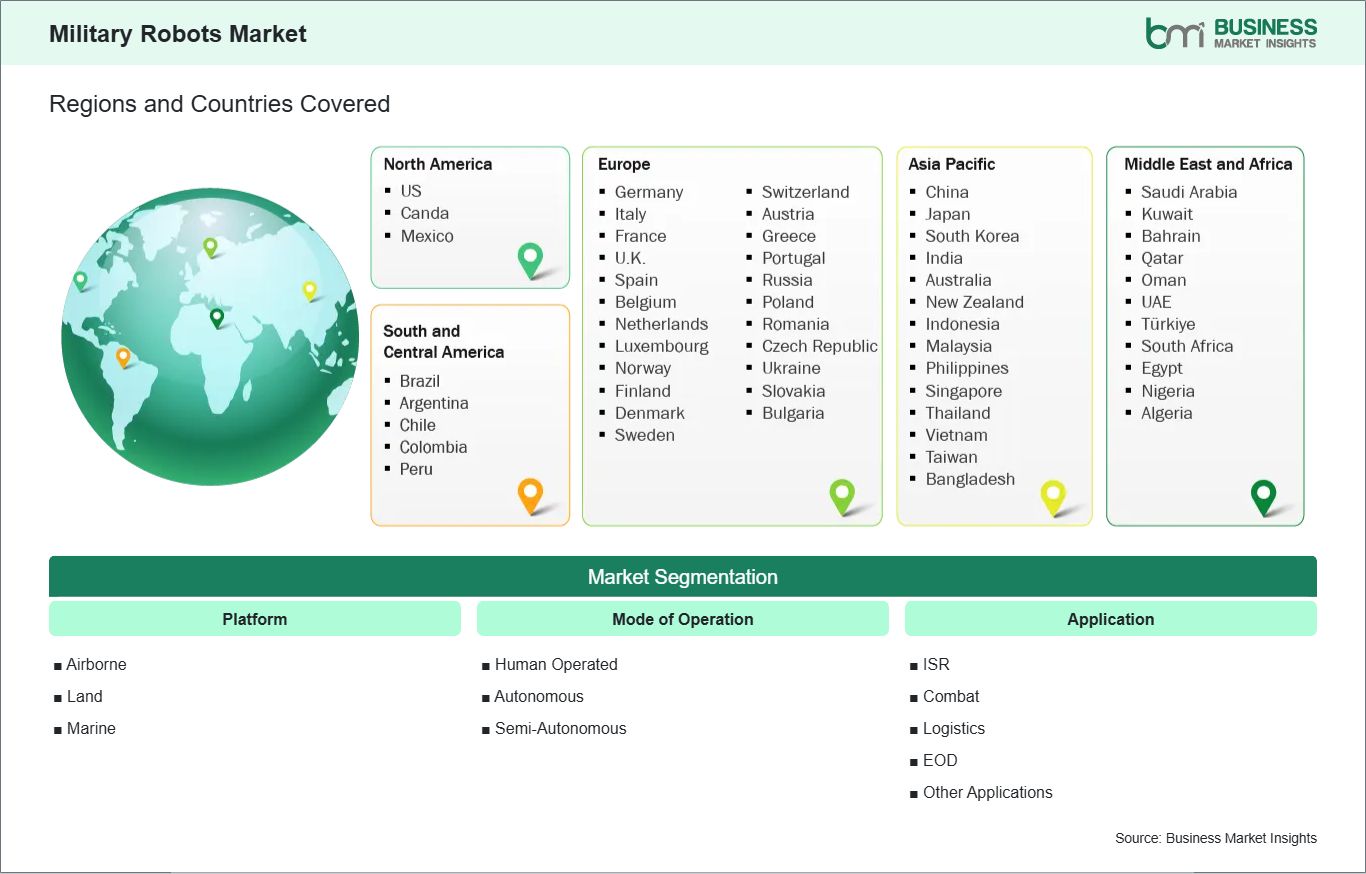
The military robots market is segmented based on platform, mode of operation, and application, reflecting the growing demand for advanced imaging and depth-sensing solutions across multiple applications.
By Platform
- Airborne: Robotic aerial systems including UAVs and autonomous drones used for ISR missions, combat support, surveillance, border patrol, and tactical strike operations
- Land: Ground-based robotic systems deployed for reconnaissance, combat support, EOD operations, logistics transportation, and battlefield surveillance applications
- Marine: Autonomous and remotely operated naval robotic systems designed for underwater surveillance, mine countermeasures, maritime patrol, anti-submarine warfare, and naval intelligence missions
By Mode of Operation
- Human Operated: Robotic systems fully controlled by military personnel for mission execution, surveillance, navigation, and tactical battlefield operations
- Autonomous: AI-enabled robots capable of independently performing navigation, threat detection, surveillance, and mission-critical operations with minimal human intervention
- Semi-Autonomous: Hybrid robotic systems combining autonomous functionalities with human supervision for enhanced operational flexibility and mission control
By Application
- ISR: Military robots used for intelligence, surveillance, and reconnaissance operations to support real-time situational awareness and threat monitoring
- Combat: Robotic systems integrated into combat missions for tactical engagement, remote weapon deployment, perimeter security, and battlefield support operations
- Logistics: Autonomous and semi-autonomous robots designed for cargo transportation, supply chain management, medical evacuation, and troop support missions
- EOD: Specialized robotic systems used for explosive ordnance disposal, bomb detection, hazardous material handling, and counter-IED operations
- Other Applications: Includes search and rescue, communication support, cyber defense assistance, training simulations, and disaster response operations
Market Forces
Military Robots Market Drivers and Opportunities
Increasing Adoption of Autonomous Warfare and Unmanned Defense Systems
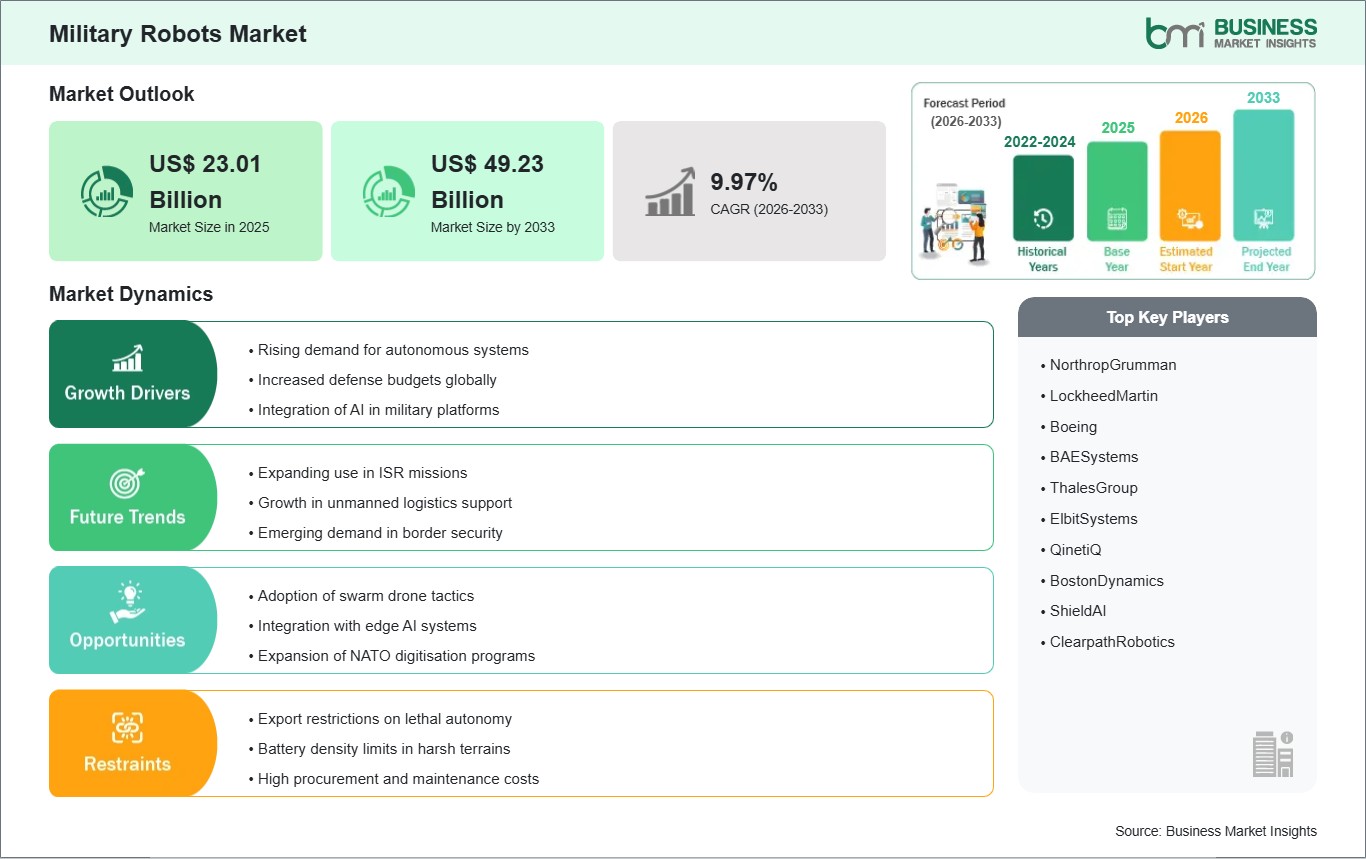
The military robots market is witnessing significant growth due to the increasing adoption of autonomous warfare technologies and unmanned defense systems across global military operations. Defense organizations are rapidly modernizing armed forces to improve operational effectiveness, enhance mission precision, and reduce risks to human personnel in high-threat combat environments. Military robots are increasingly being integrated into ISR missions, border surveillance, urban warfare, and tactical combat operations to provide real-time battlefield intelligence and improve strategic decision-making capabilities.
The growing deployment of unmanned aerial vehicles, robotic combat vehicles, and autonomous naval systems is accelerating demand for advanced military robotic technologies. Governments are heavily investing in AI-enabled autonomous systems, swarm robotics, and sensor-integrated robotic platforms capable of supporting multi-domain operations across land, air, and maritime environments. In addition, increasing military focus on counterterrorism, border security, and asymmetric warfare is driving demand for intelligent robotic systems capable of operating effectively in remote and hostile environments while minimizing troop exposure to danger.
Expansion of AI-Enabled Robotics and Advanced Battlefield Automation
Significant opportunities are emerging in the military robots market through advancements in artificial intelligence, autonomous navigation, and battlefield automation technologies. Defense agencies are increasingly focusing on the development of intelligent robotic systems capable of autonomous decision-making, collaborative operations, and real-time threat analysis. AI-powered military robots equipped with advanced sensors, machine learning algorithms, and computer vision systems are enabling improved situational awareness and mission execution across complex battlefield scenarios.
The growing demand for robotic logistics systems, autonomous underwater vehicles, and drone swarm technologies is creating new growth opportunities for defense contractors and robotics manufacturers. In addition, rising investments in integrated command-and-control systems, electronic warfare resilience, and secure communication networks are supporting the deployment of connected robotic ecosystems within modern military infrastructure. Vendors focusing on AI-driven autonomy, multi-mission robotic platforms, and cyber-resilient defense systems are expected to gain a competitive advantage as military organizations continue to invest in next-generation unmanned and autonomous warfare capabilities globally.
Size and Share Analysis
Military Robots Market Size and Share Analysis
The Military Robots Market is projected to grow from US$ 23.01 Billion in 2025 to US$ 49.23 Billion by 2033 , registering a CAGR of 9.97% from 2026 to 2033.
By platform, the airborne segment accounts for a significant market share due to increasing deployment of military drones, UAVs, and airborne ISR systems across surveillance and combat operations. Land-based robotic systems are witnessing strong demand driven by modernization of battlefield support technologies, EOD operations, and autonomous combat vehicle programs. Marine robotic systems are also gaining traction due to rising investments in underwater surveillance, autonomous naval operations, and mine countermeasure missions.
By mode of operation, semi-autonomous systems hold a substantial market share owing to their ability to balance operational autonomy with human supervision in critical defense missions. Human-operated robots continue to maintain strong adoption across EOD and tactical operations where direct operator control remains essential. Autonomous military robots are expected to witness rapid growth due to advancements in AI technologies, autonomous navigation systems, and increasing deployment of unmanned combat and surveillance platforms.
By application, the ISR segment dominates the market due to rising demand for real-time intelligence gathering, battlefield surveillance, and reconnaissance operations. Combat applications are experiencing strong growth driven by increasing integration of robotic systems into tactical military operations and remote weapon systems. Logistics robots are gaining adoption for autonomous transportation and supply chain support missions, while EOD robots continue to play a critical role in hazardous threat detection and bomb disposal operations across defense environments.
Report Coverage
Military Robots Market Report Coverage and Deliverables
The "Military Robots market Size and Forecast (2022–2033)" report provides a detailed analysis of the market covering below areas:
- Military robots market size and forecast at global, regional, and country levels for all market segments covered under the scope
- Military robots market trends, as well as drivers, restraints, and opportunities
- Military robots market analysis covering key trends, global and regional framework, major players, regulations, and recent developments
- Industry landscape and competition analysis covering market concentration, heat map analysis, prominent players, and recent developments for the military robots market
- Detailed company profiles, including SWOT analysis
Geographic Insights
Military Robots Market Geographic Insights
The Military Robots market shows diverse regional adoption patterns influenced by by defense modernization initiatives, geopolitical developments, and increasing demand for secure positioning and guidance technologies across military operations.
North America holds a dominant position in the market due to high defense expenditures, advanced defense technology infrastructure, and strong investments in autonomous military systems. The United States continues to invest heavily in AI-powered drones, robotic combat vehicles, autonomous naval systems, and integrated battlefield automation technologies. Increasing deployment of military robots across ISR, logistics, and combat support missions is further driving market growth across the region. Canada is also expanding investments in surveillance drones, border security robotics, and autonomous defense technologies to strengthen national security capabilities.
Asia Pacific is witnessing significant market expansion driven by rising military modernization initiatives, increasing geopolitical disputes, and growing indigenous defense manufacturing capabilities. Countries such as China, India, Japan, and South Korea are actively investing in unmanned aerial systems, robotic combat vehicles, and autonomous maritime defense platforms to enhance military preparedness. The region is increasingly focusing on AI-enabled battlefield systems, border surveillance robotics, and underwater autonomous vehicles to strengthen strategic defense capabilities. Rising investments in smart defense technologies, drone swarms, and integrated command-and-control infrastructure are further supporting market growth across Asia Pacific.
Both regions continue to contribute significantly to the expansion of the military robots market through ongoing investments in autonomous defense infrastructure, AI-powered robotic systems, and next-generation unmanned warfare technologies.
Industry Activity
Recent Developments
The military robots market is evaluated by gathering qualitative and quantitative data post primary and secondary research, which includes important corporate publications, association data, and databases. A few of the key developments in the military robots market are:
- In November 2025, Milrem Robotics, the world’s leading robotics and autonomous systems developer, will launch its highly anticipated 8×8 Robotic Combat Vehicle (RCV) at IDEX 2025. Representing the pinnacle of next-generation hybrid unmanned ground vehicle (UGV) technology, the new HAVOC RCV is set to revolutionize modern combat operations.
- In June 2025, Northrop Grumman Corporation’s SpaceLogistics LLC has integrated a robotics payload onto its Mission Robotic Vehicle (MRV) spacecraft bus, achieving another milestone for its MRV and the Defense Advanced Research Project Agency's Robotic Servicing of Geosynchronous Satellites (RSGS) program. The sophisticated robotics of the MRV builds on the company’s proven satellite servicing technology. Integrating the U.S. Naval Research Laboratory’s robotics payload onto MRV brings SpaceLogistics closer to delivering the first commercial spacecraft with robotic servicing capabilities for commercial and government satellites in geosynchronous earth orbit. Next, it will go through environmental testing to validate its performance in space.
Trust & Transparency
Research Methodology
The market analysis combines proprietary research with secondary data from government agencies, company disclosures, regulatory filings, industry databases and expert interviews. Market estimates are validated through data triangulation, cross-market benchmarking and analyst
review.
View Full Research Methodology
Key Sources Referred:
Stockholm International Peace Research Institute (SIPRI)
North Atlantic Treaty Organization (NATO)
International Institute for Strategic Studies (IISS)
S. Department of Defense (DoD)
Company Websites
Company Annual Reports
Company Investor Presentations