
Humanoid Robots Market Outlook: Size, Share, Trends, Growth Analysis, Competitive Landscape & Forecast, 2026-2033

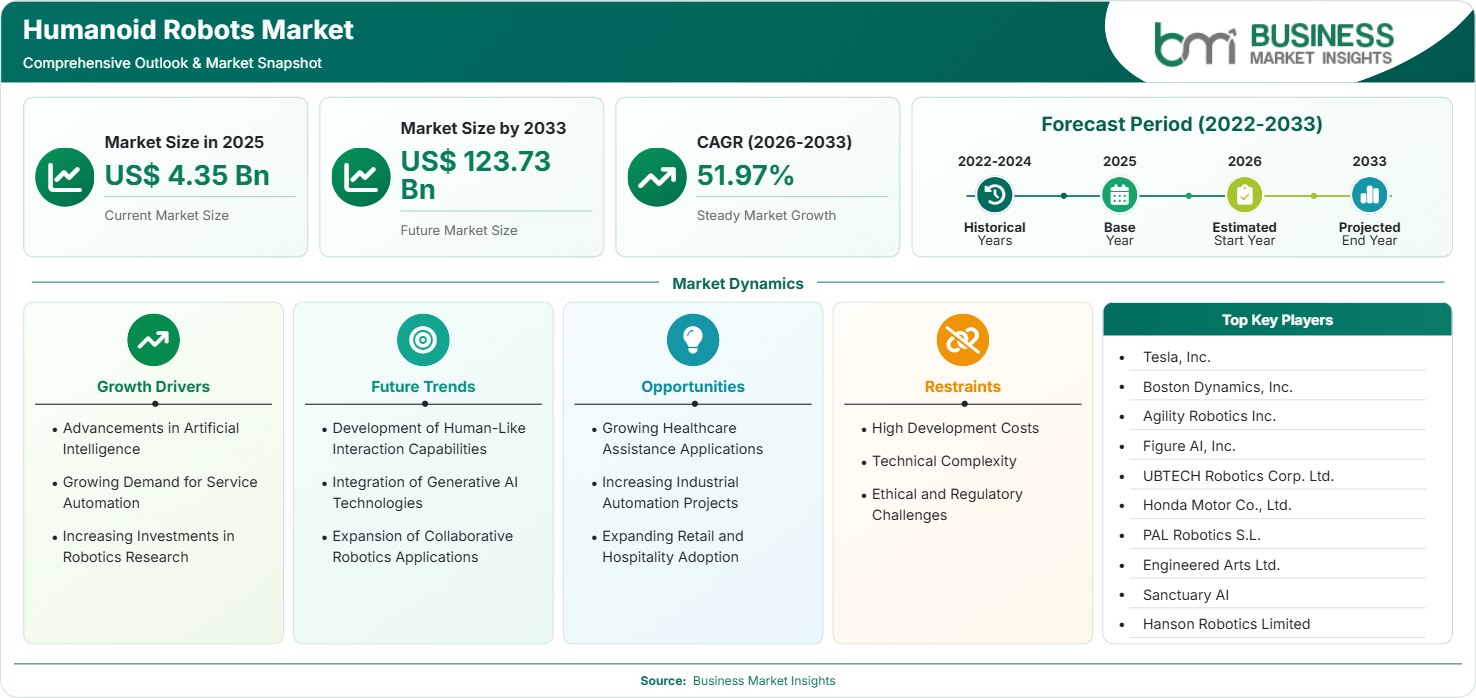
The Humanoid Robots Market size was valued at US$ 4.35 Billion in 2025 and is projected to reach US$ 123.73 Billion by 2033, growing at a CAGR of 51.97% during 2026–2033, driven by artificial intelligence advancements, industrial automation adoption, service robotics expansion, and investments in human-like robotic systems.

Report Coverage
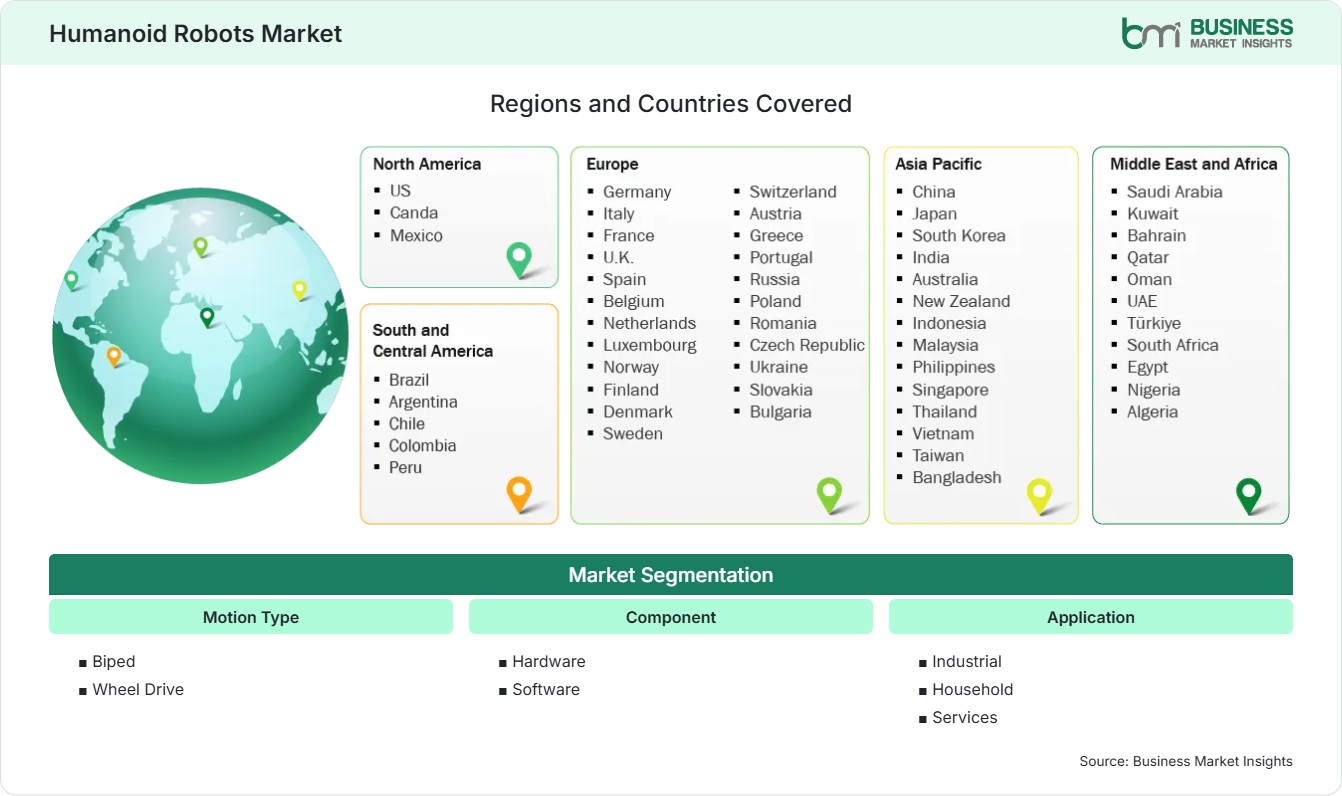
  • Motion Type: Biped, Wheel Drive
  • Component: Hardware, Software
  • Application: Industrial, Household, Services
US$ 4.35 Bn Market size in 2025
US$ 123.73 Bn Market Size by 2033
51.97% CAGR, 2026 - 2033
2026-2033 Forecast Period

AI Overview

Humanoid Robots Market Summary

  • North America Region: North America holds a 35%–39% share in 2025, growing with a CAGR of 50%–53% during 2026–2033, supported by AI research, manufacturing automation, venture funding, healthcare robotics deployment, and advanced robotics ecosystems. The US market demonstrates strong adoption momentum with a CAGR of 51%–54% due to technology investments and industrial applications.
  • Fastest Growing Region: Asia Pacific maintains a 28%–32% share in 2025, expanding at a CAGR of 53%–56% during 2026–2033, driven by robotics manufacturing capabilities, government automation programs, semiconductor integration, smart factories, and rising service robot demand across emerging economies.
  • Leading Segment: Hardware components represent a 55%–59% share in 2025, growing at a CAGR of 49%–52% during 2026–2033, supported by advanced actuators, sensors, processors, robotic mechanisms, improved mobility systems, and continuous engineering improvements in humanoid platforms.
  • High Growth Segment: Services applications account for a 42%–46% share in 2025, advancing at a CAGR of 54%–57% during 2026–2033, driven by healthcare assistance, hospitality automation, retail engagement, eldercare requirements, and increasing acceptance of interactive robotic solutions.
  • Key Market Opportunity: Expanding applications in healthcare, logistics, manufacturing, and consumer services create opportunities through AI-powered assistance, autonomous operations, workforce augmentation, and scalable humanoid deployment models across multiple industries.
  • Major Market Players: Tesla, Inc.; Boston Dynamics, Inc.; Agility Robotics Inc.; Figure AI, Inc.; UBTECH Robotics Corp. Ltd.; Honda Motor Co., Ltd.; PAL Robotics S.L.; Engineered Arts Ltd.; Sanctuary AI; Hanson Robotics Limited.
Strategic Insights

Humanoid Robots Market: Strategic Insights

Humanoid Robots Market Strategic Framework
FREE PDF
Request your free sample
Request free sample
Stakeholder View

Key Takeaways

  • The ecosystem is transitioning from component-driven development toward integrated robotics platforms combining artificial intelligence, mechanical engineering, sensors, software, and cloud connectivity. Suppliers with capabilities across hardware and AI software integration are positioned to capture higher-value opportunities.
  • Industrial and service applications represent the strongest expansion areas as enterprises explore humanoid systems for repetitive tasks, workplace assistance, customer interaction, and operational support. Companies developing adaptable robots for multiple environments can achieve broader commercialization potential.
  • Innovation priorities are moving toward improved dexterity, autonomous decision-making, energy efficiency, and realistic human interaction. Advanced AI models combined with enhanced robotic perception are enabling more flexible applications beyond traditional automation systems.
  • Asia Pacific provides significant investment potential due to strong electronics manufacturing capabilities, robotics research infrastructure, and government-backed automation programs. Countries including Japan, China, and South Korea are strengthening their positions through industrial robotics development.
  • Investment activity is increasing as technology companies, venture capital firms, and automotive manufacturers participate in robotics development. Strategic partnerships between AI companies and robotics manufacturers are accelerating commercialization pathways and reducing technology barriers.
  • The competitive landscape is becoming increasingly diversified as established robotics firms compete with emerging AI-focused companies developing specialized humanoid platforms for commercial applications.
Geographic Outlook

Humanoid Robots Market Regional Highlights

North America Humanoid Robots Market

North America accounted for a 35%–39% share in 2025 and is projected to expand at a CAGR of 50%–53% during 2026–2033. The region benefits from strong AI capabilities, advanced manufacturing infrastructure, venture investments, and robotics research institutions. The Humanoid Robots Market share remains supported by the United States, where technology companies are accelerating commercialization through industrial automation and service applications.

  • The United States leads regional adoption through investments in artificial intelligence, robotics startups, and automation solutions for manufacturing and logistics operations.
  • Canada contributes through research collaborations, university robotics programs, and increasing adoption of intelligent automation technologies across industrial sectors.
  • Advanced semiconductor capabilities and software ecosystems support development of high-performance humanoid platforms requiring complex computing and sensing technologies.
  • Venture capital funding continues supporting robotics innovation, enabling startups to accelerate prototype development and commercial deployment strategies.

US Humanoid Robots Market

The US represented a 28%–32% share of the North American market in 2025 and is expected to grow at a CAGR of 51%–54% through 2033. Strong investments from technology companies, automotive manufacturers, and research organizations are strengthening domestic robotics capabilities. The country remains a primary commercialization hub due to demand for automation, workforce assistance, and artificial intelligence integration.

  • Manufacturing companies are testing humanoid systems for repetitive industrial tasks, improving productivity while addressing labor availability challenges.
  • Healthcare providers are exploring robotic assistants for patient support, rehabilitation activities, and operational efficiency improvements.
  • Technology firms are advancing AI-powered robotics through collaborations between software developers, hardware manufacturers, and research institutions.
  • Government initiatives supporting advanced manufacturing and artificial intelligence research are encouraging robotics innovation across multiple industries.

Europe Humanoid Robots Market

Europe held a 22%–26% share in 2025 and is projected to grow at a CAGR of 48%–51% during 2026–2033. Germany, France, the United Kingdom, and Italy represent major contributors due to industrial automation expertise and engineering capabilities. The region emphasizes safe human-robot collaboration, ethical AI development, and applications across manufacturing, healthcare, and service environments.

  • Germany supports adoption through automotive automation expertise and strong industrial robotics infrastructure across manufacturing facilities.
  • France and the United Kingdom are advancing robotics research through academic partnerships and artificial intelligence development initiatives.
  • European manufacturers are focusing on collaborative robots designed to operate safely alongside human workers in shared environments.
  • Regulatory attention toward AI transparency and workplace safety is influencing humanoid robot design approaches.

Asia Pacific Humanoid Robots Market

Asia Pacific represented a 28%–32% share in 2025 and is forecast to register a CAGR of 53%–56% between 2026–2033. The region benefits from electronics manufacturing strength, robotics expertise, government automation programs, and growing demand for intelligent machines. China, Japan, and South Korea are leading countries, while India and Southeast Asian economies present emerging adoption opportunities.

  • China is expanding humanoid robotics capabilities through manufacturing investments, artificial intelligence development, and government-supported automation programs.
  • Japan continues leveraging decades of robotics expertise for healthcare assistance, industrial automation, and consumer applications.
  • South Korea is integrating advanced robotics into smart factories and service environments through technology-focused initiatives.
  • India is developing robotics ecosystems through startups, research institutions, and industrial modernization programs.
  • Southeast Asian markets are adopting automation solutions as manufacturers improve operational efficiency and production capabilities.

Rest of World Humanoid Robots Market

Rest of World accounted for a 9%–13% share in 2025 and is estimated to expand at a CAGR of 46%–49% during 2026–2033. South America and Middle East and Africa regions are gradually adopting robotics through industrial modernization, smart infrastructure projects, and service automation requirements. Brazil, UAE, and Saudi Arabia represent emerging markets with increasing technology investments.

  • Brazil is exploring robotics adoption in manufacturing, education, and research sectors through increasing digital transformation initiatives.
  • Middle Eastern countries are investing in artificial intelligence and automation projects linked with smart city development strategies.
  • Saudi Arabia and UAE are promoting advanced technologies through innovation programs and industrial diversification initiatives.
  • African markets present long-term opportunities through automation demand in logistics, healthcare, and education sectors.
  • Regional adoption remains influenced by infrastructure readiness, investment availability, and availability of skilled robotics professionals.
Global Market Geography
FREE PDF
Request your free sample
Request free sample
Segment Analysis

Humanoid Robots Market Segmentation

Motion Type

Motion Type represents a critical segmentation category, with biped systems accounting for a 60%–64% share in 2025 and expanding at a CAGR of 52%–55% during 2026–2033. Increasing demand for human-like mobility, workplace compatibility, and complex task execution supports segment development. The Humanoid Robots Market scope continues expanding as manufacturers improve balance control, navigation, and adaptable movement capabilities.

  • Biped: Biped humanoid robots enable movement across human-designed environments, supporting industrial assistance, research activities, and service applications requiring human-like mobility.
  • Wheel Drive: Wheel-driven systems provide operational efficiency, stability, and cost advantages for controlled environments such as warehouses, healthcare facilities, and commercial spaces.

Component

Component segmentation highlights the importance of advanced hardware and software integration, with hardware accounting for a 55%–59% share in 2025 and growing at a CAGR of 49%–52% during 2026–2033. Robotics manufacturers are focusing on improving processors, sensors, actuators, and mechanical structures while software development enhances autonomy and interaction capabilities.

  • Hardware: Hardware includes robotic frames, motors, sensors, processors, and mechanical components enabling physical movement, perception, and operational reliability.
  • Software: Software solutions provide artificial intelligence, navigation algorithms, machine learning capabilities, and decision-making systems supporting autonomous robotic functions.

Application

Application segmentation demonstrates strong diversification, with service applications holding a 42%–46% share in 2025 and advancing at a CAGR of 54%–57% during 2026–2033. The Humanoid Robots Market trends indicate increasing adoption across industries requiring assistance, interaction, and automation. Industrial applications remain important due to manufacturing demand, while household applications develop through consumer acceptance.

  • Industrial: Industrial humanoid robots support manufacturing automation, material handling, inspection tasks, and workplace assistance by improving productivity and operational flexibility.
  • Household: Household applications include personal assistance, elderly support, education, and domestic automation solutions requiring safe human interaction.
  • Services: Service robots address healthcare, hospitality, retail, education, and customer engagement requirements through interactive and intelligent automation platforms.
Market Forces

Humanoid Robots Market Dynamics

Key Market Drivers

Advancements in Artificial Intelligence

AI technology developments have been improving the capability of humanoid robots regarding their perception, decision-making and adaptive learning. Advanced neural network models, computer vision technologies and natural language processing allow machines to perceive the environment and interact successfully with humans. The Humanoid Robots Market growth is being driven by increased use of generative AI models that will allow the machines to execute more sophisticated operations and perform independently. The market trends reveal greater need for intelligent solutions with the capability of reacting to events in real time, predictability and flexibility of operations in different settings. Investments are made in control systems based on artificial intelligence solutions to increase accuracy and reliability of robots.

Growing Demand for Service Automation

The growing trend in automation is leading to the demand for humanoid robots that can assist with healthcare services, hospitality, retail, and customer services. The aging population, shortage of workers, and the need for increased efficiency are causing organizations to consider robotic assistance options. Healthcare organizations are considering humanoid robots for patient interaction and administration help, whereas businesses are piloting robots to interact with customers. This trend is most visible in areas where repetitive contact is needed continuously. Enhanced speech recognition capabilities, improved mobility features, and enhanced safety mechanisms are making humanoid robots more acceptable.

Increasing Investments in Robotics Research

The increase in investment in robotics R&D is leading to rapid innovations in the area of mechanics, AI, and autonomous technologies. There are growing efforts in the form of research programs to develop robots with characteristics similar to humans by governments, technology firms, automobile companies, and academia. Efforts are underway in terms of investments aimed at developing advanced actuators, lighter materials, enhanced batteries, and advanced control mechanisms. Robotics researchers are assisting companies to find solutions to technical challenges in the areas of balance, dexterity, and environmental adaptation. The Humanoid Robots Market is impacted by the consistent experiments done with the next generation architectural designs for superior performances.

Key Market Opportunities

Growing Healthcare Assistance Applications

Healthcare assistance represents a major opportunity area as healthcare providers seek technologies that improve patient support and operational efficiency. Humanoid robots can assist with elderly care, rehabilitation activities, patient communication, and routine healthcare tasks. Increasing shortages within the healthcare workforce and growing requirements for personalized solutions are motivating investments into robotics support platforms. The Humanoid Robots Market Forecast suggests that the future is bright for this market segment as healthcare providers will be able to combine intelligent robots and digital health systems. Potential future innovations may include emotional responsiveness, better mobility, and safety during human interaction.

Increasing Industrial Automation Projects

Industries are witnessing an emergence of many automation projects that offer great chances for implementation of humanoid robots in the manufacturing process, logistics and warehouse management. Organizations are considering robotic systems capable of carrying out repetitive tasks, which can integrate into existing human environments without making any changes to the facilities. Industries such as automotive, electronics, and manufacturing are looking at humanoid robots in order to carry out activities such as material handling, assembly tasks, and other operations. Focus on productivity, safety and manufacturing flexibility is fostering their application in the industry.

Expanding Retail and Hospitality Adoption

Retail and hospitality sectors are emerging as promising application areas due to increasing demand for interactive customer experiences and operational automation. Humanoid robots can support information services, customer guidance, inventory assistance, and personalized engagement activities. Firms are considering such solutions in order to enhance efficiency in service delivery while at the same time offering innovative customer interactions. With improvements in technologies like voice recognition, face recognition, and autonomous navigation, robots have become more appropriate for use in public settings. The increasing number of digital transformation efforts in the service industry is prompting firms to consider robotic solutions.

Market Restraints and Challenges

High Development Costs

Factor: High development costs associated with advanced hardware components, artificial intelligence systems, sensors, and manufacturing processes increase investment requirements. Impact: These costs can limit adoption among small and medium-sized enterprises and slow commercialization timelines. The development of reliable humanoid robots involves substantial financial investment, engineering knowledge, and testing before mass production. The complexity of the machines, power supply, and the need for training artificial intelligence result in higher costs of production when compared to conventional automation technology. The firms have to ensure that they can reduce their costs through efficient production processes and methods.

Technical Complexity

Factor: Technical complexity related to mobility, balance control, environmental perception, and human interaction creates development challenges. Impact: These limitations can affect reliability, operational efficiency, and deployment scalability across diverse environments. Humanoid robots need to combine several technologies such as artificial intelligence, sensors, mechanical and communications technology. It is still a challenge to mimic humans in both movement and decision making due to changing environments.

Company Analysis

Competitive Landscape

The Humanoid Robots Market analysis highlights increasing competition among robotics developers, artificial intelligence companies, and automation specialists. Leading players are focusing on improving mobility, autonomy, human interaction capabilities, and commercial deployment readiness. Companies are investing in hardware innovation, software development, and industry-specific applications to strengthen their competitive positioning.

Company Name

Overview

Products and Services relevant to this market

Tesla, Inc.

Tesla develops advanced artificial intelligence and robotics technologies focused on autonomous machines and human-like robotic platforms.

Optimus humanoid robot platform, AI systems, robotic hardware, autonomous control technologies, and manufacturing integration solutions.

Boston Dynamics, Inc.

Boston Dynamics specializes in advanced robotic mobility systems with expertise in dynamic movement and autonomous operation.

Atlas humanoid robot, robotic mobility technologies, manipulation systems, and advanced control software.

Agility Robotics Inc.

Agility Robotics develops commercial humanoid robots designed for workplace automation and logistics applications.

Digit humanoid robot, warehouse automation solutions, mobility systems, and robotic deployment services.

Figure AI, Inc.

Figure AI focuses on developing general-purpose humanoid robots powered by artificial intelligence.

AI-driven humanoid platforms, autonomous learning systems, robotic perception, and commercial automation solutions.

UBTECH Robotics Corp. Ltd.

UBTECH develops intelligent robots for education, services, and industrial applications.

Humanoid robots, AI robotics platforms, service robots, and interactive robotic solutions.

Honda Motor Co., Ltd.

Honda has extensive robotics expertise through decades of research into human mobility technologies.

ASIMO technology, robotics research, mobility systems, and human-assistance robotics development.

PAL Robotics S.L.

PAL Robotics creates humanoid and mobile robots for research, service, and industrial environments.

TIAGo robots, humanoid platforms, autonomous navigation systems, and research robotics solutions.

Engineered Arts Ltd.

Engineered Arts specializes in realistic humanoid robots designed for communication and entertainment applications.

Ameca humanoid robot, conversational AI integration, expressive robotics, and interactive systems.

Sanctuary AI

Sanctuary AI develops cognitive robotic systems designed to perform human-like tasks.

General-purpose humanoid robots, AI control systems, and workplace automation technologies.

Hanson Robotics Limited

Hanson Robotics develops socially intelligent humanoid robots with advanced interaction capabilities.

Sophia humanoid robot, conversational AI systems, facial expressions, and social robotics platforms.

Trust & Transparency

Research Methodology

The market analysis combines proprietary research with secondary data from government agencies, company disclosures, regulatory filings, industry databases and expert interviews. Market estimates are validated through data triangulation, cross-market benchmarking and analyst review.

View Full Research Methodology

Questions Answered

Frequently Asked Questions

How can investors evaluate opportunities in this sector?

The Humanoid Robots Market Report indicates that investors should assess AI capabilities, deployment partnerships, manufacturing scalability, component ecosystems, and application-specific commercialization strategies when evaluating robotics companies.

What factors influence the commercialization timeline of humanoid robots?

Commercial adoption depends on reducing production costs, improving reliability, enhancing battery performance, meeting safety requirements, and developing scalable manufacturing processes.

What role do humanoid robots play in manufacturing environments?

Humanoid robots support manufacturing by performing material handling, inspection, assembly assistance, and repetitive tasks while operating within existing human-designed workspaces without extensive infrastructure changes.

How does artificial intelligence improve humanoid robot market capabilities?

AI enables humanoid robots to process environmental information, understand commands, improve decision-making, and adapt to changing conditions through machine learning, computer vision, and advanced language models.

What industries are expected to adopt humanoid robots first?

Industrial manufacturing, logistics, healthcare assistance, and customer service sectors are expected to be early adopters due to repetitive workflows, labor shortages, and demand for flexible automation solutions.

Access the Full Humanoid Robots Market Report

Get segment-level forecasts, regional estimates, competitive benchmarking, company profiles and downloadable Excel datasets.

Access the full Humanoid Robots Market Report
350 pages PDF & Excel | 2026-08-12
Similar Research

Related Market Reports