
Pick And Place Robots Market Outlook: Size, Share, Trends, Growth Analysis, Competitive Landscape & Forecast, 2026–2033

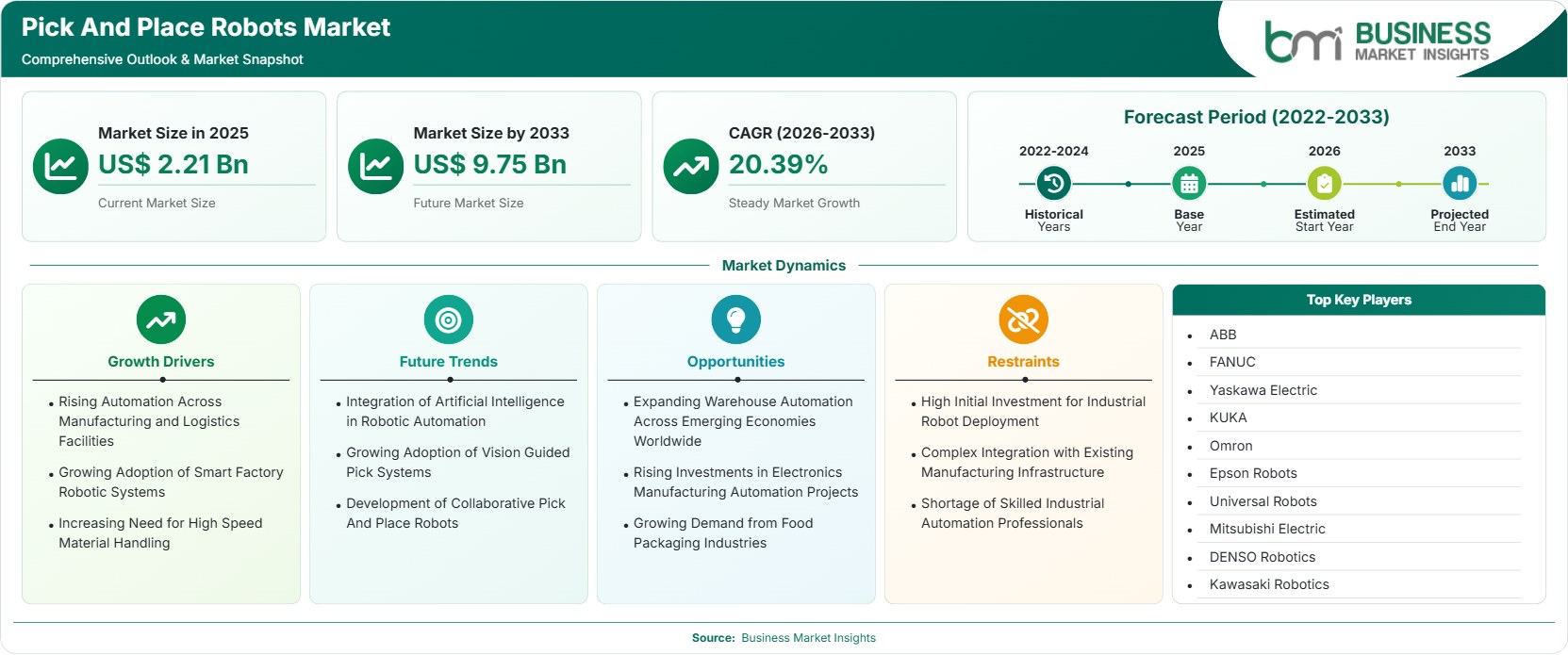
The Pick And Place Robots Market size was valued at US$ 2.21 billion in 2025 and is projected to reach US$ 9.75 billion by 2033, growing at a CAGR of 20.39% during 2026–2033, driven by manufacturing automation, smart factory expansion, logistics modernization, and increasing demand for high-speed robotic handling solutions.

Report Coverage
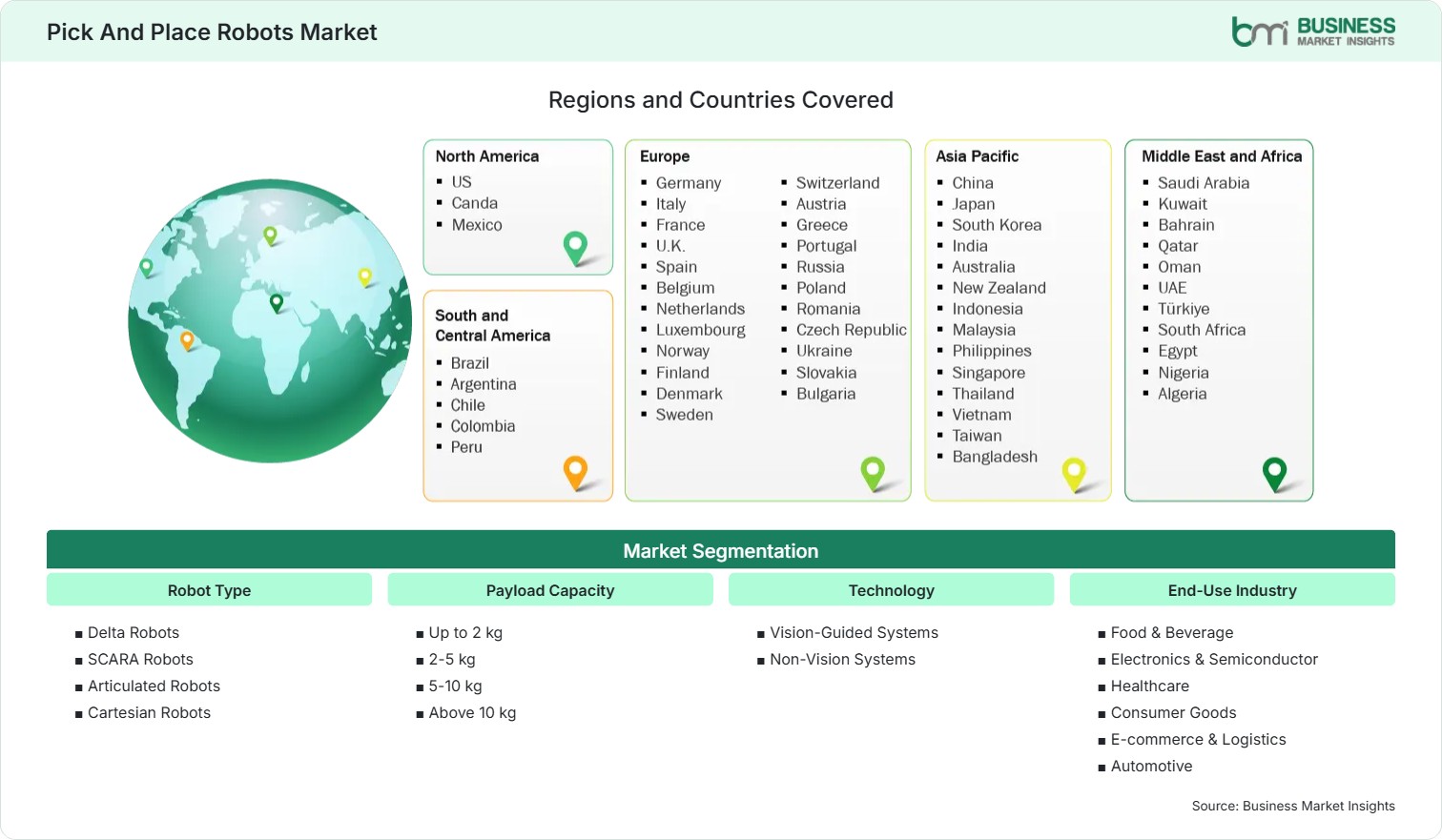
  • Robot Type: Delta Robots, SCARA Robots, Articulated Robots, Cartesian Robots
  • Payload Capacity: Up to 2 kg, 2-5 kg, 5-10 kg, Above 10 kg
  • Technology: Vision-Guided Systems, Non-Vision Systems
  • End-Use Industry: Food & Beverage, Electronics & Semiconductor, Healthcare, Consumer Goods, E-commerce & Logistics, Automotive
US$ 2.21 Bn Market size in 2025
US$ 9.75 Bn Market Size by 2033
20.39% CAGR, 2026 - 2033
2026-2033 Forecast Period

AI Overview

Pick And Place Robots Market Summary

  • North America Region: North America holds a 30%–33% share in 2025 and is projected to grow at a 18.5%–19.5% CAGR during 2026–2033. The region benefits from industrial automation investments, advanced manufacturing adoption, warehouse modernization, and demand for flexible robotic systems. The U.S. market is supported by automation initiatives across automotive, electronics, and logistics sectors, with adoption increasing through intelligent robotic integration.
  • Fastest Growing Region: Asia Pacific accounts for a 38%–42% share in 2025 and is expected to expand at a 22.0%–23.0% CAGR during 2026–2033. Growth is supported by electronics manufacturing expansion, semiconductor investments, labor optimization requirements, and increasing deployment of automated production systems across emerging economies.
  • Leading Segment: Electronics & Semiconductor represents a 28%–32% share in 2025 and is expected to grow at a 21.0%–22.0% CAGR during 2026–2033. Increasing demand for precision handling, miniaturized components, and automated assembly processes continues supporting adoption across advanced manufacturing environments.
  • High Growth Segment: Vision-Guided Systems capture a 45%–49% share in 2025 and are projected to expand at a 23.0%–24.0% CAGR during 2026–2033. Integration of artificial intelligence, machine vision, and adaptive robotics is improving accuracy, flexibility, and operational efficiency.
  • Key Market Opportunity: Expansion of automated warehouses, electronics production facilities, and smart manufacturing ecosystems is creating opportunities for robotic providers offering scalable solutions with enhanced flexibility, connectivity, and productivity improvements.
  • Major Market Players: ABB, FANUC Corporation, Yaskawa Electric Corporation, KUKA AG, Omron Corporation, Epson Robots, Universal Robots A/S, Mitsubishi Electric Corporation, DENSO Robotics, and Kawasaki Robotics.
Strategic Insights

Pick And Place Robots Market: Strategic Insights

Pick And Place Robots Market Strategic Framework
FREE PDF
Request your free sample
Request free sample
Stakeholder View

Key Takeaways

  • The market environment is evolving in favor of integrating automation systems, with companies producing robots, software, sensors, and system integrators working together to provide an end-to-end solution for industry.
  • Areas that show high growth potential include flexible automation, which involves rapid movement, precise motion, and adaptation to dynamic environments.
  • Artificial intelligence, machine vision, and advanced control systems are reshaping robotic capabilities by improving decision-making, accuracy, and operational flexibility.
  • Asia Pacific presents strong investment potential due to expanding manufacturing infrastructure, electronics production growth, and increasing adoption of automated industrial technologies.
  • Strategic partnerships, technology acquisitions, and portfolio expansion are becoming important competitive strategies as companies strengthen capabilities in intelligent automation solutions.
  • Increasing demand for connected factories and Industry 4.0 ecosystems is encouraging manufacturers to develop robots with improved interoperability, analytics capabilities, and remote monitoring features.
Geographic Outlook

Pick And Place Robots Market Regional Highlights

North America Pick And Place Robots Market

North America maintains a strong position due to advanced manufacturing capabilities, automation investments, and increasing adoption across industrial facilities. The region accounted for 30%–33% of demand in 2025 and is expected to expand at a 18.5%–19.5% CAGR through 2033. Pick And Place Robots Market share remains influenced by demand from automotive, electronics, healthcare, and logistics sectors seeking productivity improvements.

  • More and more manufacturing companies use robots to address labor shortages and improve production efficiency and consistency.
  • Companies operating in the automotive and electronics industries are investing in flexible automation systems, which enable rapid production adjustments and greater manufacturing precision.
  • Warehouse facilities are turning to robot-assisted handling systems in order to optimize their fulfillment operations and improve inventory management.
  • The increasing popularity of connected manufacturing technologies encourages the integration of robots with industrial software solutions and digital monitoring systems.

US Pick And Place Robots Market

The United States represents the leading market within North America, supported by strong industrial automation adoption, advanced manufacturing infrastructure, and increasing warehouse modernization initiatives. The country contributes 75%–79% of regional demand and is expected to grow at a 19.0%–20.0% CAGR during 2026–2033, driven by automation investments across multiple industries.

  • Manufacturers are increasingly implementing robotic solutions to improve production efficiency, reduce operational costs, and maintain competitiveness in global supply chains.
  • Electronics and semiconductor companies are expanding automated production capabilities to support precision requirements and increasing component complexity.
  • Logistics companies are investing in automated fulfillment technologies to improve speed, accuracy, and warehouse productivity.

Europe Pick And Place Robots Market

Europe demonstrates steady automation adoption supported by advanced industrial infrastructure, strong engineering capabilities, and growing Industry 4.0 implementation. The region represents a 24%–27% share in 2025 and is projected to grow at a 18.0%–19.0% CAGR through 2033. Germany leads regional adoption, while Italy and France show strong expansion through manufacturing modernization initiatives.

  • Industrial automation investments continue increasing as manufacturers seek efficient production systems with improved flexibility and reduced operational dependency.
  • Automotive manufacturers are adopting advanced robotic solutions to support precision assembly, component handling, and production optimization.
  • Rising demand for smart factories encourages integration of robotics with digital platforms, analytics tools, and connected production systems.
  • Food processing and packaging companies are expanding automation adoption to improve hygiene, efficiency, and throughput.

Asia Pacific Pick And Place Robots Market

Asia Pacific represents the fastest-growing regional market due to expanding manufacturing capacity, electronics production growth, and increasing automation investments. The region accounted for 38%–42% of demand in 2025 and is expected to grow at a 22.0%–23.0% CAGR through 2033. China remains the largest market, while India and Southeast Asian economies show strong growth potential.

  • Electronics and semiconductor manufacturers are increasing robotic deployment to improve precision, production speed, and manufacturing scalability.
  • Automotive production facilities are adopting automated handling solutions to enhance efficiency and support advanced manufacturing processes.
  • Emerging economies are attracting automation investments through industrial development programs and expanding manufacturing ecosystems.
  • E-commerce growth is encouraging warehouse operators to implement robotic systems for faster sorting, packaging, and fulfillment operations.

Rest of World Pick And Place Robots Market

South America, the Middle East, and Africa are gradually increasing automation adoption as industries modernize production facilities and improve operational capabilities. The region holds a 6%–9% share in 2025 and is projected to grow at a 17.5%–18.5% CAGR through 2033. Brazil, Mexico, UAE, and South Africa represent important markets with rising industrial automation investments.

  • Manufacturing modernization initiatives are encouraging companies to adopt robotic systems for improved productivity and process reliability.
  • Logistics infrastructure development is supporting demand for automated material handling technologies across regional supply chains.
  • Food processing industries are exploring robotic solutions to improve packaging efficiency and maintain consistent production quality.
  • Industrial diversification programs are creating opportunities for automation providers across emerging sectors.
Global Market Geography
FREE PDF
Request your free sample
Request free sample
Segment Analysis

Pick And Place Robots Market Segmentation

Robot Type

The robot types segmentation shows the different levels of automation needed in manufacturing, logistics, and assembly processes. The robot type segment is growing due to the need for faster cycle times, greater accuracy, and greater flexibility in robotic handling operations.

  • Delta Robots: High-speed robots used for lightweight picking, sorting, and packaging applications requiring rapid movement and precision.
  • SCARA Robots: Widely adopted for assembly, electronics handling, and repetitive manufacturing tasks requiring accuracy and speed.
  • Articulated Robots: Flexible robotic systems supporting complex handling, assembly, and industrial automation applications across multiple sectors.
  • Cartesian (Gantry) Robots: Linear-motion systems preferred for large workspaces, material movement, and structured industrial applications.

Payload Capacity

The segmentation of payload capacity is driven by the increasing need for robotic systems that cater to diverse handling requirements. Companies have been opting for robotic systems based on the weight of the products handled, their production rate, and the complexity of the application.

  • Up to 2 kg: Suitable for lightweight components, electronic parts, and precision handling applications requiring delicate movement.
  • 2–5 kg: Commonly used in assembly, packaging, and general manufacturing processes requiring balanced speed and handling capability.
  • 5–10 kg: Preferred for medium-weight industrial components, consumer goods, and automated production line applications.
  • Above 10 kg: Designed for heavy-duty handling, automotive components, and industrial material movement operations.

Technology

Technology-based segmentation is influenced by the transition toward intelligent automation and improved robotic decision-making. Vision capabilities are becoming increasingly important as manufacturers seek adaptive systems that improve accuracy, flexibility, and operational efficiency. Pick And Place Robots Market trend reflects rising integration of smart sensing and automation technologies.

  • Vision-Guided Systems: Enable accurate object recognition, positioning, and adaptive handling through integrated cameras and artificial intelligence.
  • Non-Vision Systems: Provide reliable automation for structured environments with fixed positioning and repetitive handling requirements.

End-Use Industry

End-use industries represent diverse adoption opportunities as organizations automate production, packaging, and logistics operations. Electronics and semiconductor applications maintain strong demand due to precision requirements, while logistics and food industries continue expanding robotic deployment. The broader Pick And Place Robots Market scope is supported by cross-industry automation adoption.

  • Food & Beverage: Utilized for packaging, sorting, and handling operations requiring speed, hygiene, and consistent processing.
  • Electronics & Semiconductor: Supports precision component placement, assembly automation, and high-volume manufacturing requirements.
  • Healthcare: Enables accurate handling of medical products, laboratory materials, and pharmaceutical manufacturing processes.
  • Consumer Goods: Improves packaging, assembly, and production efficiency across various consumer product categories.
  • E-commerce & Logistics: Supports automated sorting, order fulfillment, and warehouse material movement operations.
  • Automotive: Provides high-speed handling and assembly support across modern vehicle manufacturing facilities.
Market Forces

Pick And Place Robots Market Dynamics

Key Market Drivers

Rising Automation Across Manufacturing and Logistics Facilities

The use of robotics for handling is gaining popularity among manufacturers and logistics organizations, as it enables them to enhance productivity, overcome operational limitations, and ensure consistent output quality. With the growing need for effective workflows, many companies are considering automating repetitive tasks. The development of intelligent production settings is making it easier for them to implement robots in industries such as automotive, electronics, food processing, and warehouses.

Growing Adoption of Smart Factory Robotic Systems

The advent of connected manufacturing is spurring demand for intelligent robotic systems that can be integrated with digital technologies, sensors, and automation software. Intelligent manufacturing requires adaptable systems capable of providing real-time monitoring, enhanced coordination, and improved production efficiency. Advanced robots with improved control and connectivity capabilities are enabling better visibility and reliability in production processes for manufacturers. This trend towards adopting Industry 4.0 systems is driving advancements in automation technologies.

Increasing Need for High Speed Material Handling

With the growing production volume and rising consumer demand, it is imperative that industries invest in fast-moving robotic handling systems. Pick-and-place technology can ensure faster operations, precise placement, and greater efficiency in manufacturing and logistics processes. The focus of automation technology in the industry should be on systems with shorter production cycles that also maintain quality. The need for effective material handling continues to grow in industries that require accuracy and dependability.

Key Market Opportunities

Expanding Warehouse Automation Across Emerging Economies Worldwide

The fast growth of e-commerce operations and logistics innovation presents exciting prospects for companies providing robotic automation in developing countries. The companies are investing in automated storage facilities, which would help increase order-processing efficiency, inventory accuracy, and operational scalability. The increasing share of digital trade is prompting the use of robotic technology in logistics. The Pick And Place Robots Market forecast points to the promising prospects driven by logistics infrastructure and automation needs in developing countries.

Rising Investments in Electronics Manufacturing Automation Projects

The growing demand for electronics manufacturing and investments in semiconductor manufacturing have created a need for precise robotics to handle processes. The manufacturers need better automation techniques to handle their components with greater precision and efficiency, and enable high-volume manufacturing. The growth of electronics clusters in the region has also motivated the technology providers to innovate robots suitable for such assembly environments. The increasing need to automate production lines has created favorable opportunities in the electronics industry.

Growing Demand from Food Packaging Industries

Food manufacturing firms are currently adopting robots to increase packaging speed, maintain hygiene standards, and improve production uniformity. Through automation, firms can handle high production volumes without relying too heavily on manual, repetitive processes. Increasing demand for packaged food and convenient products is driving greater use of robots. The food packaging industry is likely to remain one of the key fields for the adoption of robots, which can process a wide range of products.

Market Restraints and Challenges

High Initial Investment for Industrial Robot Deployment

Factor: High start-up costs for robotics equipment, software integration, maintenance, and employee training can hinder the adoption of automation among SMEs. Impact: Higher capital requirements may delay automation initiatives and limit access to advanced robotic technologies for cost-sensitive businesses. Companies are addressing this challenge through modular solutions, leasing models, and scalable automation strategies that reduce financial barriers while improving long-term operational returns.

Complex Integration with Existing Manufacturing Infrastructure

Factor: Integrating robotic systems with existing production lines, legacy equipment, and industrial software platforms requires technical expertise and customized engineering solutions. Impact: Complicated implementation processes may cause delays, disruptions, and increased costs. Manufacturers are increasingly working with automation integrators to ensure proper implementation of systems.

Company Analysis

Competitive Landscape

The Pick And Place Robots Market analysis, indicates an upsurge in competition among automation companies emphasizing intelligent robotics, accuracy, and Industry 4.0 compatibility. Top firms have been working hard to improve their product range by incorporating sophisticated controllers, vision systems, software capabilities, and industry-specific automation solutions.

Company Name

Overview

Products and Services relevant to this market

ABB

Global automation technology company providing industrial robotics, digital solutions, and motion technologies for manufacturing and logistics applications.

Offers delta robots, articulated robots, robotic controllers, machine vision solutions, and automated material handling systems.

FANUC Corporation

Japanese robotics manufacturer specializing in industrial automation, CNC systems, and advanced robotic solutions for global industries.

Provides pick and place robots, collaborative robots, vision systems, controllers, and factory automation solutions.

Yaskawa Electric Corporation

Automation company delivering robotic technologies, motion control systems, and industrial solutions across multiple manufacturing sectors.

Supplies handling robots, SCARA robots, controllers, servo systems, and automation platforms for production environments.

KUKA AG

Robotics and automation specialist focused on intelligent industrial robots and manufacturing automation technologies.

Provides industrial robots, robotic cells, automation software, and handling solutions for automotive, electronics, and logistics applications.

Omron Corporation

Technology company offering automation equipment, sensing technologies, and industrial control solutions.

Delivers SCARA robots, vision-guided systems, automation controllers, and integrated robotic solutions.

Epson Robots

Robotics division specializing in precision automation systems for assembly and manufacturing operations.

Offers SCARA robots, Cartesian robots, vision systems, and high-speed robotic handling solutions.

Universal Robots A/S

Collaborative robotics company focused on flexible automation solutions for small and medium-sized manufacturers.

Provides collaborative robotic arms, automation accessories, software platforms, and flexible handling solutions.

Mitsubishi Electric Corporation

Global electronics and automation provider delivering industrial control and factory automation technologies.

Supplies industrial robots, automation controllers, servo systems, and integrated manufacturing solutions.

DENSO Robotics

Robotics manufacturer specializing in compact industrial robots and automation solutions for precision applications.

Provides SCARA robots, articulated robots, vision-supported systems, and assembly automation solutions.

Kawasaki Robotics

Industrial robotics provider serving manufacturing sectors with automation solutions and robotic technologies.

Offers industrial robots, palletizing systems, handling robots, and automated production solutions.

Trust & Transparency

Research Methodology

The market analysis combines proprietary research with secondary data from government agencies, company disclosures, regulatory filings, industry databases and expert interviews. Market estimates are validated through data triangulation, cross-market benchmarking and analyst review.

View Full Research Methodology

Questions Answered

Frequently Asked Questions

What does the Pick And Place Robots Market report indicate about future competition?

The report indicates that competition will focus on intelligent automation, vision integration, flexible robotic platforms, and industry-specific solutions. Companies developing scalable technologies and strengthening partnerships with manufacturers are expected to improve their competitive positioning.

Why are emerging economies creating new opportunities for robotic automation?

Emerging economies are expanding manufacturing capacity, logistics infrastructure, and industrial modernization programs. Rising investments in electronics production, automated warehouses, and smart factories are encouraging companies to adopt robotic solutions that improve operational efficiency and competitiveness.

How are intelligent technologies influencing robotic adoption?

Artificial intelligence, machine vision, advanced sensors, and connected control systems are improving robotic capabilities by enabling adaptive handling, better accuracy, and real-time decision-making. These technologies are helping manufacturers implement more flexible automation solutions across complex production environments.

Which applications present the strongest opportunity in the market?

Electronics and semiconductor manufacturing, automotive production, food packaging, and e-commerce logistics represent strong opportunities due to increasing automation requirements. These applications require high-speed, accurate, and flexible robotic solutions to improve productivity and support expanding operational demands.

What factors are improving Pick And Place Robots Market return on investment?

Increasing demand for manufacturing efficiency, faster production cycles, reduced labor dependency, and improved product quality are enhancing return on investment. Robotic handling systems help industries optimize repetitive operations, improve throughput, and achieve greater consistency across manufacturing, packaging, and logistics environments.

Access the Full Pick And Place Robots Market Report

Get segment-level forecasts, regional estimates, competitive benchmarking, company profiles and downloadable Excel datasets.

Access the full Pick And Place Robots Market Report
350 pages PDF & Excel | 2026-08-25
Similar Research

Related Market Reports