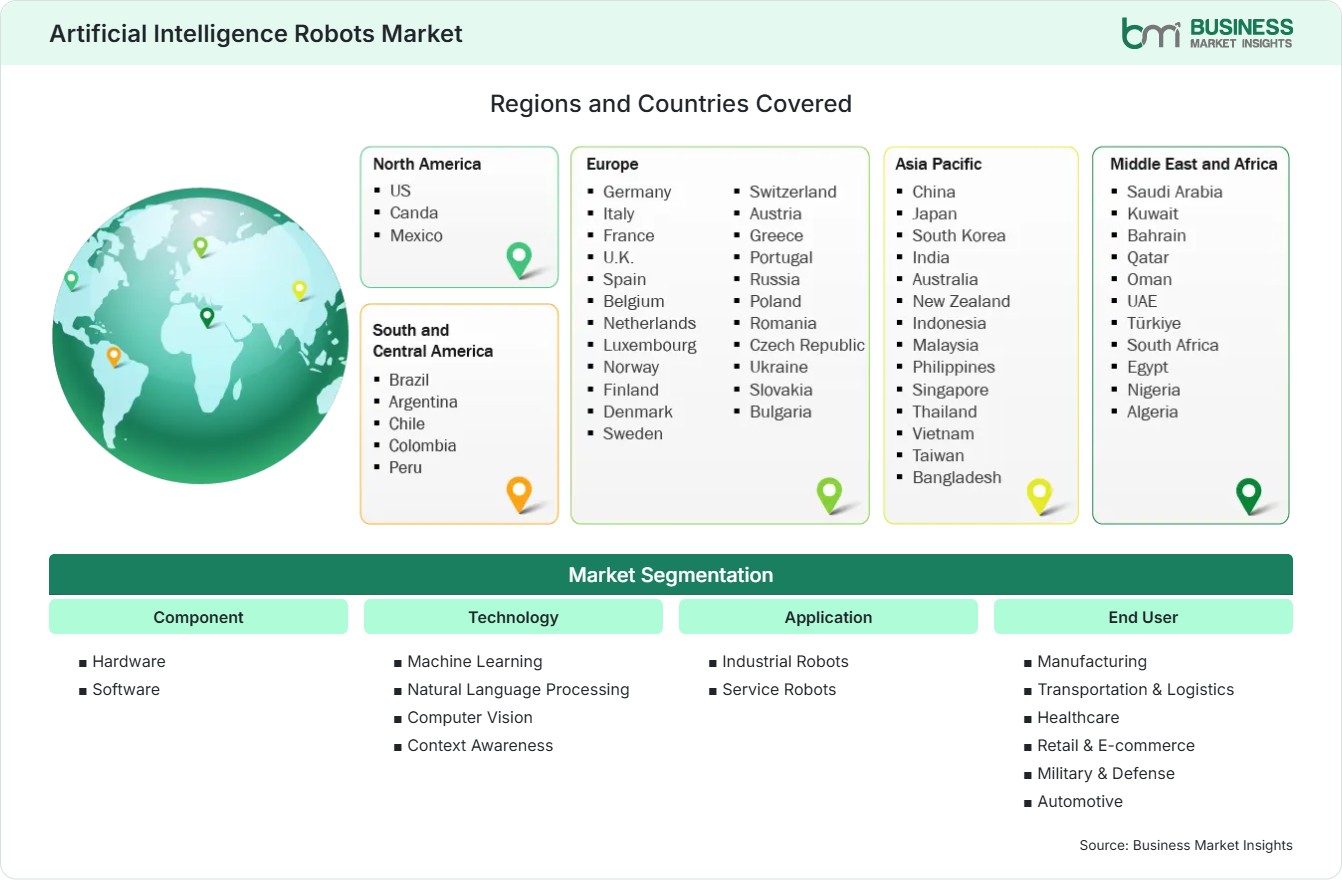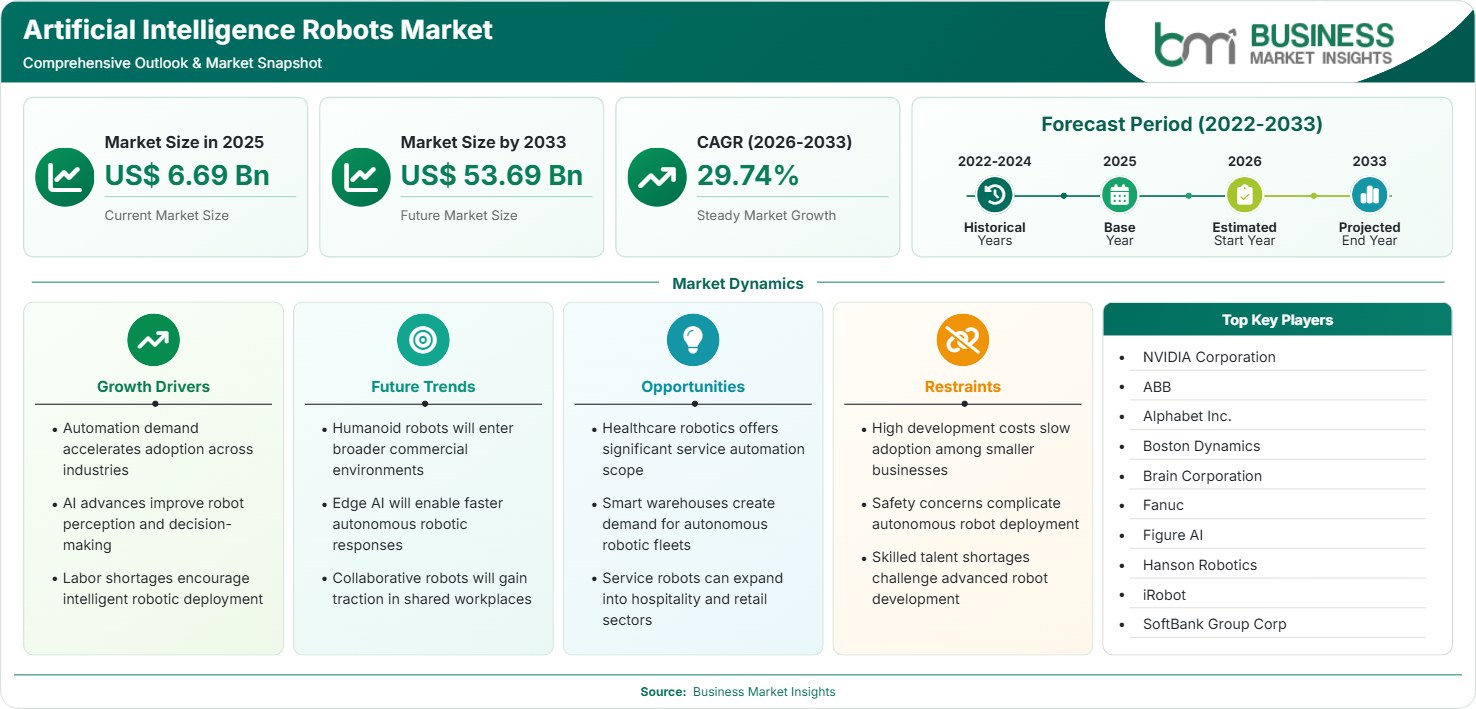
Artificial Intelligence Robots Market Regional Highlights
North America Artificial Intelligence Robots Market
North America accounts for 34%–38% market share in 2025 and is projected to register a CAGR of 28.5%–30.0% during 2026–2033. The region benefits from advanced AI development, established robotics companies, high enterprise automation spending, and demand for intelligent logistics. The United States represents the principal regional market, supported by strong adoption across manufacturing, healthcare, warehousing, defense-related applications, and commercial services. Canada also provides opportunities through industrial automation and technology-led workforce productivity initiatives.
- Enterprise investment increasingly favors robots capable of connecting with manufacturing execution, warehouse, and operational software platforms.
- Logistics operators are adopting autonomous systems to improve inventory movement, sorting, picking, and facility productivity.
- Healthcare providers represent an emerging opportunity for delivery, sanitation, rehabilitation, and assistance-oriented robotic systems.
- Advanced processors and perception technologies strengthen regional capabilities in autonomous navigation and real-time decision-making.
US Artificial Intelligence Robots Market
The United States represents approximately 82%–86% of North American demand in 2025 and is projected to expand at a CAGR of 28.8%–30.3% during 2026–2033. Strong investment in AI computing, robotics startups, industrial automation, logistics technology, and healthcare innovation supports adoption. Large enterprises are increasingly evaluating autonomous systems for productivity improvement, workplace safety, inventory management, inspection, and repetitive operational tasks. The domestic ecosystem also benefits from established technology companies and specialized robotics developers.
- Manufacturing companies increasingly deploy intelligent robots for inspection, assembly, material handling, and flexible production.
- Warehouse operators are expanding autonomous fleets to improve throughput and reduce dependence on repetitive manual labor.
- Healthcare and service providers are evaluating robots for delivery, assistance, sanitation, navigation, and routine facility operations.
Europe Artificial Intelligence Robots Market
Europe represents an estimated 22%–26% Artificial Intelligence Robots Market share in 2025 and is projected to register a CAGR of 27.0%–29.0% during 2026–2033. Germany leads regional industrial deployment because of its manufacturing base and automation expertise, while France, Italy, the United Kingdom, and the Netherlands provide additional opportunities. Poland is positioned among faster-growing markets as manufacturing modernization and logistics investment expand. European adoption increasingly emphasizes safe human-machine collaboration, energy efficiency, industrial productivity, and responsible AI integration.
- Germany remains a major industrial robotics center, supported by automotive, machinery, electronics, and advanced manufacturing applications.
- The United Kingdom provides opportunities in healthcare, logistics, research, and service robotics deployments.
- France and Italy are expanding intelligent automation across industrial production, logistics, healthcare, and commercial environments.
- European manufacturers increasingly prioritize collaborative robots that can operate alongside employees within structured production environments.
Asia Pacific Artificial Intelligence Robots Market
Asia Pacific holds an estimated 29%–33% Artificial Intelligence Robots Market share in 2025 and is projected to achieve the fastest CAGR of 31.0%–33.0% during 2026–2033. China remains a leading deployment market, while Japan and South Korea maintain sophisticated industrial robotics ecosystems. India and Southeast Asian economies offer high-growth opportunities as manufacturing capacity expands and companies address labor availability, production consistency, warehouse automation, and service delivery requirements. Regional investment also supports domestic robotics component and software capabilities.
- China continues expanding intelligent manufacturing and autonomous systems across factories, warehouses, logistics facilities, and commercial environments.
- Japan benefits from mature robotics expertise and increasing demand for elderly-care, industrial, and service applications.
- South Korea offers strong opportunities through electronics, automotive manufacturing, semiconductor production, and intelligent factory investment.
- India and Southeast Asia provide emerging opportunities as manufacturing localization and logistics modernization increase automation requirements.
Rest of World Artificial Intelligence Robots Market
Rest of World represents an estimated 10%–14% Artificial Intelligence Robots Market share in 2025 and is projected to grow at a CAGR of 27.5%–30.5% during 2026–2033. South and Central America are developing opportunities through warehouse automation, manufacturing modernization, and healthcare applications. The Middle East is increasingly focused on intelligent infrastructure, logistics, healthcare, hospitality, and technology-enabled services. Countries with expanding digital infrastructure provide favorable conditions for robotic deployment.
Brazil represents an important Latin American opportunity as manufacturers and logistics operators modernize facilities and seek productivity improvements. In the Middle East, the United Arab Emirates and Saudi Arabia provide stronger adoption potential through smart infrastructure, healthcare modernization, hospitality investment, and automated logistics. Africa remains an emerging opportunity where robotics can support industrial productivity, healthcare delivery, agriculture-related activities, and logistics. Regional adoption will depend on investment availability, technical skills, system integration capabilities, and customer awareness of lifecycle economics.
- Brazil provides opportunities for industrial automation, warehouse robotics, and intelligent manufacturing applications.
- The United Arab Emirates is developing demand across hospitality, logistics, healthcare, and smart infrastructure.
- Saudi Arabia offers opportunities through technology-led infrastructure and service-sector modernization.
- Emerging African markets provide longer-term opportunities for healthcare, logistics, agriculture, and industrial applications.