Market Summary
Executive Summary and Global Market Analysis
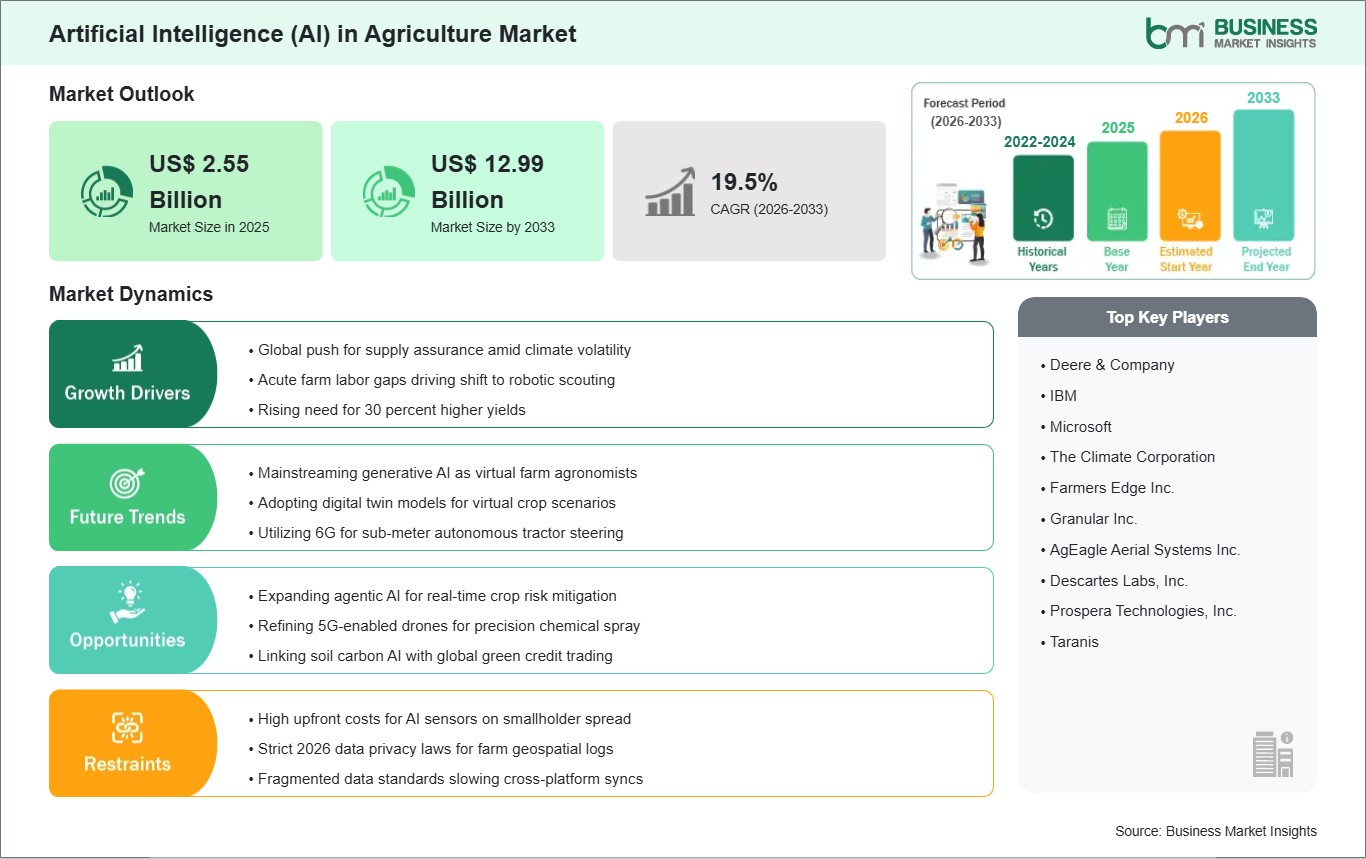
Artificial Intelligence (AI) in agriculture refers to the application of advanced computational technologies, such as machine learning, computer vision, and predictive analytics, to optimize and automate various farming processes. These technologies utilize data from diverse sources, including IoT sensors, satellite imagery, and drones, to provide actionable insights for crop management, livestock monitoring, and soil health analysis, ultimately aiming to increase resource efficiency and food production. Market expansion is primarily attributed to the rising global demand for food security driven by an increasing population, a growing need for climate-resilient farming practices, and the escalating shortage of agricultural labor. Furthermore, the integration of Generative AI copilots and autonomous navigation systems, which allow for hands-free field operations and expert-level decision support, is substantially improving procedural efficiency.
However, several challenges can restrain market growth: high initial procurement and integration costs, particularly for smallholder farmers in developing regions, can limit the adoption of advanced sensor networks and robotic hardware. Stringent regulatory hurdles and data privacy concerns, regarding the ownership and cross-border sharing of agronomic data, lengthen the time-to-market for new cloud-based platforms and increase development overhead. Additionally, the industry faces constraints due to technical complexity and a lack of digital literacy, where a shortage of skilled workers capable of maintaining AI-integrated equipment can result in the sub-optimal use of these high-tech solutions.
Despite these hurdles, the market holds immense opportunities in the universal mandate for sustainable and regenerative agriculture and the accelerating deployment of AI-powered carbon credit verification tools. The expansion of 5G-enabled edge computing, which allows for instantaneous data processing in remote fields, and the development of multi-spectral drone analytics for individual plant-level care are expected to create significant opportunities for market growth.
Segment Analysis
Artificial Intelligence (AI) in Agriculture Market Segmentation
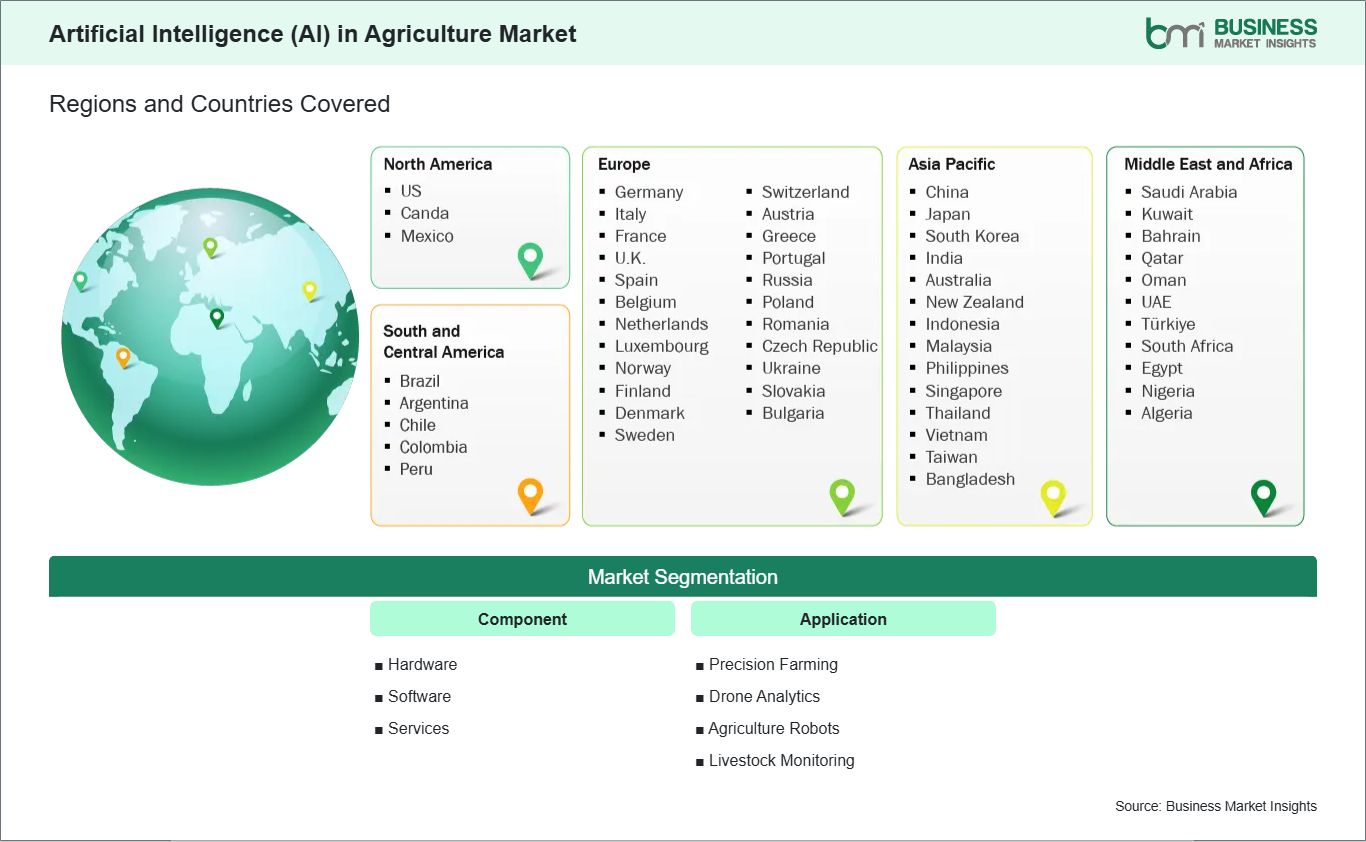
Key segments that contributed to the derivation of the Artificial Intelligence (AI) in Agriculture market analysis are component and application.
- By Component, the market is segmented into Hardware, Software, and Services.
- By Application, the market is divided into Precision Farming, Drone Analytics, Agriculture Robots, and Livestock Monitoring.
Market Forces
Artificial Intelligence (AI) in Agriculture Market Drivers and Opportunities
Food Security Pressures Fuel AI-Driven Agricultural Transformation
The primary driver for the Artificial Intelligence (AI) in Agriculture Market is the urgent global imperative to enhance food security in the face of a rapidly growing population and diminishing arable land. As traditional farming methods struggle to keep pace with the demand for higher yields, AI-driven solutions, including machine learning and predictive analytics, provide a necessary transition toward data-driven productivity. This pressure is intensified by the "triple threat" of climate change, water scarcity, and labor shortages. AI helps mitigate these challenges by enabling climate-smart practices that can predict erratic weather patterns and automate labor-intensive tasks like weeding and harvesting. Furthermore, government initiatives worldwide are increasingly subsidizing the adoption of "AgTech" to promote sustainable resource management. By reducing the over-application of fertilizers and pesticides, AI not only lowers operational costs but also aligns with global regulatory shifts toward environmental stewardship, ensuring a robust and non-discretionary growth path for the market.
AI Unlocks Hyper-Local Precision and Autonomous Farming Systems
A significant high-value opportunity lies in the advancement of hyper-local precision farming and computer vision-based diagnostics. Next-generation AI platforms can now analyze satellite and drone imagery at a sub-acre level, identifying nutrient deficiencies or pest infestations before they are visible to the human eye. This allows for "surgical" intervention, where inputs are applied only where needed, drastically improving profit margins and soil health. There is also a major growth frontier in the development of autonomous farming ecosystems. The integration of AI with robotics is moving beyond simple GPS guidance toward fully autonomous tractors and harvesters that can navigate complex terrains and perform delicate tasks like fruit picking with human-like dexterity. Additionally, the rise of AI-as-a-Service (AIaaS) and mobile-based diagnostic apps presents a massive opportunity to reach smallholder farmers in emerging economies, democratizing access to expert-level agronomic advice. Manufacturers who focus on "edge AI" processing data directly on the device to overcome rural connectivity issues, are positioned to lead the next era of decentralized, resilient agriculture.
Size and Share Analysis
Artificial Intelligence (AI) in Agriculture Market Size and Share Analysis
The Artificial Intelligence (AI) in Agriculture market demonstrates steady growth, with size and share analysis revealing evolving trends and competitive positioning among key players. The report further examines subsegments categorized within component and application, offering insights into their contribution to overall market performance.
For instance, the Software subsegment holds a significant market share. AI software platforms are indispensable for Precision Farming, as they serve as the central "brain" that processes vast datasets from satellites and soil sensors to provide real-time recommendations for irrigation and fertilization. A notable trend in 2026 is the integration of generative AI interfaces that allow farmers to interact with their data through natural language, much like a virtual agronomist. These innovations are particularly vital for large-scale agribusinesses, where they empower operators to optimize resource allocation across thousands of hectares, potentially increasing crop yields.
Furthermore, the Services subsegment is expanding as farmers seek professional consulting and system integration to bridge the "digital divide." This service-oriented approach ensures that even mid-sized operations can implement sophisticated AI models, providing a data-driven path to animal welfare and reduced mortality rates that aligns with modern consumer expectations for ethical food sourcing.
Report Coverage
Artificial Intelligence (AI) in Agriculture Market Report Coverage and Deliverables
The "Artificial Intelligence (AI) in Agriculture Market Size and Forecast (2022 - 2033)" report provides a detailed analysis of the market covering below areas:
- Artificial Intelligence (AI) in Agriculture market size and forecast at global, regional, and country levels for all the key market segments covered under the scope
- Artificial Intelligence (AI) in Agriculture market trends, as well as market dynamics such as drivers, restraints, and key opportunities
- Artificial Intelligence (AI) in Agriculture market analysis covering key market trends, global and regional framework, major players, regulations, and recent market developments
- Industry landscape and competition analysis covering market concentration, heat map analysis, prominent players, and recent developments for the Artificial Intelligence (AI) in Agriculture market
- Detailed company profiles, including SWOT analysis
Geographic Insights
Artificial Intelligence (AI) in Agriculture Market Geographic Insights
The geographical scope of the Artificial Intelligence (AI) in Agriculture market report is divided into five regions: North America, Asia Pacific, Europe, Middle East &Africa, and South &Central America.
The Asia-Pacific Artificial Intelligence (AI) in Agriculture Market is segmented into China, Japan, South Korea, India, Australia, New Zealand, Indonesia, Malaysia, the Philippines, Singapore, Thailand, Vietnam, Taiwan, Bangladesh, and the Rest of Asia. The market is primarily anchored by the region's vast agricultural output and the increasing use of AI-driven drones and predictive analytics to monitor crop health in real time. Growth is further bolstered by the rising demand for Integrated Pest Management (IPM) and the integration of IoT-enabled sensors that provide actionable data on soil moisture and nutrient levels. The expansion of AgTech startups and the introduction of regional AI-powered platforms for smallholder farmers solidify Asia-Pacific as a critical global hub for innovation and the digital transformation of traditional farming practices.
Industry Activity
Recent Developments
The Artificial Intelligence (AI) in Agriculture market is evaluated by gathering qualitative and quantitative data post primary and secondary research, which includes important corporate publications, association data, and databases. A few of the key developments in the Artificial Intelligence (AI) in Agriculture market are:
- In January 2026, SAP and Syngenta Announced Partnership to Scale AI-Assisted Agriculture. This partnership highlights the growing role of enterprise AI platforms in modern agriculture , supporting operational efficiency, scalability, and sustainability, and reflects increasing investment in AI-driven transformation across the agricultural value chain.
- In November 2025, Land O'Lakes Inc. and Microsoft Corp. announced a multiyear strategic alliance, marking a new chapter in their shared commitment to agricultural innovation. Building on five years of successful collaboration, the alliance will focus on co-developing AI-powered tools, including a digital assistant called “Oz.” This assistant is built on models within Azure AI Foundry and uses Land O'Lakes agricultural data to help farmers make informed decisions that aim to optimize operations, maximize yield potentials and mitigate risk.
Trust & Transparency
Research Methodology
The market analysis combines proprietary research with secondary data from government agencies, company disclosures, regulatory filings, industry databases and expert interviews. Market estimates are validated through data triangulation, cross-market benchmarking and analyst
review.
View Full Research Methodology
Key Sources Referred:
International Federation of Robotics (IFR)World Economic Forum (WEF) – Future of Manufacturing ReportsInternational Energy Agency (IEA)Company websiteCompany annual reportsCompany investor presentations