
Agricultural Robots Market Outlook: Size, Share, Trends, Growth Analysis, Competitive Landscape & Forecast, 2026-2033

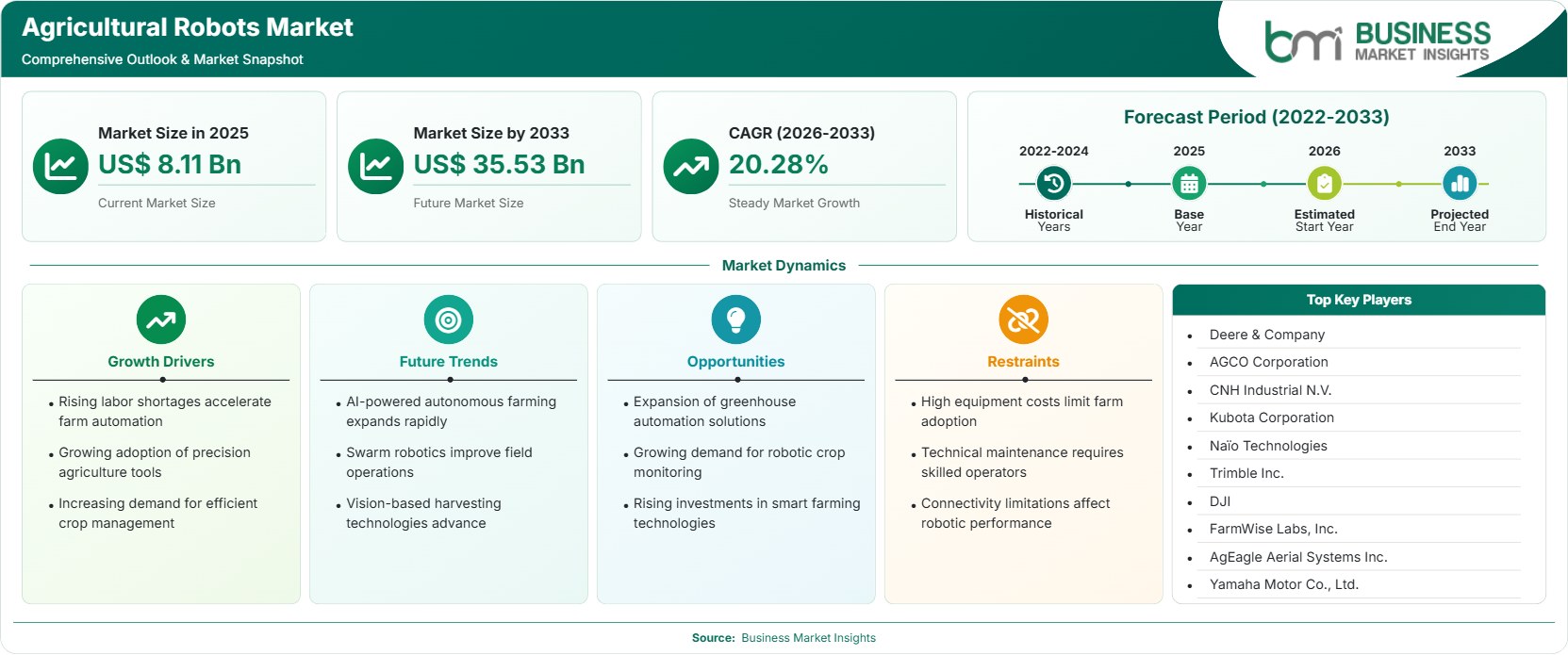
The Agricultural Robots Market size was valued at US$ 8.11 billion in 2025 and is projected to reach US$ 35.53 billion by 2033, growing at a CAGR of 20.28% during 2026–2033. Expansion of greenhouse automation solutions, growing demand for robotic crop monitoring, and rising investments in smart farming technologies are accelerating adoption, while precision agriculture and autonomous farm equipment continue creating long-term market opportunities.

Report Coverage
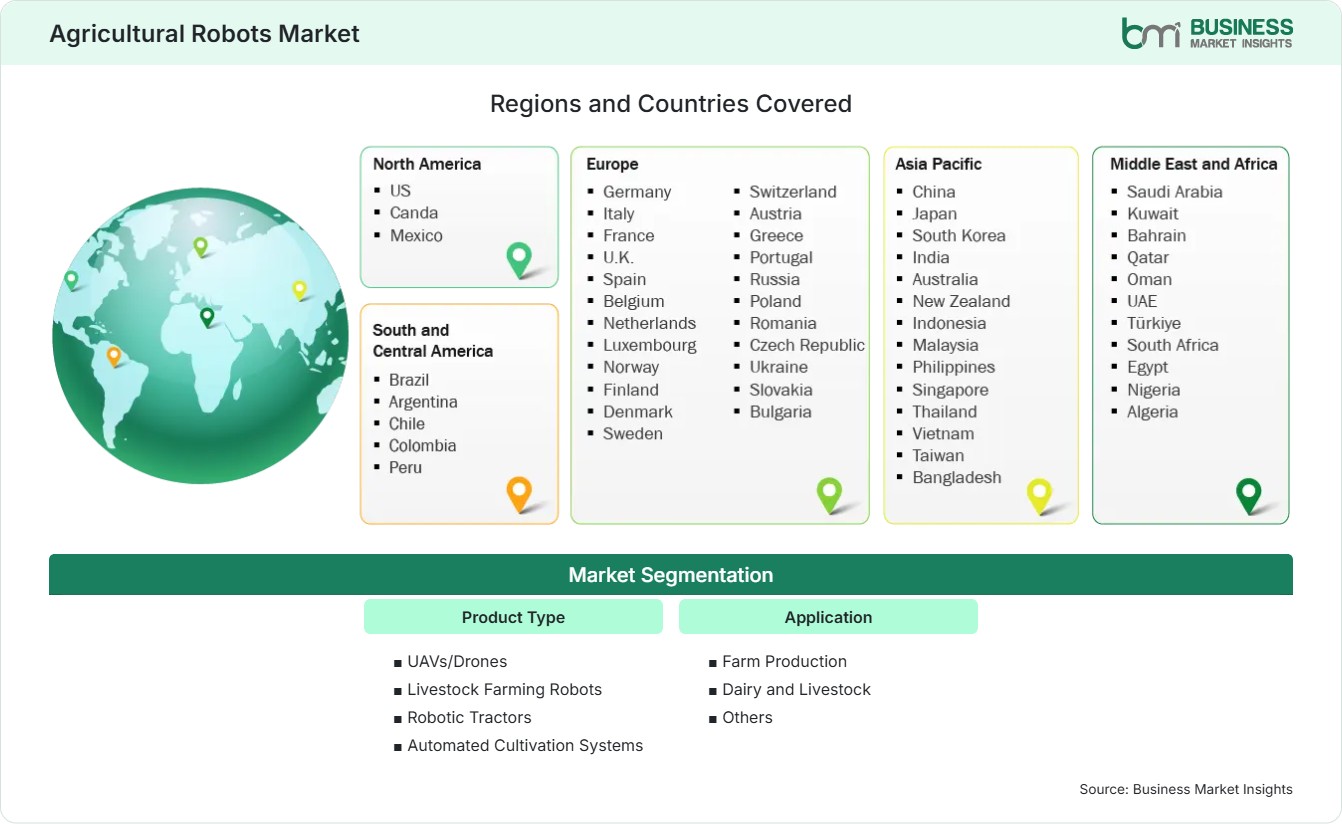
  • Product Type: UAVs/Drones, Livestock Farming Robots, Robotic Tractors, Automated Cultivation Systems
  • Application: Farm Production, Dairy and Livestock, Others
US$ 8.11 Bn Market size in 2025
US$ 35.53 Bn Market Size by 2033
20.28% CAGR, 2026 - 2033
2026-2033 Forecast Period

AI Overview

Agricultural Robots Market Summary

  • North America Region: North America holds 34%–37% market share in 2025 and is projected to expand at a CAGR of 19.4%–20.2% during 2026–2033. Rising labor shortages, precision farming adoption, and increasing investments in autonomous agricultural equipment continue supporting regional demand. The U.S. leads the regional market through large-scale commercial farming, advanced digital agriculture, and rapid adoption of autonomous machinery, expanding at an estimated CAGR of 19.8%–20.6% during 2026–2033.
  • Fastest Growing Region: Asia Pacific accounts for 28%–31% agricultural robots market share in 2025 and is expected to register a CAGR of 21.3%–22.1% during 2026–2033. Government support for agricultural modernization, increasing mechanization, and rising food production requirements continue driving rapid regional growth.
  • Leading Segment: UAVs/Drones represent 39%–42% market share in 2025 and are anticipated to grow at a CAGR of 20.1%–20.9% owing to expanding adoption for crop monitoring, field mapping, and precision spraying operations.
  • High Growth Segment: Farm Production accounts for 49%–52% market share in 2025 and is forecast to expand at a CAGR of 21.0%–21.8% as autonomous equipment increasingly supports precision planting, harvesting, and crop management.
  • Key Market Opportunity: Increasing deployment of autonomous farm machinery, AI-enabled crop monitoring, precision agriculture technologies, and greenhouse automation is creating significant opportunities for robotics manufacturers and digital farming solution providers.
  • Major Market Players: Deere & Company, AGCO Corporation, CNH Industrial N.V., Kubota Corporation, Naïo Technologies, Trimble Inc., DJI, FarmWise Labs, Inc., AgEagle Aerial Systems Inc., and Yamaha Motor Co., Ltd.
Strategic Insights

Agricultural Robots Market: Strategic Insights

Agricultural Robots Market Strategic Framework
FREE PDF
Request your free sample
Request free sample
Stakeholder View

Key Takeaways

  • Increasing integration of robotics, artificial intelligence, and precision agriculture technologies is transforming the agricultural value chain while improving operational efficiency and resource optimization.
  • Farm production applications offer the strongest commercial opportunity as growers increasingly automate planting, spraying, harvesting, and crop monitoring to improve productivity and reduce labor dependence.
  • Continuous innovation in autonomous navigation, machine vision, sensor technologies, and cloud-based farm management platforms is accelerating product development and commercial adoption.
  • Asia Pacific presents the most attractive long-term investment opportunity due to expanding agricultural mechanization, government modernization initiatives, and increasing food production requirements.
  • Strategic collaborations among robotics developers, agricultural equipment manufacturers, and precision farming technology providers continue accelerating commercialization and expanding global market penetration.
Geographic Outlook

Agricultural Robots Market Regional Highlights

North America Agricultural Robots Market

North America accounted for 34%–37% of the Agricultural Robots Market Share in 2025 and is projected to register a CAGR of 19.4%–20.2% during 2026–2033. Strong adoption of precision agriculture, autonomous machinery, and digital farm management platforms continues supporting regional expansion. Large commercial farms, favorable technology adoption rates, and increasing investments in agricultural automation further strengthen market demand across the region.

  • Labor shortages continue encouraging farmers to invest in autonomous tractors, robotic harvesters, and precision spraying equipment.
  • Government support for precision agriculture promotes adoption of AI-enabled farming technologies.
  • Integration of GPS, IoT, and cloud-based farm management improves operational efficiency and crop productivity.
  • Strong research collaborations accelerate commercialization of next-generation agricultural robotics.

US Agricultural Robots Market

The U.S. represented 76%–79% of the North American market in 2025 and is projected to expand at a CAGR of 19.8%–20.6% through 2033. Large-scale mechanized farming, technological innovation, and increasing investment in smart agriculture continue driving nationwide market growth.

  • Commercial farms increasingly deploy autonomous equipment to improve productivity and reduce operating costs.
  • Precision agriculture technologies enhance crop monitoring, irrigation management, and field analytics.
  • Rising investments in agricultural AI accelerate development of intelligent robotic solutions.
  • Strong dealer networks support wider commercialization of advanced farming equipment.

Europe Agricultural Robots Market

Europe held 26%–29% market share in 2025 and is forecast to grow at a CAGR of 19.0%–19.8% through 2026–2033. Germany leads regional adoption, while the Netherlands records the fastest growth due to advanced greenhouse farming, precision agriculture, and sustainable farming initiatives.

  • Greenhouse automation continues increasing deployment of robotic cultivation systems.
  • Sustainability regulations encourage precision farming and efficient resource utilization.
  • Autonomous machinery supports high-value crop cultivation across European farms.
  • Agricultural technology partnerships strengthen innovation in robotic farming solutions.

Asia Pacific Agricultural Robots Market

Asia Pacific accounted for 28%–31% market share in 2025 and is projected to register the strongest Agricultural Robots Market Forecasts, expanding at a CAGR of 21.3%–22.1% during 2026–2033. China leads regional revenue, while Japan demonstrates the fastest growth owing to increasing agricultural mechanization and strong robotics expertise.

  • Government initiatives encourage modernization of farming through robotic technologies.
  • Rising food demand accelerates investments in precision agriculture equipment.
  • Autonomous drones are increasingly utilized for crop monitoring and precision spraying.
  • Smart farming technologies improve productivity while reducing labor dependence.
  • Expansion of protected cultivation strengthens demand for automated farming systems.
Global Market Geography
FREE PDF
Request your free sample
Request free sample
Segment Analysis

Agricultural Robots Market Segmentation

Product Type

The Product Type UAVs/Drones accounts for the largest segment representing 39%–42% market share in 2025 and expanding at a CAGR of 20.1%–20.9%. The Agricultural Robots Market Trends indicate growing deployment of drones for crop monitoring, precision spraying, aerial imaging, and field mapping, enabling farmers to improve productivity while optimizing resource utilization.

  • UAVs/Drones: Widely deployed for precision agriculture applications including crop health monitoring, pesticide spraying, irrigation assessment, and field surveillance with real-time aerial data collection.
  • Livestock Farming Robots: Increasingly utilized for automated feeding, milking, livestock monitoring, and health management, improving operational efficiency and animal welfare.
  • Robotic Tractors: Adopted for autonomous plowing, planting, tillage, spraying, and harvesting operations, reducing labor requirements while enhancing field productivity.
  • Automated Cultivation Systems: Supporting greenhouse operations and controlled-environment agriculture through automated seeding, irrigation, weeding, and crop maintenance technologies.

Application

The Application segment continues expanding as agricultural producers increasingly implement automation technologies to improve productivity, sustainability, and operational efficiency. Farm production remains the dominant application, while robotic adoption continues increasing across specialized agricultural activities. The Market Growth is further supported by rising investments in intelligent farming technologies and digital agriculture platforms.

  • Farm Production: Leads market adoption through autonomous planting, harvesting, crop monitoring, precision spraying, and field management operations that improve agricultural productivity.
  • Dairy and Livestock: Increasing implementation of robotic milking, feeding, cleaning, and livestock monitoring systems supports efficient farm management and improved animal health.
  • Others (Specialty Crops): Robotic solutions are increasingly deployed for harvesting fruits, vegetables, vineyards, and other high-value specialty crops requiring precision operations and reduced manual labor.
Market Forces

Agricultural Robots Market Dynamics

Key Market Drivers

Rising Labor Shortages Accelerate Farm Automation

Agricultural labor shortages across developed and emerging economies are significantly supporting Agricultural Robots Market Growth. Aging farming populations, seasonal labor scarcity, and increasing wage costs are encouraging growers to invest in robotic technologies that improve productivity while reducing dependence on manual labor. Robotic agriculture involves carrying out repetitive activities like planting, harvesting, spraying, and weeding more consistently and efficiently. The government is also encouraging agricultural development by implementing mechanization and digital agriculture. With producers attempting to remain profitable despite the challenge of labor shortage, the use of robotic agriculture is anticipated to rise continuously on both large-scale and specialized farms.

Growing Adoption of Precision Agriculture Tools

The increasing adoption of precision agriculture is driving demand for autonomous farming equipment capable of collecting and analyzing field-level data. Agricultural robots equipped with GPS, artificial intelligence, machine vision, and advanced sensors enable accurate planting, targeted spraying, crop monitoring, and variable-rate input application. The use of precision technologies in order to optimize the application of fertilizers and other chemicals, save water, and increase yield is becoming more common among farmers. The rise of the sustainable farming approach and resource optimization is contributing to increased investments in smart robots. The advancements in connectivity and cloud computing add up to this trend.

Increasing Demand for Efficient Crop Management

Farmers are increasingly adopting robotic technologies to improve crop management throughout the cultivation cycle. Automated systems support precision seeding, irrigation monitoring, disease detection, weed identification, and selective harvesting while minimizing operational inefficiencies. The use of machine learning algorithms with multispectral imaging ensures that agricultural robots can sense plant stress and make informed decisions in the field. The need for increased food production due to increased demand, reduced arable land, and the constant need to increase agricultural productivity is constantly driving the adoption of automation in agriculture. This ensures that farms operate effectively and efficiently.

Key Market Opportunities

Expansion of Greenhouse Automation Solutions

The rapid expansion of controlled-environment agriculture is creating substantial opportunities for robotic solution providers. Greenhouse operators increasingly deploy autonomous robots for planting, crop inspection, harvesting, environmental monitoring, and material handling to improve operational efficiency. The Agricultural Robots Market Forecasts indicate growing investments in greenhouse automation as producers seek higher productivity, lower labor dependency, and consistent crop quality. Integration of robotics with climate control systems, artificial intelligence, and sensor technologies enables continuous monitoring and precision crop management. Increasing demand for year-round production of vegetables, fruits, and specialty crops is expected to support long-term market opportunities.

Growing Demand for Robotic Crop Monitoring

Robotic crop monitoring systems are gaining widespread adoption as farmers seek real-time visibility into crop health and field conditions. Robotic farm machines with high-end imaging devices detect deficiencies of nutrients, pest infestation, need for irrigation, and signs of diseases well before they have an impact on productivity. Detection of such issues at an early stage helps farmers take corrective actions without resorting to chemicals. It is expected that future developments in computer vision, artificial intelligence, and remote sensing technology will offer even more commercial potential for such robotic crop monitoring systems.

Rising Investments in Smart Farming Technologies

Governments, agricultural enterprises, and technology companies continue investing in smart farming infrastructure to improve food production efficiency and sustainability. The integration of robotics with IoT platforms, cloud-based farm management software, autonomous navigation systems, and AI has resulted in the formation of an extensively networked farming environment. The increased investment in digital agriculture, precision farming technologies, and climate-adaptive agriculture is creating an ideal situation for the deployment of robotic equipment. This would lead to the faster commercialization of robotic equipment and increased business prospects for robot manufacturing companies.

Market Restraints and Challenges

High Equipment Costs Limit Farm Adoption

Advanced agricultural robots require significant upfront investment because they incorporate sophisticated sensors, autonomous navigation systems, artificial intelligence software, and precision control technologies.

Factor: High capital investment and equipment acquisition costs.

Impact: Small and medium-sized farms may postpone robotic equipment purchases because of budget limitations and uncertain investment returns. High ownership costs, financing constraints, and lengthy payback periods continue slowing broader market penetration, particularly across developing agricultural economies where mechanization levels remain comparatively low.

Technical Maintenance Requires Skilled Operators

Agricultural robots depend on advanced electronics, software platforms, sensors, communication systems, and precision mechanical components that require specialized technical expertise for operation and maintenance.

Factor: Limited availability of skilled technical personnel.

Impact: Insufficient technical knowledge can increase equipment downtime, maintenance expenses, and operational inefficiencies. Farmers may also require additional training to fully utilize advanced robotic capabilities, creating adoption challenges for smaller agricultural operations with limited access to technical support and digital farming expertise.

Company Analysis

Competitive Landscape

The competitive landscape of the Market is highly dynamic, with established agricultural equipment manufacturers, robotics developers, and precision farming technology providers focusing on automation, artificial intelligence, and digital agriculture solutions. The Agricultural Robots Market Analysis indicates that companies are strengthening their competitive positions through strategic acquisitions, product innovation, autonomous vehicle development, software integration, and partnerships with agricultural technology providers. Investments in machine vision, GPS-guided navigation, cloud-based farm management, and intelligent robotic platforms continue supporting commercialization of next-generation agricultural automation solutions across global farming operations.

Company Name

Overview

Products and Services Relevant to this Market

Deere & Company

Global leader in agricultural machinery and precision farming technologies serving commercial agriculture through advanced autonomous equipment and digital solutions.

Autonomous tractors, precision agriculture platforms, AI-enabled farming equipment, harvesting machinery, spraying systems, and farm management software.

AGCO Corporation

International agricultural equipment manufacturer offering advanced mechanization solutions for crop production and precision agriculture.

Smart tractors, harvesting equipment, precision planting systems, autonomous farming technologies, and digital farm management platforms.

CNH Industrial N.V.

Global manufacturer of agricultural machinery and automation technologies supporting sustainable and efficient farming operations.

Autonomous tractors, precision farming equipment, harvesting machinery, GPS guidance technologies, and connected agricultural solutions.

Kubota Corporation

Leading agricultural equipment manufacturer specializing in compact machinery and intelligent farming technologies.

Tractors, autonomous agricultural equipment, robotic machinery, rice farming technologies, and smart farming solutions.

Naïo Technologies

Robotics company focused on autonomous agricultural robots for sustainable crop production and weed management.

Autonomous weeding robots, robotic cultivation systems, specialty crop automation, and intelligent field robotics.

Trimble Inc.

Technology company delivering positioning, automation, and digital agriculture solutions for precision farming applications.

GPS guidance systems, precision agriculture software, autonomous steering technologies, farm analytics, and connected farming platforms.

DJI

Global drone manufacturer providing advanced unmanned aerial systems for commercial agricultural operations.

Agricultural drones, aerial crop monitoring, precision spraying platforms, remote sensing technologies, and farm imaging solutions.

FarmWise Labs, Inc.

Agricultural robotics developer specializing in autonomous weeding and precision crop management technologies.

AI-powered weeding robots, machine vision technologies, precision cultivation systems, and autonomous field robotics.

AgEagle Aerial Systems Inc.

Manufacturer of unmanned aerial systems and aerial imaging technologies supporting precision agriculture applications.

Agricultural drones, aerial mapping systems, remote sensing technologies, crop monitoring platforms, and precision agriculture software.

Yamaha Motor Co., Ltd.

Diversified technology company developing unmanned helicopters and automation technologies for agricultural applications.

Agricultural unmanned helicopters, autonomous spraying systems, precision agriculture technologies, and robotic farming equipment.

Trust & Transparency

Research Methodology

The market analysis combines proprietary research with secondary data from government agencies, company disclosures, regulatory filings, industry databases and expert interviews. Market estimates are validated through data triangulation, cross-market benchmarking and analyst review.

View Full Research Methodology

Questions Answered

Frequently Asked Questions

What does the Agricultural Robots Market Report include?

The Market Report provides comprehensive analysis of market size, market share, growth trends, regional outlook, competitive landscape, product segmentation, application analysis, key company profiles, technology developments, investment opportunities, regulatory environment, recent industry developments, and long-term market forecasts. It also evaluates emerging business opportunities, strategic initiatives, innovation trends, and the competitive positioning of leading manufacturers shaping the future of agricultural automation.

What are the major challenges affecting market expansion?

The market faces challenges including limited communication infrastructure in rural areas, cybersecurity risks associated with connected farming systems, high capital investment requirements, and the need for skilled operators capable of maintaining advanced robotic equipment. Integration of robotics with existing farm operations and concerns regarding return on investment also influence purchasing decisions, particularly among small and medium-sized agricultural producers with limited financial resources.

Which application offers the highest growth opportunities?

Farm Production is expected to generate the highest growth opportunities as agricultural producers increasingly automate planting, harvesting, spraying, fertilization, and crop monitoring activities. Autonomous machinery helps farmers improve operational efficiency, reduce labor dependency, minimize input waste, and maximize crop yields. Growing adoption of precision agriculture, digital farm management platforms, and AI-driven decision support systems is expected to further accelerate robotic deployment across large-scale farming operations throughout the forecast period.

Which product segment leads the Agricultural Robots Market?

UAVs/Drones represent the leading product segment because they offer efficient aerial crop monitoring, precision spraying, field mapping, irrigation assessment, and real-time agricultural data collection. Their ability to improve decision-making, reduce chemical consumption, monitor crop health, and support precision agriculture makes them the most widely adopted robotic solution across commercial farming operations. Continuous advancements in autonomous flight technologies and imaging capabilities further strengthen demand for agricultural drones.

What is driving the Agricultural Robots Market?

The Agricultural Robots Market is primarily driven by expanding greenhouse automation, increasing deployment of robotic crop monitoring systems, and rising investments in smart farming technologies. Growing labor shortages in agriculture, increasing demand for precision farming, and widespread adoption of artificial intelligence, machine vision, GPS guidance, and IoT-enabled equipment are enabling farmers to improve productivity, optimize resource utilization, reduce operational costs, and support sustainable agricultural practices across both developed and emerging economies.

Access the Full Agricultural Robots Market Report

Get segment-level forecasts, regional estimates, competitive benchmarking, company profiles and downloadable Excel datasets.

Access the full Agricultural Robots Market Report
350 pages PDF & Excel | 2026-08-06