Market Summary
Executive Summary and Global Market Analysis
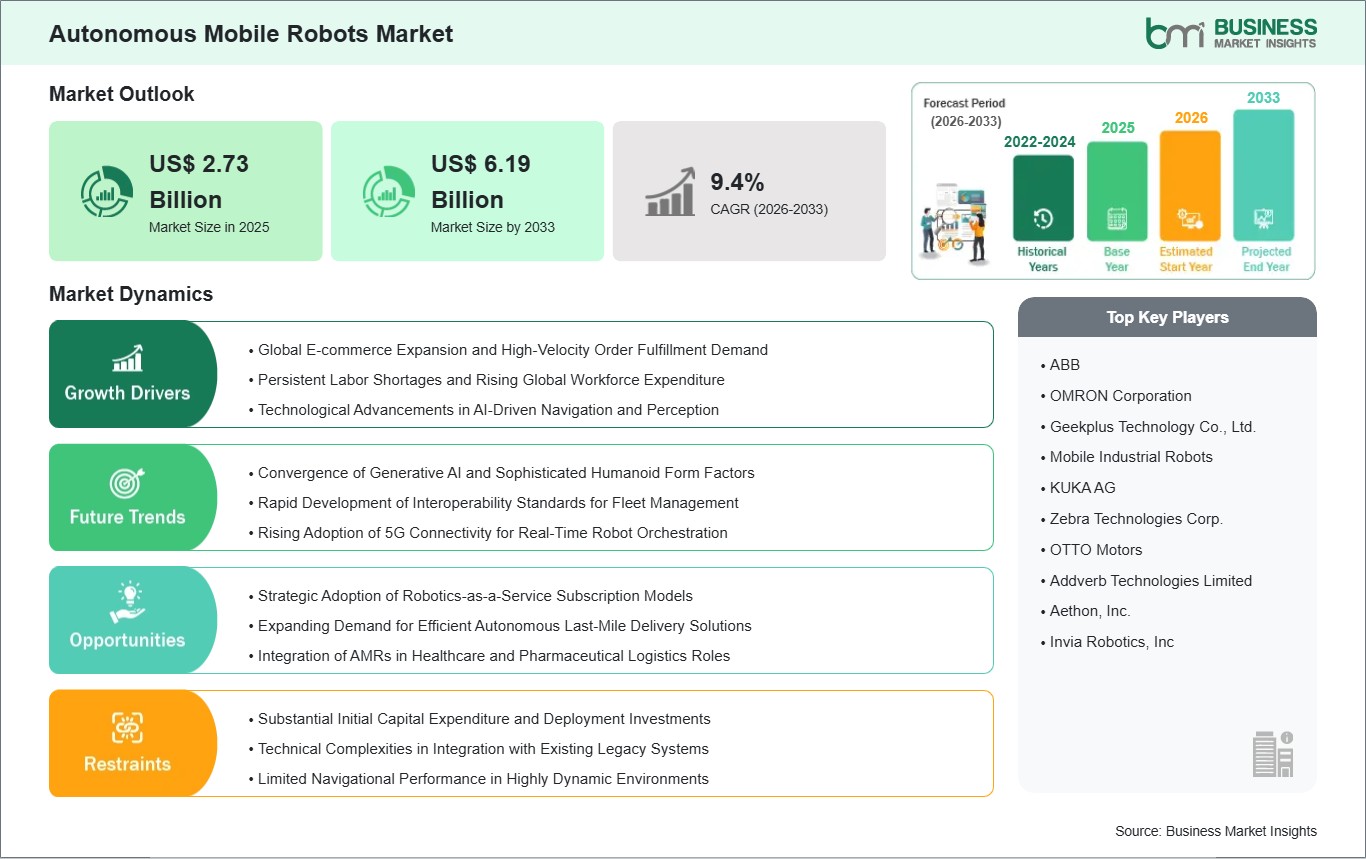
Autonomous Mobile Robots (AMRs) play a critical role in the modernization of industrial and logistics operations, offering a high degree of flexibility and intelligence compared to traditional fixed automation. They are essential for industries such as manufacturing, distribution & warehousing, healthcare, and retail. AMRs offer several advantages, including the ability to navigate dynamic environments without physical guides, rapid deployment timelines, and high scalability. Increasing global trade volumes, the rise of omnichannel e-commerce, and the persistent labor shortage in manual material handling roles are fueling the market. Additionally, innovations in machine learning, 5G connectivity, and sensor fusion are enhancing robot autonomy and operational efficiency.
However, several challenges can restrain market growth, including high capital expenditure at the beginning stages, the challenge of integrating heterogeneous fleets of robots into existing IT infrastructure, and regulatory challenges concerning safety issues among humans and robots. The sector is also impacted by changes in economic conditions and trade policies on the sourcing of components. In spite of these challenges, significant opportunities exist that will drive the market in the context of the transition toward Industry 4.0, the extension of RaaS subscription models, and the increasing need for last-mile delivery efficiency. Similarly, opportunities in advanced software investment for fleet orchestration and sustainable battery technology are expected to unlock new paths for market growth.
Segment Analysis
Autonomous Mobile Robots Market Segmentation
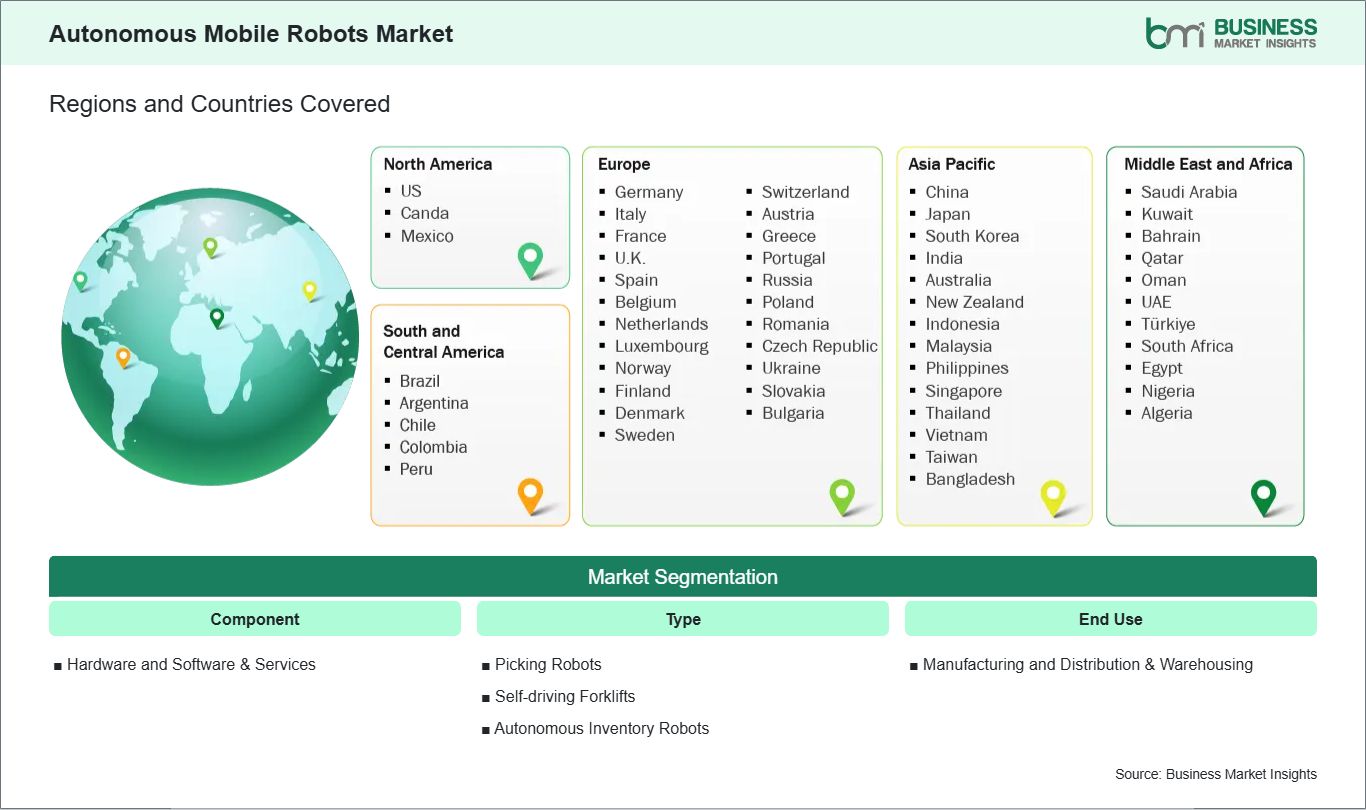
Key segments that contributed to the derivation of the Autonomous Mobile Robots market analysis are component, type, and end use.
- By Component, the market is segmented into Hardware and Software & Services.
- By Type, the market is divided into Picking Robots, Self-driving Forklifts, and Autonomous Inventory Robots.
- By End Use, the market is categorized into Manufacturing and Distribution &Warehousing.
Market Forces
Autonomous Mobile Robots Market Drivers and Opportunities
Global E-commerce Expansion and High-Velocity Order Fulfillment Demand
The rapid growth of global e-commerce has emerged as a pivotal factor driving the autonomous mobile robots market. With the digitalization of commerce and the increasing preference for online shopping, consumers now expect faster delivery times and real-time tracking, making AMRs a critical component of the supply chain.
For instance, the global B2B e-commerce is expected to grow, and robust expansion directly supports the growth of the AMR market, as the need for fast, efficient global shipping solutions continues to increase to meet consumer expectations and supply chain demands worldwide. Major e-commerce players like Amazon, which have surpassed 1 million deployed robots, have shown that autonomous fleets can quadruple throughput. These robots enable operations and "lights-out" warehousing for managing peak seasonal demands and high-volume sorting for same-day delivery services. As omnichannel retail becomes the global standard, the reliance on AMRs to navigate dynamic warehouse environments and perform precise picking tasks without fixed infrastructure continues to intensify, ensuring a steady upward trajectory for the market.
Strategic Adoption of Robotics-as-a-Service and Industry 4.0 Integration
The shift toward Industry 4.0 and the emergence of Robotics-as-a-Service (RaaS) models present significant opportunities for market expansion. As factories transition into interconnected "Smart Factories," there is a mounting demand for mobile robots that can seamlessly integrate with IoT sensors, digital twins, and cloud-based fleet management systems. This interoperability allows for advanced robotic orchestration where AMRs, cobots, and automated production lines work in a synchronized ecosystem, improving task allocation efficiency by over 25%.
Furthermore, the RaaS business model is democratizing access to high-end automation. As a technology that moves the financial costs from high Capital Expenditure to Operating Expenditure, RaaS helps SMEs overcome financial risks in implementing state-of-the-art AMR solutions. Such a technology is very important in the current state of the economy, where organizations are in need of solutions that can be scaled according to the real-time market volatility. Additionally, the development of humanoid form factors and modular payload decks allows a single AMR platform to perform diverse tasks, from light tote picking to moving heavy pallets, thereby maximizing the return on investment for industrial users and opening entirely new service-based revenue streams for robotic vendors.
Size and Share Analysis
Autonomous Mobile Robots Market Size and Share Analysis
The autonomous mobile robots market demonstrates steady growth, with size and share analysis revealing evolving trends and competitive positioning among key players. The report further examines subsegments categorized within component, type, and end use, offering insights into their contribution to overall market performance.
Based on component, the hardware subsegment led the market, driven by the high cost and volume of sensors, actuators, and power systems required for robot assembly. However, the Software & Services segment is expected to experience significant growth due to the rising demand for intelligent navigation and fleet management platforms.
In terms of type, Picking Robots (specifically Goods-to-Person systems) accounted for a considerable share, owing to their ability to replace paper-based and manual picking systems in high-volume e-commerce hubs. Meanwhile, Self-driving Forklifts are set to experience the fastest rate of market growth as heavy industries automate the movement of large pallets and components.
Distribution & Warehousing remains the leading end-use segment, attributed to the surge in online sales. Conversely, the Manufacturing segment is growing rapidly as AMRs become integral to assembly line productivity and material delivery in "smart factories."
Report Coverage
Autonomous Mobile Robots Market Report Coverage and Deliverables
The "Autonomous Mobile Robots Market Size and Forecast (2022 - 2033)" report provides a detailed analysis of the market covering below areas:
- Autonomous Mobile Robots market size and forecast at global, regional, and country levels for all the key market segments covered under the scope.
- Autonomous Mobile Robots market trends, as well as market dynamics such as drivers, restraints, and key opportunities.
- Autonomous Mobile Robots market analysis covering key market trends, global and regional framework, major players, regulations, and recent market developments.
- Industry landscape and competition analysis covering market concentration, heat map analysis, prominent players, and recent developments for the autonomous mobile robots market.
- Detailed company profiles, including SWOT analysis.
Geographic Insights
Autonomous Mobile Robots Market Geographic Insights
The geographical scope of the market report is divided into five regions: North America, Asia Pacific, Europe, Middle East & Africa, and South & Central America.
The Asia-Pacific Autonomous Mobile Robots market is experiencing robust growth, driven by the rapid expansion of cross-border e-commerce and the rising demand for time-sensitive delivery services. Major economies like China and India are leading the way, fueled by increasing industrial output, strategic logistics investments, and the development of free trade zones. The region is witnessing increased adoption of advanced technologies, including AI-based shipment tracking and 5G-enabled communication.
In North America, the market is driven by e-commerce giants and a mature technological ecosystem. The United States plays a vital role, featuring extensive research in AI and sensor technologies. Retail e-commerce sales in the U.S., underscoring the urgent need for scalable automation like AMRs in fulfillment processes.
Industry Activity
Recent Developments
The Autonomous Mobile Robots market is evaluated by gathering qualitative and quantitative data post primary and secondary research, which includes important corporate publications, association data, and databases. A few of the key developments in the autonomous mobile robots market are:
- In January 2025, Boston Dynamics unveiled the product version of its new Atlas® robot at the Consumer Electronics Show in Las Vegas. The fully electric humanoid was revealed during Hyundai's global CES media day presentation, which also featured a live stage demonstration of the prototype version of Atlas, in addition to a rousing dance performance by a troupe of its famous Spot® robots.
- In June 2025, ABB is extending its portfolio of fully autonomous mobile robots by equipping its Flexley Mover® P604 with 3D visual simultaneous localization and mapping (Visual SLAM) navigation and user-friendly AMR Studio; programming software. The launch marks another milestone in ABB's journey towards autonomous mobile robots that are more versatile, efficient, and easier to use.
Trust & Transparency
Research Methodology
The market analysis combines proprietary research with secondary data from government agencies, company disclosures, regulatory filings, industry databases and expert interviews. Market estimates are validated through data triangulation, cross-market benchmarking and analyst
review.
View Full Research Methodology
Key Sources Referred:
World Bank - Global Trade Indicators World Trade Organization (WTO) International Monetary Fund (IMF) International Trade Administration (ITA) Company website Company annual reports Company investor presentations