Tactical Optics Market Regional Highlights
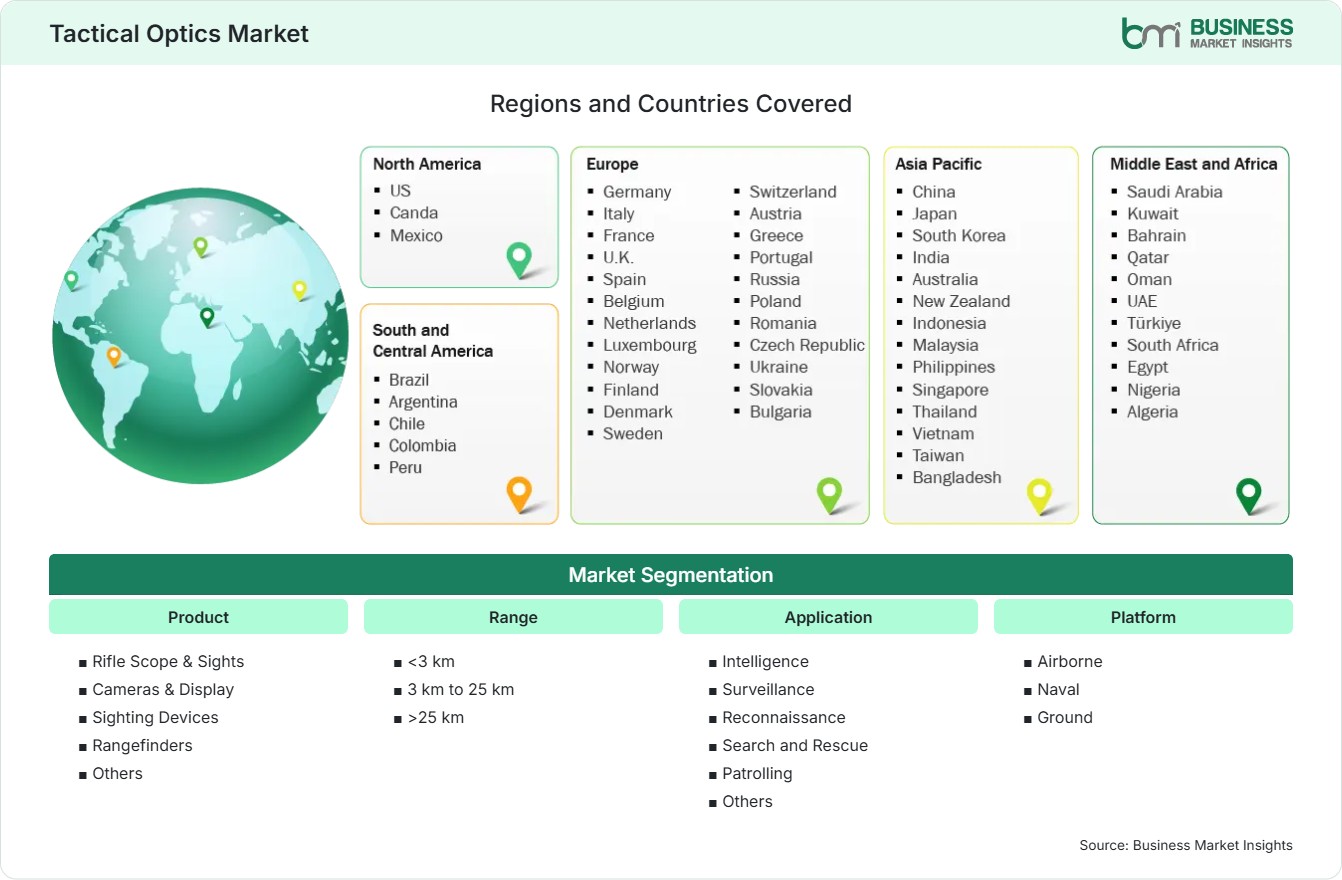
North America Tactical Optics Market
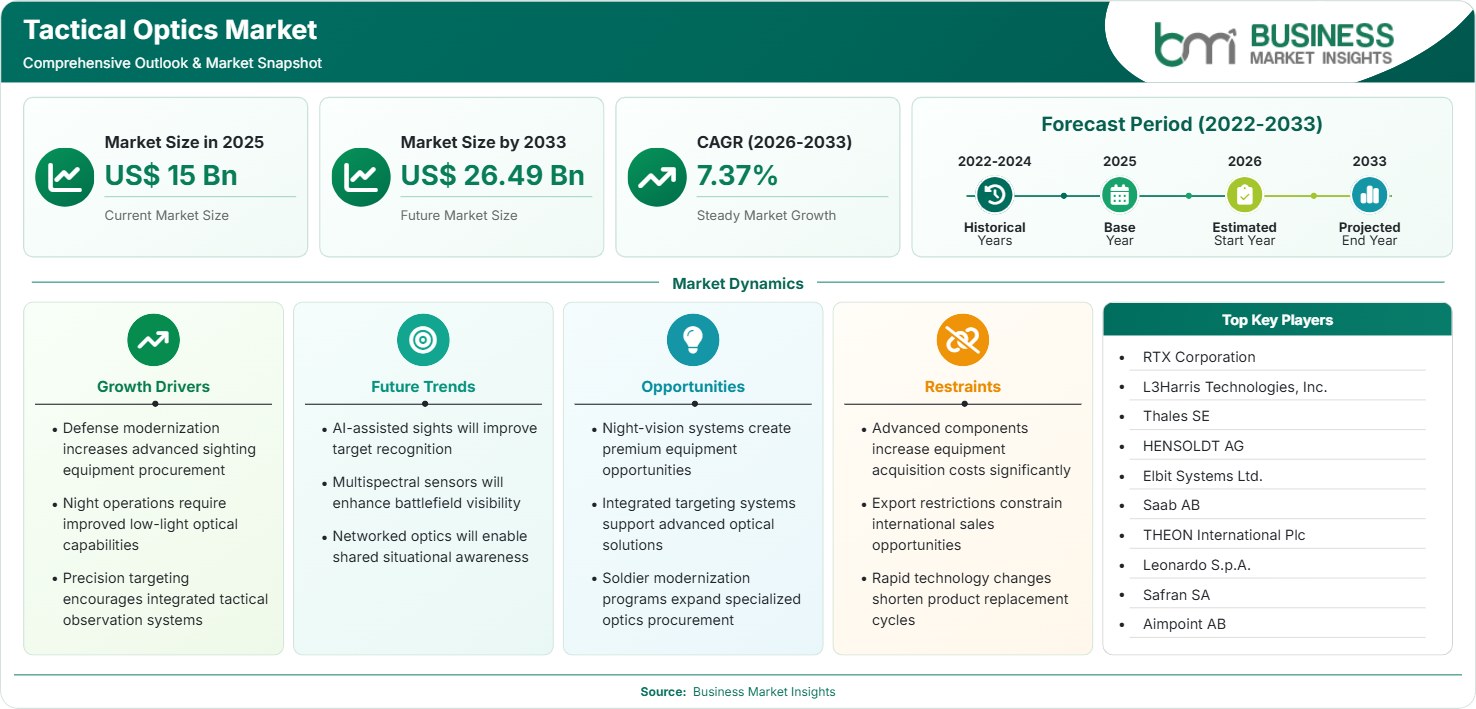
North America represents 40%–43% share in 2025, with a 6.8%–7.2% CAGR during 2026–2033. The region benefits from high defense expenditure, established optical manufacturing, and rapid adoption of thermal and digital sensing. The region’s Tactical Optics Market share reflects mature demand combined with continued replacement of legacy equipment and integration of advanced electro-optical technologies.
- The modernization of the defense sector places a priority on thermal sights, stabilized electro-optical/infrared systems, and digitally connected targeting equipment for use in contested environments.
- The demand for passive optical detection, tracking, identification, and multisensor engagement architectures is increasing due to counter-UAS requirements.
- Domestic manufacturing remains strategically important as governments emphasize secure supply chains for detectors, electronics, optics, and critical components.
- Open architectures enable the upgrading of existing platforms while reducing the cost and disruption normally associated with replacing the entire system.
US Tactical Optics Market
The US Tactical Optics Market accounts for 82%–85% of North American share in 2025, with a 6.7%–7.1% CAGR during 2026–2033. Demand is anchored by modernization of infantry equipment, armored vehicles, aircraft, and maritime platforms. The procurement environment increasingly rewards systems that combine optical performance with software, sensor fusion, and low-power processing.
- Multispectral sensing and digital processing are increasingly stressed upon by procurement since operators need to be able to identify objects during the day, at night, in smoke, in haze, and under complicated urban conditions.
- The rapid prototyping and the transition from advanced electro-optical research to deployable targeting, surveillance, and reconnaissance systems are supported by the US industrial base.
- There is increasing demand for WESCAM-class EO/IR sensors, AI-powered tracking, and passive detection technologies as a result of counter-drone programmes.
- The frequency of replacements is being shaped by lessons learned in contested environments, with greater interest now in compact systems that offer improved durability and use less power.
Europe Tactical Optics Market
Europe Tactical Optics Market represents 24%–27% share in 2025, growing at a 7.8%–8.3% CAGR during 2026–2033. Germany, France, the United Kingdom, Italy, Poland, and Nordic countries are important demand centers, while Poland and Germany represent particularly active modernization markets. European military expenditure reached US$864 billion in 2025, a 14% increase, providing a strong procurement backdrop for optronics and night-vision modernization.
- Germany is currently enhancing its procurement of thermal and night-vision equipment, which is opening up possibilities for large-scale soldier-system programmes and vehicle-mounted optical systems.
- France is still providing support for the development of domestic optronics, this including that relating to advanced night observation and integrated weapon-sighting technologies.
- The acceleration in Poland's defense spending is driving increased demand for vehicle sights, battlefield surveillance equipment, thermal imaging devices, and precision observation systems.
- The Nordic countries are emphasizing the use of robust, interoperable optical equipment suitable for low temperatures, long observation periods, and distributed operations.
- European localization programs are increasingly combining procurement with domestic maintenance, production, technology transfer, and lifecycle support.
Asia Pacific Tactical Optics Market
Asia Pacific Tactical Optics Market accounts for 21%–24% share in 2025, with a 8.5%–9.2% CAGR during 2026–2033, making it the fastest-growing regional market. Asia and Oceania military expenditure reached US$681 billion in 2025, increasing 8.1%, with China, Japan, and India among the significant spenders.
- In 2025 India's military spending amounted to 92.1 billion US dollars and this was used to support domestic production and the acquisition of advanced optical, thermal, and navigation equipment.
- In 2025, military spending in Japan went up by 9.7 percent, which in turn increased the demand for surveillance, targeting, maritime observation and advanced sensor technologies.
- Australia is increasing its sophisticated capabilities in the field of intelligence, surveillance and reconnaissance and in the maritime domain, which is opening up opportunities for stabilized EO/IR payloads and long-range observation systems.
- South Korea's approach involves combining the production of high-tech manufactured goods with the need for strong defense modernization, which in turn creates demand for digital sights and electro-optical targeting systems.
- Procurement in Southeast Asia is placing greater emphasis on coastal surveillance, border security, and the use of compact systems for both maritime and land applications.
Rest of World Tactical Optics Market
South and Central America Tactical Optics Market account for a smaller but increasingly diversified demand base, with Brazil, Colombia, Mexico, and Chile representing important procurement markets. Middle Eastern demand is supported by border security, armored platforms, counter-UAS programs, and high-end surveillance. Military spending in the Middle East increased 15% in 2024, while Saudi Arabia spent US$83.2 billion in 2025.
- Brazil’s defense system supports opportunities in surveillance, patrol, and border monitoring. These uses need tough optical equipment.
- In the Gulf countries, there is a growing preference for local maintenance, for the transfer of technology, and for partnerships involving sovereign manufacturing with regard to electro-optical and night-vision equipment.
- Israel's sophisticated defense system promotes the use of multispectral sensing, precise observation, and compact targeting technologies in the region.
- The fact that Saudi Arabia spends money on its defense opens up opportunities for the sale of vehicles equipped with sight devices, thermal imaging, surveillance cameras, and long-range observation systems.
- In African markets, demand is still very selective, with the main focus being on border surveillance, security operations, night vision, and equipment that is cost-effective and has a reliable lifecycle support.