Steel Cord Market Regional Highlights
North America Steel Cord Market
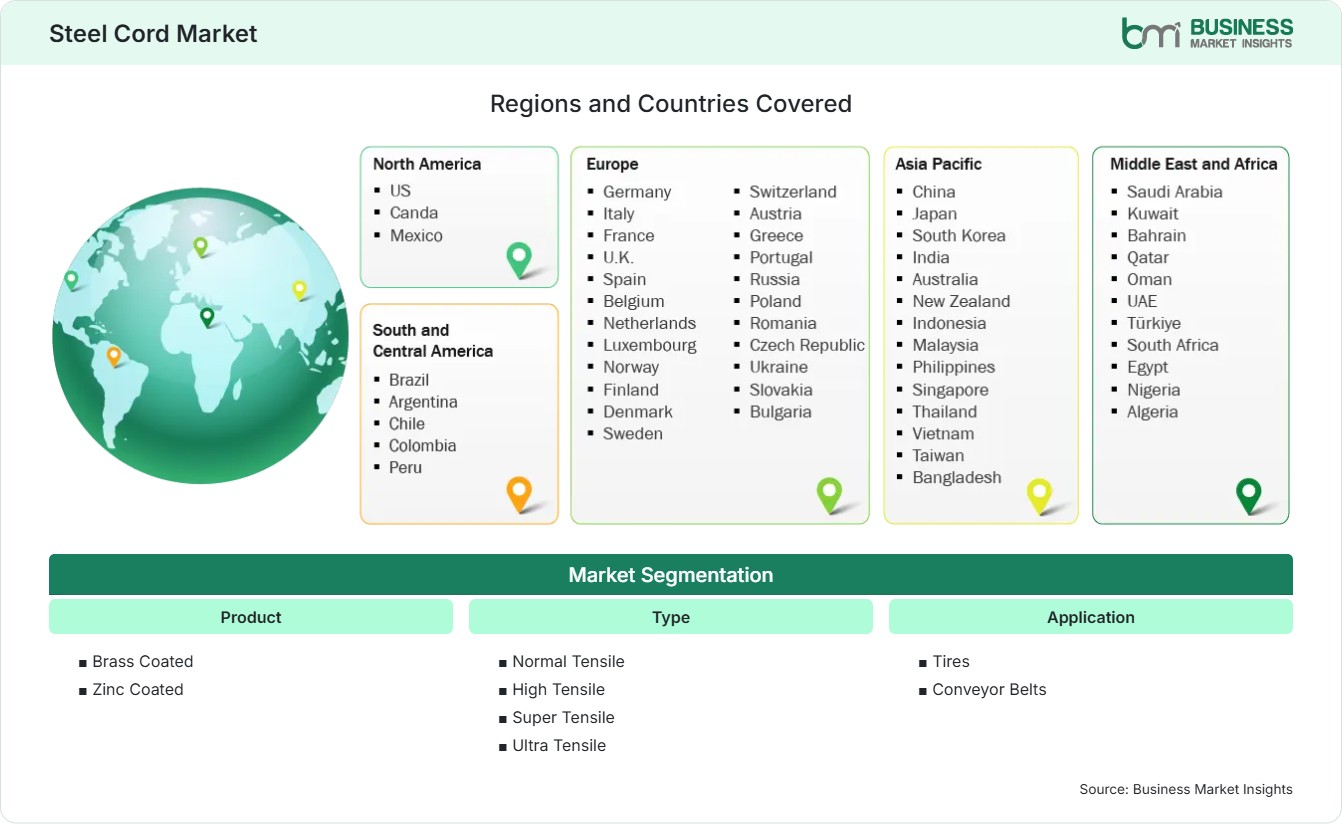
North America accounted for 16%–19% share in 2025 and is projected to expand at a 5.8%–6.3% CAGR during 2026–2033. The region benefits from a mature replacement tire market, stable commercial vehicle demand, and significant mining and material-handling operations. Tire manufacturers continue emphasizing high-performance radial tire production, supporting steady consumption of reinforcement materials. The Steel Cord Market share in the region remains supported by infrastructure investments and growing demand for durable conveyor belt systems across industrial sectors.
- Replacement tires remain a key component of demand due to aging fleets, which will sustain the need for reinforced materials in vehicles.
- Mining industry in Canada and USA is adding more and more conveyors, which increases the demand for reinforcement materials capable to resist the tough operating conditions.
- Demand from transportation industry will rise due to the growth of commercial trucks and buses, as manufacturers will try to increase the performance of the tires by using better reinforcements.
- Infrastructure improvement projects continue providing more industrial equipment applications and indirectly increasing demand for conveyors and reinforcement materials.
- Tire producers are upgrading their technology in order to increase safety and fuel efficiency, which results in increasing demand for steel cords.
US Steel Cord Market
The United States represented approximately 78%–82% of North American demand in 2025 and is expected to advance at a 5.9%–6.4% CAGR through 2033. High automotive production levels, freight transport activity, and replacement tires drive the growth of the market. Investments in industrial automation and materials handling contribute to increased use of steel cord conveyor belts. The nation continues to be an important market because of its highly developed manufacturing sector and high demand for transportation and industrial products.
- Increased logistics activities ensure constant demand for truck tires that require robust steel cord reinforcements to offer better life and higher carrying capacity.
- The growth of warehousing and logistics infrastructure will result in the increased use of conveyor belts, thus ensuring the use of reinforcement materials.
- The automobile aftermarket sector is healthy, and hence there is assured demand for tires of passenger cars and light trucks.
- Efforts towards fuel efficiency and safety of vehicles will ensure the use of high-quality tires.
Europe Steel Cord Market
Europe held an estimated 21%–24% Steel Cord Market share in 2025 and is forecast to grow at a 5.7%–6.1% CAGR through 2033. Positive features include a strong capacity for automobile manufacturing, a high level of tire production infrastructure, and an increasing need for sustainability in mobility solutions. The nation of Germany is considered the biggest national market on account of the strength of its automotive industry, while Eastern Europe exhibits quicker growth on account of manufacturing.
- Germany is the key consumer region due to its presence of automobile companies, tire makers, and industrial equipment producers.
- Poland is the high-growth country thanks to manufacturing investments and industrial production operations.
- The trend towards electric vehicles stimulates the demand for advanced tires that need better and lighter reinforcements.
- Commercial transportation operations keep driving the demand for trucks and buses tires in major European countries.
- Sustainable development projects are stimulating manufacturers to optimize reinforcement performance.
Asia Pacific Steel Cord Market
Asia Pacific accounted for 47%–50% share in 2025 and is projected to register the fastest regional expansion at a 7.1%–7.6% CAGR through 2033. The region serves as the global center for tire manufacturing, automotive production, and industrial development. China remains the largest market, while India records the highest growth momentum due to expanding vehicle production and infrastructure investments. The Steel Cord Market growth outlook remains particularly favorable because of continuing industrialization and strong domestic demand for transportation equipment.
- China has the upper hand in regional demand because of its capability to produce tires, automobile production and its industrial activities.
- India is now considered the fastest growing market country owing to its increasing production in automobiles, logistics and infrastructure programs.
- Countries in Southeast Asia have been continually attracting tire manufacturing investments geared toward export-oriented production activities.
- The mining and material handling industries are adding to the demand for reinforced conveyor belts in the region.
- The increasing adoption of electric vehicles is aiding the demand for better reinforced tire materials that can handle torque and vehicle weight.
Rest of World Steel Cord Market
The Rest of World region represented 8%–11% Steel Cord Market share in 2025 and is projected to grow at a 6.0%–6.5% CAGR through 2033. Mining, use of agricultural machinery, and improved transport links keep South and Central American countries benefiting. Infrastructure development, industrial expansion programs, and bulk materials handling keep Middle East and Africa countries supported. Demand is associated with industrial and transport developments in emerging nations.
- Brazil remains the leader in regional consumption through its automotive manufacturing facilities, mining activities, and need for transportation.
- Mexico is benefiting due to its integration into the North American manufacturing value chains and tire production.
- Saudi Arabia is spending large amounts of money on industrial projects that will need material handling and conveying systems.
- The United Arab Emirates is developing further logistics and transportation infrastructure that will be demanding reinforced industrial parts.
- Increasing industrialization in Africa presents an opportunity for conveyor belts in mining, construction, and bulk material handling situations.