
Fungicides Market Outlook: Size, Share, Trends, Growth Analysis, Competitive Landscape & Forecast, 2026–2033

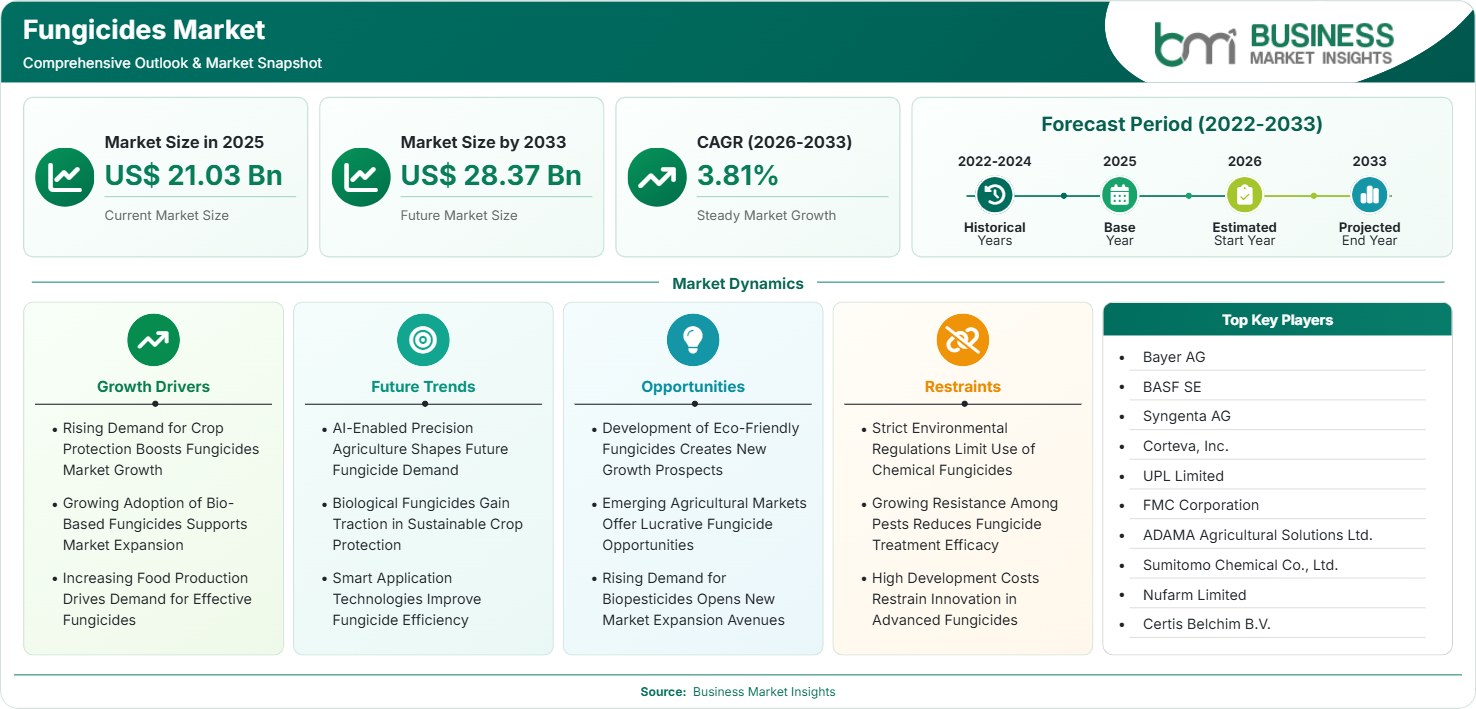
The Fungicides Market size was valued at US$ 21.03 Billion in 2025 and is projected to reach US$ 28.37 Billion by 2033, growing at a CAGR of 3.81% during 2026–2033, driven by rising crop disease pressure, food security needs, biological innovation, resistance management, and precision application technologies.

Report Coverage
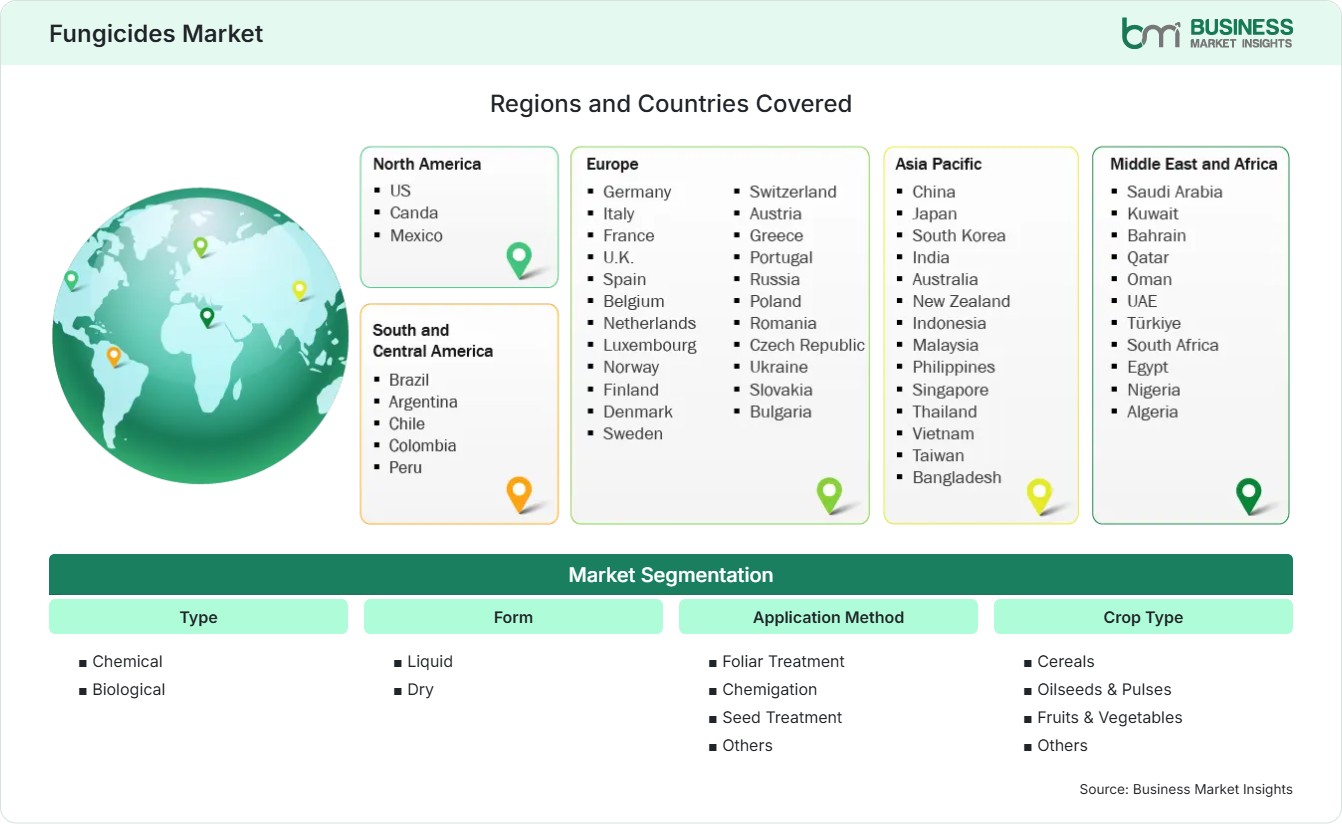
  • Type: Chemical, Biological
  • Form: Liquid, Dry
  • Application Method: Foliar Treatment, Chemigation, Seed Treatment, Others
  • Crop Type: Cereals, Oilseeds & Pulses, Fruits & Vegetables, Others
US$ 21.03 Bn Market size in 2025
US$ 28.37 Bn Market Size by 2033
3.81% CAGR, 2026 - 2033
2026-2033 Forecast Period

01 AI Overview

Fungicides Market Summary

  • North America Region: North America holds market share of 20%–24% in 2025, growing with a CAGR of 3.20%–3.80%, influenced by row-crop disease pressure, advanced application technologies, and demand for higher yield protection. The US remains the regional anchor, with a 3.10%–3.70% CAGR supported by soybean, corn, specialty crop, and disease-management applications.
  • Fastest Growing Region: Asia Pacific holds market share of 29%–33% in 2025, expanding at a CAGR of 4.60%–5.30%, driven by intensive cultivation, biological adoption, and modernization of crop protection practices.
  • Leading Segment: Chemical Type holds market share of 78%–82% in 2025, advancing at a CAGR of 3.20%–3.80%, supported by broad-spectrum efficacy, and consistent demand across cereals, oilseeds, fruits, and vegetables.
  • High Growth Segment: Biological Type represents an estimated 18%–22% share in 2025, growing at a CAGR of 7.00%–8.00%, driven by residue concerns, microbial innovation, and demand for lower-impact disease-control alternatives.
  • Key Market Opportunity: New biological actives, resistance-management chemistry, precision spraying, seed treatments, and integrated disease programs create attractive opportunities as growers seek productivity gains while reducing environmental exposure and preserving fungicide efficacy.
  • Major Market Players: Bayer AG, BASF SE, Syngenta AG, Corteva, Inc., UPL Limited, FMC Corporation, ADAMA Agricultural Solutions Ltd., Sumitomo Chemical Co., Ltd., Nufarm Limited, Certis Belchim B.V.
02 Strategic Insights

Fungicides Market: Strategic Insights

Fungicides Market Strategic Framework
FREE PDF
Request your free sample
Request free sample
03 Stakeholder View

Key Takeaways

  • The value chain is becoming more innovation-intensive, with active ingredient discovery, formulation development, regulatory registration, distributors, agronomists, and digital advisory platforms increasingly interconnected.
  • Biological products and seed-applied disease protection represent high-upside opportunities because they can complement conventional chemistry rather than immediately replace it.
  • Innovation is moving toward novel modes of action, multi-active formulations, targeted delivery, and products designed around specific pathogens.
  • South America presents a compelling investment case because soybean disease pressure creates recurring demand for advanced disease-control technologies.
  • Partnerships are becoming an important route to market. The agreement between BASF and ADAMA to co-develop and commercialize Gilboa-based fungicide solutions illustrates how proprietary active ingredients can be combined with global development capabilities and distribution reach.
  • Manufacturing investment is increasingly extending beyond conventional chemistry. BASF commissioned a new fermentation plant in Ludwigshafen, with a high double-digit million-euro investment supporting biological and biotechnology-based crop protection production, including biological fungicides.
04 Geographic Outlook

Fungicides Market Regional Highlights

North America Fungicides Market

North America holds a 20%–24% share in 2025 and records a 3.20%–3.80% CAGR through 2033. The region benefits from mechanized agriculture, strong crop protection infrastructure, and sophisticated disease forecasting. The US dominates regional demand, while Canada contributes through cereals and oilseeds. Adoption is increasingly influenced by resistance management, application timing, biological integration, and improved return-on-investment evidence.

  • Row-crop disease management remains central, with soybean, corn, wheat, and specialty crops generating recurring demand for preventive and curative programs. Performance demonstrations increasingly influence purchasing decisions and retailer recommendations.
  • The US leads regional consumption, while Canada maintains demand across cereals and oilseeds. Precision spraying, disease forecasting, and digital agronomy are improving application efficiency and reducing unnecessary treatments.
  • Regulatory approvals remain commercially decisive. BASF's Zorina fungicide received US EPA registration in October 2025, targeting white mold across soybeans, canola, and dry beans.

US Fungicides Market

The US represents 16%–20% of global demand in 2025 and US Fungicides Market forecast to grow at 3.10%–3.70% CAGR through 2033. Demand is concentrated in corn, soybean, wheat, specialty crops, and high-value horticulture. Commercial adoption is supported by extensive retailer networks, large-scale mechanized farms, and established crop protection programs.

  • Soybean and corn disease management remains a major demand center, with white mold, tar spot, rust, and foliar diseases supporting continued innovation in combination products and differentiated modes of action.
  • Specialty crops generate premium opportunities because disease-related quality losses can have disproportionate economic effects. Producers increasingly prioritize residue management, application precision, and products compatible with integrated programs.
  • Retailers and agronomists influence product selection significantly, making technical support, field demonstrations, and resistance-management guidance important competitive differentiators for suppliers.

Europe Fungicides Market

Europe Fungicides Market accounts for 17%–21% of 2025 demand and records a 2.40%–3.10% CAGR through 2033. The region combines strong cereal production with stringent environmental requirements and growing biological adoption. Germany, France, Italy, Spain, and the UK remain leading markets, while France and Germany provide substantial cereal demand.

  • France and Germany remain leading cereal markets, while Italy and Spain offer attractive specialty crop opportunities because vineyards, vegetables, and fruit production require intensive disease-management programs.
  • The UK and France are important markets for resistance-management innovation. BASF and ADAMA's Gilboa collaboration targets European cereal growers and anticipates UK formulations from 2027, followed by broader European launches.
  • The region's regulatory environment supports reduced-risk products, although registration requirements can extend commercialization timelines and increase development costs for manufacturers.

Asia Pacific Fungicides Market

Asia Pacific Fungicides Market holds 29%–33% of 2025 global demand and achieves the fastest regional CAGR of 4.60%–5.30% through 2033. China and India lead regional consumption, supported by extensive cereal, rice, fruit, vegetable, and plantation agriculture. Vietnam, Indonesia, and Thailand offer higher-growth opportunities as commercial farming expands.

  • China remains a major consumption center because of extensive crop acreage and intensive production. Demand is increasingly shaped by formulation quality, resistance management, and regulatory requirements for safer products.
  • India offers high-growth potential as horticulture, commercial agriculture, and protected cultivation expand. Improved farmer education and professional crop advisory services can increase adoption of preventive disease management.
  • Southeast Asia provides opportunities in rice, fruits, vegetables, and plantation crops. High humidity and disease-favorable conditions support recurring fungicide use, although affordability remains an important purchasing consideration.

Rest of World Fungicides Market

South and Central America represent a major disease-management opportunity, particularly in soybean, corn, fruits, and specialty crops. Brazil, Argentina, Paraguay, and Chile lead demand, while Colombia and Peru offer high-growth niches. South America's CAGR is estimated at 4.30%–5.00% through 2033, supported by soybean disease pressure and expanding commercial agriculture. Middle East and Africa demand remains smaller but offers structural upside from agricultural modernization, irrigation expansion, horticulture, and food-security initiatives. The combined RoW region represents 14%–18% of 2025 demand and grows at 4.00%–4.80% through 2033.

  • Brazil remains strategically important because soybean rust creates recurring demand for advanced disease-control programs. Novel modes of action are increasingly valuable where resistant pathogen populations challenge established chemistry.
  • Argentina and Paraguay offer opportunities in soybean and cereal production, while Chile and Peru provide attractive specialty crop applications requiring high-quality disease control and residue-conscious programs.
  • South Africa and Morocco benefit from commercial horticulture and export-oriented agriculture, creating demand for products meeting international residue requirements and maintaining crop quality.
  • Egypt and Turkey provide opportunities across vegetables, fruits, cereals, and protected cultivation, with irrigation and intensive production supporting regular fungicide applications.
  • African markets remain fragmented, but improved distribution infrastructure, farmer training, and access to affordable formulations could accelerate adoption across commercial farming systems.
Global Market Geography
FREE PDF
Request your free sample
Request free sample
05 Segment Analysis

Fungicides Market Segmentation

Type

Chemical products account for 78%–82% of global Fungicides Market share and grow at a 3.20%–3.80% CAGR through 2033, supported by broad efficacy and established registrations. Biological products expand faster from a smaller base as sustainability, resistance management, and residue requirements reshape procurement decisions.

  • Chemical: Conventional chemistry remains dominant because growers require reliable broad-spectrum protection, established field performance, and predictable application protocols across cereals, oilseeds, fruits, and vegetables.
  • Triazoles: Triazoles remain widely used for systemic disease control and resistance-management programs, although stewardship requirements encourage rotation and combination strategies to preserve efficacy.
  • Strobilurins: Strobilurins provide preventive and protective activity across major crops, with continued demand supported by broad disease coverage and compatibility with combination formulations.
  • Dithiocarbamates: Dithiocarbamates remain relevant as multi-site protectants, particularly where resistance management requires complementary chemistry with lower resistance-selection risk.
  • Inorganics: Inorganic fungicides maintain niche importance in specific crop systems, supported by established use patterns, affordability, and applications where multi-site disease suppression is preferred.
  • Chloronitriles: Chloronitriles support protective disease management and resistance programs, particularly where growers seek multi-site activity alongside single-site fungicides.
  • Biological: Biological fungicides gain adoption through microbial innovation, integrated pest management, sustainability objectives, and demand for residue-conscious solutions that complement conventional disease-control programs.

Form

Liquid products represent 63%–67% of 2025 demand and expand at a 3.50%–4.10% CAGR through 2033, supported by ease of mixing, spraying, and formulation flexibility. Dry formulations grow steadily at 3.00%–3.60%, benefiting from storage efficiency, transport economics, and applications where concentrated products reduce logistical burdens across agricultural distribution networks.

  • Liquid: Liquid formulations dominate modern spray programs because they integrate efficiently with mechanized equipment, enable precise dosing, and support combination products for foliar and soil applications.
  • Dry: Dry products remain valuable where transportation, storage, and formulation stability influence purchasing decisions, particularly across emerging markets with complex agricultural distribution networks.

Application Method

Foliar treatment represents 48%–52% of 2025 demand and grows at 3.40%–4.00% through 2033, reflecting its importance for managing visible disease pressure. Seed treatment records faster expansion at 5.50%–6.50%, supported by preventive protection and reduced early-season disease exposure.

  • Foliar Treatment: Foliar applications remain central for cereals, oilseeds, fruits, and vegetables because they provide flexible disease control during critical crop growth stages and enable rapid response.
  • Chemigation: Chemigation expands where irrigation systems permit efficient product delivery, offering potential labor savings and uniform application across suitable crops and production environments.
  • Seed Treatment: Seed treatment gains momentum through preventive protection, reduced disease establishment, and compatibility with integrated crop management programs, particularly in cereals, oilseeds, and commercial seed systems.

Crop Type

Cereals represent 34%–38% of 2025 demand and grow at 3.20%–3.80% through 2033, supported by extensive wheat, rice, and maize cultivation. Fruits and vegetables record stronger growth at 5.00%–6.00% as intensive horticulture expands. Oilseeds and pulses remain significant, while specialized crops create opportunities for differentiated formulations and residue-compliant disease-management programs.

  • Cereals: Cereals remain a major demand center because fungal diseases can materially reduce yield and quality, supporting preventive programs across wheat, rice, maize, and barley.
  • Oilseeds & Pulses: Soybean, canola, sunflower, and pulse production create recurring demand, particularly where rust, leaf diseases, and seed-borne pathogens threaten yield security and profitability.
  • Fruits & Vegetables: High-value horticulture supports premium fungicide demand because disease can directly affect appearance, shelf life, export eligibility, and marketable yield, strengthening demand for precision products.
06 Market Forces

Fungicides Market Dynamics

Key Market Drivers

Rising Demand for Crop Protection Boosts Fungicides Market Growth

The growth of the Market is driven by consistent crop disease pressure, increase in cultivation intensity, and the economic requirement to safeguard the yield potential. The Food and Agriculture Organization evaluations have consistently stressed the significance of minimizing crop damage in order to increase food availability, and commercial producers are increasingly adopting preventive disease control for protecting their yield potential. The market trends also benefit the fungicide products that are multi-mechanistic in action, as resistance makes the single site mode of fungicide application unreliable.

Growing Adoption of Bio-Based Fungicides Supports Market Expansion

Biologically based disease control technologies are becoming commercially viable, as growers, regulators, retail and food processing companies are looking at environmentally friendly approaches for crop protection. Biofungicides can be incorporated into existing chemical fungicides via integrated programs that offer different modes of action and could possibly lessen dependency on multiple applications of chemicals. Investment in areas such as fermentation technology, formulation stability, longevity of the product and field uniformity will make a difference in commercial viability. However, the possibility of biological fungicides goes beyond substituting chemical fungicides, but rather finding their niche as part of an integrated program.

Increasing Food Production Drives Demand for Effective Fungicides

The growing demands of food production have increased the economic importance of disease control in cereals, oilseeds, fruits, and vegetables. The global agricultural sector needs to produce more output on smaller areas, which implies that yield protection is becoming increasingly valuable. Disease control products help in reducing yield losses caused by diseases and keep the crops healthy and of high quality. This indicates that product development is based on the economics of crop diseases. Hence, the Fungicides Market trends are moving towards products that are effective, resistant, and able to protect yields.

Key Market Opportunities

Development of Eco-Friendly Fungicides Creates New Growth Prospects

Eco-friendly formulations provide chances for suppliers to comply with sustainability standards, but also maintain disease control efficacy. Developers may focus on strains of microbes, natural substances, low-residue products, and appropriate programs of combinations for traditional and organic farming systems. Key areas of investments would be increased product shelf-life, field effectiveness, fermentation process efficiency, and formulation compatibility. Fungicides Market Forecasts increasingly Favor manufacturers who can combine biological and chemical fungicides, instead of separating these technologies. Commercial opportunities are attractive in seed treatment, and protected cultivation, where crop value can justify premium solutions.

Emerging Agricultural Markets Offer Lucrative Fungicide Opportunities

Emerging markets offer promising growth prospects due to the fact that increasing crop density, commercial farming, and greater availability of agronomy services could drive fungicide use. India, Southeast Asia, Latin America, and some parts of Africa feature significant agricultural activity and differing product adoption levels, thus offering chances for portfolio localization. Companies could benefit from more affordable formulations, smaller packs, locally recommended diseases, and retailer training. Moreover, digital advisory services could optimize the process of application by linking weather information and disease alerts with actual field experience.

Rising Demand for Biopesticides Opens New Market Expansion Avenues

Biopesticides create an opportunity to broaden disease-management portfolios as regulators and downstream food companies encourage reduced environmental impact. Microbial and biochemical products can be positioned for seed treatment, foliar applications, integrated disease programs, and residue-sensitive crops. The strongest commercial potential lies where biologicals solve specific agronomic problems rather than competing solely on price with established chemistry. Companies investing in fermentation capacity, formulation technology, and field validation can improve product reliability and expand farmer confidence. This pathway could increase access to biological disease-control products while supporting more diversified resistance-management strategies across major agricultural production regions.

Market Restraints and Challenges

Strict Environmental Regulations Limit Use of Chemical Fungicides

Factor: Higher regulatory scrutiny on issues such as the activity levels of the ingredients, residue thresholds, persistence in the environment, and non-target impacts may limit access to these products and make the registration process more costly. Impact: There is an effect that impact companies as they require more time to develop their products, more tests to be conducted, and may even have to streamline their portfolios due to chemistries which become commercially or regulatorily restricted.

Growing Resistance Among Pests Reduces Fungicide Treatment Efficacy

Factor: Pathogens can develop resistance to fungicides with a similar mode of action through repeated use, thereby reducing their susceptibility and making treatment less effective. Impact: There would be a need for a combination of more expensive products, additional applications, or a switch to other fungicidal actives that are more costly to produce, which could accelerate demand for novel modes of action. Resistance would be difficult to manage in plant diseases where pathogens evolve quickly and have a higher application rate.

07 Company Analysis

Competitive Landscape

The Fungicides Market analysis indicates that the competitive landscape has moved from purely based on portfolio coverage to differentiated modes of actions, biological platforms, formulating technologies, regulatory prowess, and regional crop disease experience. Companies are combining their discovery efforts with strategic partnerships and commercialization.

Company Name

Overview

Products and Services relevant to this market

Bayer AG

Global life sciences company with a major Crop Science business spanning crop protection, seeds, traits, and digital agricultural solutions.

Chemical and biological fungicides, seed treatment technologies, crop disease management, formulation development, and digital agronomic support.

BASF SE

Global chemical producer with a broad Agricultural Solutions portfolio focused on crop protection innovation and integrated farming systems.

Fungicides, biological solutions, seed treatments, resistance-management products, formulation technologies, and crop-specific disease-control programs.

Syngenta AG

Major global agricultural technology company providing crop protection products and seeds across diverse commercial farming systems.

Fungicides, seed treatments, disease-control products, integrated crop protection programs, and technical agronomic solutions.

Corteva, Inc.

Agricultural company focused on seed, crop protection, and farmer productivity solutions across major global crop markets.

Foliar fungicides, disease-control combinations, crop protection products, seed technologies, and resistance-management solutions.

UPL Limited

Global agricultural solutions provider with extensive crop protection, biological, and sustainable agriculture offerings.

Chemical fungicides, biosolutions, biological crop protection, seed treatments, formulation technologies, and integrated disease management.

FMC Corporation

Agricultural sciences company specializing in crop protection and innovative solutions for commercial growers worldwide.

Fungicides, crop protection technologies, active ingredients, formulation development, and disease-management solutions for major crops.

ADAMA Agricultural Solutions Ltd.

Crop protection company focused on accessible products, formulation expertise, and innovative active ingredient commercialization.

Fungicides, crop protection formulations, active ingredients, disease-control products, and integrated resistance-management solutions.

Sumitomo Chemical Co., Ltd.

Diversified chemical company with a strong crop protection business and research capabilities in novel agricultural chemistry.

Fungicides, novel active ingredients, crop protection products, resistance-management technologies, and agricultural research.

Nufarm Limited

Agricultural inputs company serving growers through crop protection and seed technologies across multiple international markets.

Fungicides, crop protection formulations, disease-control products, seed technologies, and agricultural input solutions.

Certis Belchim B.V.

European crop protection specialist with strong capabilities in biological and conventional products for sustainable agriculture.

Biological and conventional fungicides, biocontrol products, specialty crop solutions, formulation expertise, and integrated crop protection programs.

10 Trust & Transparency

Research Methodology

The market analysis combines proprietary research with secondary data from government agencies, company disclosures, regulatory filings, industry databases and expert interviews. Market estimates are validated through data triangulation, cross-market benchmarking and analyst review.

View Full Research Methodology

11 Questions Answered

Frequently Asked Questions

What should investors evaluate when assessing a Fungicides Market Report?

Investors should assess active ingredient pipelines, regulatory exposure, biological capabilities, manufacturing resilience, regional crop exposure, resistance risks, distribution strength, and partnerships.

How important is seed treatment to future disease-management strategies?

Seed treatment provides preventive protection at crop establishment and can reduce early disease pressure. Its commercial appeal is increasing because it integrates effectively with modern seed and crop protection systems.

Why is resistance management becoming a stronger competitive differentiator?

Resistance can reduce the effective lifespan of established chemistry, increasing the value of new modes of action, multi-site products, and integrated rotation programs.

How are biological fungicides changing procurement strategies in market?

Biological products are increasingly evaluated as complementary tools within integrated disease-management programs.

What factors will determine the commercial success of new fungicide active ingredients?

Success will depend on genuinely differentiated modes of action, resistance-management value, regulatory acceptance, crop-specific efficacy, formulation performance, and the ability to demonstrate measurable economic returns for growers.

Access the Full Fungicides Market Report

Get segment-level forecasts, regional estimates, competitive benchmarking, company profiles and downloadable Excel datasets.

Access the full Fungicides Market Report
350 pages PDF & Excel | 2026-08-12