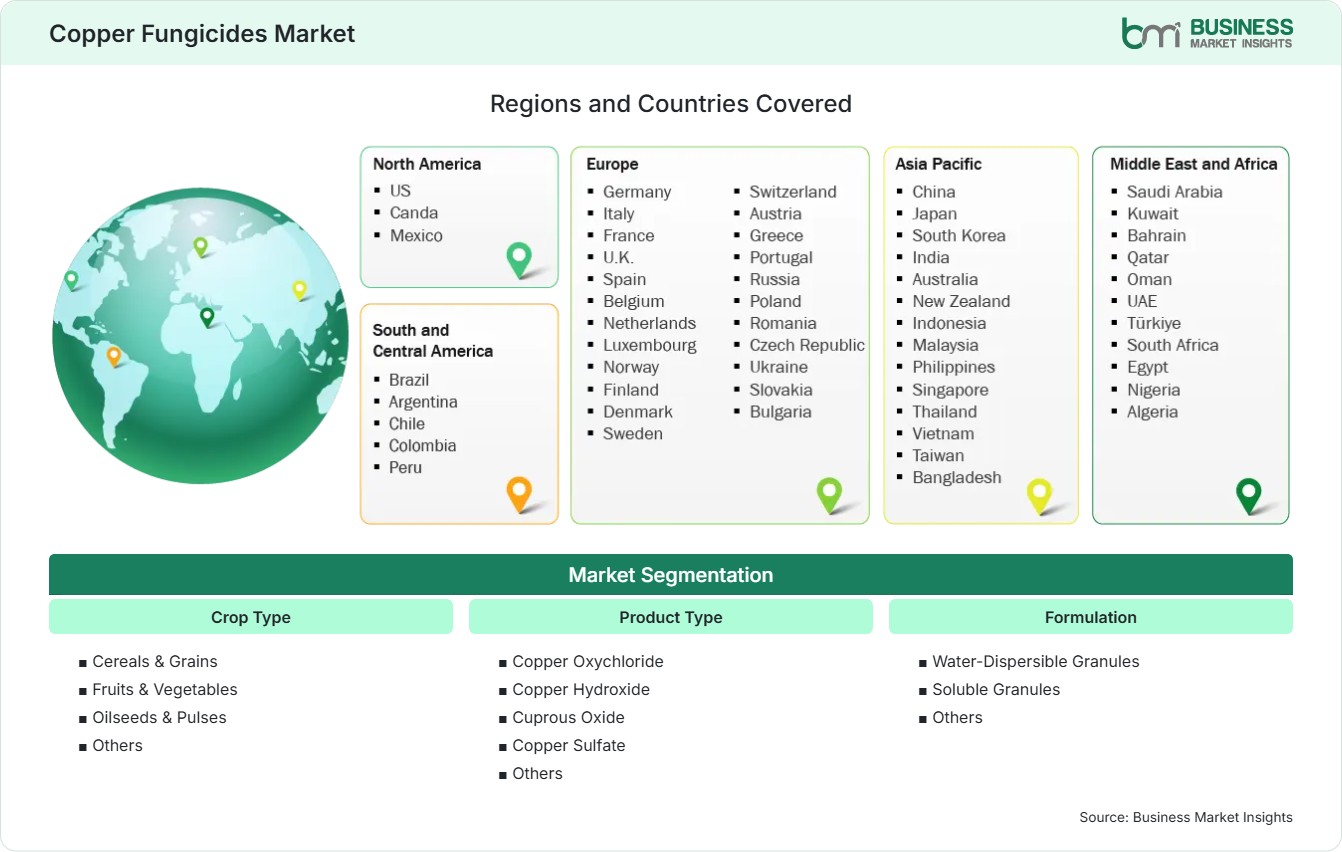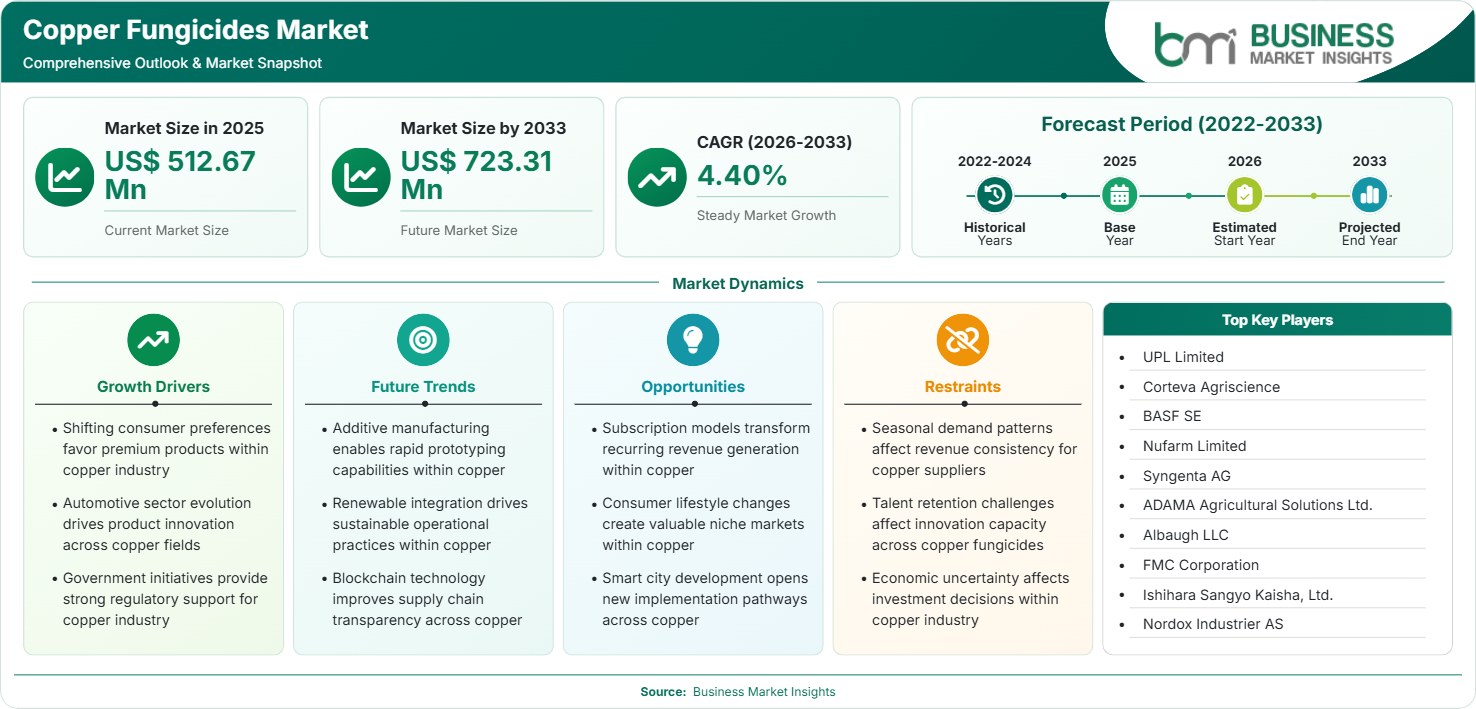
Copper Fungicides Market Regional Highlights
North America Copper Fungicides Market
North America accounts for 32%–35% of the global market share in 2025 and is projected to expand at a CAGR of 3.9%–4.3% through 2033. The Copper Fungicides Market share remains strong because of extensive cultivation of fruits, vegetables, vineyards, and specialty crops requiring preventive fungal disease management. Strict environmental regulations continue encouraging adoption of advanced formulations with improved crop safety, while precision agriculture technologies support efficient fungicide application and sustainable farming practices across the region.
- Commercial orchards increasingly integrate copper fungicides with predictive disease monitoring systems, improving spray schedules, minimizing unnecessary applications, and enhancing overall disease management efficiency while supporting environmental stewardship initiatives across North American farming operations.
- Precision agriculture adoption continues expanding through GPS-guided sprayers, drone-assisted monitoring, and digital farm management platforms that optimize fungicide dosage, improve field coverage, and reduce operational costs without compromising crop protection effectiveness.
- Regulatory oversight by environmental and agricultural agencies encourages manufacturers to develop lower-residue formulations that meet evolving sustainability standards while maintaining broad-spectrum disease control across diverse crop categories.
- Investments in specialty crop cultivation, including vineyards, berries, citrus, apples, and tomatoes, continue supporting Copper Fungicides Market growth, driven by increasing consumer demand for premium-quality agricultural produce and export competitiveness.
- Research collaborations between universities, agrochemical manufacturers, and growers are accelerating innovation in formulation technology, resistance management strategies, and integrated pest management programs to improve long-term crop productivity.
US Copper Fungicides Market
The United States represents approximately 74%–77% of North America's market in 2025 and is expected to expand at a CAGR of 4.0%–4.4% through 2033. Demand remains supported by extensive production of grapes, almonds, citrus fruits, berries, potatoes, tomatoes, and other high-value crops where preventive fungal disease management is essential. Continued investment in precision agriculture and sustainable farming technologies further strengthens long-term Copper Fungicides Market development.
- California remains the largest consuming state due to extensive vineyards, orchards, and vegetable production, creating sustained demand for copper-based fungicides throughout multiple growing seasons annually.
- Increasing adoption of integrated pest management encourages growers to combine copper fungicides with biological crop protection products, improving disease control while supporting sustainable agricultural production systems.
- Digital disease forecasting platforms enable growers to optimize fungicide application timing, reducing unnecessary treatments while improving operational efficiency, productivity, and compliance with environmental regulations.
- Continuous investment in specialty agriculture and export-oriented crop production strengthens long-term demand for advanced copper formulations offering improved performance, crop compatibility, and reduced environmental impact.
Europe Copper Fungicides Market
Europe represents 27%–30% of the global Copper Fungicides Market in 2025 and is anticipated to register a CAGR of 4.1%–4.5% during 2026–2033. Demand remains supported by intensive cultivation of vineyards, fruits, potatoes, and vegetables, alongside stringent regulatory oversight governing crop protection products. Sustainable farming initiatives, integrated pest management programs, and continuous formulation innovation are strengthening adoption across both conventional and organic agriculture. Spain, Italy, and France remain leading markets, while Eastern European countries are witnessing faster expansion through agricultural modernization and improved disease management practices.
- Spain maintains regional leadership through its extensive fruit, vegetable, olive, and vineyard cultivation, creating consistent demand for copper fungicides across commercial farming operations while supporting export-oriented agricultural production and quality standards.
- Italy continues investing in sustainable viticulture and horticulture, encouraging adoption of advanced copper formulations that balance disease control effectiveness with increasingly strict environmental and residue compliance requirements.
- France strengthens regional demand through high-value vineyards, orchard production, and integrated crop protection programs, supported by continuous research into precision fungicide application technologies and sustainable agriculture initiatives.
- Poland and Romania are among the fastest-growing agricultural markets, supported by modernization funding, increasing mechanization, and rising awareness of preventive crop disease management across cereals and horticultural production systems.
- European manufacturers continue investing in low-dose, high-efficiency formulations compatible with integrated pest management programs, helping growers improve productivity while complying with evolving environmental regulations.
Asia Pacific Copper Fungicides Market
Asia Pacific accounts for 25%–28% of the global Copper Fungicides Market in 2025 and is projected to expand at the fastest CAGR of 5.3%–5.8% through 2033. Rising food demand, expanding horticultural cultivation, increasing government support for agricultural modernization, and wider adoption of scientific crop protection practices continue driving regional demand. China leads overall consumption, while India and Southeast Asian countries are rapidly increasing investments in high-value agriculture, precision farming technologies, and integrated disease management programs.
- China remains the largest regional market owing to extensive fruit, vegetable, rice, and plantation crop cultivation supported by ongoing investments in agricultural productivity and advanced crop protection technologies.
- India records one of the fastest expansion rates as horticultural acreage increases and growers adopt preventive fungicide programs to reduce production losses from fungal diseases affecting fruits and vegetables.
- Japan and South Korea emphasize premium agricultural production, encouraging adoption of technologically advanced formulations with improved environmental performance and compatibility with precision farming practices.
- Southeast Asian countries, including Vietnam, Thailand, and Indonesia, continue expanding commercial fruit and plantation crop production, supporting long-term demand for broad-spectrum copper fungicide products.
- Government initiatives promoting food security, yield improvement, and sustainable farming practices are encouraging wider use of scientifically managed crop protection programs throughout the region.
Rest of World Copper Fungicides Market
The Rest of World region accounts for 12%–15% of the global Copper Fungicides Market in 2025 and is projected to grow at a CAGR of 4.5%–5.0% through 2033. South & Central America benefit from expanding fruit exports, soybean cultivation, and vineyard production, while the Middle East & Africa continue improving agricultural productivity through irrigation expansion, commercial farming investments, and enhanced crop protection awareness. Brazil and Chile lead regional consumption, whereas South Africa and Saudi Arabia are emerging as promising growth markets.
- Brazil remains the dominant South American market because of extensive soybean, coffee, citrus, and fruit cultivation requiring effective fungal disease prevention throughout multiple growing seasons.
- Chile supports sustained demand through export-focused grape, berry, and orchard production, where preventive disease management is essential for maintaining international quality standards.
- South Africa continues increasing adoption across commercial fruit, grape, and vegetable farming, supported by expanding investments in precision agriculture and sustainable crop management practices.
- Gulf countries are investing in controlled-environment agriculture and high-value horticulture, encouraging adoption of efficient crop protection solutions capable of improving productivity under challenging climatic conditions.
- Agricultural development initiatives, improved distribution networks, and increasing farmer education programs continue supporting long-term regional demand for advanced copper-based fungicide technologies.