
Copper Scrap Market Outlook: Size, Share, Trends, Growth Analysis, Competitive Landscape & Forecast, 2026-2033

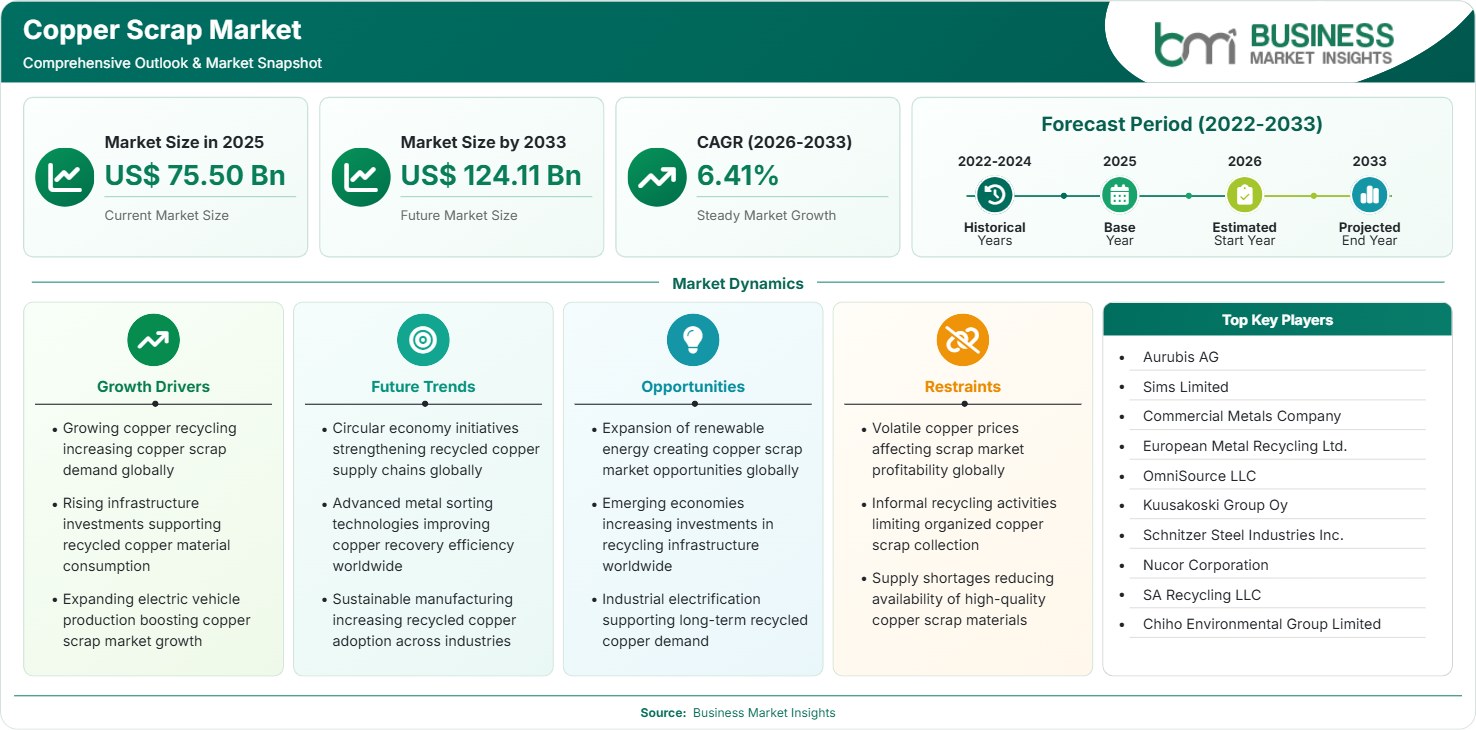
The Copper Scrap Market size was valued at US$ 75.5 billion in 2025 and is projected to reach US$ 124.11 billion by 2033, growing at a CAGR of 6.41% during 2026–2033. Growing copper recycling, rising infrastructure investments, and expanding electric vehicle production continue driving demand, while renewable energy expansion, recycling infrastructure investment, and industrial electrification create long-term market opportunities.

Report Coverage
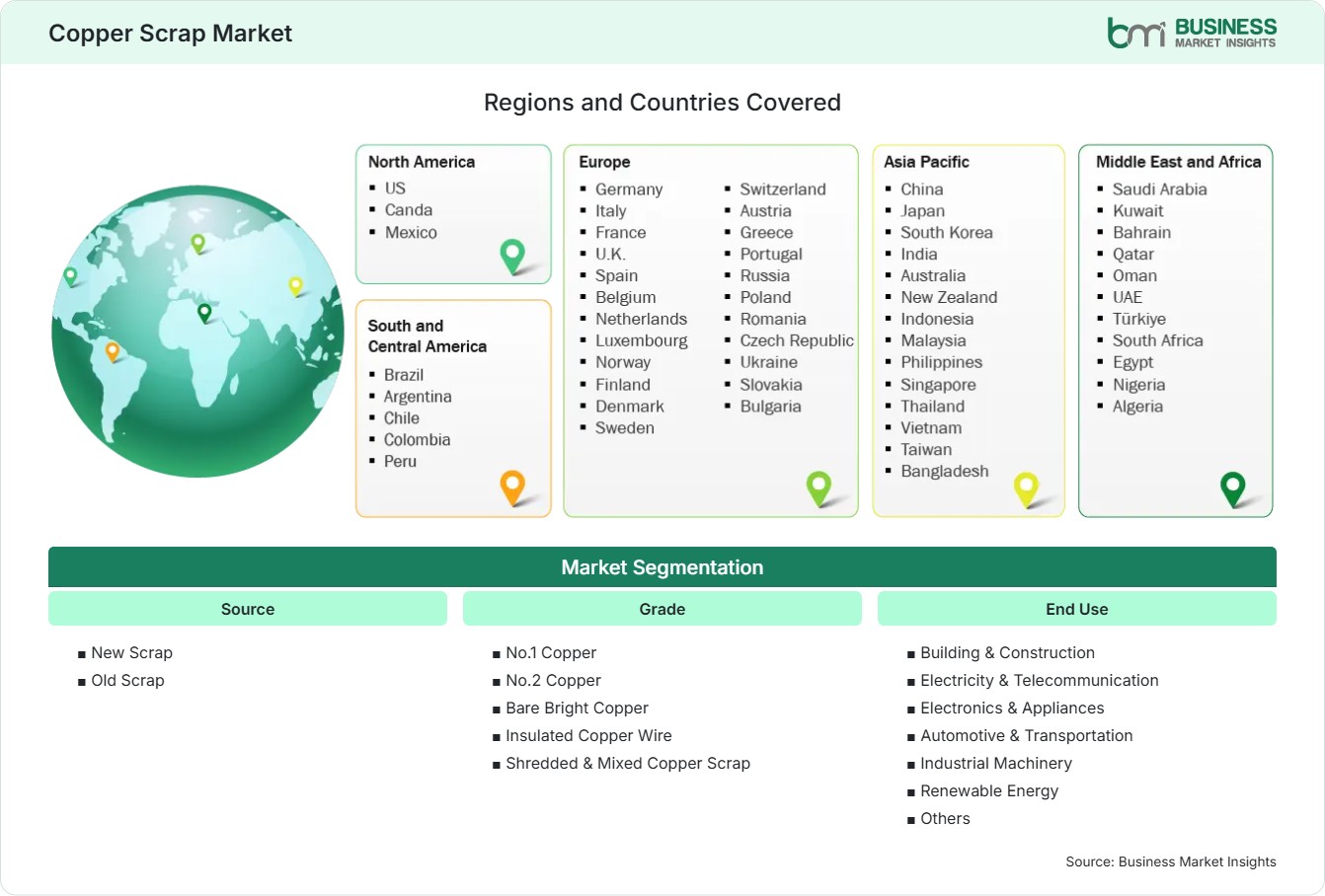
  • Source: New Scrap, Old Scrap
  • Grade: No.1 Copper, No.2 Copper, Bare Bright Copper, Insulated Copper Wire, and Shredded & Mixed Copper Scrap
  • End Use: Building & Construction, Electricity & Telecommunication, Electronics & Appliances, Automotive & Transportation, Industrial Machinery, Renewable Energy, Others
US$ 75.50 Bn Market size in 2025
US$ 124.11 Bn Market Size by 2033
6.41% CAGR, 2026 - 2033
2026-2033 Forecast Period

AI Overview

Copper Scrap Market Summary

  • North America Region: North America accounts for 28%–31% market share in 2025 and is projected to expand at a 5.9%–6.3% CAGR during 2026–2033. Strong recycling infrastructure, increasing infrastructure modernization, industrial demand, and supportive sustainability policies continue strengthening regional copper scrap utilization. The United States leads regional demand with a 6.0%–6.4% CAGR, supported by extensive recycling capacity, manufacturing activity, and expanding electrical infrastructure investment.
  • Fastest Growing Region: Asia Pacific represents 36%–39% market share in 2025 while registering a 7.2%–7.7% CAGR through 2033. Rapid industrialization, urban infrastructure expansion, increasing electric vehicle manufacturing, and growing recycling investments continue supporting regional market growth.
  • Leading Segment: Old Scrap accounts for 60%–64% market share in 2025 and is expected to grow at a 6.4%–6.8% CAGR. High material availability, established collection systems, superior recycling value, and broad industrial applications continue supporting segment leadership.
  • High Growth Segment: Renewable Energy represents 10%–13% market share in 2025 and is forecast to expand at a 8.3%–8.8% CAGR. Increasing solar installations, wind power investments, transmission upgrades, and sustainable electrification projects continue accelerating recycled copper demand.
  • Key Market Opportunity: Circular economy initiatives, renewable energy deployment, advanced recycling technologies, industrial electrification, sustainable manufacturing, and investment in organized scrap collection continue creating attractive long-term opportunities worldwide.
  • Major Market Players: Aurubis AG, Sims Limited, Commercial Metals Company, European Metal Recycling Ltd., OmniSource LLC, Kuusakoski Group Oy, Schnitzer Steel Industries Inc., Nucor Corporation, SA Recycling LLC, and Chiho Environmental Group Limited.
Strategic Insights

Copper Scrap Market: Strategic Insights

Copper Scrap Market Strategic Framework
FREE PDF
Request your free sample
Request free sample
Stakeholder View

Key Takeaways

  • Integrated collection, sorting, processing, and refining networks are becoming increasingly important as recyclers seek higher recovery rates, lower operating costs, and reliable secondary copper supplies for industrial customers.
  • Old scrap remains the largest source segment because of established collection systems and high recovery potential, while renewable energy applications are expected to generate the strongest long-term demand.
  • Investment in automated sorting, sensor-based separation, and advanced refining technologies is improving material purity, operational efficiency, and compliance with increasingly stringent environmental regulations.
  • Asia Pacific offers the strongest investment opportunity owing to expanding manufacturing activity, rapid electrification, infrastructure development, and growing government support for organized recycling ecosystems.
  • Strategic acquisitions, regional processing facility expansion, and partnerships between recyclers, manufacturers, and utility companies continue strengthening supply security and competitive positioning across the industry.
Geographic Outlook

Copper Scrap Market Regional Highlights

North America Copper Scrap Market

North America accounts for 28%–31% of global revenue in 2025 and is expected to expand at a 5.9%–6.3% CAGR through 2033. The Copper Scrap Market share remains significant because of mature recycling infrastructure, stringent environmental regulations, and strong demand from electrical, construction, and manufacturing industries. Continuous investment in collection systems and processing technologies supports stable regional growth.

  • Advanced recycling facilities improve copper recovery efficiency while supporting consistent secondary raw material supply for electrical equipment manufacturers, construction companies, and industrial users.
  • Infrastructure modernization and utility grid upgrades continue increasing recycled copper consumption across power transmission, telecommunications, and public construction projects.
  • Manufacturers increasingly incorporate recycled copper into production to reduce carbon emissions, improve resource efficiency, and comply with sustainability targets.
  • Strong regulatory oversight encourages organized recycling activities while supporting investments in modern processing equipment and environmentally responsible material recovery practices.

US Copper Scrap Market

The United States contributes approximately 81%–84% of North American demand and is projected to grow at a 6.0%–6.4% CAGR through 2033. Strong industrial activity, expanding electrical infrastructure, and increasing investment in recycling facilities continue supporting market expansion. Growing adoption of recycled metals across manufacturing and construction further strengthens long-term demand.

  • Utility modernization and renewable energy investments continue increasing recycled copper utilization across transmission, distribution, and electrical equipment manufacturing.
  • Large-scale recycling operations supported by advanced processing technologies improve recovery efficiency while strengthening domestic secondary copper availability.
  • Rising electric vehicle production and industrial electrification continue supporting sustained demand for recycled copper across multiple manufacturing sectors.

Europe Copper Scrap Market

Europe represents 24%–27% of global revenue in 2025 and is projected to register a 6.0%–6.4% CAGR through 2033. Germany remains the leading regional market because of its advanced recycling industry and manufacturing base, while Poland records comparatively faster growth supported by industrial investment, circular economy initiatives, and expanding metal processing capacity.

  • Germany leads regional recycling activity through advanced processing infrastructure, strong industrial demand, and comprehensive environmental regulations.
  • Poland demonstrates faster expansion owing to manufacturing growth, infrastructure investment, and increasing adoption of organized recycling systems.
  • Circular economy policies continue encouraging higher recycled material utilization across automotive, construction, and electrical equipment industries.
  • Investments in automated sorting and refining technologies improve processing efficiency while enhancing recycled copper quality for industrial applications.

Asia Pacific Copper Scrap Market

Asia Pacific accounts for 36%–39% of global revenue in 2025 and is projected to expand at a 7.2%–7.7% CAGR through 2033. Rapid industrialization, expanding manufacturing capacity, urban infrastructure development, and increasing electric vehicle production continue driving regional demand. China remains the leading market because of its extensive metal processing industry, while India records comparatively faster growth supported by recycling investments, industrial electrification, and expanding renewable energy projects.

  • China continues leading regional consumption through large-scale copper processing capacity, growing electrical equipment manufacturing, and continuous investment in advanced recycling technologies.
  • India is expected to record the fastest regional growth due to expanding infrastructure projects, organized recycling initiatives, and increasing demand from automotive, construction, and renewable energy sectors.
  • Government initiatives promoting resource efficiency and circular economy practices continue encouraging investment in modern scrap collection and processing facilities.
  • Growing production of electric vehicles, power equipment, and consumer electronics strengthens long-term demand for recycled copper across regional manufacturing industries.

Rest of World Copper Scrap Market

Rest of World contributes 10%–13% of global revenue in 2025 and is anticipated to register a 6.5%–6.9% CAGR through 2033. South & Central America benefits from expanding mining support industries and infrastructure development, while the Middle East & Africa experiences increasing recycling investments supported by industrial diversification and construction activities. Brazil leads regional demand, whereas Saudi Arabia demonstrates comparatively faster growth through industrial expansion and sustainability initiatives.

  • Brazil maintains regional leadership through growing industrial activity, expanding recycling operations, and increasing utilization of secondary copper across manufacturing sectors during copper scrap market forecasts.
  • Saudi Arabia records comparatively faster expansion owing to infrastructure investment, industrial diversification programs, and rising demand for recycled metals.
  • Increasing construction projects, power transmission investments, and industrial manufacturing continue supporting recycled copper consumption across developing economies.
  • Organized scrap collection networks and modern recycling facilities improve recovery efficiency while strengthening regional supply of secondary copper for domestic industries.
Global Market Geography
FREE PDF
Request your free sample
Request free sample
Segment Analysis

Copper Scrap Market Segmentation

Source

The Source segment accounted for 41%–44% of the market in 2025 and is projected to grow at a 6.5%–6.9% CAGR through 2033. Availability of recyclable materials, organized collection systems, and expanding industrial recovery activities continue supporting segment growth. The Copper Scrap Market scope continues broadening as governments and industries prioritize circular economy practices and resource-efficient manufacturing.

  • New Scrap: New scrap is generated during manufacturing and fabrication processes, offering high-purity recyclable material with lower processing requirements and consistent availability for secondary copper production.
  • Old Scrap: Old scrap dominates the segment because of abundant availability from demolished buildings, electrical equipment, vehicles, industrial machinery, and obsolete consumer products, supporting large-scale recycling operations.

Grade

The Grade segment represented 30%–33% of market revenue in 2025 and is expected to register a 6.3%–6.7% CAGR through 2033. Demand for higher-purity recycled copper continues increasing as manufacturers seek efficient raw materials for electrical, industrial, and infrastructure applications.

  • No.1 Copper: High-purity No.1 copper remains widely preferred because it requires minimal refining and supports premium recycled copper production across multiple industrial applications.
  • No.2 Copper: No.2 copper continues recording stable demand through cost-effective recycling and broad utilization across manufacturing and construction industries.
  • Bare Bright Copper: Bare Bright Copper commands premium value because of its superior conductivity, cleanliness, and suitability for high-quality electrical applications.
  • Insulated Copper Wire: Increasing recovery from electrical cables and communication infrastructure supports rising demand for insulated copper wire recycling and processing.
  • Shredded & Mixed Copper Scrap: Mixed copper scrap strengthens resource utilization by enabling recovery of recyclable materials from diverse industrial, automotive, and consumer waste streams.

End Use

The End Use segment contributed 26%–29% of global revenue during 2025 and is projected to expand at a 6.8%–7.2% CAGR through 2033. The Copper Scrap Market trends increasingly reflect rising electrification, sustainable manufacturing, and greater utilization of recycled metals across high-growth industrial applications.

  • Building & Construction: Construction activities continue generating substantial recycled copper demand for wiring, plumbing systems, roofing materials, and building infrastructure projects.
  • Electricity & Telecommunication: Power transmission, distribution networks, and communication infrastructure remain major consumers because of copper's high electrical conductivity and durability.
  • Electronics & Appliances: Consumer electronics and household appliances increasingly utilize recycled copper to improve resource efficiency and reduce manufacturing costs.
  • Automotive & Transportation: Expanding electric vehicle production and automotive electrification continue increasing recycled copper utilization across motors, wiring harnesses, and charging systems.
  • Industrial Machinery: Industrial machinery manufacturers incorporate recycled copper into equipment, motors, transformers, and production systems to support sustainable manufacturing.
  • Renewable Energy: Solar farms, wind turbines, battery storage systems, and grid modernization projects continue driving rapid growth in recycled copper consumption.
  • Others: Additional applications include marine equipment, aerospace components, defense systems, consumer goods, and specialized engineering products requiring recycled copper materials.
Market Forces

Copper Scrap Market Dynamics

Key Market Drivers

Growing copper recycling increasing copper scrap demand globally

Growing emphasis on circular economy practices, resource conservation, and carbon emission reduction continues accelerating copper recycling worldwide. The Copper Scrap Market growth is supported by increasing recovery of secondary copper from construction waste, end-of-life vehicles, electrical equipment, and industrial machinery. Recycled copper exhibits almost identical performance properties to the original copper but requires much less energy for processing, which incentivizes producers to use more recycled products. Modern improvements in sorting, automation, and collection of copper allow for higher efficiency, thus ensuring a consistent supply of raw materials and sustainable manufacturing processes in different industries.

Rising infrastructure investments supporting recycled copper material consumption

Large investments in power transmission, urban infrastructure, transport, telecommunication, and commercial construction are continuously driving the demand for recycled copper. Governments of both developed and developing countries are investing in improving their electricity grid systems, smart city developments, and infrastructure, which will drive the demand for copper products. Recycled copper not only provides manufacturers with an economic and environmental-friendly source of material but also helps to achieve the sustainability goals of the organization. With the growing emphasis on sustainable development in the construction sector, there is a growing need for recycled copper products.

Expanding electric vehicle production boosting copper scrap market growth

The growing rate of electric car manufacturing is driving an increased need for recycled copper in battery packs, electric motors, charging stations, wiring harnesses, and power electronics. Auto manufacturers are beginning to incorporate recycled content in their processes in an effort to minimize the environmental footprint of their operations. Growing investments in the EV charging network, battery plants, and auto electrification programs will drive further copper demand. All these factors motivate the recyclers to scale up recycling capacity and build relationships with auto manufacturers.

Key Market Opportunities

Expansion of renewable energy creating copper scrap market opportunities globally

Renewable energy transition remains a source of opportunities for recycled copper manufacturers around the world. According to the market forecast, there will be high demand for recycled copper from solar photovoltaics, wind farms, battery energy storage systems, and grid modernizations. The use of renewable energy sources entails large amounts of copper usage due to its conductivity and ability to transmit electricity. More attention is paid to the use of recycled copper in order to minimize negative impacts on the environment.

Emerging economies increasing investments in recycling infrastructure worldwide

Countries experiencing growth are continually improving their systems for collecting and recycling copper through investments in scrap metal collections and metal recovery processes. Countries experiencing rapid industrialization and urbanization as well as manufacturing operations lead to increased recyclable copper resources. The involvement of the government in the formalization of recycling operations makes it an attractive business venture. There are opportunities for foreign firms interested in the business.

Industrial electrification supporting long-term recycled copper demand

Electrification of industries through manufacturing, transport, utility sectors, and commercial establishments keeps on escalating the demand for the use of recycled copper materials. Automation systems, electric machines, energy-efficient machines, and the adoption of digital technology within industries demands a constant supply of copper materials that ensure the electrical conductivity and reliability of the material. Recycling of copper in the production process by industries ensures reduction of carbon footprint and enhanced sustainability performance.

Market Restraints and Challenges

Volatile copper prices affecting scrap market profitability globally

Factor: Frequent fluctuations in global copper prices caused by changing supply-demand conditions, geopolitical uncertainty, mining output variations, and international trade policies directly influence scrap valuation. Impact: Recycling companies are faced with volatile margins, problems of inventory valuation and purchasing. Price volatility has an effect on contracts, investments and purchasing throughout the recycling industry value chain. Firms have embraced dynamic pricing strategies, diversified sourcing and optimal inventory management in order to minimize financial risks, although market volatility remains an ongoing challenge.

Informal recycling activities limiting organized copper scrap collection

Factor: Unorganized collection networks and informal recycling activities remain prevalent across several developing economies, often operating without standardized processing practices or environmental compliance. Impact: The organized recyclers face reduced access to good scrap, fluctuations in the availability of materials, and increased competition for copper recovery. Environmental issues might also arise due to informal recycling. Better regulation, better collection mechanisms, and formalized recycling systems are critical to increasing recovery rates.

Company Analysis

Competitive Landscape

The Copper Scrap Market analysis highlights a competitive industry where companies focus on advanced recycling technologies, processing capacity expansion, strategic acquisitions, and sustainable material recovery. Investments in automated sorting, refining efficiency, and regional collection networks continue strengthening competitive positioning while supporting growing industrial demand for recycled copper.

Company Name

Overview

Products and Services relevant to this market

Aurubis AG

Global non-ferrous metals producer specializing in copper recycling, refining, and sustainable resource management through advanced processing technologies.

Copper scrap recycling, refined copper products, precious metal recovery, recycling services, and circular economy solutions.

Sims Limited

International metal recycler operating extensive collection, processing, and recovery facilities across multiple global markets.

Copper scrap recycling, ferrous and non-ferrous recycling, metal recovery, processing services, and industrial recycling solutions.

Commercial Metals Company

Steel and metal recycling company with integrated processing operations supporting sustainable raw material supply.

Metal recycling, copper scrap processing, industrial recycling services, and secondary raw material supply.

European Metal Recycling Ltd.

Leading recycling company serving industrial and commercial customers through extensive collection and processing infrastructure.

Copper scrap collection, non-ferrous recycling, metal processing, recovery services, and industrial recycling solutions.

OmniSource LLC

Major scrap processor supplying recycled metals to manufacturing and industrial customers throughout North America.

Copper scrap processing, metal recycling, industrial scrap management, and secondary metal supply.

Kuusakoski Group Oy

International recycling company focused on sustainable material recovery and advanced circular economy solutions.

Copper recycling, industrial recycling, electronic scrap processing, material recovery, and recycling services.

Schnitzer Steel Industries Inc.

Metal recycling and steel manufacturing company operating integrated collection and processing facilities.

Copper scrap recycling, non-ferrous processing, metal recovery, and recycling solutions for industrial customers.

Nucor Corporation

Diversified steel producer utilizing recycled materials to support sustainable manufacturing operations.

Scrap processing, recycled metals, industrial recycling, and sustainable raw material utilization.

SA Recycling LLC

Large North American recycler operating an extensive network of scrap collection and processing facilities.

Copper scrap collection, recycling services, non-ferrous processing, and industrial material recovery.

Chiho Environmental Group Limited

International recycler specializing in metal recovery and environmentally responsible recycling operations.

Copper scrap recycling, mixed metal processing, material recovery, and environmental recycling solutions.

Trust & Transparency

Research Methodology

The market analysis combines proprietary research with secondary data from government agencies, company disclosures, regulatory filings, industry databases and expert interviews. Market estimates are validated through data triangulation, cross-market benchmarking and analyst review.

View Full Research Methodology

Questions Answered

Frequently Asked Questions

How are companies improving competitiveness in this industry?

Leading companies are investing in automated sorting technologies, processing capacity expansion, sustainable recycling solutions, regional collection networks, strategic partnerships, and advanced metal recovery systems to improve operational efficiency and secure long-term raw material supply.

What does the market report include?

The Copper Scrap Market Report provides detailed insights into market size, segmentation, regional performance, competitive landscape, company profiles, market dynamics, opportunities, restraints, recent developments, and forecasts through 2033.

Which source segment holds the largest market share?

Old Scrap remains the leading source segment owing to its abundant availability from end-of-life products, construction materials, electrical equipment, vehicles, and established global collection networks.

Which region is expected to grow the fastest?

Asia Pacific is projected to register the fastest growth through 2033 because of rapid industrialization, expanding manufacturing capacity, increasing electric vehicle production, and continued investment in organized recycling infrastructure.

What is driving demand for recycled copper globally?

Growing infrastructure development, increasing copper recycling, expanding electric vehicle production, industrial electrification, and rising sustainability initiatives are accelerating demand for recycled copper across construction, electrical, automotive, and manufacturing industries.

Access the Full Copper Scrap Market Report

Get segment-level forecasts, regional estimates, competitive benchmarking, company profiles and downloadable Excel datasets.

Access the full Copper Scrap Market Report
350 pages PDF & Excel | 2026-08-31