
Geosynthetics Market Outlook: Size, Share, Trends, Growth Analysis, Competitive Landscape & Forecast, 2026–2033

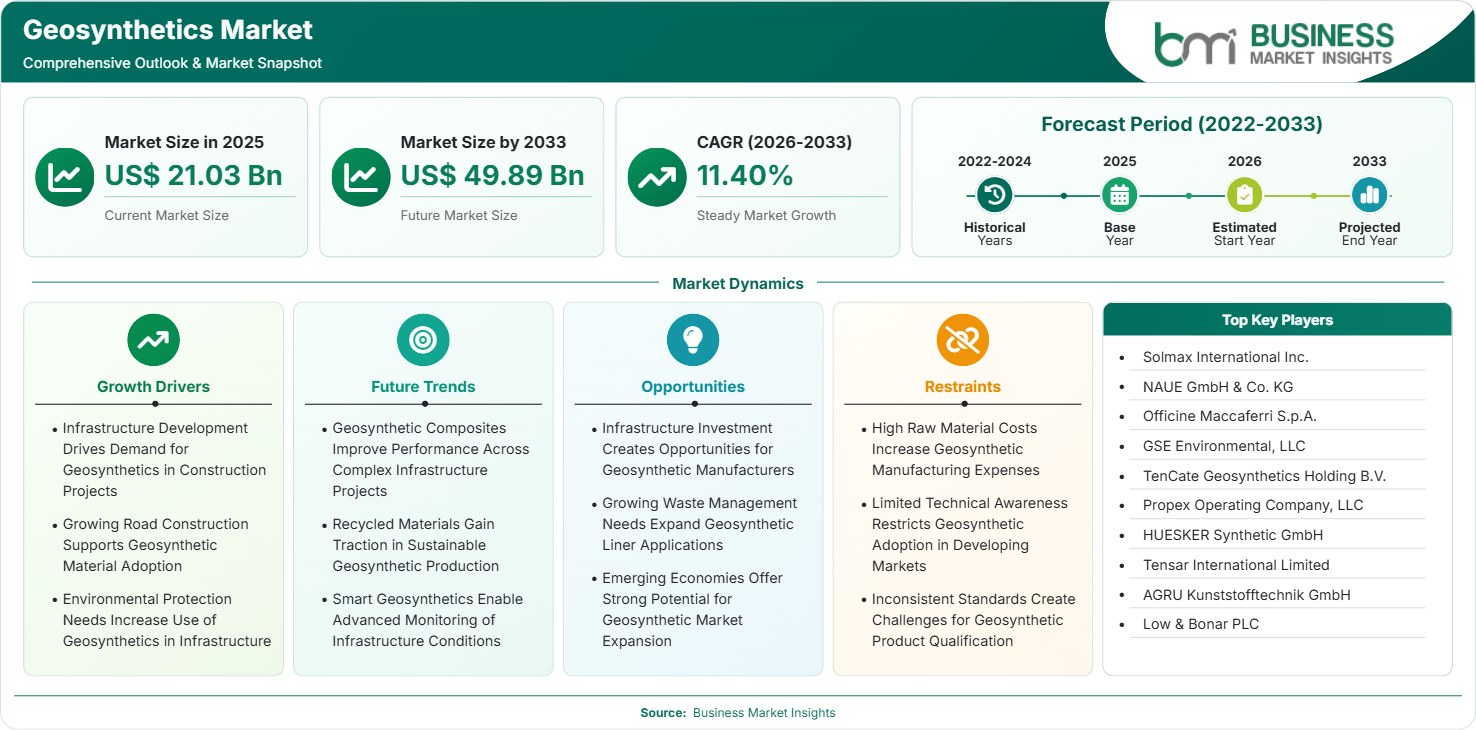
The Geosynthetics Market size was valued at US$ 21.03 Billion in 2025 and is projected to reach US$ 49.89 Billion by 2033, growing at a CAGR of 11.40% during 2026–2033, driven by infrastructure investment, road construction, environmental protection, waste management, and expanding applications across emerging economies.

Report Coverage
  • Product: Geotextile Geogrid, Geonets, Geocells, Geofoam, Geosynthetic Clay Liner, Geocomposites
  • Application: Road Construction and Pavement, Railway Infrastructure, Water Management, Others
US$ 21.03 Bn Market size in 2025
US$ 49.89 Bn Market Size by 2033
11.40% CAGR, 2026 - 2033
2026-2033 Forecast Period

AI Overview

Geosynthetics Market Summary

  • North America Region: North America holds a share of 24%–28% in 2025, growing at a CAGR of 9%–11% during 2026–2033, supported by highway rehabilitation, landfill containment, water infrastructure upgrades, erosion control, and environmental regulations. The US remains the dominant regional market, with a CAGR of 9%–11% during 2026–2033, driven by aging infrastructure replacement, transportation investment, landfill modernization, stormwater management, and demand for durable construction solutions.
  • Fastest Growing Region: Asia Pacific holds a share of 34%–38% in 2025, expanding at a CAGR of 13%–15% through 2033, fueled by fast-paced urbanization, infrastructure spending on transportation, rail expansion, need for water management, flood prevention, and increasing environmental protection activities in China, India, Southeast Asia, and many other developing countries.
  • Leading Segment: Geotextiles hold a share of 35%–40% in 2025, growing at a CAGR of 10%–12% through 2033, supported by broad use in road construction, drainage, filtration, separation, erosion control, railway infrastructure, and soil stabilization applications.
  • High Growth Segment: Water Management represents a share of 20%–24% in 2025 and is projected to grow at a CAGR of 12%–14% through 2033, supported by water conservation, flood control, reservoir lining, wastewater treatment, drainage, and climate-resilience infrastructure investments.
  • Key Market Opportunity: Infrastructure modernization, landfill expansion, water scarcity, flood resilience, and sustainable construction are creating opportunities for manufacturers offering high-performance, durable, and cost-efficient geosynthetic systems.
  • Major Market Players: Solmax International Inc., NAUE GmbH & Co. KG, Officine Maccaferri S.p.A., GSE Environmental, LLC, TenCate Geosynthetics Holding B.V., Propex Operating Company, LLC, HUESKER Synthetic GmbH, Tensar International Limited, AGRU Kunststofftechnik GmbH, Low & Bonar PLC.
Strategic Insights

Geosynthetics Market: Strategic Insights

Geosynthetics Market Strategic Framework
FREE PDF
Request your free sample
Request free sample
Stakeholder View

Key Takeaways

  • The industry value chain spans polymer producers, compounders, geosynthetic manufacturers, engineering consultants, contractors, distributors, and infrastructure owners, making technical specification and project relationships important competitive factors.
  • Water management and waste containment provide strong application upside as governments address water scarcity, wastewater treatment, landfill expansion, and environmental protection requirements.
  • Product innovation is shifting toward high-strength reinforcement, durable liners, engineered composites, advanced drainage systems, and materials designed to perform under demanding environmental conditions.
  • Asia Pacific presents the strongest regional investment opportunity due to large-scale transportation construction, rapid urban development, railway expansion, water infrastructure investment, and increasing environmental requirements.
  • Competitive positioning increasingly depends on technical support, project engineering capabilities, installation expertise, product certifications, and the ability to provide integrated geosynthetic solutions.
  • Climate-resilient infrastructure is creating additional demand for erosion control, flood management, coastal protection, drainage, and soil reinforcement systems, broadening the industry's addressable applications.
Geographic Outlook

Geosynthetics Market Regional Highlights

North America Geosynthetics Market

North America accounted for a Geosynthetics Market share of 24%–28% in 2025 and is projected to grow at a CAGR of 9%–11% through 2033. The US represents the dominant regional market, supported by transportation infrastructure rehabilitation, landfill containment, water management, and environmental engineering. Canada contributes through mining, road development, and resource infrastructure projects.

  • Highway rehabilitation and pavement modernization are supporting demand for geogrids and geotextiles that improve structural performance while reducing maintenance requirements.
  • Landfill expansion and environmental regulations are sustaining demand for geomembranes, geosynthetic clay liners, and composite containment systems.
  • Water infrastructure modernization is creating opportunities for drainage, filtration, erosion control, and reservoir lining applications.
  • Climate resilience programs are encouraging geosynthetic use in flood protection, coastal defense, stormwater management, and soil stabilization projects.

US Geosynthetics Market

The US represented 82%–86% of North America's Geosynthetics Market share in 2025 and is projected to grow at a CAGR of 9%–11% through 2033. Demand is supported by transportation infrastructure rehabilitation, environmental containment, water management, and landfill modernization. State and federal infrastructure spending is encouraging contractors to adopt materials that reduce construction time and lifecycle costs.

  • Highway and bridge infrastructure rehabilitation is increasing demand for geotextiles and geogrids that improve pavement performance and reduce maintenance requirements.
  • Landfill containment projects continue to support demand for engineered liners and drainage systems designed to prevent environmental contamination.
  • Water management projects are expanding applications across reservoirs, wastewater facilities, stormwater systems, and erosion-control infrastructure.

Europe Geosynthetics Market

Europe held a Geosynthetics Market share of 22%–26% in 2025 and is projected to grow at a CAGR of 9%–11% through 2033. Germany, France, the UK, Italy, and Spain represent leading markets, while Poland and other Eastern European economies provide high-growth opportunities. Germany is projected to grow at a CAGR of 9%–11%, while Poland is expected to expand at 11%–13%.

  • Germany remains a leading market due to advanced civil engineering capabilities, transportation infrastructure requirements, environmental standards, and extensive industrial applications.
  • France and the UK provide opportunities through road rehabilitation, water management, waste containment, and infrastructure resilience projects.
  • Poland offers strong growth potential as transportation infrastructure investment and European infrastructure funding support road and railway modernization.
  • Sustainability objectives are encouraging infrastructure developers to evaluate geosynthetic solutions that reduce aggregate consumption and improve construction efficiency.

Asia Pacific Geosynthetics Market

Asia Pacific accounted for a Geosynthetics Market share of 34%–38% in 2025 and is projected to grow at a CAGR of 13%–15% through 2033. China, India, Japan, South Korea, and Southeast Asia represent key markets, with India projected to grow at a CAGR of 14%–16%. Rapid urbanization, highway construction, railway development, water infrastructure investment, flood management, and waste containment are expanding demand.

  • China represents a major market due to extensive transportation construction, urban infrastructure development, water management projects, and environmental engineering requirements.
  • India is experiencing strong demand as highway expansion, railway modernization, urban development, and water infrastructure investment increase geosynthetic adoption.
  • Southeast Asian economies are expanding road, port, railway, and flood-control infrastructure, creating new opportunities for geosynthetic manufacturers and engineering suppliers.
  • Japan and South Korea offer mature opportunities in infrastructure rehabilitation, environmental protection, advanced drainage, and high-performance engineering applications.

Rest of World Geosynthetics Market

South and Central America represented a Geosynthetics Market share of 7%–10% in 2025 and are projected to grow at a CAGR of 10%–12%. Brazil, Mexico, Chile, and Argentina are leading markets, supported by mining, transportation, water management, and environmental infrastructure. Brazil is projected to grow at a CAGR of 10%–12%, while Chile is expected to expand at 11%–13%. The Middle East and Africa accounted for a 7%–10% share in 2025 and are projected to grow at a CAGR of 11%–13%. Saudi Arabia, the UAE, and South Africa represent leading markets. Saudi Arabia is projected to grow at a CAGR of 12%–14%, supported by infrastructure diversification, water management, waste treatment, and large construction projects.

  • Brazil provides opportunities through road construction, mining, landfill development, water infrastructure, and environmental engineering projects requiring reinforcement and containment systems.
  • Chile benefits from mining investment and demanding environmental conditions, supporting demand for geomembranes, drainage systems, and engineered containment solutions.
  • Saudi Arabia offers strong potential through large infrastructure programs, water management investment, urban development, and waste management modernization.
  • The UAE provides opportunities across major construction, water management, landfill, and environmental infrastructure projects requiring high-performance geosynthetic systems.
  • South Africa remains an important market for mining, transportation, water infrastructure, and waste containment applications, although project financing influences demand.
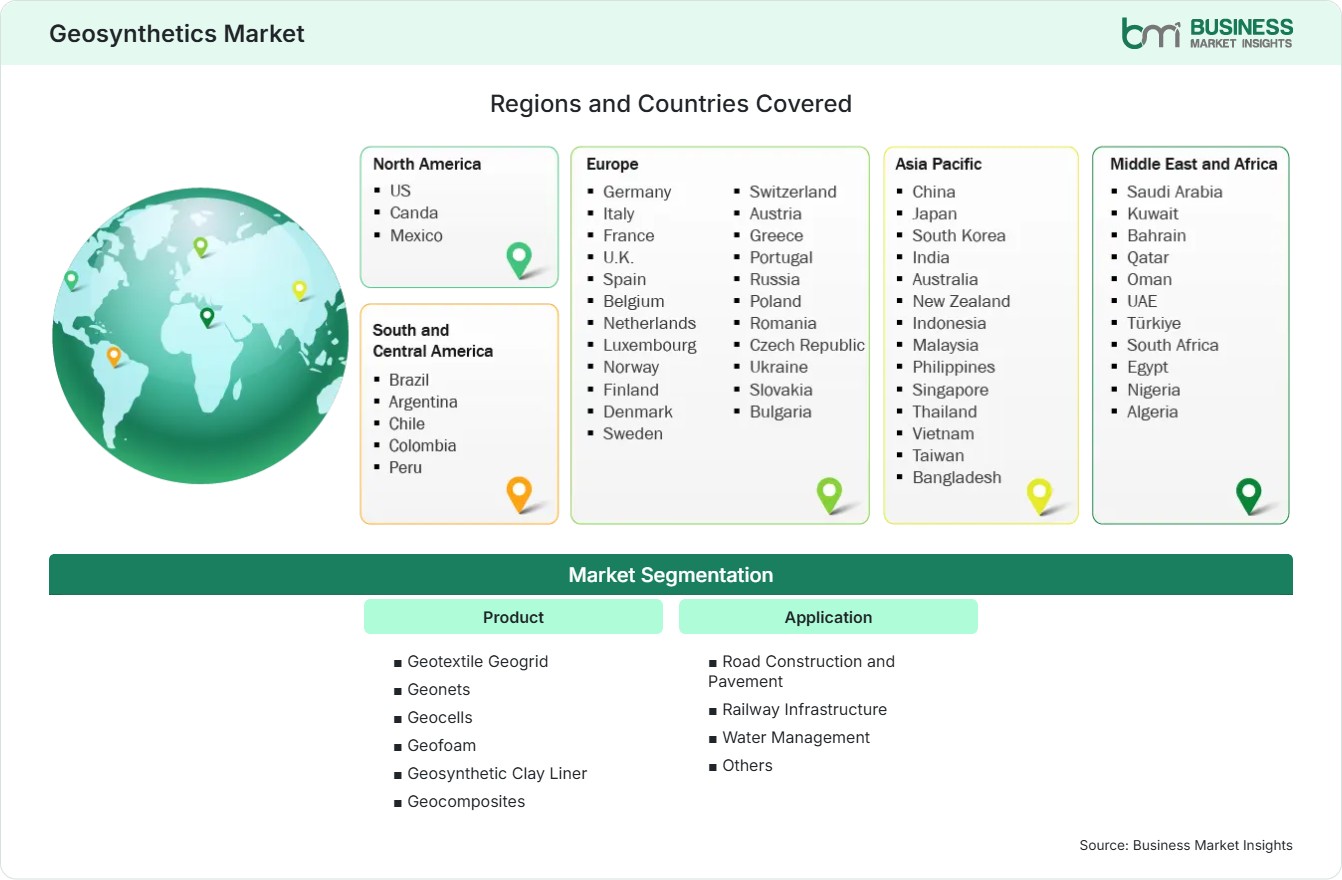
Global Market Geography
FREE PDF
Request your free sample
Request free sample
Segment Analysis

Geosynthetics Market Segmentation

Product

Geotextiles represented a 35%–40% share in 2025 and are projected to grow at a CAGR of 10%–12% through 2033. Broad use in separation, filtration, drainage, reinforcement, and erosion control supports adoption, while infrastructure development expands application opportunities.

  • Geotextile: Geotextiles provide separation, filtration, drainage, and reinforcement across roads, railways, drainage systems, and erosion-control projects, supporting broad infrastructure adoption.
  • Geogrid: Geogrids reinforce soils and pavement structures, improving load distribution and reducing deformation in roads, retaining structures, embankments, and transportation infrastructure.
  • Geonets: Geonets provide drainage and fluid transmission within engineered systems, supporting landfill, environmental containment, and infrastructure applications requiring controlled liquid movement.
  • Geocells: Geocells create three-dimensional confinement structures that stabilize soils, improve load distribution, and support roads, slopes, channels, and erosion-control projects.
  • Geofoam: Geofoam provides lightweight fill for construction projects, reducing structural loads and improving construction efficiency across roads, embankments, bridges, and infrastructure rehabilitation.
  • Geosynthetic Clay Liner: Geosynthetic clay liners provide hydraulic containment for landfills, wastewater facilities, and environmental applications, supporting leakage prevention and regulatory compliance requirements.
  • Geocomposites: Geocomposites combine multiple geosynthetic functions within integrated structures, improving drainage, reinforcement, filtration, and containment performance while simplifying installation and system design.

Application

Road Construction and Pavement represented a 38%–43% share in 2025 and are projected to grow at a CAGR of 10%–12% through 2033. Infrastructure investment, pavement rehabilitation, soil stabilization, and lifecycle cost reduction support adoption across transportation projects.

  • Road Construction and Pavement: Geosynthetics improve soil stabilization, drainage, reinforcement, and pavement performance, helping infrastructure owners reduce maintenance needs and extend roadway service life.
  • Railway Infrastructure: Geosynthetics support separation, reinforcement, drainage, and filtration in railway foundations, improving track stability and reducing maintenance requirements under repeated loading conditions.
  • Water Management: Water management applications use liners, drainage systems, geotextiles, and erosion-control products to support reservoirs, wastewater treatment, flood protection, and water conservation.
  • Others: Additional applications include mining, landfills, coastal protection, agriculture, and environmental remediation, expanding demand for specialized reinforcement, drainage, filtration, and containment systems.
Market Forces

Geosynthetics Market Dynamics

Key Market Drivers

Infrastructure Development Drives Demand for Geosynthetics in Construction Projects

Infrastructure development is increasing demand for materials that improve construction performance, reduce material consumption, and extend infrastructure service life. Roads, railways, bridges, airports, water facilities, and urban development projects increasingly use geosynthetics for reinforcement, separation, drainage, filtration, and soil stabilization. The Geosynthetics Market growth is closely linked to infrastructure investment because these materials can reduce reliance on conventional aggregates and improve construction efficiency. In transportation projects, geotextiles and geogrids help manage weak soils and improve pavement performance. In environmental applications, liners and drainage systems provide containment and leakage control.

Growing Road Construction Supports Geosynthetic Material Adoption

Road construction and pavement rehabilitation represent major demand centers because geosynthetics provide reinforcement, separation, filtration, and drainage functions within transportation infrastructure. Rapid urbanization and increasing vehicle traffic are placing pressure on existing road networks, requiring both new construction and rehabilitation. Geogrids can improve load distribution and pavement performance, while geotextiles help prevent soil migration and maintain drainage characteristics. These functions can reduce maintenance requirements and extend service life, making geosynthetics attractive for infrastructure owners focused on lifecycle economics..

Environmental Protection Needs Increase Use of Geosynthetics in Infrastructure

Environmental protection requirements are increasing adoption of geosynthetics across waste management, water containment, erosion control, and remediation projects. Landfills require engineered systems that limit leakage and protect surrounding soil and groundwater, supporting demand for geomembranes and geosynthetic clay liners. Water infrastructure also uses geosynthetics for reservoir lining, drainage, flood control, and erosion management. Geosynthetics Market trends increasingly reflect the convergence of infrastructure development and environmental compliance, as project owners seek materials that deliver technical performance while supporting environmental objectives.

Key Market Opportunities

Infrastructure Investment Creates Opportunities for Geosynthetic Manufacturers

Large-scale infrastructure investment is creating opportunities for manufacturers capable of supplying technically certified materials at project scale. Transportation modernization, railway expansion, urban development, and water infrastructure programs are increasing demand for reinforcement, drainage, filtration, and soil stabilization solutions. Suppliers can strengthen their market position by establishing local manufacturing capacity, technical service teams, and partnerships with engineering consultants and contractors. Geosynthetics Market Forecasts increasingly reflect opportunities linked to infrastructure spending because product adoption often occurs when materials are incorporated into engineering specifications at the project design stage.

Growing Waste Management Needs Expand Geosynthetic Liner Applications

Increasing waste generation and stricter environmental requirements are expanding opportunities for geosynthetic liners in landfill construction, closure systems, wastewater containment, and remediation projects. Municipalities and industrial operators require engineered barriers capable of preventing contaminants from entering soil and groundwater. Developing economies with expanding urban populations are likely to generate additional demand as waste management infrastructure develops. Manufacturers can capture opportunities by offering integrated liner systems, technical design support, installation guidance, and quality assurance services.

Emerging Economies Offer Strong Potential for Geosynthetic Market Expansion

Opportunities are emerging in developing nations with rising investments in transportation, water, sanitation, waste management and urban infrastructures by their governments. A majority of these projects are faced with tough soil conditions, water shortages, flooding, and other environmental limitations that create huge opportunities for engineered geosynthetic products. The collaboration between local manufacturing and distribution of the products would help to make the products more readily available at lower project costs. There are many opportunities for companies with great engineering abilities and projects in Asia, Latin America, Middle East and Africa.

Market Restraints and Challenges

High Raw Material Costs Increase Geosynthetic Manufacturing Expenses

Factor: The manufacturing of geosynthetics involves the heavy use of polymer materials like polyethylene, polypropylene, and polyester. This makes the manufacturers vulnerable to changes in the prices of petrochemical feedstocks and polymer prices. Impact: Rising raw materials prices could lead to higher manufacturing costs and reduce profit margins, especially for infrastructure projects that have limited budgets. High-cost levels may also compel the contractors to Favor cheaper substitutes.

Limited Technical Awareness Restricts Geosynthetic Adoption in Developing Markets

Factor: The lack of knowledge about geosynthetic design, installation needs, and lifecycle advantages amongst contractors, engineers, project developers, and government agencies may hamper the knowledge of geosynthetics in developing countries. Impact: Lack of adequate knowledge may hinder specification and adoption of geosynthetics leading to the use of traditional materials despite better performance or cost effectiveness of geosynthetics. Technical training and engineering services can be provided by manufacturers to overcome this obstacle.

Company Analysis

Competitive Landscape

Geosynthetics Market analysis indicates a competitive environment comprising global geosynthetic specialists, engineered materials manufacturers, and infrastructure solution providers. Competition is increasingly influenced by product breadth, technical expertise, manufacturing scale, project certifications, geographic presence, and application engineering capabilities. Companies are developing advanced reinforcement, containment, drainage, and composite systems while expanding technical support for contractors and engineering consultants.

Company Name

Overview

Products and Services relevant to this market

Solmax International Inc.

Global geosynthetics specialist providing engineered solutions for infrastructure, environmental, mining, and energy applications.

Geomembranes, geotextiles, geogrids, geocomposites, geosynthetic clay liners, and containment solutions.

NAUE GmbH & Co. KG

German geosynthetic manufacturer serving civil engineering, environmental protection, waste management, and infrastructure markets.

Geotextiles, geogrids, geocomposites, geosynthetic clay liners, drainage, and landfill containment systems.

Officine Maccaferri S.p.A.

Engineering company providing geosynthetic and infrastructure solutions for soil stabilization, erosion control, and environmental applications.

Geogrids, geotextiles, erosion-control systems, reinforcement products, and engineered geosynthetic solutions.

GSE Environmental, LLC

Geosynthetics provider specializing in environmental containment and infrastructure protection applications.

Geomembranes, geosynthetic clay liners, geocomposites, drainage products, and containment systems.

TenCate Geosynthetics Holding B.V.

Global geosynthetic solutions provider serving transportation, environmental, water, and civil engineering applications.

Geotextiles, geogrids, geocomposites, erosion-control products, and engineered reinforcement solutions.

Propex Operating Company, LLC

Geosynthetic manufacturer supplying engineered materials for transportation, environmental, and civil infrastructure applications.

Geotextiles, geogrids, erosion-control products, and reinforcement systems for infrastructure projects.

HUESKER Synthetic GmbH

Specialist manufacturer focused on high-performance geosynthetics for soil reinforcement, transportation, and environmental engineering.

Geogrids, geotextiles, geocomposites, reinforcement systems, and specialized civil engineering solutions.

Tensar International Limited

Geosynthetic engineering company known for reinforcement technologies used in roads, foundations, and infrastructure.

Geogrids, soil stabilization systems, pavement reinforcement, and engineered geosynthetic solutions.

AGRU Kunststofftechnik GmbH

Austrian manufacturer specializing in polymer-based products for infrastructure, environmental protection, and industrial applications.

Geomembranes, geosynthetic liners, geocomposites, drainage products, and containment systems.

Low & Bonar PLC

Advanced materials company supplying technical textiles and engineered solutions for construction and infrastructure applications.

Geotextiles, reinforcement materials, composite systems, and specialized technical textile solutions.

Trust & Transparency

Research Methodology

The market analysis combines proprietary research with secondary data from government agencies, company disclosures, regulatory filings, industry databases and expert interviews. Market estimates are validated through data triangulation, cross-market benchmarking and analyst review.

View Full Research Methodology

Questions Answered

Frequently Asked Questions

What is limiting adoption in developing markets?

Limited technical awareness among engineers, contractors, and project owners can restrict specification and adoption of geosynthetic solutions.

Why are geosynthetics used in road construction?

They improve soil stabilization, reinforcement, drainage, filtration, and pavement performance while helping reduce maintenance requirements and extend infrastructure service life.

Which region offers the strongest growth opportunity in geosynthetics market report?

Asia Pacific offers the strongest growth opportunity, supported by infrastructure development, urbanization, transportation investment, and water management requirements.

Which geosynthetic product has the largest demand?

Geotextiles lead demand due to extensive use in separation, filtration, drainage, reinforcement, and erosion-control applications.

What are the main applications of geosynthetics?

Road construction, railway infrastructure, water management, landfill containment, mining, erosion control, and environmental protection are major application areas.

Access the Full Geosynthetics Market Report

Get segment-level forecasts, regional estimates, competitive benchmarking, company profiles and downloadable Excel datasets.

Access the full Geosynthetics Market Report
350 pages PDF & Excel | 2026-08-31