
N-Propanol Market Outlook: Size, Share, Trends, Growth Analysis, Competitive Landscape & Forecast, 2026–2033

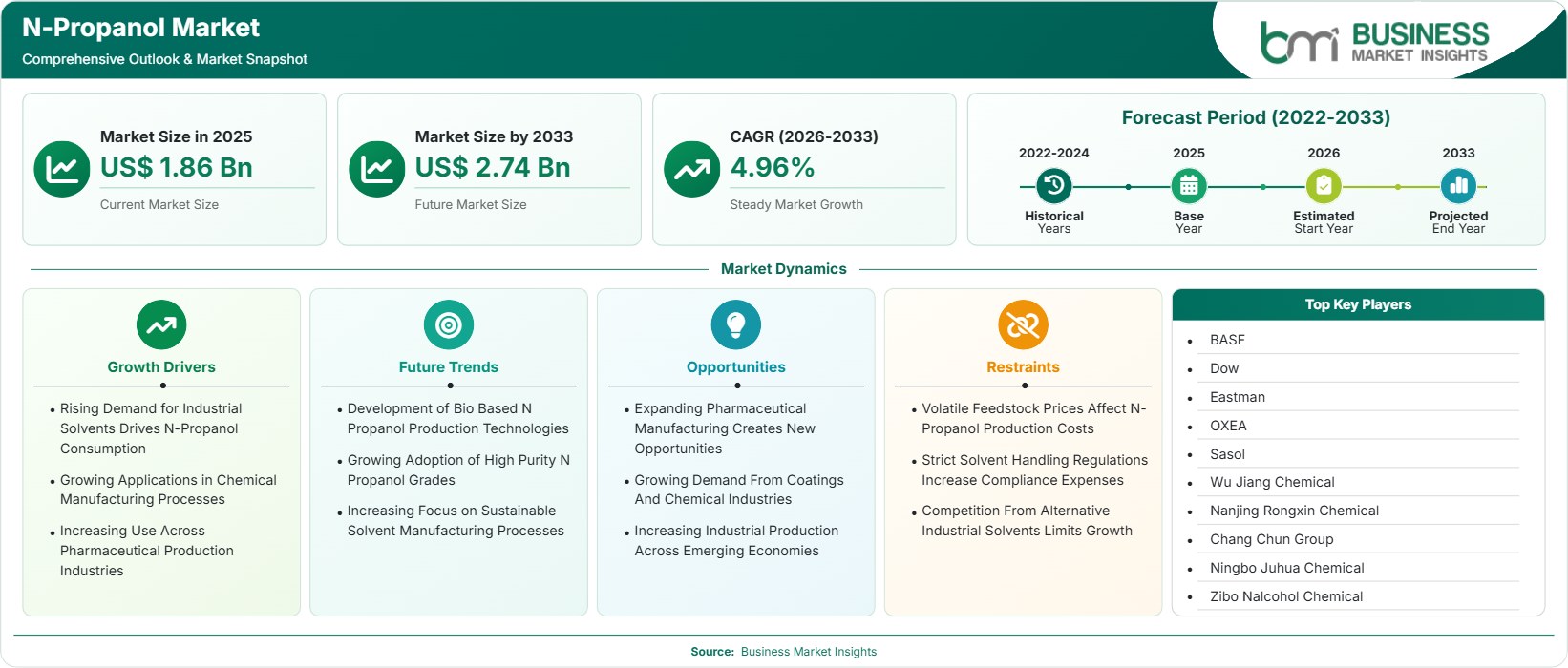
The N-Propanol Market size was valued at US$ 1.86 billion in 2025 and is projected to reach US$ 2.74 billion by 2033, growing at a CAGR of 4.96% during 2026–2033, driven by solvent demand, coatings expansion, pharmaceutical manufacturing, chemical processing, and emerging-market industrialization.

Report Coverage
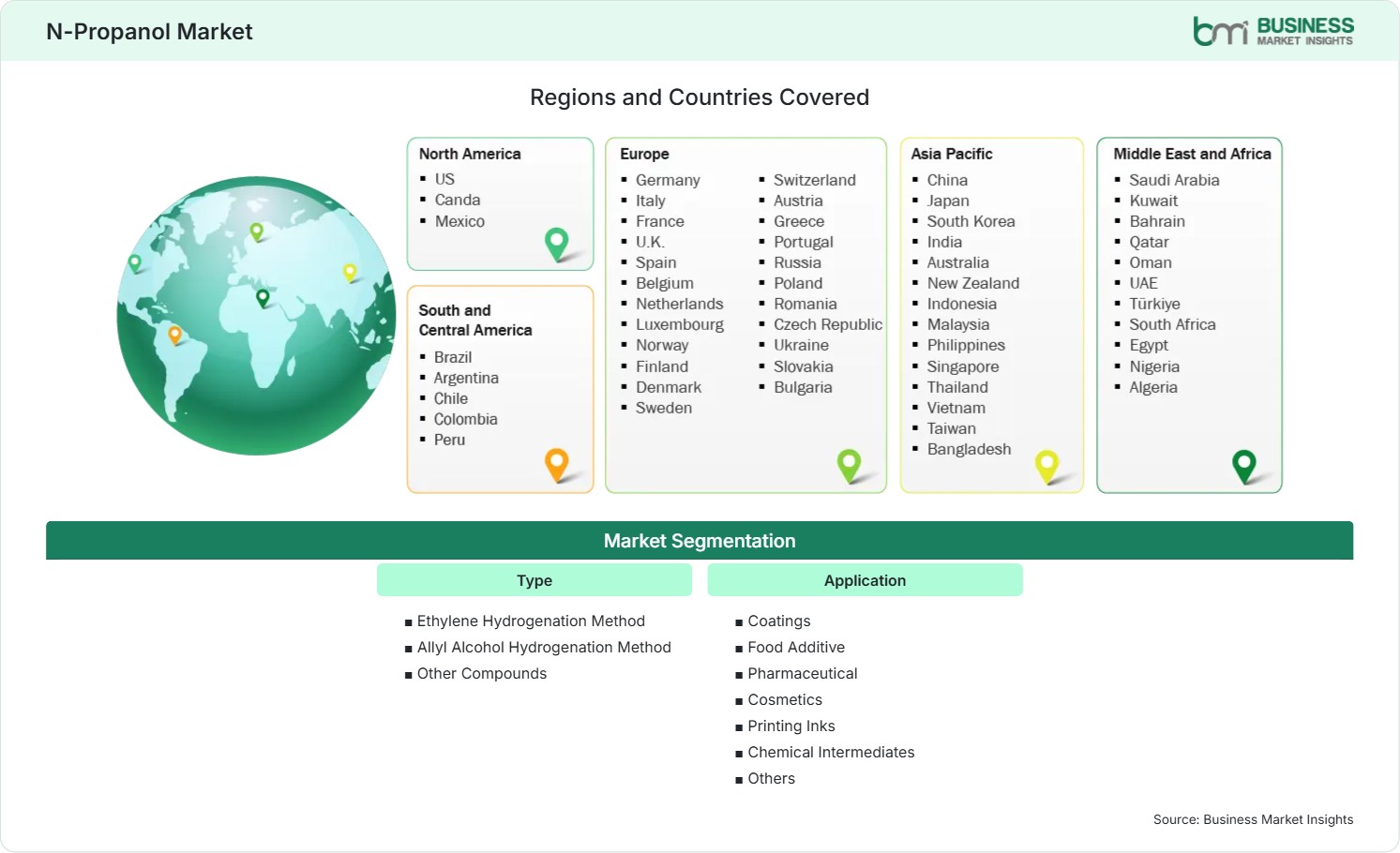
  • Type: Ethylene Hydrogenation Method, Allyl Alcohol Hydrogenation Method, Other Compounds
  • Application: Coatings, Food Additive, Pharmaceutical, Cosmetics, Printing Inks, Chemical Intermediates, Others
US$ 1.86 Bn Market size in 2025
US$ 2.74 Bn Market Size by 2033
4.96% CAGR, 2026 - 2033
2026-2033 Forecast Period

01 AI Overview

N-Propanol Market Summary

  • North America Region: North America holds an estimated 19%–22% share in 2025 and is projected to grow at a 4.2%–4.8% CAGR through 2033, supported by coatings, pharmaceuticals, chemical processing, printing inks, and established industrial solvent infrastructure.
  • Fastest Growing Region: Asia Pacific holds an estimated 48%–52% share in 2025 and is projected to grow at a 5.4%–6.1% CAGR, supported by expanding chemical manufacturing, pharmaceutical production, coatings, industrial investment, and rising demand for solvent-based processing applications.
  • Leading Segment: Coatings represent an estimated 24%–28% share in 2025 and are projected to grow at a 5.0%–5.6% CAGR, supported by solvent demand, industrial finishing, protective coatings, formulation requirements, and construction-related manufacturing activity.
  • High Growth Segment: Pharmaceutical applications represent an estimated 12%–15% share in 2025 and are projected to grow at a 5.8%–6.5% CAGR, supported by pharmaceutical manufacturing expansion, formulation processes, solvent requirements, and rising production capacity.
  • Key Market Opportunity: Pharmaceutical manufacturing, emerging industrial economies, coatings production, specialty chemical processing, and application-specific formulations offer attractive avenues for capacity expansion and product differentiation.
  • Major Market Players: BASF, Dow, Eastman, OXEA, Sasol, Wu Jiang Chemical, Nanjing Rongxin Chemical, Chang Chun Group, Ningbo Juhua Chemical, and Zibo Nalcohol Chemical.
02 Strategic Insights

N-Propanol Market: Strategic Insights

N-Propanol Market Strategic Framework
FREE PDF
Request your free sample
Request free sample
03 Stakeholder View

Key Takeaways

  • The value chain depends on feedstock availability, hydrogenation or byproduct production routes, purification infrastructure, bulk storage, distribution networks, and downstream formulation demand.
  • Pharmaceutical manufacturing and coatings provide attractive opportunities because both applications require dependable solvent performance, consistent quality, and supply continuity across production cycles.
  • Production technology is increasingly focused on improving process efficiency, reducing energy intensity, optimizing feedstock utilization, and maintaining consistent purity across commercial grades.
  • Asia Pacific provides the strongest expansion opportunity as chemical manufacturing, coatings, pharmaceuticals, and industrial production continue broadening across major manufacturing economies.
  • Investment priorities are likely to center on production efficiency, regional supply resilience, specialty grades, downstream partnerships, and capacity positioned close to major consuming industries.
  • Competitive positioning increasingly depends on reliable logistics, product consistency, application support, feedstock management, and the ability to serve customers requiring differentiated purity specifications.
04 Geographic Outlook

N-Propanol Market Regional Highlights

North America N-Propanol Market

North America held an estimated 19%–22% share in 2025 and is projected to grow at a 4.2%–4.8% CAGR through 2033. The region benefits from established chemical manufacturing, coatings production, pharmaceutical processing, and sophisticated industrial distribution. The U.S. represents the dominant regional demand center, supported by diverse downstream applications.

  • Coatings manufacturers require dependable solvent inputs for formulation, processing, and performance characteristics across industrial and specialty coating products.
  • Pharmaceutical manufacturing supports demand for consistent-purity material used across selected production and formulation processes requiring controlled solvent specifications.
  • Established chemical infrastructure supports efficient procurement, storage, transportation, and integration into downstream manufacturing processes across multiple industrial applications.
  • Domestic production capabilities and established distribution networks help reduce supply disruption risks for large-volume industrial consumers.

US N-Propanol Market

The U.S. represents an estimated 17%–20% global share in 2025 and is projected to grow at a 4.1%–4.7% CAGR through 2033. Demand is supported by coatings, pharmaceuticals, chemical manufacturing, printing inks, and specialty formulations. Mature industrial infrastructure enables established procurement channels and supports consistent consumption across diversified end-use industries.

  • Pharmaceutical and chemical manufacturers prioritize reliable solvent quality because production consistency and process control directly influence manufacturing efficiency and product specifications.
  • Coatings production remains an important consumption area, particularly across industrial formulations requiring controlled solvent characteristics and predictable processing performance.
  • Strong distribution infrastructure supports bulk purchasing and regional availability, helping manufacturers manage inventory requirements across multiple downstream production locations.

Europe N-Propanol Market

Europe held an estimated 21%–24% N-Propanol Market share in 2025 and is projected to grow at a 3.8%–4.5% CAGR through 2033. Germany, France, Italy, the Netherlands, and the United Kingdom remain important markets, while Germany is projected at a 4.1%–4.8% CAGR and Poland at 4.8%–5.5%.

  • Germany benefits from advanced chemical manufacturing, coatings production, pharmaceutical activity, and strong industrial distribution capabilities.
  • France and Italy support demand through pharmaceutical manufacturing, coatings, specialty chemicals, and printing-related applications requiring industrial solvent inputs.
  • The Netherlands functions as an important chemical and logistics hub, supporting regional movement and distribution of industrial solvents.
  • European regulatory requirements encourage manufacturers to optimize handling, storage, emissions management, and process efficiency across solvent-intensive production environments.

Asia Pacific N-Propanol Market

Asia Pacific held an estimated 48%–52% share in 2025 and is projected to grow at a 5.4%–6.1% CAGR through 2033. China, India, Japan, South Korea, and Southeast Asia are important demand centers, supported by chemical manufacturing, coatings, pharmaceuticals, industrialization, and expanding production infrastructure.

  • China remains a major manufacturing base, supporting consumption across coatings, chemical intermediates, printing inks, and industrial processing applications.
  • India provides strong expansion potential through pharmaceutical manufacturing, coatings production, chemical processing, and broader industrial capacity development.
  • Southeast Asian economies are attracting manufacturing investment, creating additional downstream demand for industrial solvents and chemical-processing inputs.
  • Japan and South Korea provide mature demand through sophisticated chemical, pharmaceutical, coatings, and electronics-related manufacturing ecosystems.

Rest of World N-Propanol Market

Rest of World accounted for an estimated 7%–10% share in 2025 and is projected to grow at a 4.5%–5.2% CAGR through 2033. South America benefits from industrial and coatings activity, while the Middle East and Africa provide opportunities through chemical manufacturing and industrial diversification.

Brazil is projected at a 4.8%–5.5% CAGR, supported by coatings, chemicals, pharmaceuticals, and industrial production. Middle Eastern demand is developing alongside downstream chemical investments.

  • Brazil provides demand through coatings, chemical processing, pharmaceutical production, and industrial manufacturing applications requiring solvent inputs.
  • Mexico benefits from manufacturing activity, coatings production, pharmaceutical processing, and proximity to established North American industrial supply chains.
  • Middle Eastern chemical investments can support future consumption as regional producers expand downstream manufacturing and specialty chemical capabilities.
  • African N-Propanol Markets provide longer-term opportunities as pharmaceutical, coatings, construction-related manufacturing, and industrial processing capacity develops.
Global Market Geography
FREE PDF
Request your free sample
Request free sample
05 Segment Analysis

N-Propanol Market Segmentation

Type

Ethylene Hydrogenation Method represents an estimated 34%–38% share in 2025 and is projected to grow at a 4.7%–5.3% CAGR through 2033. Established production infrastructure and process familiarity support continued adoption, while alternative routes provide flexibility where feedstock economics favor different production configurations.

  • Ethylene Hydrogenation Method: This established route supports commercial production through hydrogenation processes, with competitiveness influenced by feedstock availability, process efficiency, plant economics, and production scale.
  • Allyl Alcohol Hydrogenation Method: This route provides an alternative production pathway, with adoption shaped by feedstock economics, process configuration, plant integration, and regional availability of suitable inputs.

Application

Coatings represent an estimated 24%–28% share in 2025 and are projected to grow at a 5.0%–5.6% CAGR through 2033. Broad industrial use and formulation requirements support demand, while pharmaceutical applications provide additional growth through expanding manufacturing capacity and specialized solvent needs.

  • Coatings: Coatings applications use solvent properties to support formulation, processing, application behavior, and product performance across industrial and specialty coating systems.
  • Food Additive: Food-related applications require controlled specifications and appropriate regulatory compliance, with demand influenced by formulation requirements and processing standards.
  • Pharmaceutical: Pharmaceutical production requires consistent-quality solvents for selected manufacturing processes, creating demand linked to formulation activity, production expansion, and quality-control requirements.
  • Cosmetics: Cosmetics manufacturers use solvent inputs across selected formulations, with consumption influenced by product development, formulation compatibility, purity expectations, and personal-care manufacturing activity.
  • Printing Inks: Printing ink applications depend on solvent characteristics that support formulation and processing, particularly across industrial printing and specialized ink systems.
  • Chemical Intermediates: Chemical processing applications use N-propanol as an input or processing solvent, linking consumption with specialty chemical production and broader industrial manufacturing activity.
06 Market Forces

N-Propanol Market Dynamics

Key Market Drivers

Rising Demand for Industrial Solvents Drives N-Propanol Consumption

The manufacturers in the industrial sector are looking for solvents with reliable properties, predictable performance, and quality, in addition to being compatible with all formulations. Coatings, printing inks, chemical processing, and some selected pharmaceutical uses serve as diverse market channels for demand generation. The N-Propanol Market growth will be linked to industrial production since the more active the manufacturing process, the greater the requirement for processing and formulation materials. Manufacturers are concentrating on providing a reliable supply, high purity of the products, and good economics in terms of production. Substitution will impact demand from manufacturers based on performance, regulations, availability, and total cost of the process.

Growing Applications in Chemical Manufacturing Processes

The chemical industry uses solvents in a number of reactions, extractions, cleaning, formulations, and intermediate production processes. This leads to a diversified demand base that is less reliant on a single application alone. The N-Propanol Market trend is now being influenced more by process optimization within industries, wherein the performance of the solvent will be judged along with other factors such as cost, ease of handling, quality, and reliability. Suppliers may increase the demand by offering grades that meet the needs of the process and by maintaining consistency in the specifications of the product. Expansion of the chemical industry in regions could promote local sourcing as well. As more specialty chemicals are produced, there may be chances for suppliers who can offer reliable materials and technical assistance for use where purity/formulation requirements are more stringent.

Increasing Use Across Pharmaceutical Production Industries

Production of pharmaceuticals will result in a need for controlled quality solvents for certain production and formulation operations. The growth in pharmaceutical manufacturing capability in emerging manufacturing economies will lead to higher use of solvents, while existing manufacturers will keep their focus on process and quality.  The N-Propanol Market forecast will be shaped by trends in pharmaceutical manufacturing, regulatory considerations, investments in manufacturing, and reliable industrial input supplies. The suppliers of such products need to ensure consistent product quality and reliable documentation since the buying decisions will often include high-quality considerations. Opportunities will also arise for distributors who can ensure that they have secure inventory and prompt deliveries to pharmaceutical manufacturing complexes.

Key Market Opportunities

Expanding Pharmaceutical Manufacturing Creates New Opportunities

Pharmaceutical manufacturing is growing both in existing and new manufacturing centers, thus providing an opportunity for solvent suppliers that will be able to satisfy the demands for consistent quality and consistent supply. Manufacturers can manufacture grades dedicated to the pharmaceutical industry, improve quality control systems, and create distribution channels close to major manufacturing centers. An increase in demand can also come about due to outsourcing and contract manufacturing by pharmaceutical companies that allocate manufacturing processes to specialized centers. Suppliers who have the ability to provide proper documentation, technical service, and logistics are better positioned to create good business relations. Localized storage can minimize the lead time as well as secure the supply chain for the manufacturer running on a tight schedule.

Growing Demand From Coatings And Chemical Industries

The coating and chemical sectors offer chances since both use solvents in their various formulations and processes. Needs can be boosted due to construction, manufacturing activities, infrastructure development, and specialty chemicals production. Manufacturers can benefit from offering customized product types and assisting in formulating to ensure stable process performance by their clients. Localized manufacturing plants located closer to big industrial areas will cut down on logistics and increase responsiveness. There are also possibilities in emerging countries where industrialization is boosting the need for coatings, inks, intermediates, and chemical formulations. Supply partnerships with big downstream players will help ensure steady volumes for manufacturers while maximizing capacity utilization and logistics efficiency.

Increasing Industrial Production Across Emerging Economies

Emerging economies offer potential as the development of manufacturing capabilities takes place within the sectors of chemicals, coatings, pharmaceuticals, print media, consumer goods, and industrials. As the manufacturing capacity rises, the need for more solvents and chemical intermediates also increases. This allows for the diversification of demand. The producers will be able to enhance their market reach through regional distribution, regional stocking, and application support services. The emergence of manufacturing clusters may even open up the possibility for securing agreements that allow for reduced dependency on distant supplies. When making investment choices, companies must evaluate the availability of raw materials, the quality of infrastructure, logistics costs, regulations, and customer proximity.

Market Restraints and Challenges

Volatile Feedstock Prices Affect N-Propanol Production Costs

Factor: fluctuations in feedstock and energy prices can alter the cost base for N-propanol production, particularly where manufacturers rely on petrochemical inputs and energy-intensive processing. Impact: unstable production costs can compress margins, complicate contract pricing, and reduce predictability for downstream buyers. Producers may respond through procurement diversification, process optimization, inventory management, and longer-term supply agreements. Manufacturing economics can also vary by production route and geography, creating competitive differences between suppliers. Companies with efficient facilities and secure feedstock relationships may manage volatility more effectively. Nevertheless, sustained cost instability can make capacity planning more difficult and encourage downstream customers to evaluate alternative solvents or reformulate products where technically and economically feasible.

Strict Solvent Handling Regulations Increase Compliance Expenses

Factor: solvent handling requirements can impose controls covering storage, transportation, workplace safety, emissions, labeling, and environmental management. Impact: compliance obligations can increase operating costs and require additional investments in infrastructure, training, monitoring, and documentation. Requirements may also vary across jurisdictions, complicating international distribution and increasing the administrative burden for manufacturers and suppliers. Companies must maintain robust safety procedures while ensuring that product handling information remains consistent throughout the supply chain. Investments in containment, process controls, and employee training can improve operational reliability but may raise fixed costs. These requirements favor established suppliers with mature compliance systems and can create barriers for smaller producers seeking entry into regulated industrial markets.

07 Company Analysis

Competitive Landscape

The competitive environment includes diversified chemical manufacturers, solvent specialists, and regional producers serving industrial and specialty applications. N-Propanol Market analysis highlights competition around production efficiency, feedstock access, product consistency, geographic reach, logistics reliability, and downstream technical support. Suppliers with broad chemical portfolios can leverage existing customer relationships across multiple applications.

Company Name

Overview

Products and Services relevant to this market

BASF

Global chemical producer with broad industrial and specialty chemical capabilities.

Industrial solvents, chemical intermediates, coatings inputs, pharmaceutical-related chemicals, and formulation solutions.

Dow

Diversified materials science company serving major industrial and chemical-processing markets.

Solvents, performance materials, chemical intermediates, coatings-related products, and industrial formulation inputs.

Eastman

Specialty materials and chemical company serving diverse downstream industries.

Solvents, specialty chemicals, coatings ingredients, performance additives, and formulation technologies.

OXEA

Chemical producer focused on oxo intermediates, solvents, and specialty chemical products.

Alcohols, solvents, oxo intermediates, specialty chemicals, and industrial formulation inputs.

Sasol

Integrated chemicals and energy company with broad chemical manufacturing capabilities.

Solvents, alcohols, chemical intermediates, performance chemicals, and industrial chemical products.

Wu Jiang Chemical

Regional chemical manufacturer serving industrial chemical markets and downstream processors.

Chemical solvents, intermediates, industrial chemicals, and related manufacturing products.

Nanjing Rongxin Chemical

Chinese chemical producer serving solvent and chemical-processing applications.

Industrial chemical products, solvents, intermediates, and downstream manufacturing inputs.

Chang Chun Group

Diversified chemical manufacturer with materials and industrial chemical operations.

Chemical intermediates, solvents, resins, coatings materials, and industrial chemical solutions.

Ningbo Juhua Chemical

Chemical producer serving industrial markets through a diversified product portfolio.

Chemical intermediates, industrial chemicals, solvents, and related downstream processing materials.

Zibo Nalcohol Chemical

Regional chemical producer focused on alcohols and solvent-related products.

Alcohol solvents, chemical intermediates, industrial-grade products, and related chemical manufacturing inputs.

10 Trust & Transparency

Research Methodology

The market analysis combines proprietary research with secondary data from government agencies, company disclosures, regulatory filings, industry databases and expert interviews. Market estimates are validated through data triangulation, cross-market benchmarking and analyst review.

View Full Research Methodology

11 Questions Answered

Frequently Asked Questions

What does the N-Propanol Market Report indicate about future competition?

The report indicates that competition will increasingly center on production economics, feedstock security, product consistency, regional availability, logistics performance, application support, and specialty-grade capabilities. Suppliers able to combine dependable supply with efficient manufacturing and strong downstream relationships can strengthen their competitive position.

Why are emerging economies creating new opportunities for N-propanol suppliers?

Emerging economies are expanding pharmaceutical, coatings, chemical, printing, and general industrial manufacturing capacity. This creates additional demand for solvents and chemical intermediates while encouraging suppliers to establish regional inventory, distribution partnerships, and production capabilities closer to growing downstream manufacturing clusters.

How are production technologies influencing N-propanol supply?

Production technologies influence supply through feedstock efficiency, process economics, purification capability, energy consumption, and plant integration. Hydrogenation-based routes remain important, while byproduct-based production can create localized opportunities where suitable chemical streams and infrastructure are available.

Which applications present the strongest opportunity in the market?

Coatings, pharmaceuticals, chemical intermediates, printing inks, and cosmetics offer attractive opportunities. These applications require dependable solvent performance and consistent quality, while expansion of pharmaceutical and industrial manufacturing can create additional consumption across established and emerging production centers.

What factors are improving N-Propanol Market return on investment?

Growing industrial solvent demand, pharmaceutical manufacturing expansion, coatings production, chemical processing, and emerging-market industrialization are improving investment potential. Producers can strengthen returns through efficient manufacturing, dependable feedstock sourcing, regional distribution, specialty grades, and long-term supply relationships with downstream industrial customers.

Access the Full N-Propanol Market Report

Get segment-level forecasts, regional estimates, competitive benchmarking, company profiles and downloadable Excel datasets.

Access the full N-Propanol Market Report
350 pages PDF & Excel | 2026-08-24