
Silicate Market Outlook: Size, Share, Trends, Growth Analysis, Competitive Landscape & Forecast, 2026–2033

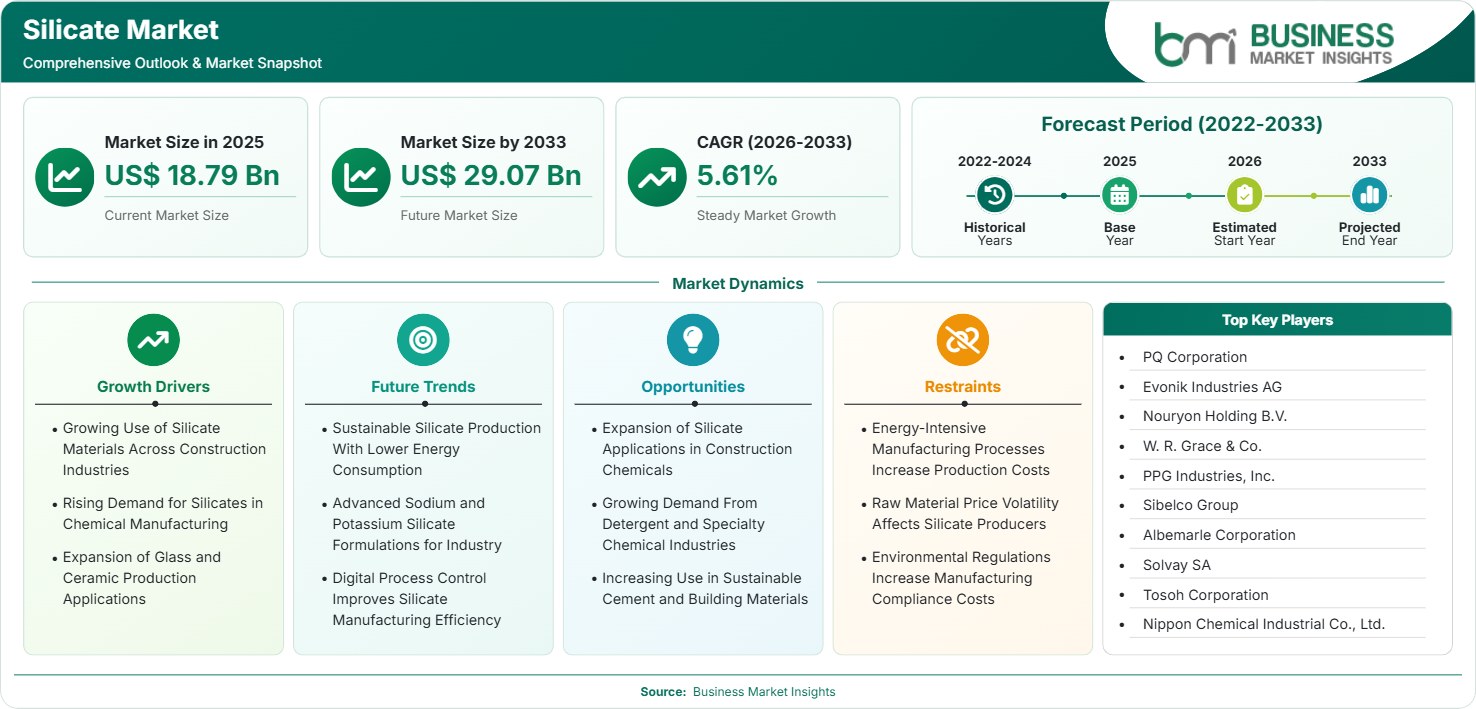
The Silicate Market size was valued at US$ 18.79 Billion in 2025 and is projected to reach US$ 29.07 Billion by 2033, growing at a CAGR of 5.61% during 2026–2033, supported by construction demand, water treatment, and sustainable building-material applications.

Report Coverage
  • Type: Sodium Silicate, Potassium Silicate, Aluminum Silicate, Magnesium Silicate, Others
  • End-Use: Detergents, Construction, Paper & Ceramics, Rubber & Plastics, Agriculture, Water Treatment, Others
US$ 18.79 Bn Market size in 2025
US$ 29.07 Bn Market Size by 2033
5.61% CAGR, 2026 - 2033
2026-2033 Forecast Period

AI Overview

Silicate Market Summary

  • North America Region: North America holds a 20%–24% share in 2025 and grows at a 5.2%–5.9% CAGR during 2026–2033, supported by construction chemicals, detergents, water treatment, ceramics, specialty chemicals, and demand for higher-performance silicate formulations. The US represents the principal regional market, with growth supported by construction activity, industrial processing, water treatment applications, and replacement demand across established end-use industries.
  • Fastest Growing Region: Asia Pacific holds a 39%–43% share in 2025 and grows at a 6.3%–7.1% CAGR during 2026–2033, driven by construction expansion, detergent production, ceramics, paper manufacturing, agriculture, water treatment, and increasing industrial chemical consumption.
  • Leading Segment: Sodium Silicate holds a 48%–52% share in 2025 and grows at a 5.5%–6.1% CAGR during 2026–2033, supported by broad industrial use, detergent manufacturing, construction chemicals, paper processing, water treatment, and chemical production.
  • High Growth Segment: Water Treatment holds a 9%–12% share in 2025 and grows at a 6.5%–7.3% CAGR during 2026–2033, supported by water purification requirements, industrial wastewater treatment, infrastructure development, process-efficiency needs, and environmental compliance.
  • Key Market Opportunity: Sustainable building materials, detergents, water treatment, and specialized formulations are contributing to an increase in silicate usage, and it also drives manufacturers to manufacture eco-friendly and high-performance products that can be used for specific purposes.
  • Major Market Players: PQ Corporation, Evonik Industries AG, Nouryon Holding B.V., W. R. Grace & Co., PPG Industries, Inc., Sibelco Group, Albemarle Corporation, Solvay SA, Tosoh Corporation, Nippon Chemical Industrial Co., Ltd.
Strategic Insights

Silicate Market: Strategic Insights

Silicate Market Strategic Framework
FREE PDF
Request your free sample
Request free sample
Stakeholder View

Key Takeaways

  • Competitive advantage increasingly depends on access to reliable raw materials, efficient production assets, technical formulation capabilities, distribution infrastructure, and application-specific customer support.
  • Construction chemicals, detergents, water treatment, and ceramics provide diversified demand pools, reducing reliance on any single downstream industry and supporting more balanced portfolio strategies.
  • Producers are moving toward higher-purity, application-specific, performance-oriented grades that improve compatibility with modern formulations while addressing efficiency, environmental, and processing requirements.
  • Asia Pacific offers the strongest expansion potential as construction, manufacturing, detergents, ceramics, paper, agriculture, and industrial water-treatment requirements broaden the consumption base.
  • Capacity optimization, localized production, specialty-grade development, and downstream application support are becoming important investment priorities as customers place greater emphasis on supply reliability and technical performance.
  • Producers can reduce exposure to raw-material and energy-cost volatility through operational efficiency, diversified sourcing, geographic balancing, product specialization, and stronger long-term customer relationships.
Geographic Outlook

Silicate Market Regional Highlights

North America Silicate Market

North America holds a 20%–24% share in 2025 and North America Silicate Market forecast to grow at a 5.2%–5.9% CAGR through 2033. The region benefits from established demand across construction, detergents, water treatment, ceramics, paper, and specialty chemicals. The US represents the leading national market, while Canada supports additional consumption through industrial processing, construction materials, and resource-related applications. The Silicate Market share reflects a mature industrial base where replacement demand, formulation upgrades, sustainability requirements, and specialized applications increasingly influence purchasing decisions across downstream industries.

  • Construction chemicals remain an important demand channel as manufacturers use silicate-based materials for binding, surface treatment, stabilization, and performance enhancement across commercial and infrastructure applications.
  • Detergent producers continue to support demand through formulations requiring builders and processing aids that improve cleaning performance, stability, and manufacturing efficiency.
  • Water-treatment applications benefit from industrial wastewater requirements and increasing emphasis on efficient treatment processes, resource management, and regulatory compliance.
  • Specialty chemical applications provide higher-value opportunities as manufacturers increasingly require consistent grades tailored to formulation, processing, and performance specifications.

US Silicate Market

The US Silicate Market accounts for 78%–82% of North American demand in 2025 and grows at a 5.3%–6.0% CAGR through 2033. Demand is supported by established construction, detergent, chemical, water-treatment, paper, and ceramics industries. The market increasingly favors consistent product quality, reliable domestic supply, application-specific formulations, and efficient manufacturing.

  • Construction and infrastructure activity sustains demand for silicate-based binders, coatings, admixtures, and specialized construction formulations.
  • Industrial water treatment supports recurring consumption where manufacturers require dependable treatment chemistry and improved process control.
  • Specialty formulations provide attractive opportunities for suppliers offering customized grades, technical support, and consistent product performance across demanding industrial applications.

Europe Silicate Market

Europe Silicate Marke holds a 18%–22% share in 2025 and grows at a 4.8%–5.6% CAGR through 2033. Germany, France, Italy, Spain, and the United Kingdom represent leading markets, while Germany and Italy provide stronger growth opportunities within specialized industrial applications. Demand is influenced by construction materials, detergents, ceramics, paper, water treatment, and specialty chemistry.

  • Germany remains a major market because of its strong chemical, construction-material, detergent, paper, and industrial manufacturing base.
  • Italy provides attractive opportunities through ceramics, construction materials, detergents, and specialized industrial applications requiring consistent silicate formulations.
  • France and the United Kingdom support diversified demand across construction chemicals, water treatment, cleaning formulations, and industrial processing.
  • European sustainability requirements are encouraging producers to improve manufacturing efficiency and downstream formulations while reducing resource intensity.

Asia Pacific Silicate Market

Asia Pacific Silicate Marke holds a 39%–43% share in 2025 and grows at a 6.3%–7.1% CAGR through 2033, making it the largest regional market. China, India, Japan, South Korea, and Southeast Asian economies represent important demand centers, with India and Southeast Asia providing stronger growth opportunities. Construction, detergents, ceramics, paper, agriculture, chemicals, and water treatment support consumption.

  • China remains a major market because of its extensive construction, chemical, ceramics, detergent, paper, and industrial manufacturing base.
  • India offers strong growth opportunities as construction activity, detergents, ceramics, water treatment, and chemical manufacturing expand across industrial and consumer applications.
  • Japan and South Korea support higher-value applications through advanced manufacturing, specialty chemicals, ceramics, electronics-related materials, and sophisticated industrial formulations.
  • Southeast Asian markets provide additional opportunities through construction development, detergent production, industrialization, and expanding water-treatment requirements.

Rest of World Silicate Market

Rest of World holds a 14%–18% share in 2025 and grows at a 4.9%–5.7% CAGR through 2033. South and Central America contribute demand through Brazil, Mexico, Argentina, Chile, and Colombia, supported by construction, detergents, agriculture, ceramics, paper, and industrial processing. Brazil and Mexico remain leading markets, while Argentina and Colombia provide higher-growth opportunities. Demand is increasingly linked to infrastructure development, industrial expansion, water management, and increasing use of formulated chemical products. Middle East and Africa provide additional demand through construction, detergents, water treatment, agriculture, ceramics, and industrial applications. Saudi Arabia, the United Arab Emirates, South Africa, Egypt, and Turkey represent important markets, while Saudi Arabia and the UAE provide stronger growth opportunities.

  • Brazil provides diversified demand through construction materials, detergents, ceramics, paper, agriculture, and industrial chemical applications.
  • Mexico benefits from manufacturing, construction, detergent production, and industrial processing, creating opportunities for both standard and specialty silicate grades.
  • Saudi Arabia and the UAE provide growth opportunities through construction, industrial diversification, water treatment, and infrastructure-related chemical consumption.
  • South Africa supports demand through industrial processing, construction materials, detergents, agriculture, and water-treatment applications.
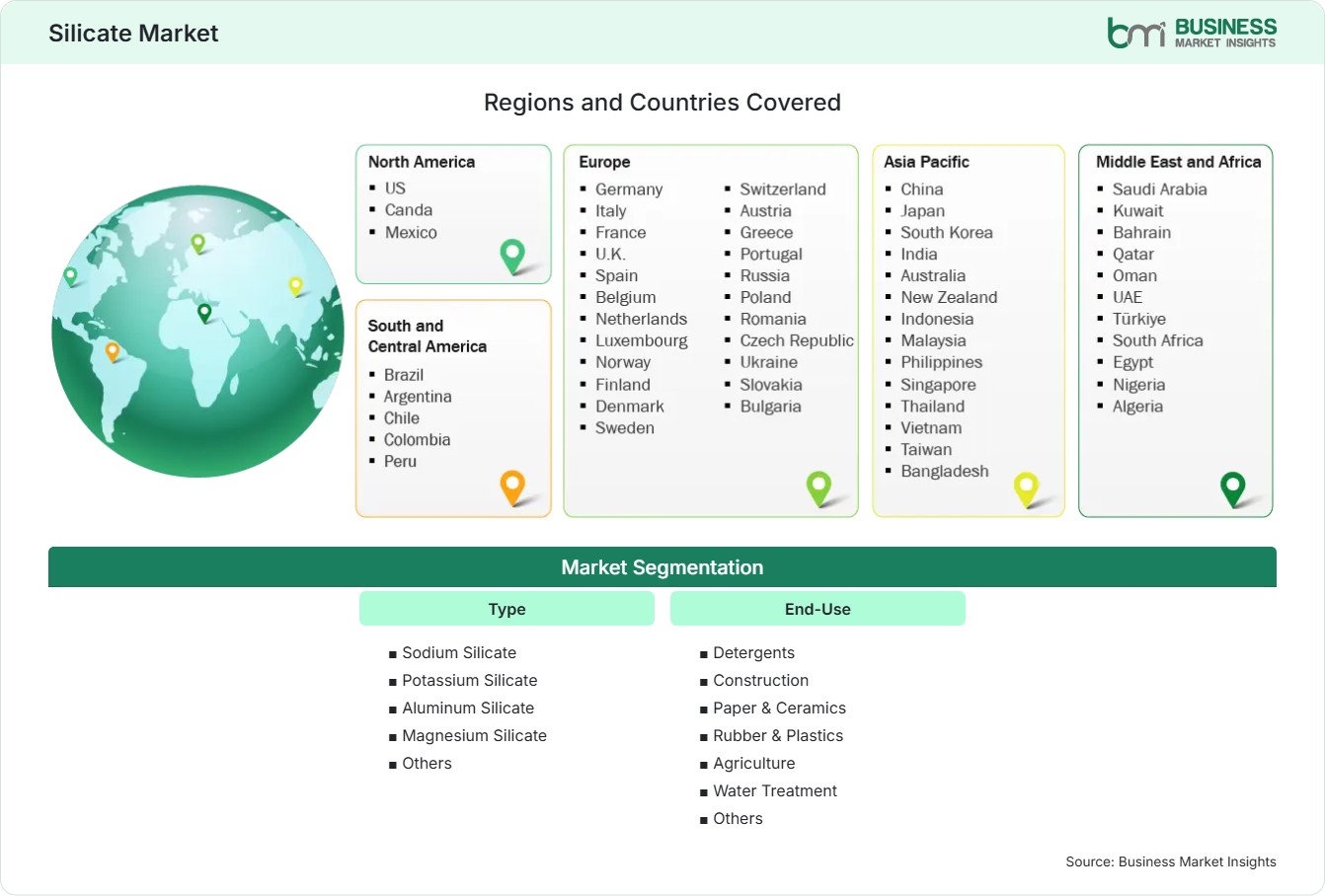
Global Market Geography
FREE PDF
Request your free sample
Request free sample
Segment Analysis

Silicate Market Segmentation

Type

Sodium Silicate holds a 48%–52% Silicate Market share in 2025 and grows at a 5.5%–6.1% CAGR through 2033. Its broad functionality supports detergents, construction, paper, ceramics, water treatment, and chemical applications. Potassium, aluminum, and magnesium silicates serve more specialized requirements, creating opportunities for differentiated formulations and application-specific products.

  • Sodium Silicate: Broad industrial adoption is supported by detergent formulation, construction chemicals, paper processing, water treatment, and chemical manufacturing requirements.
  • Potassium Silicate: Demand is linked to specialized construction materials, agriculture, coatings, and formulations requiring potassium-based chemistry and controlled performance characteristics.
  • Aluminum Silicate: Used across ceramics, construction materials, fillers, and specialized industrial formulations where thermal, structural, and processing properties are important.
  • Magnesium Silicate: Supports rubber, plastics, agriculture, ceramics, and specialty formulations requiring controlled physical properties and functional mineral performance.

End-Use

Detergents hold a 23%–27% share in 2025 and grow at a 5.3%–5.9% CAGR through 2033. Construction, paper & ceramics, rubber & plastics, agriculture, and water treatment diversify consumption. Demand increasingly favors consistent quality, formulation compatibility, efficient processing, and products capable of supporting performance and sustainability requirements across downstream applications.

  • Detergents: Silicates support formulation stability, cleaning performance, alkalinity management, and processing efficiency across household and industrial cleaning products.
  • Construction: Demand is driven by binders, coatings, surface treatments, construction chemicals, and materials requiring improved durability and processing characteristics.
  • Paper & Ceramics: Consumption is supported by processing, binding, surface, and formulation requirements across paper production and ceramic manufacturing.
  • Rubber & Plastics: Silicate materials support functional formulations, fillers, reinforcement, processing, and performance requirements across diverse polymer applications.
  • Agriculture: Demand is linked to soil management, crop-input formulations, plant-support products, and applications requiring controlled mineral-based chemistry.
  • Water Treatment: Consumption is supported by industrial water management, treatment processes, resource efficiency, and requirements for reliable chemical performance.
Market Forces

Silicate Market Dynamics

Key Market Drivers

Growing Use of Silicate Materials Across Construction Industries

The construction sector still constitutes a major demand driver due to the beneficial characteristics of silicates for binding, stabilizing, surface treatment, and formulating construction materials. Infrastructure development, construction of commercial buildings, renovations, and demand for better-performing materials will sustain demand. Manufacturers are shifting their emphasis to developing grades that will fit modern construction formulation requirements, such as those that are easy to process and consistent in application. The broad application range minimizes risk related to individual construction material sectors.

Rising Demand for Silicates in Chemical Manufacturing

Chemical manufacturing diversifies demand due to silicates' ability to serve as intermediates, processing aids, stabilizers, binders, and active ingredients in many different formulas. The diversity allows manufacturers to cater to many end-use applications without depending solely on commodity use. The growth of manufacturing chemicals leads to wider silicate usage especially for those who require a stable formula composition and processing behavior. Specialized grades are more commercially valuable where they address formulaic needs that cannot be effectively addressed by generic products. Suppliers are consequently focusing on product consistency, technical service, customized specifications, and reliable logistics.

Expansion of Glass and Ceramic Production Applications

The glass and ceramic manufacturing industry is also a significant source of demand due to the contribution of the silicate minerals in the formulation process, processing, binding, and performance needs of the material. Increased construction, consumer goods, industrial parts, and ceramics applications may lead to increased demand in these industries. Consistent mineral input is becoming necessary for ceramic manufacturers to control formulations and maintain efficiencies in production processes; quality becomes a selection factor for suppliers. Producers can strengthen their market position by supporting customers with technical guidance and providing grades optimized for specific manufacturing terms.

Key Market Opportunities

Expansion of Silicate Applications in Construction Chemicals

The use of construction chemicals presents an opportunity as companies seek functional additives which will enhance the performance of materials. Silicates can be used to enhance the performance of binders, coatings, and surfaces treatments among others, hence giving an opportunity beyond the usual commodity application. Increased demand caters to construction firms which are seeking to develop products that have a longer life span, are energy efficient, and whose performance is better controlled.

Growing Demand from Detergent and Specialty Chemical Industries

The detergents and specialty chemicals industries offer opportunities for expanding silicate use via formulation innovation and performance-driven product development. The detergents industry is continually looking for components which enhance their product performance and stability during formulation as well as during processing. In the same vein, the specialty chemicals industry needs reliable materials suited to its manufacturing process. These factors contributing to the technical formulation support and considered a major Silicate Market trend.

Increasing Use in Sustainable Cement and Building Materials

The sustainable cement and building material are one of the new opportunities to manufacturers as they continue to look for new ways of enhancing material efficiency. The silicate technology will be useful in areas such as bonding, surface treatment, stabilization, and special construction applications, giving the manufacturer an opportunity to be involved in developing sustainable products. The opportunity is particularly relevant where construction-material manufacturers are redesigning formulations to processing efficiency, improve durability, and lifecycle performance.

Market Restraints and Challenges

Energy-Intensive Manufacturing Processes Increase Production Costs

Factor: The production of silicates can consume considerable energy both thermally and during the process, thus affecting the economics of production depending on energy availability, efficiency in production, and regional production costs. Impact: Increased energy consumption will lead to increased costs of production and reduced margins for producers, especially if customers are still price sensitive and competition is intense. Producers can overcome this challenge by increasing furnace efficiency and improving production processes.

Raw Material Price Volatility Affects Silicate Producers

Factor: Silicate producers depend on raw materials whose prices can fluctuate because of energy markets, mineral availability, transportation costs, supply disruptions, and regional production conditions. Impact: Raw-material volatility can compress margins, complicate pricing decisions, and create uncertainty for producers and downstream customers operating under longer-term supply agreements. Companies can reduce exposure through diversified sourcing, procurement planning, supplier relationships, inventory management, and improved production efficiency.

Company Analysis

Competitive Landscape

The Silicate market analysis reveals a competitive structure characterized by a broad range of competition, where large-scale chemical companies, mineral firms, silicate producers, and specialist material providers compete using a combination of products offered, production size, technology, geographical location, and customer service. Product consistency, specialized formulas, environmental activities, supply chain, and end-user industry support are some of the factors that influence competition.

Company Name

Overview

Products and Services relevant to this market

PQ Corporation

Global supplier focused strongly on silicates, silicas, and derivative materials, with broad industrial market coverage.

Sodium silicates, specialty silicates, silica products, technical support, manufacturing, and application-focused solutions.

Evonik Industries AG

Global specialty chemicals company with advanced materials capabilities serving industrial and specialty applications.

Specialty silica and related performance materials used across industrial, rubber, chemical, and formulation applications.

Nouryon Holding B.V.

Specialty chemicals producer serving industrial and consumer markets with emphasis on application performance and sustainable chemistry.

Specialty chemical ingredients, silica-related technologies, formulation support, and industrial application solutions.

W. R. Grace & Co.

Specialty materials company with expertise in catalysts, engineered materials, and industrial processing technologies.

Silica-based materials, specialty chemical technologies, catalysts, and engineered materials for industrial applications.

PPG Industries, Inc.

Global coatings and specialty materials company with broad industrial formulation capabilities.

Silicate-related materials and technologies supporting coatings, construction, industrial, and specialty formulations.

Sibelco Group

Global industrial minerals supplier serving construction, ceramics, glass, and specialty applications.

Industrial minerals, silicate-bearing materials, ceramic inputs, glass materials, and application-specific mineral solutions.

Albemarle Corporation

Specialty chemicals company with mineral and chemical processing expertise across industrial markets.

Specialty chemical materials and mineral-based products supporting industrial, chemical, and formulation applications.

Solvay SA

Global specialty chemicals company with advanced materials and sustainable chemistry capabilities.

Silica and specialty materials, formulation technologies, sustainable material solutions, and industrial applications.

Tosoh Corporation

Japanese chemical producer with diversified inorganic and specialty chemical operations.

Inorganic chemicals, silicate-related materials, specialty chemicals, and industrial formulation solutions.

Nippon Chemical Industrial Co., Ltd.

Japanese chemical manufacturer specializing in inorganic and functional chemical products.

Inorganic chemical materials, specialty products, industrial additives, and application-focused chemical solutions.

Trust & Transparency

Research Methodology

The market analysis combines proprietary research with secondary data from government agencies, company disclosures, regulatory filings, industry databases and expert interviews. Market estimates are validated through data triangulation, cross-market benchmarking and analyst review.

View Full Research Methodology

Questions Answered

Frequently Asked Questions

How can manufacturers improve competitiveness?

Manufacturers can strengthen competitiveness through efficient production, reliable raw-material sourcing, distribution, and product development aligned with customer performance and sustainability requirements.

What makes Asia Pacific strategically important in Silicate Market?

Asia Pacific combines large downstream manufacturing capacity with expanding construction, detergents, ceramics, paper, agriculture, chemicals, and water-treatment demand.

How are silicate producers responding to sustainability requirements?

Producers are emphasizing efficient manufacturing, improved resource utilization, lower-impact feedstocks, application-specific formulations, and process optimization. Sustainability is increasingly incorporated into both manufacturing strategies and customer-facing product development.

Which applications provide the strongest diversification opportunity in Silicate Market report?

Construction, detergents, water treatment, ceramics, and specialty chemicals provide complementary demand streams. This diversified application base allows producers to balance exposure to individual downstream industries and develop specialized products for higher-value applications.

What factors determine silicate product selection?

Customers primarily evaluate chemical composition, consistency, formulation compatibility, processing behavior, supply reliability, technical support, and total application economics. Requirements vary substantially between detergents, construction materials, ceramics, paper, agriculture, and water treatment.

Access the Full Silicate Market Report

Get segment-level forecasts, regional estimates, competitive benchmarking, company profiles and downloadable Excel datasets.

Access the full Silicate Market Report
350 pages PDF & Excel | 2026-08-19