
Chemicals Packaging Market Outlook: Size, Share, Trends, Growth Analysis, Competitive Landscape & Forecast, 2026–2033

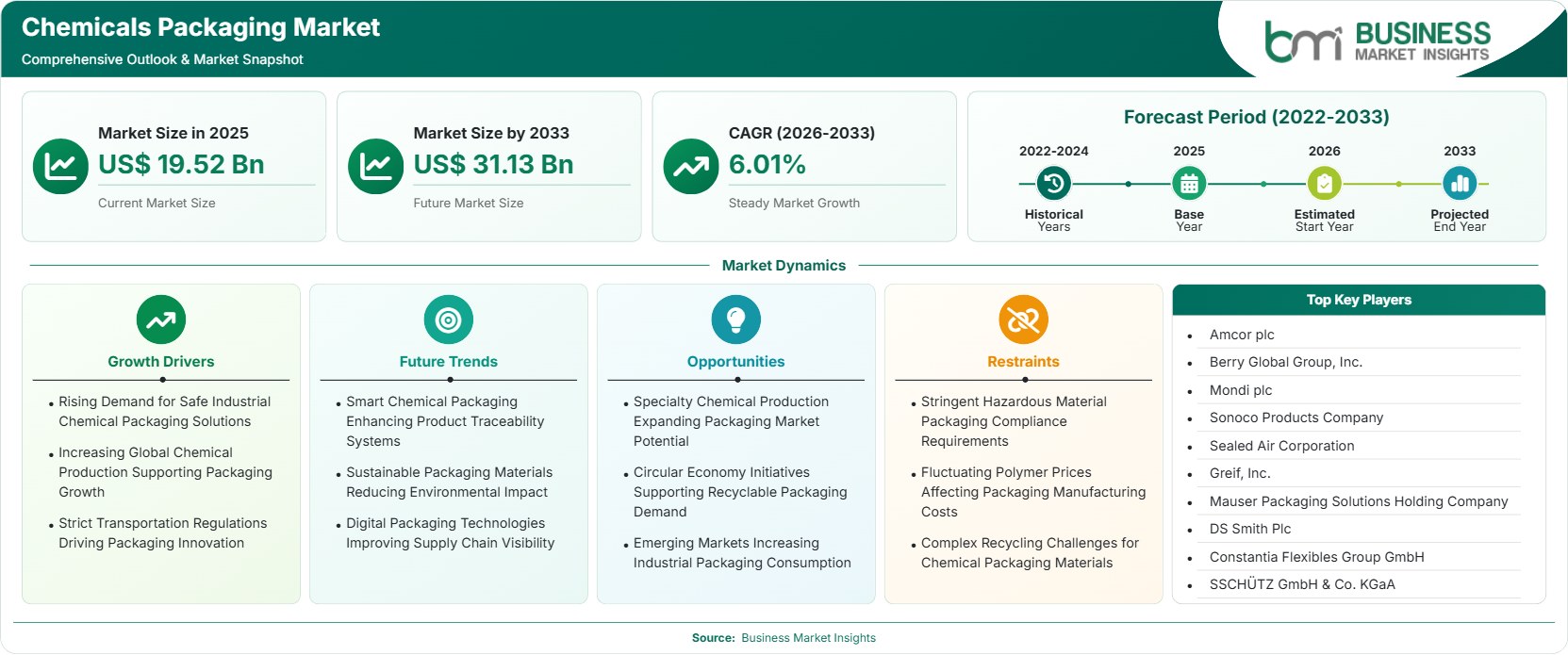
The Chemicals Packaging Market size was valued at US$ 19.52 Billion in 2025 and is projected to reach US$ 31.51 Billion by 2033, growing at a CAGR of 6.01% during 2026–2033, driven by increasing chemical production, demand for safer packaging formats, regulatory compliance, and opportunities in recyclable and sustainable industrial packaging solutions.

Report Coverage
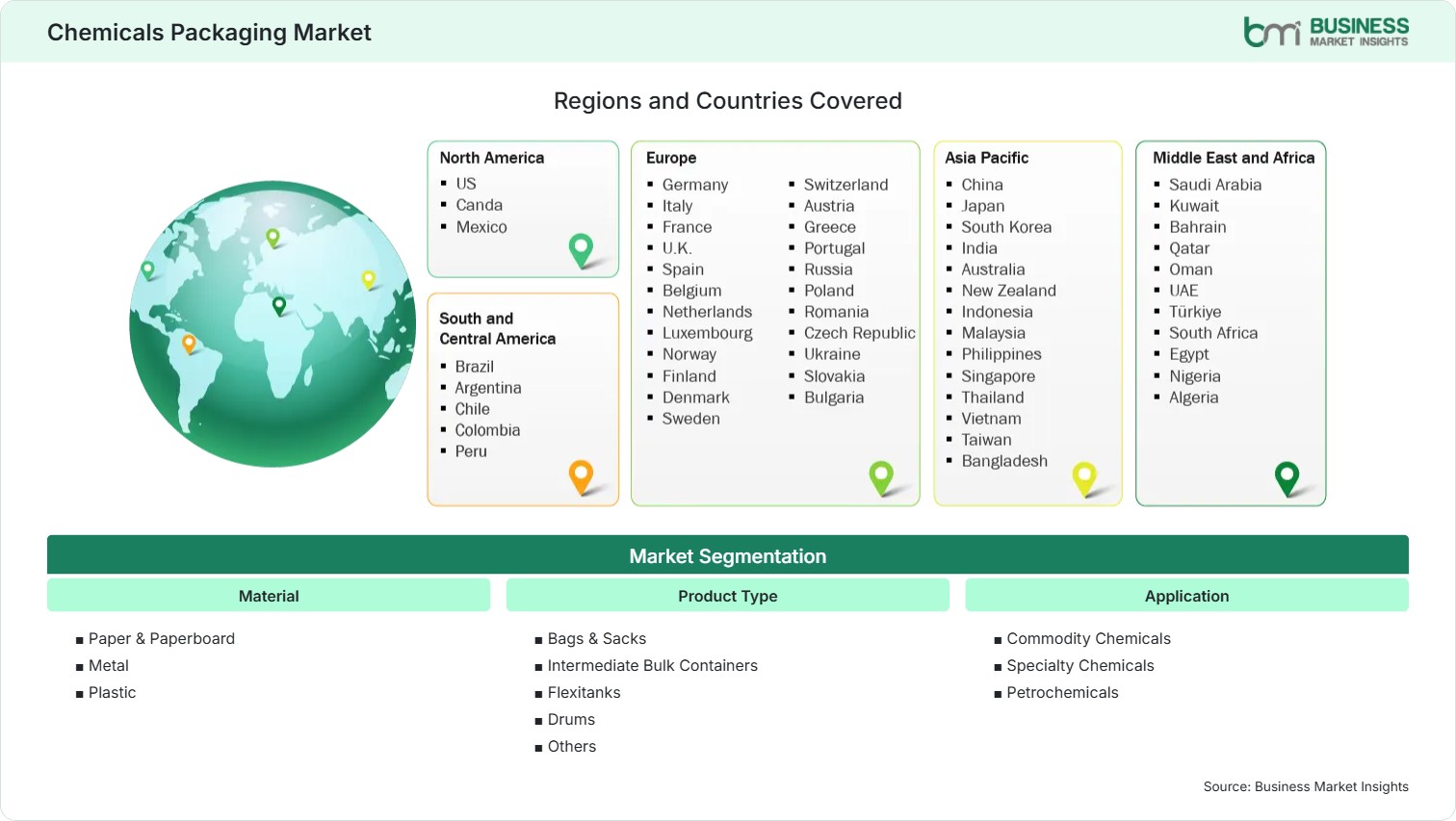
  • Material: Paper & Paperboard, Metal, Plastic
  • Product Type: Bags & Sacks, Intermediate Bulk Containers , Flexitanks, Drums, Others
  • Application: Commodity Chemicals, Specialty Chemicals, Petrochemicals
US$ 19.52 Bn Market size in 2025
US$ 31.13 Bn Market Size by 2033
6.01% CAGR, 2026 - 2033
2026-2033 Forecast Period

AI Overview

Chemicals Packaging Market Summary

  • North America Region: North America holds 32%–35% share in 2025, growing with a CAGR of 5.80%–6.20% influenced by advanced chemical manufacturing, stringent packaging standards, sustainable material adoption, and investment opportunities. The US market demonstrates stable expansion with a CAGR of 5.90%–6.30% during 2026–2033 due to industrial modernization.
  • Fastest Growing Region: Asia Pacific accounts for 38%–41% share in 2025, expanding with a CAGR of 6.70%–7.10% supported by rising chemical production capacity, industrial infrastructure development, manufacturing relocation, and increasing demand for efficient bulk packaging solutions across emerging economies.
  • Leading Segment: Plastic material solutions represent the leading segment with 52%–55% share in 2025, registering a CAGR of 6.10%–6.50% due to lightweight characteristics, durability, chemical resistance, transportation efficiency, and widespread industrial chemical packaging applications.
  • High Growth Segment: Intermediate Bulk Containers (IBC) represent a high-growth product category with 7.00%–7.40% CAGR during 2026–2033, supported by reusable designs, logistics optimization, hazardous chemical handling requirements, and growing adoption across specialty chemical industries.
  • Key Market Opportunity: Increasing demand for sustainable packaging, recyclable polymers, reusable containers, and advanced bulk transportation systems creates opportunities for manufacturers to develop cost-efficient solutions aligned with environmental regulations and industrial safety requirements.
  • Major Market Players: Amcor plc, Berry Global Group, Inc., Mondi plc, Sonoco Products Company, Sealed Air Corporation, Greif, Inc., Mauser Packaging Solutions Holding Company, DS Smith Plc, Constantia Flexibles Group GmbH, SCHÜTZ GmbH & Co. KGaA.
Strategic Insights

Chemicals Packaging Market: Strategic Insights

Chemicals Packaging Market Strategic Framework
FREE PDF
Request your free sample
Request free sample
Stakeholder View

Key Takeaways

  • Chemical packaging value chain integration is gaining more momentum as resin makers, packaging converters, chemical producers, and transport companies cooperate to enhance efficiency and adhere to the regulation.
  • Specialty chemicals and bulk transport represent highly promising areas for growth as they need packaging that ensures protection, efficiency, and proper international transportation.
  • Innovation is shifting toward recyclable polymers, reusable containers, advanced barrier coatings, and smart packaging technologies that improve chemical safety while reducing environmental impact.
  • Asia Pacific presents a strong investment opportunity due to expanding chemical manufacturing capacity, infrastructure development, and increasing adoption of industrial packaging solutions across China, India, and Southeast Asia.
  • Market consolidation is increasing as global packaging companies expand capabilities through acquisitions, strategic partnerships, and investments in sustainable packaging technologies.
  • Companies focusing on circular economy models and regulatory-aligned packaging solutions are positioned to strengthen competitiveness in industrial chemical supply chains.
Geographic Outlook

Chemicals Packaging Market Regional Highlights

North America Chemicals Packaging Market

North America represented 32%–35% share in 2025 and is projected to grow at a CAGR of 5.80%–6.20% between 2026–2033. The region benefits from established chemical manufacturing infrastructure, advanced logistics networks, and strict industrial safety standards. The Chemicals Packaging Market share remains supported by demand from specialty chemicals, petrochemicals, and industrial manufacturing sectors.

  • The United States maintains a dominant position due to extensive chemical production facilities, strong packaging infrastructure, and increasing adoption of sustainable industrial containers across manufacturing operations.
  • Canada contributes through chemical exports, resource-based industries, and demand for durable packaging systems supporting transportation of industrial chemicals and hazardous materials.
  • Regulatory requirements from agencies such as the Environmental Protection Agency encourage manufacturers to adopt safer and more environmentally responsible packaging solutions.
  • Growth opportunities are supported by investments in recyclable materials, automated packaging lines, and improved bulk chemical transportation systems.

US Chemicals Packaging Market

The US Chemicals Packaging Market accounted for 27%–30% share in 2025 within North America and is expected to register a CAGR of 5.90%–6.30% from 2026–2033. Strong chemical production capabilities, advanced manufacturing facilities, and increasing sustainability commitments support market expansion. The country remains a key innovation hub for packaging technologies.

  • Chemical manufacturers are adopting lightweight and reusable packaging formats to improve operational efficiency and reduce material consumption throughout supply chains.
  • Increasing specialty chemical production is supporting demand for customized packaging solutions with improved compatibility, protection, and transportation performance.
  • The presence of major packaging companies and advanced recycling infrastructure strengthens domestic market development.

Europe Chemicals Packaging Market

Europe accounted for 24%–27% share in 2025 and is projected to expand at a CAGR of 5.50%–5.90% during 2026–2033. The region is influenced by sustainability regulations, circular economy initiatives, and advanced chemical manufacturing capabilities. Germany, France, and the Netherlands remain important markets, while Poland shows increasing growth potential due to industrial expansion. The Chemicals Packaging Market growth is supported by environmental compliance requirements.

  • Germany leads regional demand through strong chemical production capacity, industrial exports, and adoption of sustainable packaging technologies.
  • France and the Netherlands are expanding chemical packaging consumption due to specialty chemical manufacturing and advanced logistics infrastructure.
  • European regulations promoting recyclable materials are accelerating investments in innovative packaging solutions.
  • Manufacturers are developing reusable containers and low-carbon packaging formats to align with sustainability targets.

Asia Pacific Chemicals Packaging Market

Asia Pacific accounted for 38%–41% share in 2025 and is expected to achieve a CAGR of 6.70%–7.10% during 2026–2033. Rapid industrialization, expanding chemical production, and infrastructure development are supporting regional growth. China, India, Japan, and South Korea represent major markets, while Southeast Asian economies are emerging manufacturing destinations. Increasing chemical exports are strengthening demand for advanced packaging solutions.

  • China remains the largest contributor due to extensive chemical manufacturing capacity and strong demand for bulk packaging systems.
  • India is experiencing rising adoption due to expanding chemical industries, manufacturing investments, and infrastructure development initiatives.
  • Japan and South Korea continue focusing on high-performance packaging solutions for specialty chemicals and advanced materials.
  • Southeast Asian countries are attracting investments from chemical producers seeking regional manufacturing advantages.

Rest of World Chemicals Packaging Market

Rest of World accounted for 8%–11% share in 2025 and is projected to grow at a CAGR of 5.20%–5.70% during 2026–2033. South and Central America benefit from chemical processing industries, agricultural chemical demand, and industrial development. Middle East and Africa markets are supported by petrochemical production and export activities, creating opportunities for specialized chemical packaging systems.

  • Brazil and Mexico contribute significantly through agricultural chemicals, industrial manufacturing, and expanding packaging requirements.
  • Middle Eastern countries are increasing demand due to petrochemical production growth and export-oriented chemical industries.
  • Africa presents emerging opportunities through industrialization, infrastructure development, and increasing chemical distribution networks.
  • Sustainable packaging adoption is gradually increasing as companies address environmental concerns and regulatory requirements.
Global Market Geography
FREE PDF
Request your free sample
Request free sample
Segment Analysis

Chemicals Packaging Market Segmentation

Material

Material segment accounted for 52%–55% share in 2025 and is projected to grow at a CAGR of 6.10%–6.50% between 2026–2033. Material selection is influenced by chemical compatibility, durability, transportation efficiency, sustainability requirements, and regulatory compliance. Plastic remains dominant due to lightweight properties, while paper and metal solutions maintain demand for specialized chemical applications requiring strength, barrier protection, and enhanced safety performance.

  • Paper & Paperboard: Paper and paperboard packaging solutions are gaining adoption for dry chemicals, powdered products, and sustainable applications. Increasing recyclable packaging demand supports innovation in coated paper formats.
  • Metal: Metal packaging provides durability, chemical resistance, and protection for hazardous materials. Steel drums and containers remain essential for transporting industrial chemicals requiring high mechanical strength.
  • Plastic: Plastic packaging dominates due to lightweight design, corrosion resistance, flexibility, and cost efficiency. High-density polyethylene containers and polymer-based solutions support diverse chemical handling requirements.

Product Type

Product Type segment represented a significant portion of demand in 2025, with growth supported by diverse chemical transportation requirements and increasing focus on safe handling systems. The segment is projected to expand at a CAGR of 6.00%–6.40% between 2026–2033, driven by industrial expansion, international chemical trade, and adoption of efficient bulk packaging solutions. Flexible and reusable formats are gaining importance across industries.

  • Bags & Sacks: Bags and sacks are widely used for powdered chemicals, fertilizers, and dry industrial materials. Demand is increasing due to improved barrier technologies and lightweight transportation advantages.
  • Intermediate Bulk Containers (IBC): IBC solutions are experiencing rapid adoption due to reusability, storage efficiency, and suitability for liquid chemical transportation. Manufacturers are focusing on durable designs and circular usage models.
  • Flexitanks: Flexitanks support cost-efficient transportation of liquid chemicals by maximizing container capacity. Their adoption is increasing across international logistics networks requiring flexible bulk movement solutions.
  • Drums: Drums remain essential for hazardous and specialty chemicals due to strong containment capability, standardized handling, and compliance with transportation regulations.

Application

Application segment is expanding as chemical manufacturers require specialized packaging formats for different product characteristics, safety requirements, and distribution conditions. The segment is expected to grow at a CAGR of 5.90%–6.30% between 2026–2033. The Chemicals Packaging Market scope continues to broaden with increasing demand from commodity chemicals, specialty chemicals, and petrochemical industries requiring reliable packaging infrastructure.

  • Commodity Chemicals: Commodity chemicals generate consistent packaging demand due to high-volume production, bulk transportation requirements, and extensive industrial applications across manufacturing sectors.
  • Specialty Chemicals: Specialty chemicals require advanced packaging solutions offering contamination prevention, product stability, and customized designs for high-value chemical formulations.
  • Petrochemicals: Petrochemical applications depend on robust packaging systems capable of handling large-scale transportation, storage requirements, and strict safety regulations.
Market Forces

Chemicals Packaging Market Dynamics

Key Market Drivers

Rising Demand for Safe Industrial Chemical Packaging Solutions

The increasing emphasis on safer chemical handling throughout the manufacturing, storage, and transport processes is leading to the need for efficient packaging solutions. The chemical manufacturers need better-quality packaging that offers strength, leak resistance, and compatibility with different chemical formulations to reduce the risk associated with their operations. The growing transport of hazardous and specialty chemicals has led to an increased uptake of modern drum, intermediate bulk container, and engineered plastic packaging solutions. This chemicals packaging market trend is creating consistent demand for high-performance packaging formats across industrial applications.

Increasing Global Chemical Production Supporting Packaging Growth

Expansion of global chemical production capacity is creating sustained demand for industrial packaging systems across commodity chemicals, specialty chemicals, and petrochemical applications. Increasing manufacturing activities in Asia Pacific, North America, and the Middle East are generating higher requirements for bulk containers, flexible packaging, and rigid packaging formats. Chemical manufacturers are increasing investments in production facilities, resulting in greater movement of raw materials and finished chemical products through domestic and international supply chains. Rising industrial output is also encouraging packaging suppliers to develop scalable solutions capable of supporting large-volume chemical distribution.

Strict Transportation Regulations Driving Packaging Innovation

Stringent regulation relating to hazardous material transport has motivated manufacturers of chemical packaging to come up with innovations that increase safety in packaging design. The requirements of container durability, labeling, compatibility of material used in the construction of packages, and safety during transport have motivated companies in coming up with innovative techniques of packaging. Manufacturers are implementing sophisticated manufacturing processes that ensure production of packaging materials that meet regulatory requirements and increase efficiencies in operations.

Key Market Opportunities

Specialty Chemical Production Expanding Packaging Market Potential

The growth in the output of specialty chemicals provides packaging manufacturers an opportunity to design packaging solutions tailored to the high-end chemicals. Specialty chemicals tend to have a need for packaging that offers enhanced barrier features, contamination-free environments, and precision handling. More interest in sectors like pharmaceuticals, agriculture, electronics, and advanced materials is prompting specialty chemicals companies to consider packaging that is specific to their application. The Chemicals Packaging Market Forecasts point to more value in specialty chemicals applications for better product protection and transport.

Circular Economy Initiatives Supporting Recyclable Packaging Demand

Growing emphasis on circular economy practices is creating opportunities for recyclable and reusable chemical packaging solutions. Companies across the chemical value chain are adopting sustainability strategies focused on reducing waste generation, improving material recovery, and increasing recycled content usage. Packaging manufacturers are developing solutions such as reusable intermediate bulk containers, recyclable plastic systems, and lightweight designs that reduce material consumption. Environmental regulations and corporate sustainability commitments are encouraging industries to evaluate packaging lifecycle performance.

Emerging Markets Increasing Industrial Packaging Consumption

Emerging economies are creating new opportunities for chemical packaging suppliers due to expanding industrialization, manufacturing investments, and growing chemical production capabilities. Countries across Asia Pacific, Latin America, and the Middle East are increasing chemical manufacturing capacity to support agriculture, construction, automotive, and industrial sectors. Rising chemical trade activities in developing markets are encouraging global packaging companies to establish regional production facilities and distribution networks. These investments are creating additional growth opportunities across developing industrial economies.

Market Restraints and Challenges

Stringent Hazardous Material Packaging Compliance Requirements

Factor: Increasing regulatory requirements for hazardous chemical packaging, including certification standards, testing procedures, and transportation compliance obligations, are increasing complexity for manufacturers. Impact: Packaging producers face higher operational expenses, longer development timelines, and additional investments in testing and quality control systems. Companies must continuously upgrade packaging designs to meet changing regulatory expectations across different geographic markets. Smaller manufacturers often experience challenges in managing compliance costs compared with larger organizations having established testing infrastructure.

Fluctuating Polymer Prices Affecting Packaging Manufacturing Costs

Factor: Volatility in crude oil prices, resin availability, and global supply chain conditions affects polymer pricing used in plastic chemical packaging production. Impact: Manufacturers experience uncertainty in raw material costs, pricing pressure, and challenges in maintaining stable profit margins. Plastic packaging producers are particularly exposed to fluctuations in polyethylene and polypropylene prices due to their dependence on petrochemical feedstocks. Sudden cost increases can influence product pricing and procurement decisions among chemical manufacturers.

Company Analysis

Competitive Landscape

The Chemicals Packaging Market analysis highlights strong competition among global packaging manufacturers focusing on material innovation, sustainability initiatives, and customized industrial solutions. Leading companies are expanding product portfolios through technological development, acquisitions, and strategic partnerships to address evolving chemical transportation requirements.

Company Name

Overview

Products and Services relevant to this market

Amcor plc

Global packaging company providing flexible and rigid packaging solutions across industrial and specialty applications.

Supplies flexible packaging, polymer containers, and sustainable packaging solutions for chemical and industrial products.

Berry Global Group, Inc.

International manufacturer specializing in engineered packaging products and advanced material solutions.

Provides plastic containers, industrial packaging systems, and customized solutions for chemical applications.

Mondi plc

Sustainable packaging producer focused on paper-based and flexible packaging innovations.

Offers industrial bags, paper packaging, and sustainable solutions for chemical transportation needs.

Sonoco Products Company

Diversified packaging company serving industrial markets with engineered packaging technologies.

Provides drums, rigid containers, composite packaging, and specialty industrial packaging solutions.

Sealed Air Corporation

Packaging technology company developing protective and sustainable packaging systems.

Supplies industrial packaging solutions, protective materials, and specialized packaging technologies.

Greif, Inc.

Global industrial packaging manufacturer focused on container solutions and services.

Produces steel drums, plastic containers, IBC solutions, and chemical packaging systems.

Mauser Packaging Solutions Holding Company

Industrial packaging specialist providing reusable and sustainable container solutions.

Manufactures drums, IBCs, and reconditioning services for chemical industries.

DS Smith Plc

Sustainable packaging company focused on fiber-based packaging solutions.

Provides paper-based industrial packaging and customized solutions for chemical applications.

Constantia Flexibles Group GmbH

Flexible packaging manufacturer serving industrial and specialty markets globally.

Offers flexible barrier packaging solutions suitable for chemical products and industrial applications.

SCHÜTZ GmbH & Co. KGaA

Leading provider of industrial container systems and reusable packaging solutions.

Manufactures IBCs, composite containers, and packaging services for chemical transportation.

Trust & Transparency

Research Methodology

The market analysis combines proprietary research with secondary data from government agencies, company disclosures, regulatory filings, industry databases and expert interviews. Market estimates are validated through data triangulation, cross-market benchmarking and analyst review.

View Full Research Methodology

Questions Answered

Frequently Asked Questions

What factors should investors consider when evaluating the Chemicals Packaging Market Report?

Investors should evaluate regional chemical production trends, sustainability regulations, material innovation, competitive positioning, and demand from specialty chemicals and petrochemical applications to identify long-term growth opportunities.

How are regulations influencing chemical packaging innovation?

Regulatory requirements related to hazardous material handling, transportation safety, and environmental compliance are encouraging manufacturers to develop stronger, traceable, and performance-focused packaging solutions.

What role does sustainability play in chemical packaging development?

Sustainability is influencing packaging design through increased use of recycled polymers, reusable containers, lightweight materials, and circular economy models that help companies reduce environmental impact while maintaining safety standards.

Why are IBC solutions gaining importance in chemical packaging?

IBC systems are gaining adoption because they improve storage efficiency, enable reusable transportation models, reduce logistics costs, and support safe movement of liquid chemicals across domestic and international supply chains.

Which material type dominates the Chemicals Packaging Market?

Plastic packaging leads due to lightweight properties, chemical resistance, cost efficiency, and compatibility with large-scale industrial chemical transportation requirements. Metal and paper-based solutions remain important for specialized applications.

Access the Full Chemicals Packaging Market Report

Get segment-level forecasts, regional estimates, competitive benchmarking, company profiles and downloadable Excel datasets.

Access the full Chemicals Packaging Market Report
350 pages PDF & Excel | 2026-08-20
Similar Research

Related Market Reports