
Agriculture Chemical Packaging Market Outlook: Size, Share, Trends, Growth Analysis, Competitive Landscape & Forecast, 2026-2033

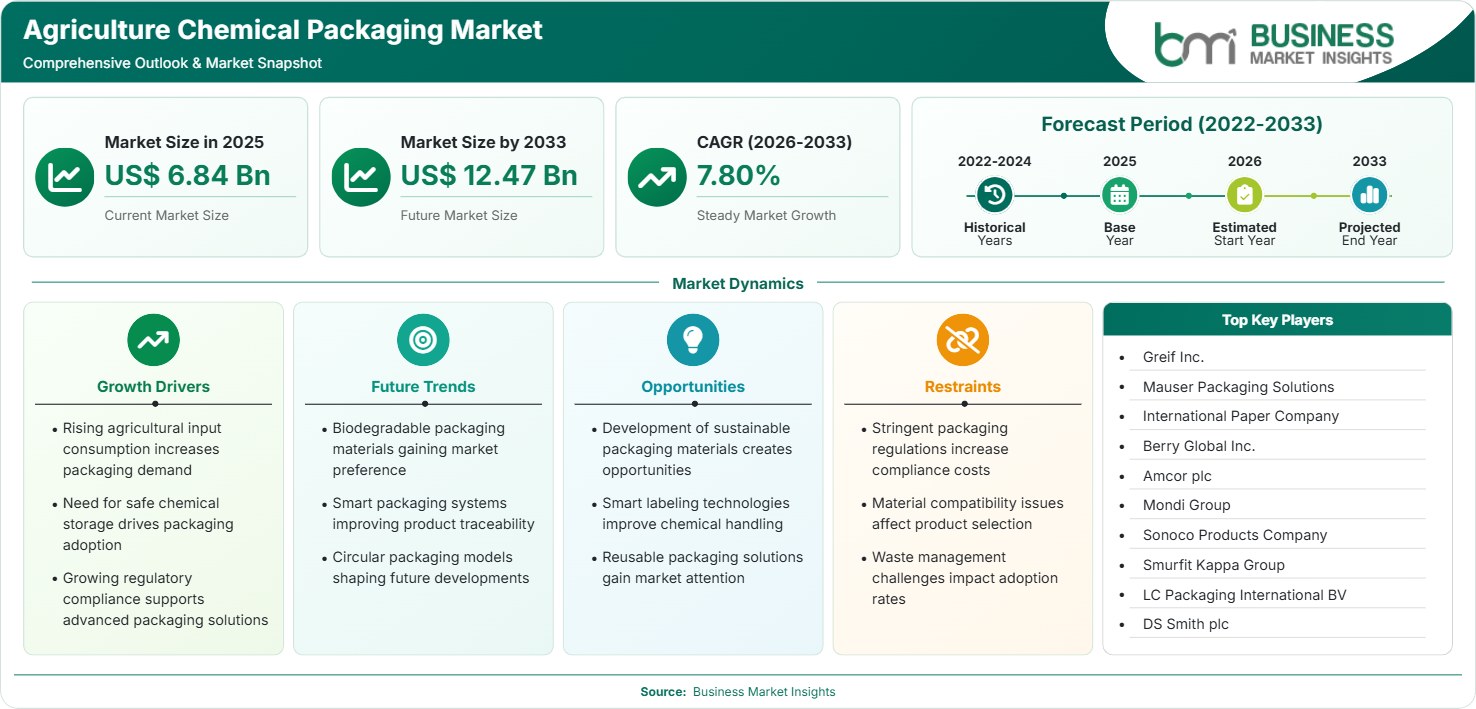
The Agriculture Chemical Packaging Market size was valued at US$ 6.84 billion in 2025 and is projected to reach US$ 12.47 billion by 2033, growing at a CAGR of 7.80% during 2026–2033, driven by rising agrochemical consumption, safer containment requirements, sustainable materials, smart labeling, and reusable packaging adoption.

Report Coverage
  • Material: Plastics, Metal, Paper & Paperboard, Glass, Others
  • Packaging Type: Bottles, Bags & Sacks, Pouches, IBCs, Drums & Jerry Cans
  • Chemical Type: Pesticides, Fertilizers, Plant Growth Regulators, Bio-stimulants
US$ 6.84 Bn Market size in 2025
US$ 12.47 Bn Market Size by 2033
7.80% CAGR, 2026 - 2033
2026-2033 Forecast Period

01 AI Overview

Agriculture Chemical Packaging Market Summary

  • North America Region: North America holds 30%–33% Agriculture Chemical Packaging Market share in 2025, with a 6.9%–7.4% CAGR during 2026–2033, supported by regulated chemical handling, crop protection demand, durable containers, recycling initiatives, and packaging modernization. The US market is projected to expand at a 7.0%–7.5% CAGR, supported by intensive crop protection use, compliance-focused packaging design, and demand for reliable chemical containment.
  • Fastest Growing Region: Asia Pacific holds 31%–34% market share in 2025 and is projected to expand at a CAGR of 8.2%–8.8% during 2026–2033. Expanding agricultural production, increasing agrochemical utilization, packaging localization, infrastructure development, and sustainability requirements create opportunities for flexible and rigid formats.
  • Leading Segment: Plastics account for 58%–62% market share in 2025 and are projected to grow at a CAGR of 7.7%–8.2% during 2026–2033. Lightweight construction, chemical resistance, scalable manufacturing, closure compatibility, and suitability for bottles, pouches, IBCs, drums, and jerry cans support adoption.
  • High Growth Segment: Bio-stimulant packaging represents a high-growth chemical category, with 8%–11% share in 2025 and a projected CAGR of 9.0%–9.6% during 2026–2033. Expanding biological input adoption, formulation sensitivity, smaller pack sizes, traceability, and premium positioning support packaging innovation.
  • Key Market Opportunity: Sustainable polymers, recyclable fiber formats, smart labels, reusable containers, and digitally enabled traceability can create differentiated value by reducing material intensity while improving handling, identification, logistics, and compliance throughout agrochemical distribution.
  • Major Market Players: Greif Inc., Mauser Packaging Solutions, International Paper Company, Berry Global Group, Inc., Amcor plc, Mondi plc, Sonoco Products Company, Smurfit Westrock plc, LC Packaging International B.V., and DS Smith plc.
02 Strategic Insights

Agriculture Chemical Packaging Market: Strategic Insights

Agriculture Chemical Packaging Market Strategic Framework
FREE PDF
Request your free sample
Request free sample
03 Stakeholder View

Key Takeaways

  • The value chain is evolving away from simple commodity container production towards engineering of packaging systems where the choices of materials, closures, chemical compatibility, labels, and logistics performance will all play together to create value for the customer.
  • Plastic packaging continues to have the broadest range of applications because one type of plastic can be used for bottles, pouches, drums, jerry cans, and IBC components while allowing flexibility in terms of wall thickness and barrier properties.
  • Sustainable packaging is evolving beyond material substitution to include lightweighting, increased use of recycled material, reusability, mono-material structures, fiber-based recycling, and packaging that maintains chemical protection.
  • Asia Pacific represents the best opportunity for investment due to the agricultural growth, local manufacturing, changes in distribution structure, and needs for improved agrochemical handling.
  • Packaging suppliers with capabilities across rigid plastics, flexible packaging, industrial containers, closures, and paper-based solutions can capture broader customer relationships while reducing dependence on one packaging format.
04 Geographic Outlook

Agriculture Chemical Packaging Market Regional Highlights

North America Agriculture Chemical Packaging Market

North America represents 30%–33% Agriculture Chemical Packaging Market share in 2025 and is projected to register a 6.9%–7.4% CAGR during 2026–2033. The regional structure favors high-performance rigid containers, closures, bulk packaging, and compliance-oriented labeling. Demand is supported by established agricultural supply chains and sophisticated chemical distribution. The United States remains the principal contributor, while Canada adds demand through commercial farming and crop protection activities. The Agriculture Chemical Packaging Market share is supported by durable packaging specifications, safety requirements, and established recycling infrastructure.

  • Containment properties dictate strong bottles, cans, drums, and IBCs able to sustain integrity in storage, transportation, and farm operations.
  • Packaging providers now differentiate themselves through weight savings, sealability, compatibility with labels, and material engineering beyond just bottle volume or production scale.
  • The need for recyclable and recycled content products is prompting changes to packaging design without sacrificing chemical resistance or product strength.
  • The major agricultural distributors prefer standardized packaging systems to streamline procurement, storage, transportation, filling, and inventory control of multiple formulations.

US Agriculture Chemical Packaging Market

The United States represents 84%–87% of North American Agriculture Chemical Packaging Market share and is projected to grow at a 7.0%–7.5% CAGR during 2026–2033. Demand is concentrated around crop protection chemicals, fertilizers, specialty agricultural inputs, and bulk handling requirements.

  • Crop protection products require dependable packaging that protects formulations from leakage, contamination, and degradation while supporting secure dispensing and transportation.
  • Large-scale agricultural operations encourage packaging standardization because consistent container dimensions can simplify storage, palletization, distribution, and handling across extensive supply networks.
  • Sustainable packaging initiatives are encouraging suppliers to reduce material consumption and incorporate recyclable structures without compromising chemical compatibility or container performance.
  • Digital labeling can improve product identification, authentication, handling instructions, and traceability across chemical distribution channels.

Europe Agriculture Chemical Packaging Market

Europe accounts for 25%–28% Agriculture Chemical Packaging Market share in 2025 and is expected to expand at a 6.8%–7.3% CAGR during 2026–2033. Germany, France, Italy, and Spain represent important agricultural packaging markets, while countries across Central and Eastern Europe offer additional expansion potential. The regional Agriculture Chemical Packaging Market growth profile is shaped by sustainability priorities, material efficiency, recycling requirements, and demand for packaging that combines chemical protection with lower environmental impact throughout the product lifecycle.

  • Germany and France remain important demand centers because diversified agricultural production requires packaging across pesticides, fertilizers, plant growth products, and biological inputs.
  • European packaging development increasingly emphasizes material reduction, recyclability, reusable structures, and designs capable of maintaining performance under demanding chemical conditions.
  • Flexible bags and pouches can gain application where reduced package weight and efficient transportation provide advantages over conventional rigid formats.
  • Smaller agricultural input containers require precise labeling, secure closures, and convenient handling to support safe application and minimize product waste.

Asia Pacific Agriculture Chemical Packaging Market

Asia Pacific holds 31%–34% Agriculture Chemical Packaging Market share in 2025 and is forecast to achieve an 8.2%–8.8% CAGR during 2026–2033, making it the fastest-growing regional market. China, India, Japan, South Korea, and Southeast Asian agricultural economies contribute to demand. Expanding agricultural input use, diverse farm structures, increasing chemical distribution, and packaging localization support growth. The region also provides opportunities for lightweight containers, flexible packaging, bulk systems, and cost-efficient production platforms.

  • China and India offer large application bases where agricultural inputs require packaging adapted to varied farm sizes, distribution routes, and storage conditions.
  • Southeast Asian markets support demand for moisture-resistant and durable packaging because agricultural chemicals frequently move through complex distribution networks and diverse climatic environments.
  • Local manufacturing investment can reduce transportation costs and improve responsiveness to regional packaging specifications, formulation changes, and customer requirements.
  • Biological inputs and bio-stimulants create opportunities for smaller, differentiated packaging formats that emphasize product identity, handling, and controlled use.

Rest of World Agriculture Chemical Packaging Market

Rest of World represents 7%–10% Agriculture Chemical Packaging Market share in 2025 and is projected to expand at a 7.1%–7.6% CAGR during 2026–2033. South and Central America benefit from large-scale agricultural production, while the Middle East and Africa provide opportunities linked to crop intensification, fertilizer use, irrigation development, and expanding input distribution. Packaging demand remains sensitive to logistics conditions, affordability, import structures, and the availability of reliable regional manufacturing capacity.

South and Central American markets favor durable containers and bulk packaging capable of supporting long agricultural supply chains and intensive crop protection applications. Middle Eastern and African markets increasingly require packaging that withstands heat, transportation stress, and variable storage infrastructure.

  • Crop protection packaging presents significant opportunities in Brazil and Argentina, as large-scale commercial agriculture demands reliable packaging in a variety of chemical groups.
  • Mexico and other Latin American countries have good opportunities for packaging expansion due to growing agricultural modernization and packaging requirements.
  • The Middle East market is interested in heat-resistant, durable, and long-storage packaging.
  • Africa offers good prospects for the future as commercial farming, fertilizer delivery, and crop protection become widespread in regional supply chains.
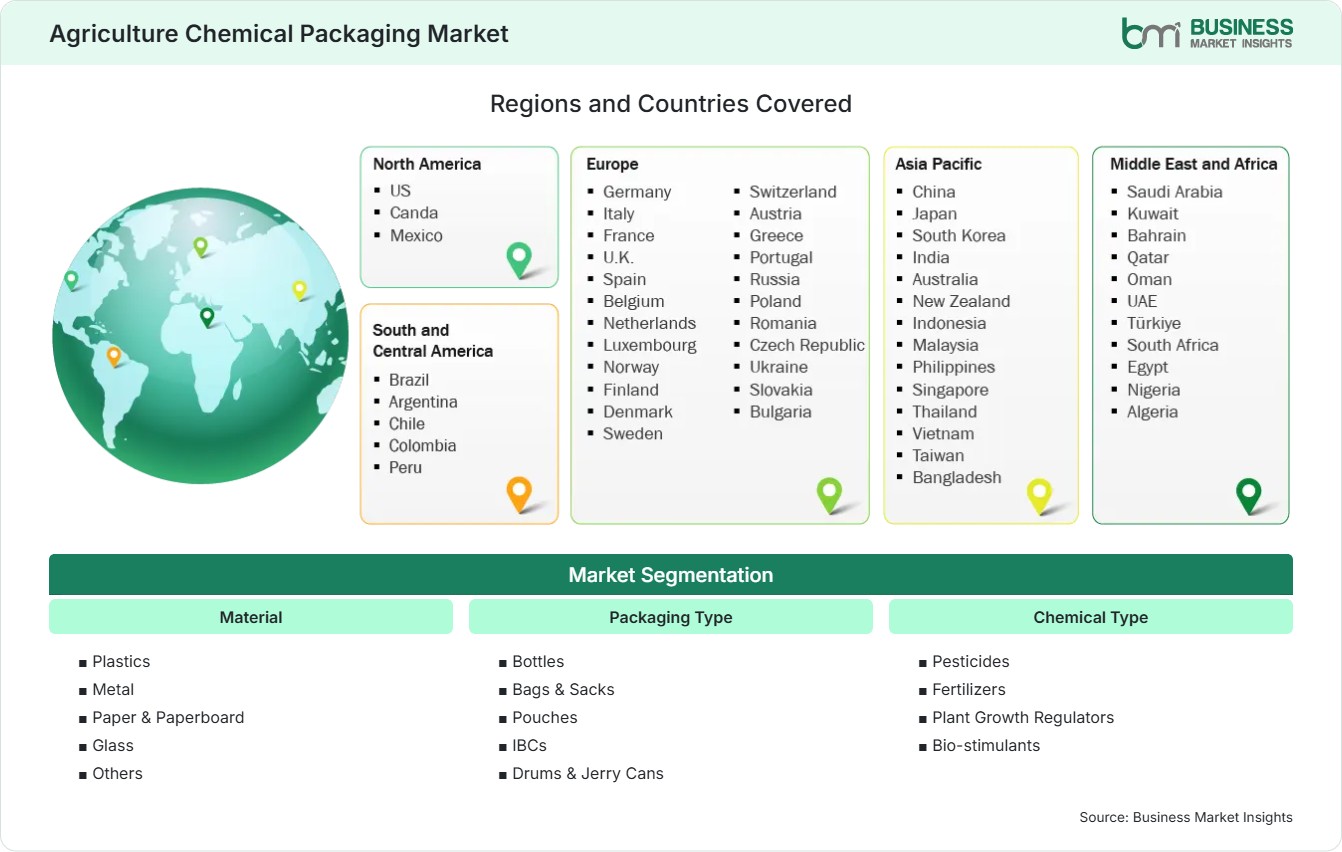
Global Market Geography
FREE PDF
Request your free sample
Request free sample
05 Segment Analysis

Agriculture Chemical Packaging Market Segmentation

Material

The material segment determines chemical compatibility, barrier performance, structural integrity, sustainability, and manufacturing economics. Plastics represent 58%–62% share in 2025 and are projected to expand at a 7.7%–8.2% CAGR during 2026–2034. The Agriculture Chemical Packaging Market scope increasingly includes lightweight, recyclable, and chemically resistant materials capable of supporting varied package formats and demanding distribution conditions.

  • Plastics: Plastics provide chemical resistance, lightweight construction, scalable molding, and broad format flexibility, supporting bottles, pouches, IBCs, drums, jerry cans, closures, and other agricultural chemical packaging applications.
  • Metal: Metal packaging supports formulations requiring strong structural protection, durable containment, and resistance to demanding handling conditions, particularly for selected chemicals and specialized agricultural inputs.
  • Paper & Paperboard: Paper and paperboard are gaining attention where dry agricultural chemicals can use fiber-based structures, enabling material reduction, printability, efficient secondary packaging, and sustainability-oriented positioning.
  • Glass: Glass serves specialized formulations requiring strong barrier properties and chemical stability, although its weight and breakage considerations restrict broader application across agricultural distribution networks.

Packaging Type

Packaging type influences handling, storage efficiency, filling requirements, transport economics, and application convenience. Bottles and rigid formats remain central to the segment, while flexible pouches and IBCs address specific volume and logistics needs. The segment accounted for 49%–53% share in 2025 and is projected to grow at a 7.5%–8.0% CAGR during 2026–2034, with packaging selection increasingly aligned to formulation characteristics and distribution scale.

  • Bottles: Bottles support liquid pesticides and specialty agricultural chemicals by combining convenient handling, controlled dispensing, labeling space, and compatibility with secure closure systems.
  • Bags & Sacks: Bags and sacks support fertilizers, powders, granules, and selected dry inputs where high capacity, stacking strength, moisture protection, and efficient transportation are essential.
  • Pouches: Pouches provide lightweight packaging for selected agricultural formulations, reducing material use and transportation burden while enabling convenient handling and differentiated product presentation.
  • Intermediate Bulk Containers (IBCs): IBCs serve bulk agricultural chemicals by improving filling efficiency, storage utilization, handling, and transportation for commercial users requiring larger formulation volumes.
  • Drums & Jerry Cans: Drums and jerry cans provide durable containment for liquid chemicals, combining impact resistance, secure closures, stackability, and suitability for demanding storage and transportation conditions.

Chemical Type

Chemical type directly determines packaging specifications because pesticides, fertilizers, plant growth regulators, and biological inputs differ in formulation, concentration, sensitivity, handling, and storage requirements. Pesticides remain the largest category, while bio-stimulants provide the strongest expansion potential. The segment represented 46%–50% share in 2025 and is projected to grow at a 7.9%–8.4% CAGR during 2026–2034, reinforcing product-specific packaging development.

  • Pesticides: Pesticides require secure, chemically compatible packaging that limits leakage and contamination while supporting accurate identification, safe handling, storage stability, and controlled dispensing.
  • Fertilizers: Fertilizers require packaging tailored to liquid, granular, and powdered formulations, with moisture protection, load-bearing strength, and transportation efficiency shaping format selection.
  • Plant Growth Regulators: Plant growth regulators favor precise packaging and clear labeling because formulations are often applied at controlled concentrations and require accurate product identification during agricultural use.
  • Bio-stimulants: Bio-stimulants create demand for packaging that protects formulation stability while supporting differentiated branding, smaller pack sizes, traceability, and controlled handling across emerging agricultural input categories.
06 Market Forces

Agriculture Chemical Packaging Market Dynamics

Key Market Drivers

Rising agricultural input consumption increases packaging demand

Agricultural productivity depends on reliable access to pesticides, fertilizers, plant growth regulators, and biological inputs, creating corresponding requirements for primary and bulk packaging. Rising input diversity increases the number of formulations that require distinct container specifications, closure systems, labeling configurations, and storage conditions. Agriculture Chemical Packaging Market growth therefore benefits from both higher agricultural chemical volumes and increasing packaging complexity.

Need for safe chemical storage drives packaging adoption

Agricultural chemicals are highly concentrated, reactive, moisture-sensitive, or hazardous during storage and transport. The packaging needs to prevent any leaks, maintain the formulation's integrity, be able to withstand the rigors of shipping, and offer effective closure sealing. Such demands increase the importance of technologically advanced packaging systems relative to simple commodity packaging. Rigid plastic packaging is especially important for chemical resistance, impact performance, stacking capability, and lightweight construction. Packaging in drums, jerry cans, bottles, or IBCs depends on the formulation volume and distribution needs.

Growing regulatory compliance supports advanced packaging solutions

Regulatory requirements influence container design, labeling, closures, material selection, transport preparation, and disposal considerations. Agriculture Chemical Packaging Market trends are consequently moving toward packaging systems that provide stronger traceability and more consistent compliance performance. Chemical producers increasingly require packaging suppliers to understand the relationship between formulation characteristics and container materials. Secure closures, tamper evidence, clear identification, and durable labels can support safer handling across the supply chain. Compliance requirements also encourage manufacturers to reduce ambiguity around product information and disposal instructions.

Key Market Opportunities

Development of sustainable packaging materials creates opportunities

Sustainable materials represent an attractive development path because agricultural chemical packaging must increasingly reconcile environmental objectives with demanding technical performance. Recycled polymers, lightweight structures, recyclable fiber formats, and material-efficient designs can reduce resource intensity without eliminating the protection required by chemical formulations. The Agriculture Chemical Packaging Market Forecasts support an opportunity environment for suppliers investing in circular material capabilities, compatibility testing, and scalable manufacturing.

Smart labeling technologies improve chemical handling

Intelligent labeling is a way to add an even greater layer of value to the agricultural chemical packaging through association of tangible objects with digital data about products. QR codes, serial numbers, recordkeeping through batches, and other digital ways of communication can contribute to better product authentication, guidance for its handling, inventory, and traceability. This is possible because each stakeholder, from the manufacturer through distributor to retailer and professional user of agricultural chemicals, can utilize such digital information associated with packaging in a different way.

Reusable packaging solutions gain market attention

Reusable packaging can help address specific bulk uses of agricultural chemicals, where the issues of reuse, transportation, cleaning, and repackaging can be integrated in a manner that works. The IBCs and heavy-duty containers represent the best foundation to this end due to their higher capacity enabling controlled movement of the chemicals between the manufacturer, distributor, and professional user. This will result in less frequent packaging replacement and increased efficiency of materials provided that reverse logistics become profitable for business. Manufacturers can develop service-based approaches that involve the supply, monitoring, maintenance, and collection of containers.

Market Restraints and Challenges

Stringent packaging regulations increase compliance costs

Factor: The packaging for agricultural chemicals needs to meet several requirements that have to do with containment, labelling, transportation, material properties, closures, and identification of the product. Impact: Compliance will result in higher costs incurred in relation to testing, certification, tooling, documentation, quality control, and design for the packaging producer as well as the chemical producer. Smaller companies will find it more difficult to bear these costs as regulation compliance may require specialized knowledge and validation of the formulation or packaging changes.

Material compatibility issues affect product selection

Factor: Chemical formulations in agriculture may react differently with plastic, metal, glass, paper materials, caps, liners, glues, and barriers. Impact: Material incompatibility may limit the choice of materials, require additional testing, and make direct substitution of traditional packaging with sustainable alternatives impossible. The material, which works well with one fertilizer or pesticide formulation, does not guarantee the same level of protection for another formulation. It is necessary for packaging suppliers to conduct testing and qualify the materials based on specific formulations.

07 Company Analysis

Competitive Landscape

The competitive environment combines industrial packaging specialists, rigid plastic manufacturers, paper-based packaging producers, flexible packaging companies, and diversified material suppliers. Agriculture Chemical Packaging Market analysis indicates that competitive differentiation depends on chemical compatibility, format breadth, production reliability, sustainability capabilities, customization, and customer support. The ten companies below represent the supplied competitive set, with their portfolios positioned across rigid containers, paper packaging, flexible formats, industrial packaging, and related solutions.

Company Name

Overview

Products and Services relevant to this market

Greif Inc.

Industrial packaging specialist serving demanding chemical and agricultural applications through rigid and bulk packaging capabilities.

Plastic bottles, drums, jerry cans, IBCs, closures, industrial containers, and packaging services for agricultural chemicals.

Mauser Packaging Solutions

Global industrial packaging provider focused on reusable and rigid containment systems for demanding chemical applications.

Drums, jerry cans, IBCs, plastic containers, reconditioning, reuse systems, and industrial packaging services.

International Paper Company

Fiber-based packaging producer with capabilities supporting agricultural and industrial supply chains requiring durable paper packaging.

Corrugated packaging, paper-based industrial packaging, containerboard, and fiber solutions relevant to agricultural distribution.

Berry Global Group, Inc.

Diversified packaging manufacturer with strong rigid plastic and flexible packaging capabilities across agricultural applications.

Canisters, jerry cans, bottles, bags, films, closures, containers, and crop protection packaging solutions.

Amcor plc

Global packaging company providing rigid and flexible structures designed for chemical containment, handling, and distribution.

HDPE containers, bottles, closures, flexible packaging, recyclable structures, and agricultural chemical packaging formats.

Mondi plc

Packaging and paper producer emphasizing engineered paper and flexible solutions with sustainability-oriented material development.

Paper bags, flexible packaging, industrial packaging, barrier solutions, and recyclable packaging structures.

Sonoco Products Company

Diversified packaging company supplying industrial paper, metal, rigid, and engineered packaging solutions across multiple sectors.

Industrial paper packaging, rigid packaging, metal containers, closures, and specialized packaging systems.

Smurfit Westrock plc

Packaging company combining paper-based packaging expertise with industrial solutions for chemical and agricultural supply chains.

Corrugated packaging, industrial paper solutions, heavy-duty boxes, chemical packaging, and protective packaging formats.

LC Packaging International B.V.

Packaging specialist providing industrial and agricultural solutions for safe containment, transport, and storage.

Bulk bags, woven packaging, industrial sacks, chemical packaging, flexible formats, and agricultural packaging solutions.

DS Smith plc

Fiber-based packaging specialist serving agricultural and industrial applications through recyclable paper packaging platforms.

Corrugated packaging, paper products, containerboard, agricultural packaging, and recyclable fiber-based solutions.

10 Trust & Transparency

Research Methodology

The market analysis combines proprietary research with secondary data from government agencies, company disclosures, regulatory filings, industry databases and expert interviews. Market estimates are validated through data triangulation, cross-market benchmarking and analyst review.

View Full Research Methodology

11 Questions Answered

Frequently Asked Questions

What does the Agriculture Chemical Packaging Market Report include?

The Market Report provides an integrated view of market size, segmentation, regional dynamics, competitive positioning, growth drivers, opportunities, restraints, packaging trends, and strategic considerations across materials, packaging types, and agricultural chemical categories.

How can sustainable packaging retain chemical protection?

Sustainability of package materials should have a combination of reduced material usage or being recyclable with good resistance to chemicals, structure, and barriers. Light weighting, proper container design, recyclable polymers, re-usable systems, and fiber constructions could achieve sustainability without sacrificing function.

What packaging characteristics matter most for pesticides?

Compatibility with chemicals, absence of leakage, closure, label integrity, impact resistance, stacking ability, and dispensing safety are crucial considerations. The package is supposed to be able to keep the formulation safe during transportation and handling.

Why are IBCs important for agricultural chemical distribution?

IBCs facilitate better movement of agricultural chemicals in large quantities while increasing the efficiency of handling, utilization of space and cost-effectiveness in transporting goods. They are most applicable to commercial users who distribute goods in bulk thereby reducing the number of times goods are handled.

How does packaging selection vary between liquid and dry agricultural chemicals?

Liquid formulations generally require chemically resistant bottles, jerry cans, drums, or IBCs with secure closures, while dry products can favor bags, sacks, or specialized paper structures. Selection depends on formulation behavior, moisture sensitivity, storage duration, transportation requirements, and dispensing method.

Access the Full Agriculture Chemical Packaging Market Report

Get segment-level forecasts, regional estimates, competitive benchmarking, company profiles and downloadable Excel datasets.

Access the full Agriculture Chemical Packaging Market Report
350 pages PDF & Excel | 2026-08-19