
Plasticizers Market Outlook: Size, Share, Trends, Growth Analysis, Competitive Landscape & Forecast, 2026–2033

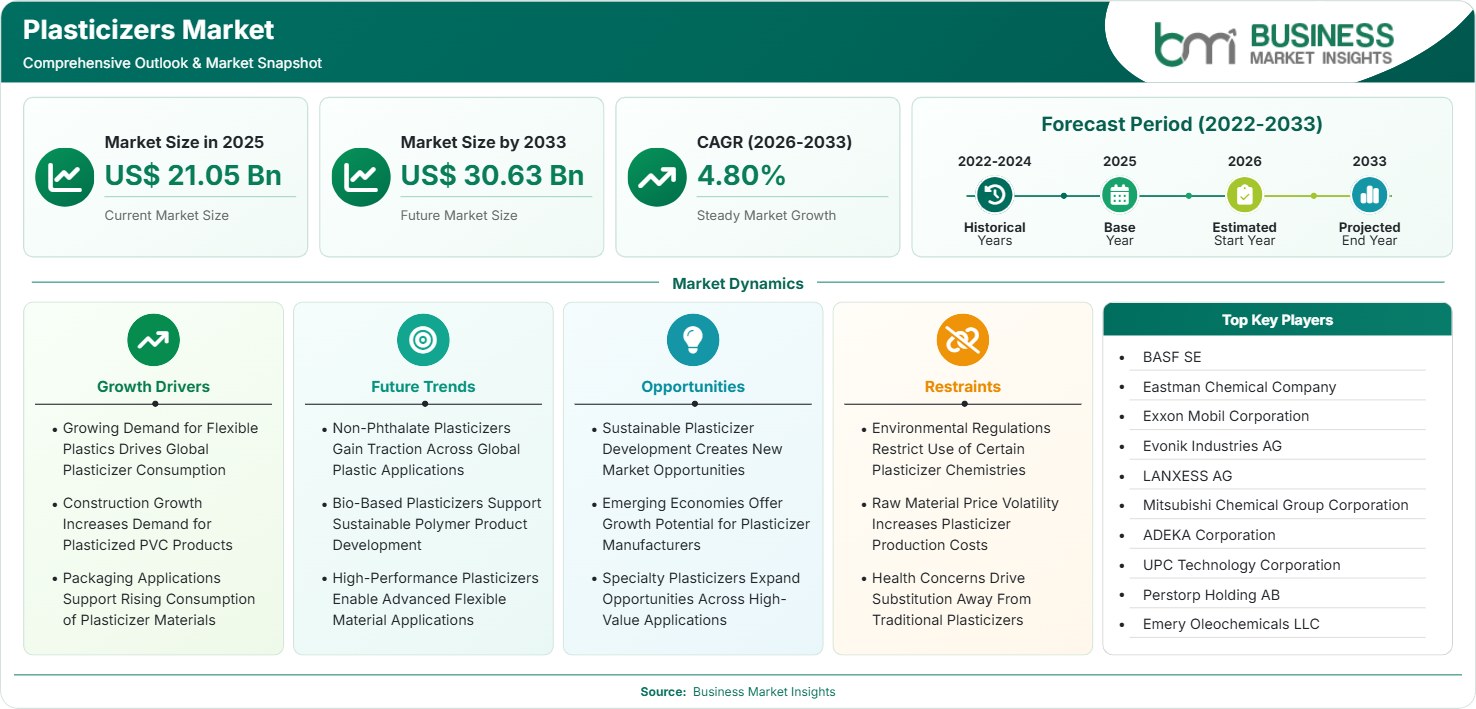
The Plasticizers Market size was valued at US$ 21.05 Billion in 2025 and is projected to reach US$ 30.63 Billion by 2033, growing at a CAGR of 4.80% during 2026–2033, driven by flexible plastics, construction, packaging, sustainable chemistries, and specialty applications.

Report Coverage
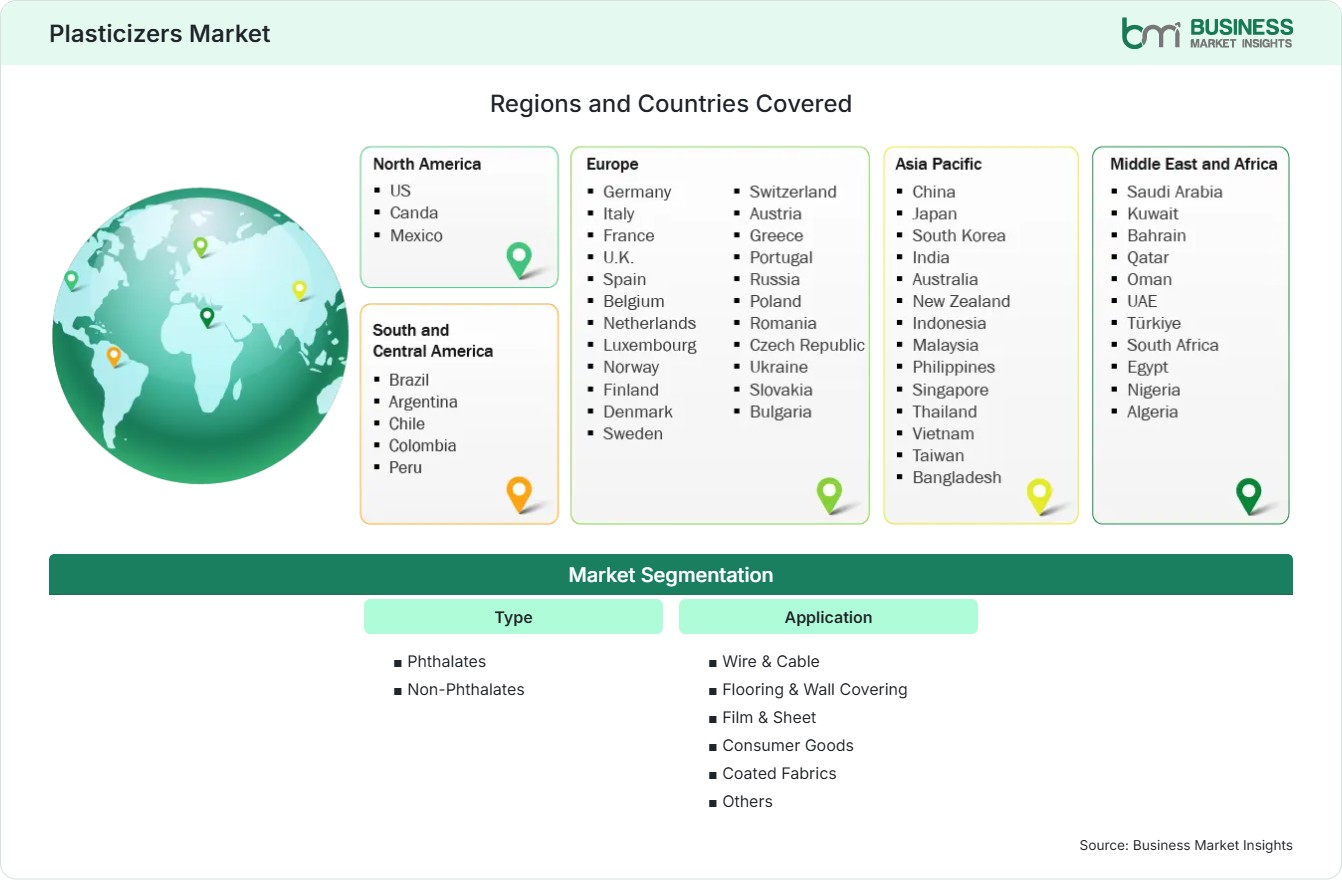
  • Type: Phthalates, Non-Phthalates
  • Application: Wire & Cable, Flooring & Wall Covering, Film & Sheet, Consumer Goods, Coated Fabrics, Others
US$ 21.05 Bn Market size in 2025
US$ 30.63 Bn Market Size by 2033
4.80% CAGR, 2026 - 2033
2026-2033 Forecast Period

AI Overview

Plasticizers Market Summary

  • North America Region: North America holds a share of 18%–22% in 2025, growing at a CAGR of 3%–5% during 2026–2033, supported by resilient construction activity, wire and cable demand, packaging applications, automotive production, and increasing substitution toward non-phthalate plasticizers. The US market remains regionally dominant, with a CAGR of 3%–5% during 2026–2033, supported by construction renovation, electrical infrastructure, flexible packaging, and rising demand for regulatory-compliant plasticizer formulations.
  • Fastest Growing Region: Asia Pacific holds a share of 52%–57% in 2025, expanding at a CAGR of 5%–7% through 2033, driven by construction, infrastructure investment, urbanization, flexible PVC manufacturing, packaging production, automotive applications, and expanding industrial output across China, India, and Southeast Asia.
  • Leading Segment: Phthalates hold a share of 55%–60% in 2025, growing at a CAGR of 3%–5% through 2033, supported by established PVC processing infrastructure, cost competitiveness, broad industrial applications, mature supply chains, and continued use in applications where regulatory requirements permit their adoption.
  • High Growth Segment: Wire & Cable represents a share of 20%–25% in 2025 and is projected to grow at a CAGR of 5%–7% through 2033, supported by electrification, grid modernization, renewable energy infrastructure, telecommunications expansion, and increasing demand for flexible and durable cable insulation.
  • Key Market Opportunity: Demand for bio-based, low-VOC, non-phthalate, and specialty plasticizers creates opportunities for producers to capture premium applications while meeting evolving regulatory requirements and sustainability objectives across construction, packaging, automotive, and electrical industries.
  • Major Market Players: BASF SE, Eastman Chemical Company, Exxon Mobil Corporation, Evonik Industries AG, LANXESS AG, Mitsubishi Chemical Group Corporation, ADEKA Corporation, UPC Technology Corporation, Perstorp Holding AB, Emery Oleochemicals LLC.
Strategic Insights

Plasticizers Market: Strategic Insights

Plasticizers Market Strategic Framework
FREE PDF
Request your free sample
Request free sample
Stakeholder View

Key Takeaways

  • The value chain remains closely linked to petrochemical feedstocks, alcohols, acids, and specialty chemical intermediates, making feedstock security and formulation expertise important competitive factors for manufacturers.
  • Non-phthalate formulations offer the strongest structural growth opportunity as manufacturers and end users respond to regulatory restrictions and customer requirements for safer material chemistries.
  • Wire and cable applications provide attractive growth potential because electrification, renewable power projects, grid modernization, and telecommunications infrastructure require increasing volumes of flexible insulation materials.
  • Asia Pacific provides the strongest investment case due to its large PVC processing base, construction activity, manufacturing expansion, and growing electrical infrastructure requirements.
  • Chemical manufacturers are increasingly investing in sustainable formulations, specialty plasticizers, and portfolio diversification to reduce exposure to regulatory changes affecting traditional chemistries.
  • Product differentiation is shifting toward migration resistance, low emissions, bio-based content, thermal stability, and compatibility with demanding polymer applications rather than price alone.
Geographic Outlook

Plasticizers Market Regional Highlights

North America Plasticizers Market

North America accounted for a Plasticizers Market share of 18%–22% in 2025 and is projected to grow at a CAGR of 3%–5% through 2033. The US represents the leading regional market, supported by construction renovation, electrical infrastructure, packaging, automotive production, and industrial manufacturing. Demand is increasingly influenced by regulatory scrutiny of specific chemistries and customer preference for non-phthalate alternatives.

  • Construction renovation and infrastructure spending support demand for flexible PVC used in flooring, wall coverings, roofing materials, and related construction products.
  • Electrical grid upgrades and renewable energy installations are increasing requirements for flexible cables and wires, supporting demand for plasticized PVC insulation materials.
  • Regulatory scrutiny is encouraging manufacturers to expand non-phthalate portfolios and develop formulations that meet evolving requirements without compromising processing performance.
  • Packaging and consumer goods applications continue to support demand, although material substitution and sustainability initiatives are influencing long-term formulation decisions.

US Plasticizers Market

The US represented 78%–82% of North America's Market share in 2025 and US plasticizers market forecast to grow at a CAGR of 3%–5% through 2033. Construction, infrastructure modernization, electrical equipment, packaging, and consumer applications remain important demand centers. The market is increasingly influenced by regulatory considerations and customer preferences for alternative chemistries.

  • Infrastructure modernization supports wire and cable demand, particularly across power transmission, renewable energy, telecommunications, and commercial construction projects.
  • The US market is experiencing greater interest in non-phthalate formulations as manufacturers seek alternatives suitable for regulated applications and sustainability-focused product portfolios.
  • Construction and renovation activity continues to support plasticized PVC consumption across flooring, wall coverings, roofing, and related flexible building materials.

Europe Plasticizers Market

Europe held a Plasticizers Market share of 10%–14% in 2025 and is projected to grow at a CAGR of 2%–4% through 2033. Germany, Italy, and France are leading regional markets supported by construction, automotive, industrial manufacturing, and electrical applications. Germany is projected to grow at a CAGR of 2%–4%, while Italy is expected to expand at 3%–5%. Regulatory requirements and sustainability objectives are accelerating the transition toward non-phthalate, bio-based, and specialty plasticizers.

  • Germany remains a leading market because of its large industrial base, automotive production, electrical manufacturing, and demand for specialized polymer formulations.
  • Italy benefits from construction, flooring, consumer goods, and flexible PVC applications, creating opportunities for specialty and non-phthalate plasticizer suppliers.
  • France offers opportunities across construction, packaging, electrical infrastructure, and industrial applications as manufacturers increasingly evaluate sustainable material alternatives.
  • European regulatory requirements are encouraging chemical companies to invest in safer formulations and expand portfolios with lower-emission and alternative chemistries.

Asia Pacific Plasticizers Market

Asia Pacific accounted for a Plasticizers Market share of 52%–57% in 2025 and is projected to grow at a CAGR of 5%–7% through 2033. China, India, Japan, and South Korea represent major regional markets supported by construction, manufacturing, packaging, automotive, and electrical industries. China remains the leading market, while India is projected to grow at a CAGR of 6%–8%. Expanding infrastructure, urbanization, and industrial production are supporting consumption of plasticized PVC across diverse applications.

  • China remains the dominant regional market due to its extensive PVC processing capacity, construction activity, packaging production, and electrical manufacturing ecosystem.
  • India offers strong growth potential as infrastructure development, urbanization, housing construction, and electrical network expansion increase demand for flexible PVC products.
  • Southeast Asian economies are attracting manufacturing investment, creating additional demand for plasticizers used in construction materials, cables, consumer products, and packaging.
  • Automotive manufacturing across the region supports demand for plasticized materials used in interiors, wiring systems, seals, and flexible components.
  • Regional producers are increasing attention toward non-phthalate and specialty formulations as multinational customers introduce stricter material requirements across Asian supply chains.

Rest of World Plasticizers Market

South and Central America represented a Plasticizers Market share of 6%–9% in 2025 and are projected to grow at a CAGR of 3%–5%. Brazil and Mexico are leading markets, supported by construction, packaging, automotive manufacturing, and electrical applications. Mexico benefits from industrial integration with North American supply chains, while Brazil provides opportunities through its large domestic manufacturing base. The Middle East and Africa accounted for a 4%–6% share in 2025 and are projected to grow at a CAGR of 4%–6%. Saudi Arabia, the UAE, and South Africa represent key markets.

  • Mexico benefits from automotive and industrial manufacturing expansion, supporting demand for flexible materials used in wiring, components, construction, and consumer products.
  • Brazil's construction and packaging industries provide a broad application base for plasticizer consumption, while local economic conditions influence demand and investment decisions.
  • Saudi Arabia's infrastructure development and industrial diversification programs are creating opportunities for plasticized PVC across construction and electrical applications.
  • The UAE offers demand opportunities through construction, infrastructure, packaging, and industrial projects requiring flexible polymer materials.
  • South Africa remains an important regional market because of its construction, electrical, manufacturing, and consumer goods applications, although economic conditions influence growth.
Global Market Geography
FREE PDF
Request your free sample
Request free sample
Segment Analysis

Plasticizers Market Segmentation

Type

Phthalates represented a 55%–60% share in 2025 and are projected to grow at a CAGR of 3%–5% through 2033. Established production infrastructure, cost advantages, broad PVC compatibility, and mature applications sustain demand, while regulatory requirements accelerate development of alternatives.

  • Phthalates: Phthalates remain widely used because of cost efficiency, established processing performance, and broad compatibility with flexible PVC across construction, consumer goods, cables, and industrial applications.
  • Non-Phthalates: Non-phthalate formulations are gaining adoption as manufacturers respond to regulatory scrutiny, customer sustainability requirements, and demand for alternatives offering comparable flexibility, durability, and processing performance.

Application

Wire & Cable represented a 20%–25% share in 2025 and is projected to grow at a CAGR of 5%–7% through 2033. Electrification, renewable energy, telecommunications, grid modernization, and infrastructure development are strengthening demand for flexible insulation materials.

  • Wire & Cable: Electrification, renewable energy projects, grid modernization, and telecommunications expansion increase demand for flexible PVC insulation requiring durability, flexibility, and electrical performance.
  • Flooring & Wall Covering: Construction and renovation activity supports plasticizer demand in flexible flooring and wall coverings requiring dimensional stability, flexibility, durability, and aesthetic versatility.
  • Film & Sheet: Plasticized films and sheets serve packaging, agriculture, industrial, and consumer applications, with demand influenced by flexibility, processing efficiency, barrier requirements, and material sustainability.
  • Consumer Goods: Flexible plastics support footwear, toys, household products, and other consumer applications, while manufacturers increasingly evaluate low-migration and alternative plasticizer formulations.
  • Coated Fabrics: Coated fabrics use plasticizers to improve flexibility and durability in upholstery, automotive interiors, protective materials, and industrial products requiring resilient polymer coatings.
  • Others: Specialized applications across automotive, medical, industrial, and specialty products create demand for formulations offering tailored flexibility, durability, migration resistance, and regulatory compliance.
Market Forces

Plasticizers Market Dynamics

Key Market Drivers

Growing Demand for Flexible Plastics Drives Global Plasticizer Consumption

The growing demand for flexible plastics will drive the use of plasticizers in various end-user industries like construction, electrical, automotive, consumer goods, and industry segments. Plasticizers enhance the flexibility, processability, and longevity of polymers, thus becoming important in items which need to bend, be resistant to impact, and have a long-life span. The usage of flexible PVC will remain a key application base especially in the production of wires and cables, flooring, wall coverings, and coated fabrics. The demand for flexible polymers in developing nations due to urbanization and infrastructural growth. This Plasticizers Market trend is also supported by increasing use of flexible materials in specialized applications requiring customized performance.

Construction Growth Increases Demand for Plasticized PVC Products

Construction activity is a major demand driver because plasticized PVC is widely used in flooring, wall coverings, roofing membranes, cables, and other building products. Urbanization, infrastructure development, commercial construction, and renovation projects create recurring requirements for flexible polymer materials. Developing economies are particularly important because expanding housing and infrastructure programs increase demand for electrical cables and construction materials. Mature markets also generate demand through building renovation, energy efficiency upgrades, and infrastructure replacement. Plasticizers that provide durability, flexibility, and long service life remain important in these applications.

Packaging Applications Support Rising Consumption of Plasticizer Materials

Package applications influence the need for plasticizers via flexible films, sheet, coatings, and polymers with unique characteristics of flexibility and processability. The rising use of packaged foods, consumer goods, healthcare goods, and industrial goods is fueling the demand for flexible packaging materials, especially in developing countries. Manufacturers are trying to balance performance needs with issues of migration, recycling, and regulation. This trend is helping develop formulations that are specifically targeted for packaging applications and customer needs. Opportunities lie ahead for plasticizer makers who offer materials that deliver flexibility along with low emissions.

Key Market Opportunities

Sustainable Plasticizer Development Creates New Market Opportunities

Sustainability is creating opportunities for manufacturers developing bio-based, renewable-feedstock, low-VOC, and non-phthalate plasticizers. Customers across construction, consumer goods, automotive, and packaging are increasingly evaluating material portfolios based on environmental performance alongside cost and technical specifications. Producers can differentiate by developing products that reduce dependence on conventional petrochemical inputs while maintaining flexibility, durability, migration resistance, and processing efficiency. Bio-based formulations may also provide opportunities in premium applications where customers are willing to pay for improved environmental profiles. Regulatory changes are reinforcing this shift by encouraging manufacturers to reconsider restricted chemistries.

Emerging Economies Offer Growth Potential for Plasticizer Manufacturers

Emerging economies provide attractive opportunities because urbanization, infrastructure development, industrialization, and rising consumer spending are increasing demand for flexible polymer products. India, Southeast Asia, Latin America, and parts of the Middle East are expanding construction, electrical networks, manufacturing, and packaging capacity. These trends support demand for plasticized PVC and specialty polymer materials across multiple applications. Local production expansion can also reduce supply chain costs and improve access to regional customers. Companies that provide differentiated products alongside competitive conventional formulations can address diverse customer requirements while benefiting from long-term industrial and infrastructure development across emerging markets.

Specialty Plasticizers Expand Opportunities Across High-Value Applications

Specialty plasticizers are creating opportunities in applications where standard products cannot meet demanding performance requirements. Automotive interiors, medical materials, aerospace components, electrical systems, high-performance cables, and industrial products may require improved thermal stability, low migration, durability, flame resistance, or specialized compatibility. These requirements allow producers to compete through technical differentiation rather than commodity pricing. Specialty formulations can also support regulatory compliance in applications where conventional chemistries face restrictions. Manufacturers with strong application development capabilities can collaborate with customers to optimize formulations for specific polymer systems and processing conditions.

Market Restraints and Challenges

Environmental Regulations Restrict Use of Certain Plasticizer Chemistries

Factor: Increasing regulatory scrutiny of specific plasticizer chemistries is restricting their use in selected consumer, medical, food-contact, and other sensitive applications, requiring manufacturers to demonstrate compliance with evolving safety requirements. Impact: Regulatory restrictions can increase reformulation costs and accelerate substitution away from established products, creating additional R&D, testing, certification, and supply chain requirements for producers and downstream manufacturers. Companies must continuously monitor regional regulatory developments because requirements can differ across countries and application categories.

Raw Material Price Volatility Increases Plasticizer Production Costs

Factor: Plasticizer production depends on petrochemical-derived feedstocks and chemical intermediates whose prices can fluctuate because of crude oil movements, energy costs, supply disruptions, geopolitical conditions, and changes in global chemical capacity. Impact: Raw material volatility can compress producer margins and increase pricing uncertainty, particularly when manufacturers cannot immediately pass higher input costs to customers. Cost fluctuations can also affect purchasing decisions among downstream PVC processors and create pressure for inventory optimization.

Company Analysis

Competitive Landscape

Plasticizers Market Analysis indicates that the market faces competition due to the presence of diversified chemical companies, specialty chemical companies, and regional players. The dynamics of competition involve production capacity, raw material availability, product range, regulatory expertise, sustainability expertise, and technical assistance. Major companies are focusing on offering a wide range of non-phthalate and specialty plasticizers along with the existing product range.

Company Name

Overview

Products and Services relevant to this market

BASF SE

Global chemical manufacturer with a broad portfolio spanning performance chemicals, materials, intermediates, and specialty formulations.

Plasticizers, specialty chemical formulations, sustainable chemistry solutions, polymer additives, and application-specific materials.

Eastman Chemical Company

Specialty materials company with strong capabilities in plasticizers and differentiated products serving multiple demanding end markets.

Non-phthalate plasticizers, specialty plasticizers, polymer additives, and solutions for construction, automotive, and consumer applications.

Exxon Mobil Corporation

Major energy and chemical company with integrated feedstock and chemical production capabilities supporting global polymer markets.

Plasticizers, chemical intermediates, specialty chemical products, and feedstock solutions for polymer processing applications.

Evonik Industries AG

Specialty chemicals producer developing high-performance materials and chemical solutions for industrial and consumer applications.

Specialty plasticizers, additives, performance chemicals, and formulation solutions for demanding polymer applications.

LANXESS AG

Specialty chemicals company serving construction, automotive, electrical, and industrial markets with performance-focused chemical products.

Plasticizers, specialty chemicals, additives, and materials designed for flexible polymers and industrial applications.

Mitsubishi Chemical Group Corporation

Diversified chemical company offering advanced materials and chemical solutions across global industrial value chains.

Plasticizers, specialty chemicals, polymer materials, additives, and sustainable material solutions for diverse applications.

ADEKA Corporation

Japanese chemical manufacturer supplying additives and performance materials for polymers, plastics, and industrial applications.

Plasticizers, polymer additives, stabilizers, specialty materials, and performance-enhancing chemical solutions.

UPC Technology Corporation

Chemical producer with capabilities across plasticizers and related products serving PVC and flexible polymer markets.

Phthalate and non-phthalate plasticizers, specialty plasticizers, and chemical products for PVC processing applications.

Perstorp Holding AB

Specialty chemicals company focused on sustainable and performance-driven solutions for industrial and polymer applications.

Plasticizers, specialty chemical intermediates, sustainable chemical solutions, and performance materials for polymer applications.

Emery Oleochemicals LLC

Producer specializing in oleochemical-based products and renewable solutions for industrial and polymer applications.

Bio-based plasticizers, oleochemical solutions, specialty additives, and sustainable materials for polymer and PVC applications.

Trust & Transparency

Research Methodology

The market analysis combines proprietary research with secondary data from government agencies, company disclosures, regulatory filings, industry databases and expert interviews. Market estimates are validated through data triangulation, cross-market benchmarking and analyst review.

View Full Research Methodology

Questions Answered

Frequently Asked Questions

What is the biggest challenge for plasticizer producers?

Raw material price volatility can increase production costs and create margin pressure, particularly when higher input costs cannot be passed to customers.

What is driving specialty plasticizer demand?

Demand for low migration, thermal stability, durability, and regulatory compliance is increasing specialty plasticizer adoption in high-value applications.

Which region dominates plasticizer consumption?

Asia Pacific leads consumption due to its large PVC processing base, construction activity, manufacturing capacity, and expanding infrastructure investment.

Why are non-phthalate plasticizers gaining demand plasticizers market report?

Regulatory scrutiny and customer sustainability requirements are encouraging manufacturers to adopt alternatives with improved compliance and environmental profiles.

What are the main applications of plasticizers?

Wire and cable, flooring and wall coverings, films and sheets, consumer goods, and coated fabrics are major applications.

Access the Full Plasticizers Market Report

Get segment-level forecasts, regional estimates, competitive benchmarking, company profiles and downloadable Excel datasets.

Access the full Plasticizers Market Report
350 pages PDF & Excel | 2026-08-31