
Seeds Market Outlook: Size, Share, Trends, Growth Analysis, Competitive Landscape & Forecast, 2026–2033

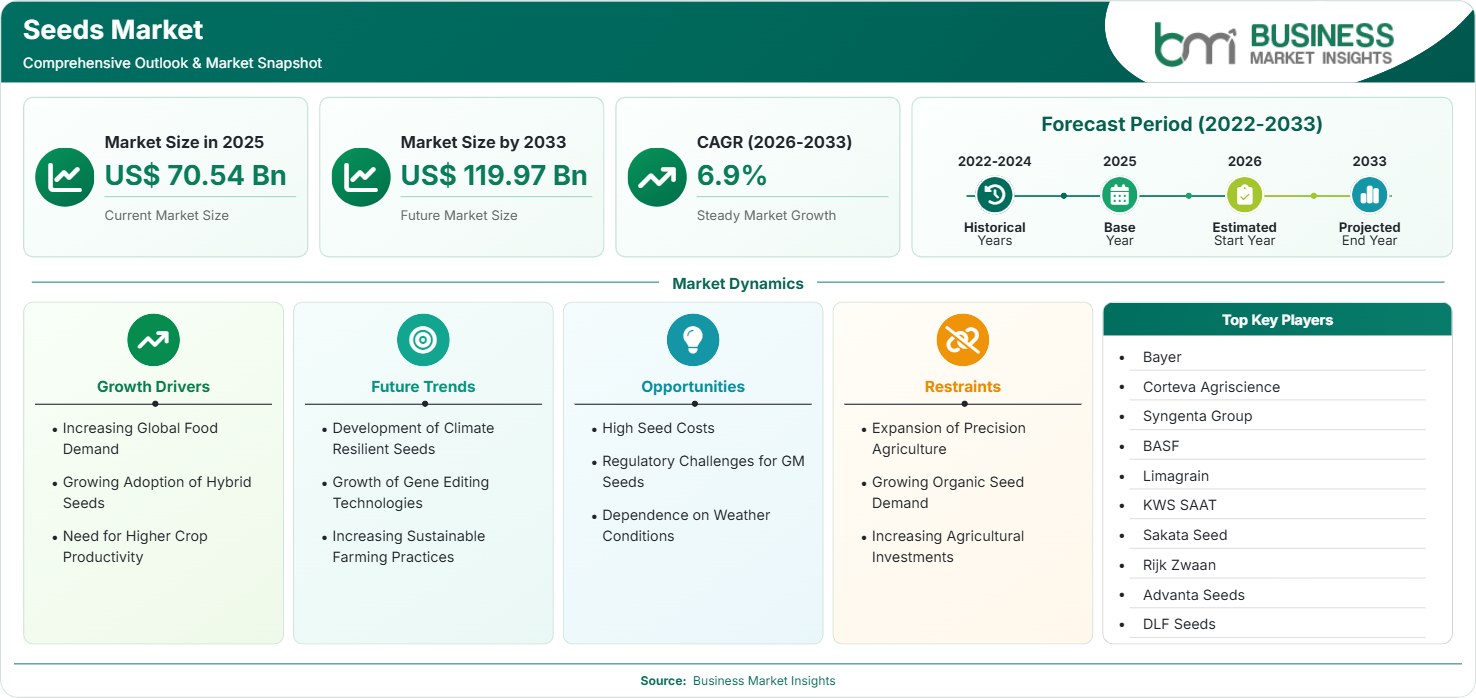
The Seeds Market size was valued at US$ 70.54 billion in 2025 and is projected to reach US$ 119.97 billion by 2033, growing at a CAGR of 6.9% during 2026–2033. Rising global food consumption, rapid adoption of hybrid and high-yielding seed varieties, increasing investments in agricultural biotechnology, and expanding precision farming practices continue to strengthen demand for advanced seed technologies across commercial agriculture.

Report Coverage
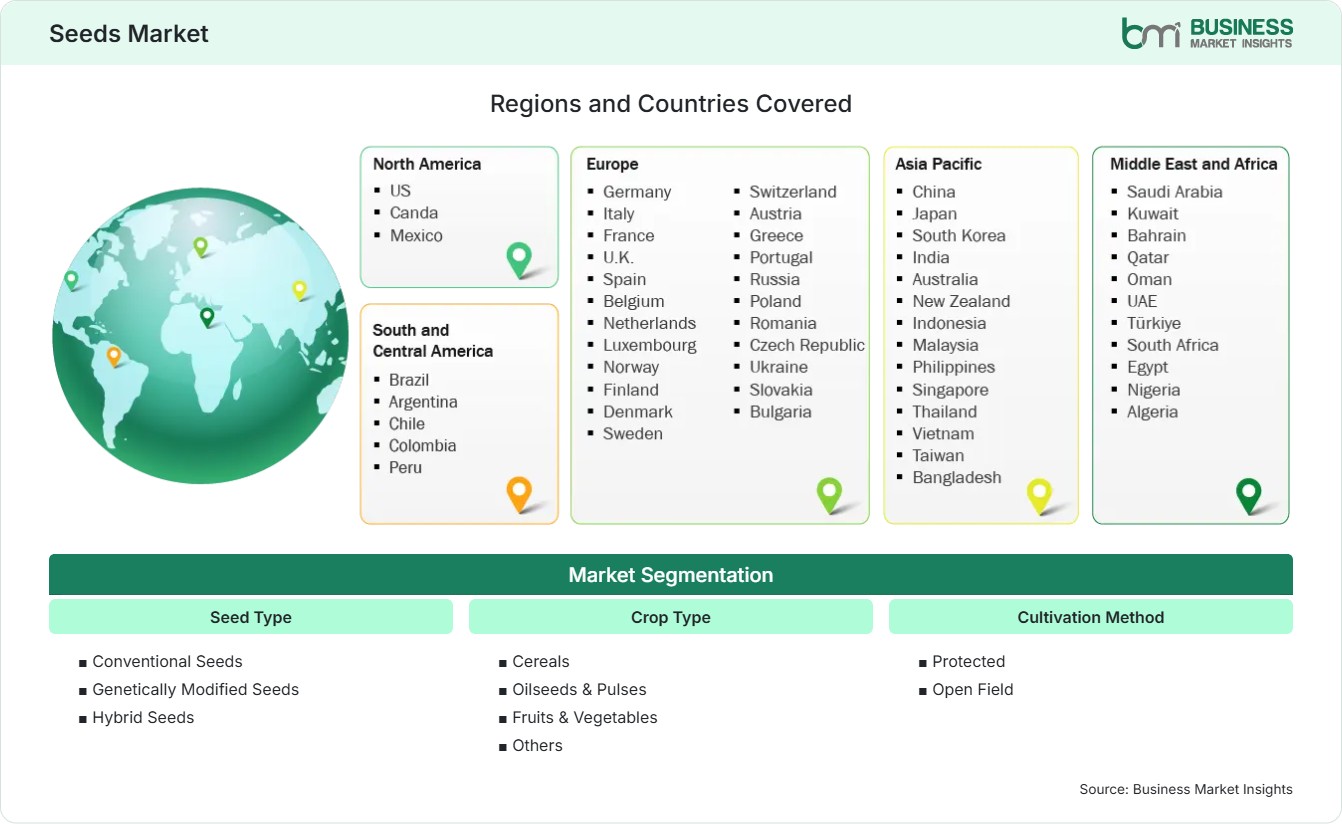
  • Seed Type: Conventional Seeds, Genetically Modified Seeds, Hybrid Seeds
  • Crop Type: Cereals, Oilseeds & Pulses, Fruits & Vegetables, Others
  • Cultivation Method: Protected, Open Field
US$ 70.54 Bn Market size in 2025
US$ 119.97 Bn Market Size by 2033
6.9% CAGR, 2026 - 2033
2026-2033 Forecast Period

AI Overview

Seeds Market Summary

  • North America Region: North America holds 34%–36% share in 2025 and is projected to grow at a CAGR of 5.8%–6.4% during 2026–2033, supported by widespread adoption of hybrid and genetically modified crops, advanced mechanized farming, and strong agricultural biotechnology investments. The U.S. seeds market benefits from large-scale commercial farming and continuous seed innovation, expanding at a 6.1% CAGR through 2033.
  • Fastest Growing Region: Asia Pacific accounts for 27%–29% share in 2025 and is anticipated to register a 7.8%–8.5% CAGR during 2026–2033, driven by increasing food demand, government-supported seed replacement programs, expanding hybrid crop cultivation, and improving agricultural productivity.
  • Leading Segment: Hybrid Seeds represent 44%–46% share in 2025 and are forecast to grow at a 7.4%–8.0% CAGR during 2026–2033, supported by superior yield performance, disease resistance, climate adaptability, and rising farmer preference for commercial cultivation.
  • High Growth Segment: Fruits & Vegetables account for 29%–31% share in 2025 and are expected to expand at a 7.8%–8.4% CAGR during 2026–2033, driven by increasing consumption of fresh produce, protected cultivation, and demand for premium-quality horticultural crops.
  • Key Market Opportunity: Expanding adoption of climate-resilient seed varieties and digital agronomy platforms enables producers to improve productivity, strengthen food security, and address evolving environmental challenges across both developed and emerging agricultural markets.
  • Major Market Players: Bayer AG, Corteva Agriscience Inc., Syngenta Group, BASF SE, Groupe Limagrain, KWS SAAT SE & Co. KGaA, Sakata Seed Corporation, Rijk Zwaan Zaadteelt en Zaadhandel B.V., Advanta Seeds, and DLF Seeds A/S.
Strategic Insights

Seeds Market: Strategic Insights

Seeds Market Strategic Framework
FREE PDF
Request your free sample
Request free sample
Stakeholder View

Key Takeaways

  • The seed sector is continually evolving towards integration of value chains involving breeding, biotechnology, digital agronomy, and crop advisory services, thus allowing for the provision of complete productivity solutions rather than just seeds alone.
  • The uptake of hybrid seed is the most commercially viable path because farmers look for stable yields, adaptation to climatic changes, and improved pest and disease tolerance.
  • New technologies such as gene editing, molecular breeding, artificial intelligence-based phenotyping, and genomics contribute to the quick development of varieties as well as shorter breeding cycles.
  • The region of Asia Pacific holds more promise from an investment perspective owing to growing agricultural output, favorable government policies, rising adoption rates of certified seeds, and private companies' involvement in seed research.
  • Strategic partnerships, licensing deals, and acquisitions are being used to develop proprietary germplasm libraries, as well as to gain market access to different regions.
  • Sustainability trends related to drought tolerance, efficient use of nutrients, and regenerative farming encourage continual investment in new generation seed technology.
Geographic Outlook

Seeds Market Regional Highlights

North America Seeds Market

North America accounted for 34%–36% of the Seeds Market share in 2025 and is projected to expand at a 5.8%–6.4% CAGR through 2033. Strong adoption of biotechnology, advanced farm mechanization, and extensive use of certified hybrid seeds continue to support regional leadership. Commercial farming operations increasingly invest in improved seed genetics to maximize productivity, optimize resource utilization, and strengthen resilience against changing climatic conditions.

  • The US and Canada have been making investments in developing cutting-edge breeding technologies that will facilitate the early commercialization of high-yield crops with high resistance against diseases.
  • Innovations in the breeding of corn, soybeans, and canola will help increase productivity and make the crops resistant to drought, pests, and changing environments through precision agriculture.
  • Biotech firms have extensive collaboration with research firms to develop traits, build germplasms, and enhance seed performance in different climate conditions.
  • Increasing demand for sustainable agricultural production drives the use of seed treatments, biological products, and climate-resilient seeds.

US Seeds Market

The United States represented 29%–31% of global revenue in 2025 and is expected to grow at a 6.1% CAGR during 2026–2033. Large commercial farms, strong biotechnology research capabilities, and widespread adoption of genetically improved crop varieties continue supporting productivity improvements. Investments in precision agriculture and digital farm management further strengthen demand for premium-quality certified seeds.

  • Corn and soybean remain the dominant commercial crops in the seeds market, encouraging continuous investments in hybrid breeding, biotechnology innovation, and advanced seed treatment technologies for higher productivity.
  • Precision agriculture technologies enable farmers to optimize planting density, nutrient management, and seed selection using real-time field data and predictive analytics.
  • Public-private research partnerships continue supporting next-generation breeding programs focused on climate resilience, improved disease resistance, and enhanced resource-use efficiency.
  • Rising export demand for agricultural commodities encourages growers to adopt premium seed varieties capable of delivering consistent quality and competitive yields.

Europe Seeds Market

Europe held 23%–25% revenue share in 2025 and is anticipated to grow at a 5.9%–6.5% CAGR through 2033. Strong regulatory oversight, advanced breeding programs, and increasing focus on sustainable agriculture continue shaping regional seed development. France remains the leading regional seeds market, while Spain is projected to register the fastest growth at a 7.2% CAGR through the forecast period.

  • Investments in conventional breeding, molecular genetics, and climate-resilient crop varieties support sustainable agricultural production across diverse climatic regions.
  • Seed companies increasingly develop varieties requiring lower fertilizer and water inputs to align with environmental sustainability objectives and evolving agricultural regulations.
  • Demand for premium vegetable and horticultural seeds continues expanding alongside protected cultivation and high-value crop production across Southern Europe.
  • Collaborative research initiatives between universities, breeders, and agricultural organizations accelerate innovation in disease-resistant and stress-tolerant crop varieties.

Asia Pacific Seeds Market

Asia Pacific accounted for 27%–29% of global revenue in 2025 and is projected to register the fastest Seeds Market growth at 7.8%–8.5% CAGR through 2033. Expanding food requirements, rising farm mechanization, and increasing adoption of certified hybrid seeds continue supporting market expansion. China remains the largest regional market, while India is forecast to record the highest growth with an estimated 8.8% CAGR through 2033.

  • Government-supported seed replacement programs are improving adoption of certified seeds among small and medium-scale farmers across major agricultural economies.
  • Increasing cultivation of rice, maize, vegetables, and oilseed crops creates sustained demand for improved hybrid and disease-resistant seed varieties.
  • Private seed companies continue expanding localized breeding centers to develop crop varieties adapted to diverse agro-climatic conditions throughout the region.
  • Rising investments in irrigation, mechanization, and digital agriculture strengthen productivity while encouraging greater adoption of premium-quality commercial seeds.

Rest of World Seeds Market

The Rest of World region, comprising South & Central America and the Middle East & Africa, accounted for 14%–16% of global revenue in 2025 and is expected to expand at a 6.8%–7.4% CAGR through 2033. Brazil leads agricultural production across Latin America, while Saudi Arabia is projected to achieve the fastest regional growth with a 7.6% CAGR owing to increasing investments in protected cultivation and food security initiatives.

Across the Middle East and Africa, governments continue investing in climate-smart agriculture, irrigation infrastructure, and certified seed distribution programs to improve domestic food production. Expanding commercial farming activities and supportive agricultural modernization policies are strengthening long-term demand for improved seed varieties.

  • Brazil continues strengthening hybrid soybean and corn cultivation through investments in advanced breeding programs and commercial agricultural expansion.
  • Protected cultivation is expanding across Gulf countries, increasing demand for premium vegetable and horticultural seed varieties suited to controlled growing environments.
  • African governments are promoting certified seed distribution, improved extension services, and climate-resilient crop varieties to strengthen agricultural productivity and food security.
  • International partnerships supporting agricultural research and technology transfer continue improving access to high-quality seeds across developing farming economies.
Global Market Geography
FREE PDF
Request your free sample
Request free sample
Segment Analysis

Seeds Market Segmentation

Seed Type

Seed Type accounted for the largest proportion of the global market in 2025, supported by continuous advances in breeding technologies, expanding commercial agriculture, and increasing demand for high-yielding crop varieties. This segment represented 53%–55% market share in 2025 and is projected to grow at a 7.1%–7.7% CAGR during 2026–2033. The Seeds Market scope continues to expand as growers increasingly prioritize productivity, climate resilience, and superior crop quality while adopting certified seed varieties for sustainable agricultural production.

  • Conventional Seeds: Conventional seeds remain widely cultivated due to their affordability, established cultivation practices, and suitability for regions with restrictive biotechnology regulations and traditional farming systems.
  • Genetically Modified Seeds: Genetically modified seeds continue gaining adoption across commercial farming operations by improving insect resistance, herbicide tolerance, and overall productivity while reducing crop protection requirements.
  • Hybrid Seeds: Hybrid seeds dominate commercial cultivation through superior yield potential, enhanced disease resistance, uniform crop development, and adaptability across diverse agro-climatic conditions supporting long-term agricultural productivity.

Crop Type

Crop Type represents the broadest application segment, reflecting the diversity of global agricultural production. The segment accounted for 61%–63% market share in 2025 and is expected to register a 6.9%–7.5% CAGR through 2033. Increasing food consumption, changing dietary preferences, and expanding commercial cultivation continue supporting demand across major crop categories. Ongoing breeding innovation and regional crop diversification further contribute to favorable long-term market prospects.

  • Cereals: Cereals remain the largest crop category due to extensive cultivation and their importance in global food security.
    • Corn: Corn seed demand is supported by food, feed, ethanol production, and continuous development of high-yielding hybrid varieties.
    • Wheat: Wheat cultivation continues benefiting from improved disease-resistant varieties and breeding programs focused on drought tolerance and productivity enhancement.
    • Rice: Rice seed innovation focuses on higher productivity, stress tolerance, and improved grain quality to meet growing food requirements.
    • Others: Other cereal crops continue receiving breeding investments aimed at improving regional adaptability and production efficiency.
  • Oilseeds & Pulses: Expanding demand for edible oils, protein-rich foods, and biofuel feedstocks continues supporting commercial cultivation.
    • Soybean: Soybean breeding focuses on improving yield, disease resistance, and protein content while supporting expanding processing industries.
    • Cotton: Cotton seed development emphasizes fiber quality, pest resistance, and productivity improvements across major producing countries.
    • Canola: Canola seed innovation supports higher oil content, disease tolerance, and improved agronomic performance under changing climatic conditions.
    • Others: Other oilseed and pulse crops continue benefiting from breeding programs addressing nutritional quality and climate resilience.
  • Fruits & Vegetables: Horticultural crops continue recording strong commercial demand due to expanding protected cultivation and premium produce consumption.
    • Solanaceae: High-quality tomato, pepper, and eggplant varieties emphasize disease resistance, shelf life, and improved productivity.
    • Cucurbits: Cucurbit breeding supports higher yields, improved fruit quality, and resistance against viral and fungal diseases.
    • Leafy Vegetables: Advanced breeding programs improve uniformity, nutritional value, disease resistance, and post-harvest quality.
    • Citrus Fruits: Certified planting materials contribute to orchard productivity through enhanced disease tolerance and fruit quality characteristics.
    • Root & Bulb: Breeding efforts improve storage life, crop uniformity, and environmental adaptability across commercial production systems.
    • Rosacea: Premium fruit varieties continue supporting commercial orchard expansion through higher productivity and improved consumer appeal.
    • Others: Additional horticultural crops continue benefiting from specialized breeding programs targeting regional production requirements.

Cultivation Method

Cultivation Method continues evolving as growers adopt production systems that maximize land utilization and crop quality. This segment accounted for 22%–24% seeds market share in 2025 and is projected to grow at a 6.6%–7.2% CAGR through 2033. Increasing investments in controlled-environment agriculture, efficient irrigation, and sustainable farming practices are supporting demand for seed varieties specifically developed for diverse cultivation environments.

  • Protected: Protected cultivation encourages adoption of premium vegetable and horticultural seeds offering higher productivity, disease resistance, and superior quality under greenhouse and controlled-environment conditions.
  • Open Field: Open field cultivation remains the dominant farming practice worldwide, supporting large-scale production of cereals, oilseeds, pulses, and several horticultural crops using certified commercial seed varieties.
Market Forces

Seeds Market Dynamics

Key Market Drivers

Increasing Global Food Demand

The rising population, urbanization trends, and changes in diets keep pushing up demand for agricultural products worldwide. The Seeds Market growth has been getting additional support from the growing popularity of high-performing certified seeds that will be able to provide better yield and will be more resistant to climate variability. Food security measures have been bolstered by governments through advancements in modern agriculture.

Growing Adoption of Hybrid Seeds

The use of hybrid seeds for various commercial crops continues owing to their high yields, high disease resistance, and greater adaptability to environmental conditions. There has been an increased realization by farmers of the economic advantages of using seeds that have high yields, even growth of crops, and high-quality harvesting. The seed industry is spending a lot of money on breeding techniques, genomic selection, and molecular marker-assisted breeding for developing hybrids for different cereal, vegetable, and oilseed crops. Innovation continues to allow farmers to develop varieties that can grow well in varying climatic conditions.

Need for Higher Crop Productivity

Scarcity of land for farming, uncertain climatic conditions, and increasing demand for agricultural resources have compelled farmers to increase production efficiency by better utilizing the available land. Improved seed technology plays an important role in ensuring higher germination rate, stress resistance, nutrient use efficiency, and resistance against pathogens and other pests. The combination of improved genetics with precision farming, digital agronomy, and crop management practices allows farmers to efficiently utilize available resources while maintaining the same level of output.

Key Market Opportunities

Expansion of Precision Agriculture

The field of precision agriculture is revolutionizing modern agriculture through the widespread use of GPS-enabled machines, remote sensing technology, drones, and AI-based crop monitoring. Such innovations allow farmers to choose varieties of seeds depending on specific soil properties, climate conditions, and productivity objectives, thus enhancing the process of planting crops. Widespread implementation of information systems in farms encourages seed providers to create agronomic programs that include genetics along with data analysis and field advice. The shift in focus opens up many business prospects for seeds of superior quality that can be used effectively in digital farms.

Growing Organic Seed Demand

Consumer preference for sustainably grown foods is driving further growth in the global organic farming sector, shaping seeds market trends. This results in very favorable circumstances for certified organic seed production. Farmers have now started demanding untreated seeds that are not genetically modified and are well adapted to the regions from which they originate to meet organic production standards. Investments in organic breeding programs, biological seed treatments, and strong crop genetics enable companies to meet these demands while ensuring higher yields in the low-input agricultural environment.

Increasing Agricultural Investments

Continued investment is being made by governments, development organizations, and private entities in the fields of agricultural technology, research facilities, irrigation methods, and biotechnology, supporting the seeds market forecast. This helps in increasing the production of seeds, their distribution via certified sources, and the commercialization of new seed varieties. Public-private partnerships have been developed between research institutes and seed producers to develop more resilient genetic strains of crops as well as make new seed varieties available to farmers.

Market Restraints and Challenges

High Seed Costs

Factor: Premium hybrid and genetically improved seed varieties require substantial research, breeding, production, quality assurance, and distribution investments, resulting in higher purchase costs for farmers.

Impact: High costs of seeds may act as a discouragement for adopting such technologies by small-scale farmers, especially in developing nations, due to the lack of agricultural funding in such areas. The high cost incurred in adopting technology is bound to delay the adoption process despite the potential increase in productivity that can be achieved using premium seeds.

Regulatory Challenges for GM Seeds

Factor: Regulatory approval processes for genetically modified seeds vary significantly across countries, involving extensive environmental assessments, biosafety evaluations, and commercialization requirements.

Impact: The lengthy process of approval and lack of consistency in regulatory structures raise the cost of developing products, delay time to market entry, and limit international business prospects of biotechnology firms. Inconsistencies in biotechnology policies across nations create uncertainty for seed producers seeking to launch their innovations as genetically engineered crops into different markets.

Company Analysis

Competitive Landscape

The competitive landscape is characterized by continuous investments in biotechnology, molecular breeding, hybrid seed innovation, and digital agronomic solutions. The Seeds Market analysis highlights that leading companies are strengthening proprietary germplasm, expanding regional breeding programs, and introducing climate-resilient crop varieties to improve productivity, disease resistance, and sustainability while addressing changing global food security requirements.

Company Name

Overview

Products and Services Relevant to this Market

Bayer AG

Global agricultural biotechnology company with a diversified crop science portfolio and extensive seed research capabilities.

Hybrid, genetically modified, vegetable seeds, seed traits, digital farming, and seed treatment technologies.

Corteva Agriscience Inc.

Leading agricultural innovation company specializing in advanced genetics and crop improvement technologies.

Hybrid corn, soybean, canola, sunflower, seed genetics, biotechnology traits, and digital agronomy services.

Syngenta Group

Global agricultural technology provider with strong capabilities across field crops and vegetable seeds.

Corn, soybean, sunflower, vegetable seeds, hybrid breeding, biotechnology traits, and integrated crop solutions.

BASF SE

International agricultural solutions provider investing in seed innovation and advanced crop breeding technologies.

Hybrid, canola, vegetable seeds, seed treatments, biotechnology research, and digital agriculture solutions.

Groupe Limagrain

Farmer-owned international seed company focused on cereal, vegetable, and field crop genetics.

Vegetable, cereal, corn seeds, breeding technologies, and crop improvement solutions.

KWS SAAT SE & Co. KGaA

Global seed specialist recognized for extensive research in field crop breeding and innovation.

Sugar beet, corn, cereal, oilseed, vegetable seeds, hybrid breeding, and precision agriculture.

Sakata Seed Corporation

Global horticultural seed developer with strong expertise in vegetable and ornamental crop breeding.

Vegetable, flower seeds, breeding technologies, disease-resistant varieties, and horticultural genetics.

Rijk Zwaan Zaadteelt en Zaadhandel B.V.

International vegetable breeding company serving commercial growers worldwide.

Vegetable seeds, greenhouse varieties, breeding innovation, disease-resistant cultivars, and seed technologies.

Advanta Seeds

International seed company specializing in tropical and subtropical crop improvement.

Sorghum, corn, sunflower, rice, forage crops, hybrid seeds, and climate-resilient varieties.

DLF Seeds A/S

Global forage and turf seed company serving agricultural and environmental markets.

Forage, turfgrass, clover, cover crops, breeding technologies, and pasture improvement solutions.

Industry Activity

Recent Developments

December 2024

Corteva Agriscience highlighted new agronomy and phytosanitary practices at the ASTA 2024 Field Crop Seed Convention, emphasizing measures to protect the global seed supply from emerging seed-borne diseases and strengthen international seed trade. The initiatives are expected to support seed health, improve crop productivity, and promote more resilient agricultural supply chains.

October 2024

BASF announced that the U.S. Environmental Protection Agency (EPA) approved Liberty ULTRA herbicide, powered by Glu-L Technology, for use on glufosinate-enabled soybean, cotton, corn, and canola. The approval is expected to expand crop protection options and support effective weed management across key agricultural crops.

June 2024

Syngenta Seeds announced a collaboration with InstaDeep to accelerate crop trait research using AI and Large Language Models (LLMs). The partnership combines Syngenta's seed R&D capabilities with InstaDeep's genomics AI platform to speed the discovery and development of improved traits for corn and soybean seeds.

June 2024

Bayer announced a collaboration with Solynta to commercialize and distribute hybrid true potato seeds in India and Kenya. The partnership aims to improve access to disease-free planting material, enhance productivity, and strengthen sustainable potato production for smallholder farmers.

Trust & Transparency

Research Methodology

The market analysis combines proprietary research with secondary data from government agencies, company disclosures, regulatory filings, industry databases and expert interviews. Market estimates are validated through data triangulation, cross-market benchmarking and analyst review.

View Full Research Methodology

Questions Answered

Frequently Asked Questions

What does the Seeds Market Report include?

The report covers market sizing, forecast, competitive landscape, regional insights, segmentation, technology trends, regulations, company profiles, and strategic recommendations.

How is technology influencing the seed industry?

Molecular breeding, genomic selection, artificial intelligence, precision agriculture, and digital phenotyping are accelerating variety development and improving productivity and resource efficiency.

Which region is expected to record the fastest growth?

Asia Pacific is projected to grow fastest during the forecast period, driven by agricultural modernization, certified seed adoption, government support, and rising food demand.

Which seed type dominates the global market?

Hybrid Seeds lead the market due to high yield potential, disease resistance, climate adaptability, and growing adoption in commercial farming.

What factors are supporting long-term expansion of the Seeds Market?

Rising food demand, adoption of hybrid and improved seeds, breeding advances, precision agriculture, and government initiatives promoting certified seeds support long-term market expansion.

Access the Full Seeds Market Report

Get segment-level forecasts, regional estimates, competitive benchmarking, company profiles and downloadable Excel datasets.

Access the full Seeds Market Report
350 pages PDF & Excel | 2026-07-31