
Emollient Market Outlook: Size, Share, Trends, Growth Analysis, Competitive Landscape & Forecast, 2026–2033

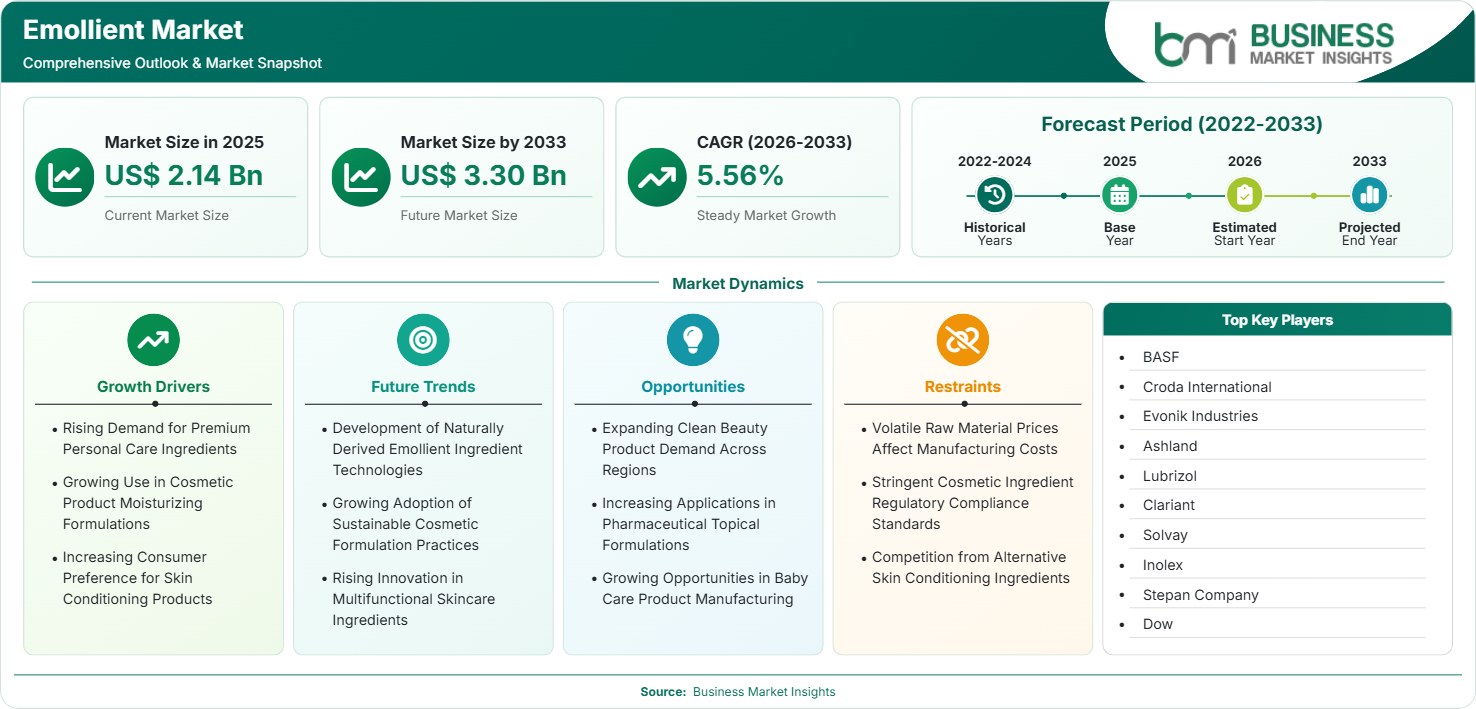
The Emollient Market size was valued at US$ 2.14 billion in 2025 and is projected to reach US$ 3.30 billion by 2033, growing at a CAGR of 5.56% during 2026–2033. Rising demand for premium personal care ingredients, expanding clean beauty products, increasing skincare innovation, and growing topical pharmaceutical applications are supporting market opportunities.

Report Coverage
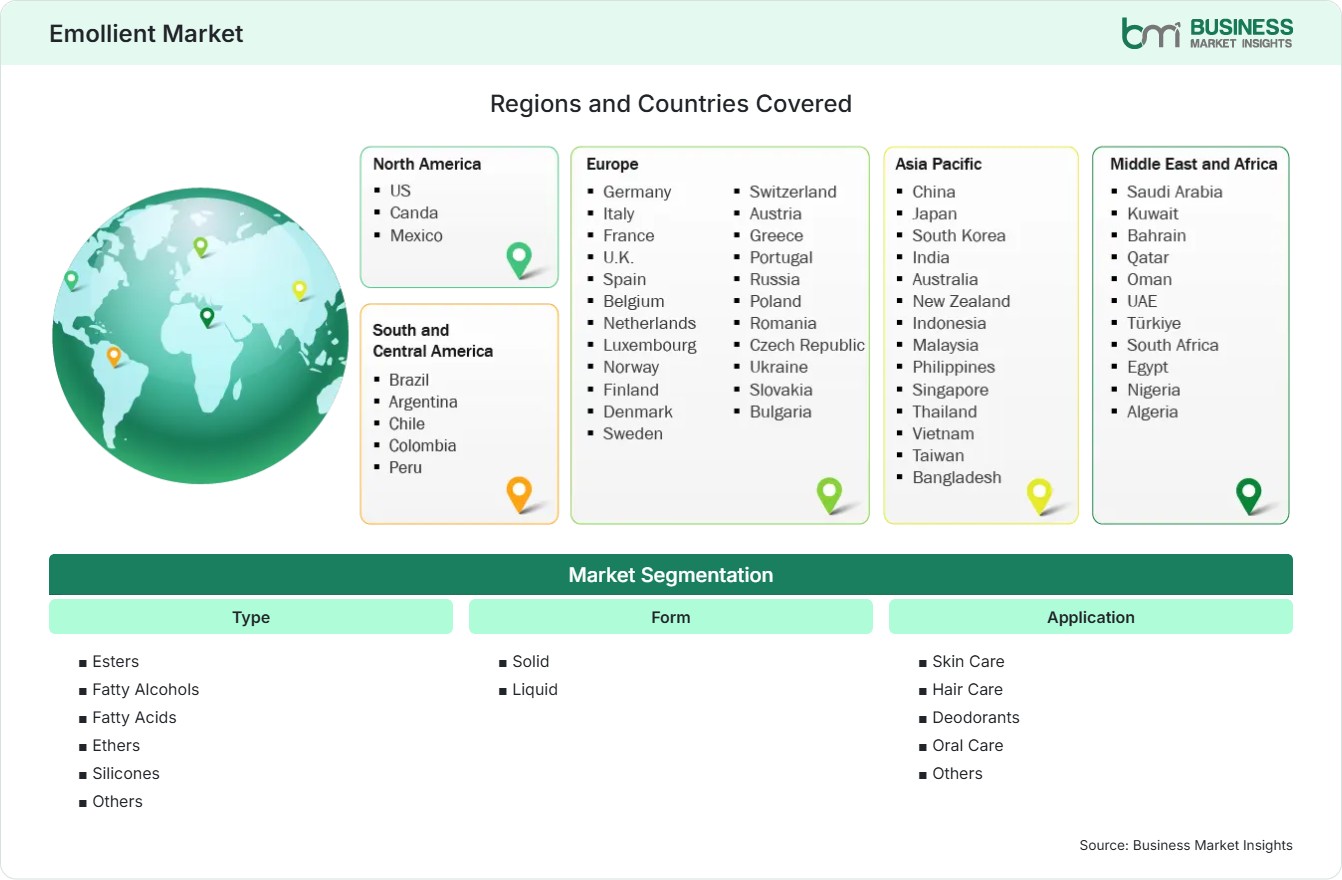
  • Type: Esters, Fatty Alcohols, Fatty Acids, Ethers, Silicones, Others
  • Form: Solid, Liquid
  • Application: Skin Care, Hair Care, Deodorants, Oral Care, Others
US$ 2.14 Bn Market size in 2025
US$ 3.30 Bn Market Size by 2033
5.56% CAGR, 2026 - 2033
2026-2033 Forecast Period

AI Overview

Emollient Market Summary

  • North America Region: North America holds a market share of 29%–32% in 2025 and is expected to grow at a CAGR of 5.1%–5.6% during 2026–2033. Premium skincare demand, advanced cosmetic formulations, pharmaceutical topical applications, and consumer preference for high-performance ingredients are supporting regional growth. The United States remains a key contributor due to established beauty and personal care industries, supporting expansion at a CAGR of 5.2%–5.7%.
  • Fastest Growing Region: Asia Pacific accounts for 35%–38% of the market in 2025 and is projected to expand at a CAGR of 6.0%–6.5% through 2033. Rising disposable income, expanding cosmetics manufacturing, increasing skincare awareness, and growth of personal care consumption across emerging economies are driving regional adoption.
  • Leading Segment: Skin Care applications represent 42%–45% of market demand in 2025 and are expected to grow at a CAGR of 5.8%–6.3% through 2033. Increasing demand for moisturizers, anti-aging products, and advanced skincare formulations continues supporting segment expansion.
  • High Growth Segment: Silicones are projected to grow at a CAGR of 6.2%–6.7% during 2026–2033, driven by superior sensory properties, formulation flexibility, lightweight textures, and increasing adoption in premium cosmetic and personal care products.
  • Key Market Opportunity: Growing clean beauty adoption, pharmaceutical topical formulations, baby care product development, and demand for multifunctional cosmetic ingredients are creating opportunities for manufacturers offering innovative emollient solutions.
  • Major Market Players: BASF SE, Croda International Plc, Evonik Industries AG, Ashland Inc., Lubrizol Corporation, Clariant AG, Solvay SA, Inolex Inc., Stepan Company, The Dow Chemical Company.
Strategic Insights

Emollient Market: Strategic Insights

Emollient Market Strategic Framework
FREE PDF
Request your free sample
Request free sample
Stakeholder View

Key Takeaways

  • The value chain is becoming increasingly integrated, with ingredient manufacturers, cosmetic brands, formulation specialists, and pharmaceutical companies collaborating to develop advanced personal care solutions.
  • Skincare, hair care, pharmaceutical topical products, and baby care applications represent attractive opportunities due to increasing consumer focus on product performance and ingredient quality.
  • Innovation is shifting toward sustainable emollients, multifunctional ingredients, improved sensory properties, and formulations designed for specific consumer needs.
  • Asia Pacific offers strong investment potential due to expanding personal care markets, increasing beauty awareness, and rising demand for premium cosmetic products.
  • Companies are strengthening competitive positions through product innovation, strategic partnerships, sustainable ingredient development, and expansion into emerging markets.
  • Growing demand for environmentally responsible formulations is encouraging manufacturers to develop renewable and naturally derived emollient solutions.
Geographic Outlook

Emollient Market Regional Highlights

North America Emollient Market

North America represents 29%–32% of global demand in 2025 and is projected to grow at a CAGR of 5.1%–5.6% through 2033. The region benefits from strong cosmetic innovation, established personal care brands, and advanced pharmaceutical industries. The United States remains the leading contributor due to high demand for premium skincare products and specialized formulation ingredients.

  • Cosmetic manufacturers are increasing adoption of advanced emollients to develop premium moisturizers, anti-aging products, and multifunctional skincare formulations.
  • Pharmaceutical companies are expanding topical product development requiring reliable ingredients with enhanced skin compatibility and performance.
  • Consumers are showing increasing preference for clean-label and sustainable personal care products with effective conditioning benefits.
  • Ingredient suppliers are investing in research and development to create innovative solutions for evolving formulation requirements.

US Emollient Market

The United States represents a significant North American market supported by strong personal care consumption, cosmetic innovation, and pharmaceutical formulation activities. Increasing demand for premium skincare products and sustainable ingredients is encouraging manufacturers to develop advanced emollient solutions. The country benefits from established distribution networks, research capabilities, and strong demand for specialized cosmetic ingredients.

  • Skincare brands are increasing use of advanced emollients to improve product texture, hydration, and consumer experience.
  • Pharmaceutical companies are utilizing conditioning ingredients in topical treatments and dermatological formulations.
  • Premium cosmetic categories are supporting demand for high-quality and innovative ingredient solutions.

Europe Emollient Market

Europe accounts for 25%–28% of global demand in 2025 and is expected to expand at a CAGR of 5.0%–5.5% through 2033. Germany, France, and the United Kingdom remain important markets due to strong cosmetic industries, sustainability initiatives, and regulatory emphasis on ingredient safety. The region continues supporting demand for advanced and environmentally responsible personal care ingredients.

  • Clean beauty adoption is encouraging manufacturers to develop sustainable and naturally derived emollient solutions.
  • Cosmetic companies are focusing on premium skincare formulations with enhanced moisturizing and sensory properties.
  • Regulatory standards are influencing ingredient development and encouraging transparent sourcing practices.
  • Specialty ingredient producers are expanding product portfolios to address changing consumer preferences.

Asia Pacific Emollient Market

Asia Pacific holds 35%–38% of the global market in 2025 and is projected to achieve a CAGR of 6.0%–6.5% through 2033. China, India, Japan, and South Korea are key markets due to expanding cosmetic industries, rising skincare awareness, and increasing disposable income. Growing beauty product consumption is strengthening regional opportunities.

  • Rising demand for skincare products is increasing adoption of emollients across mass and premium cosmetic categories.
  • Cosmetic manufacturers are expanding production capacity to meet growing regional beauty market requirements.
  • Increasing interest in natural and sustainable ingredients is influencing product development strategies.
  • Pharmaceutical and personal care applications are creating additional demand for specialized formulations.

Rest of World Emollient Market

The Rest of World region represents 8%–11% of global demand in 2025 and is forecast to grow at a CAGR of 5.2%–5.7% through 2033. Latin America benefits from expanding beauty markets, while Middle Eastern and African countries are experiencing rising personal care consumption. Increasing product availability and changing consumer preferences are supporting market development.

  • Latin American cosmetic markets are increasing demand for moisturizing and conditioning ingredients across skincare applications.
  • Middle Eastern personal care industries are adopting premium formulations with advanced ingredient technologies.
  • Baby care product expansion is supporting demand for gentle and effective emollient solutions.
  • Regional distributors are improving access to specialty cosmetic ingredients across developing markets.
Global Market Geography
FREE PDF
Request your free sample
Request free sample
Segment Analysis

Emollient Market Segmentation

Type

The type segment is expanding as manufacturers develop diverse emollient solutions for personal care, pharmaceutical, and cosmetic formulations. Esters remain widely adopted due to versatility, sensory benefits, and compatibility with multiple product categories. The Emollient Market scope continues expanding through innovation in silicone, fatty alcohol, and ester-based ingredients designed for improved skin conditioning and formulation performance.

  • Esters: Widely used in skincare and cosmetic formulations due to lightweight texture, spreading ability, moisturizing properties, and compatibility with premium beauty product development.
  • Fatty Alcohols: Increasingly adopted as conditioning agents, stabilizers, and texture enhancers in creams, lotions, and hair care formulations requiring improved formulation consistency.
  • Fatty Acids: Used in personal care products for moisturizing benefits, barrier support, and formulation enhancement across skincare and pharmaceutical topical applications.
  • Ethers: Applied in cosmetic formulations requiring smooth sensory characteristics, improved absorption, and enhanced product performance across various beauty applications.
  • Silicones: Growing adoption due to superior skin feel, smooth application, lightweight characteristics, and demand for advanced cosmetic textures in premium products.

Form

The form segment is influenced by increasing demand for convenient handling, formulation flexibility, and application-specific ingredient solutions. Liquid emollients represent a major category due to their widespread use in cosmetic formulations requiring smooth application and enhanced spreadability. Manufacturers are focusing on developing stable and efficient formulations to support evolving personal care product requirements.

  • Solid: Used in specialized cosmetic formulations, balms, and structured products requiring stability, consistency, and controlled texture characteristics.
  • Liquid: Widely preferred in skincare, hair care, and cosmetic formulations due to easy processing, smooth application, and compatibility with diverse product systems.

Application

The application segment is driven by increasing consumer focus on skincare, personal wellness, and premium beauty products. Skin Care remains the leading application area due to growing demand for moisturizers, anti-aging solutions, and advanced conditioning products. The Emollient Market trend reflects increasing adoption of multifunctional ingredients across cosmetics, pharmaceuticals, and personal care categories.

  • Skin Care: Dominant application area supported by increasing demand for moisturizers, creams, serums, and specialized formulations offering improved hydration and skin conditioning benefits.
  • Hair Care: Increasingly used in conditioners, treatments, and styling products due to smoothing properties, improved texture, and enhanced hair conditioning performance.
  • Deodorants: Applied to improve skin feel, formulation quality, and consumer comfort in personal care products designed for daily use.
  • Oral Care: Adoption is increasing in specialized oral formulations requiring smooth textures, ingredient compatibility, and enhanced product performance.
Market Forces

Emollient Market Dynamics

Key Market Drivers

Rising Demand for Premium Personal Care Ingredients

Growth in consumer use of premium cosmetic ingredients is spurring demand for high-performance emollients with enhanced sensory and moisturizing properties. Cosmetic companies are developing advanced formulations that offer an improved user experience, multi-benefit functionality, and enhanced hydration. The Emollient Market growth is driven by increased investment in the development of advanced cosmetic ingredients and formulations, as well as customized cosmetic products. Companies are increasingly investing in the development of ingredients that meet sustainability expectations while maintaining performance standards. Growing interest in advanced skincare products in both developed and emerging countries is creating opportunities for suppliers.

Growing Use in Cosmetic Product Moisturizing Formulations

The rising use of moisturizer-based cosmetic products is driving the requirement for emollients as key ingredients in these formulations. Consumers are looking for cosmetics that can increase hydration, soften skin, and support overall well-being. Cosmetics firms use various emollients, including esters, fatty alcohols, and silicones, to improve the efficacy of their products. The factors influencing the Emollient Market growth include growth in categories such as facial care, body care, and dermatological products. Companies are developing innovative ingredients to improve the absorption and performance of formulations.

Increasing Consumer Preference for Skin Conditioning Products

Rising awareness of skin health, along with the growing inclination towards conditioning products, will drive companies to develop advanced formulations based on emollients. Consumers are increasingly choosing products meant to ensure softness, protection, and a moisturizing effect. Skin care brands are now incorporating ingredients that can contribute to effective barrier protection and improved product performance. As noted in the Emollient Market analysis, consumer-driven innovations play an important role for brands as they aim to offer specialized solutions for specific skin types and needs. Rising demand for products aimed at people with sensitive skin, natural products, and premium personal care solutions creates more opportunities for ingredient suppliers.

Key Market Opportunities

Expanding Clean Beauty Product Demand Across Regions

Rising adoption of clean beauty products is creating opportunities for emollient manufacturers that produce eco-friendly ingredients from natural sources. Consumers are becoming more concerned about the transparency of product ingredients and their sustainability when buying personal care products. Cosmetic firms are redeveloping their products to use sustainable, renewable ingredients. According to the Emollient Market forecast, there are rising opportunities for companies producing multi-functional plant-based emollients. Companies are working to develop eco-friendly production systems, sustainable sourcing, and innovative ingredient technology. Growing categories of clean beauty products in regions such as Asia-Pacific, Europe, and North America are likely to create new opportunities for manufacturers.

Increasing Applications in Pharmaceutical Topical Formulations

The field of pharmaceutical topical formulations presents a new growth opportunity owing to rising demand for skin-care and dermatological products, as well as specialty therapeutic uses. Emollients aid in stability, skin compatibility, and efficacy of topical drugs and health care products. Pharmaceutical companies are focusing on developing advanced formulations to improve patient experience and efficacy. Ritheess about of use of health care and demand for dermatological products have encouraged the use of specialty ingredients. Pharmaceutical companies with formulation know-how and regulatory compliance are well-positioned to leverage this growth opportunity. The use of emollients in pharmaceuticals would increase further as companies develop products needing better skin compatibility and delivery features.

Growing Opportunities in Baby Care Product Manufacturing

The increasing need for softer, safer baby care products is creating opportunities for suppliers of soft, skin-friendly emollients. Consumers are increasingly looking for products that provide protection, hydration, and comfort for their babies without causing any irritation. In this regard, manufacturers are developing special formulations of baby lotions, creams, and personal care products that are safer than ever before. The emergence of premium baby care categories in emerging markets is also leading to increased demand for ingredients. Businesses that provide proven, reliable, and sustainable emollients will be able to tap into this growing market sector. Innovations and consumer awareness of ingredient quality should drive further adoption in baby care products.

Market Restraints and Challenges

Volatile Raw Material Prices Affect Manufacturing Costs

Factor: Emollient production depends on raw materials including vegetable oils, fatty acids, and specialty chemical inputs that experience price fluctuations due to agricultural conditions, supply chain disruptions, and commodity market volatility. Impact: Changing raw material costs can increase production expenses, affect pricing strategies, and create margin pressures for manufacturers operating in competitive markets. Companies are adopting diversified sourcing strategies, improving inventory management, and exploring alternative feedstock options to reduce cost risks. However, maintaining stable supply chains remains challenging due to external market conditions. Manufacturers are focusing on operational efficiency and long-term supplier partnerships to improve resilience and manage cost fluctuations effectively.

Stringent Cosmetic Ingredient Regulatory Compliance Standards

Factor: Cosmetic ingredient regulations require manufacturers to comply with safety assessments, quality standards, labeling requirements, and regional approval frameworks before commercializing emollient products. Impact: Increasing regulatory complexity can extend product development timelines, increase compliance costs, and create challenges for companies entering new markets. Manufacturers are investing in regulatory expertise, testing capabilities, and documentation processes to ensure product acceptance across regions. While regulations support consumer safety and product quality, compliance requirements can increase operational complexity. Companies with strong quality management systems and regulatory capabilities are better positioned to navigate evolving standards and maintain market competitiveness.

Company Analysis

Competitive Landscape

The competitive environment is shaped by ingredient innovation, sustainable formulation development, specialty chemical expertise, and expansion of personal care application portfolios. The Emollient Market analysis highlights that leading companies are focusing on advanced moisturizing technologies, renewable ingredient solutions, and customized formulations to address growing demand from skincare, hair care, pharmaceutical, and cosmetic industries.

Company Name

Overview

Products and Services Relevant to this Market

BASF SE

Global chemical company providing specialty ingredients and sustainable solutions for personal care and industrial applications.

Emollients, cosmetic ingredients, skin conditioning agents, formulation additives, and specialty personal care solutions.

Croda International Plc

Specialty ingredient manufacturer developing high-performance solutions for beauty, healthcare, and consumer industries.

Emollients, cosmetic actives, skin care ingredients, hair care solutions, and sustainable formulation technologies.

Evonik Industries AG

Specialty chemicals company producing innovative ingredients for personal care and healthcare markets.

Emollients, cosmetic ingredients, conditioning agents, specialty additives, and formulation support solutions.

Ashland Inc.

Global specialty materials company supplying ingredients for pharmaceutical, personal care, and consumer applications.

Cosmetic emollients, skin care ingredients, formulation enhancers, and specialty chemical solutions.

Lubrizol Corporation

Specialty chemical company providing performance ingredients for personal care and healthcare industries.

Emollients, personal care additives, skin conditioning ingredients, and formulation technologies.

Clariant AG

Specialty chemicals company developing sustainable ingredients and solutions across multiple industries.

Personal care ingredients, emollients, specialty additives, cosmetic formulation components, and sustainable solutions.

Solvay SA

Advanced materials and specialty chemicals producer serving beauty, healthcare, and industrial markets.

Cosmetic ingredients, specialty emollients, performance additives, and formulation solutions.

Inolex Inc.

Personal care ingredient manufacturer focused on sustainable and naturally derived specialty ingredients.

Emollients, preservation systems, cosmetic ingredients, and clean beauty formulation solutions.

Stepan Company

Chemical manufacturer supplying specialty ingredients for consumer and industrial applications.

Emollients, surfactants, personal care ingredients, and specialty formulation products.

The Dow Chemical Company

Global materials science company providing innovative chemical solutions for consumer and industrial markets.

Silicone-based emollients, personal care ingredients, specialty materials, and formulation technologies.

Trust & Transparency

Research Methodology

The market analysis combines proprietary research with secondary data from government agencies, company disclosures, regulatory filings, industry databases and expert interviews. Market estimates are validated through data triangulation, cross-market benchmarking and analyst review.

View Full Research Methodology

Questions Answered

Frequently Asked Questions

What does the Emollient Market report indicate about future competition?

The report indicates that competition will focus on sustainable ingredient innovation, formulation performance, regulatory compliance, and expansion into emerging personal care applications. Companies developing advanced emollient technologies and strengthening partnerships with cosmetic manufacturers are expected to improve their competitive positioning.

Why are clean beauty products creating new opportunities for emollient solutions?

Clean beauty products are creating opportunities because consumers increasingly prefer transparent, sustainable, and naturally derived ingredients. Emollients support these products by providing moisturizing, smoothing, and conditioning benefits while helping brands develop premium formulations aligned with changing consumer expectations.

How are sustainable ingredient technologies influencing emollient adoption?

Sustainable ingredient technologies are increasing adoption by enabling renewable sourcing, improved environmental performance, and development of clean beauty formulations. Manufacturers are using advanced technologies to create emollients that combine effective skin conditioning properties with consumer demand for responsible product choices.

Which applications present the strongest opportunity in the market?

Skincare, hair care, pharmaceutical topical formulations, baby care products, and premium cosmetic categories represent strong opportunities. These applications require ingredients that deliver improved moisturization, product performance, consumer comfort, and compatibility with evolving formulation trends.

What factors are improving Emollient Market return on investment?

Increasing demand for premium skincare products, sustainable cosmetic ingredients, pharmaceutical topical applications, and multifunctional personal care formulations is improving return on investment. Emollients provide hydration, conditioning, and sensory benefits, making them valuable ingredients for expanding beauty, healthcare, and consumer product applications.

Access the Full Emollient Market Report

Get segment-level forecasts, regional estimates, competitive benchmarking, company profiles and downloadable Excel datasets.

Access the full Emollient Market Report
350 pages PDF & Excel | 2026-08-21
Similar Research

Related Market Reports