
Zeolite Market Outlook: Size, Share, Trends, Growth Analysis, Competitive Landscape & Forecast, 2026–2033

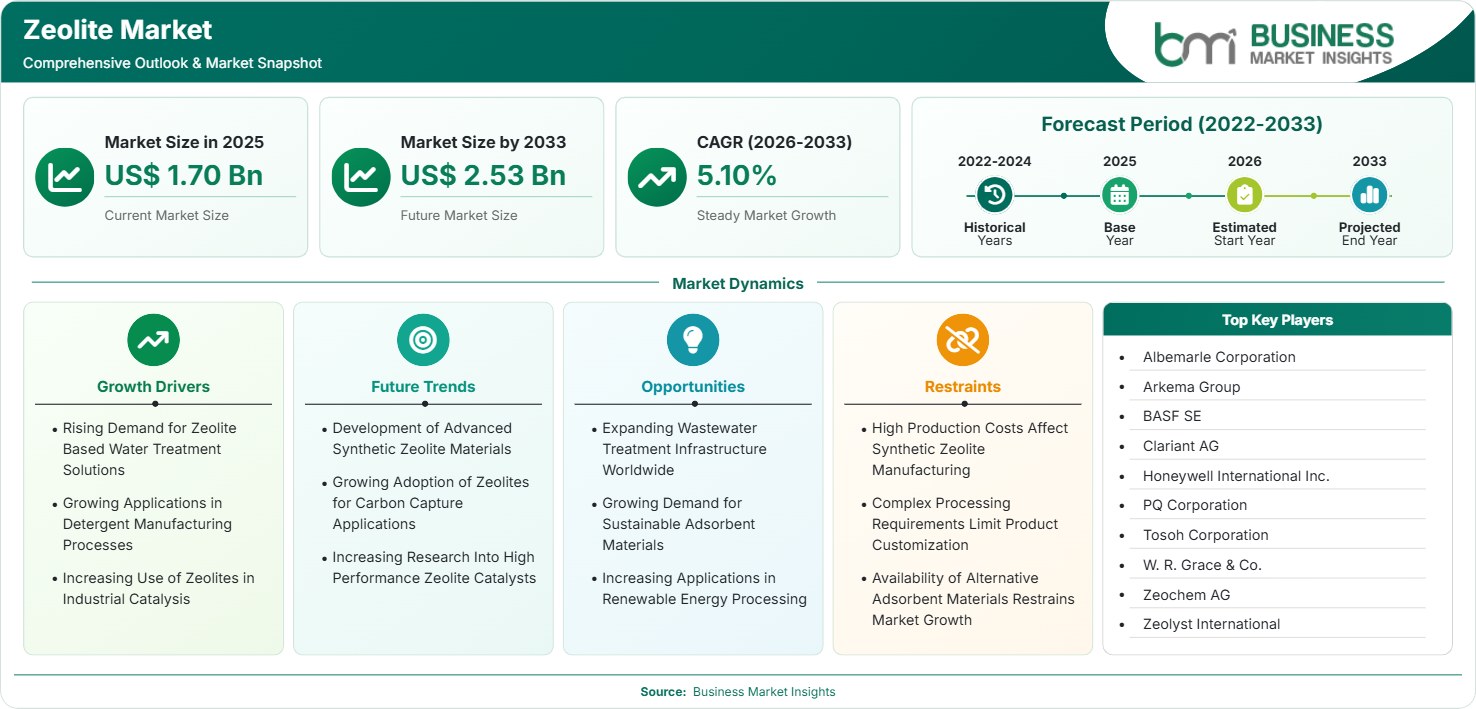
The Zeolite Market size was valued at US$ 1.70 billion in 2025 and is projected to reach US$ 2.53 billion by 2033, growing at a CAGR of 5.10% during 2026–2033, supported by water treatment, industrial catalysis, detergent manufacturing, sustainable adsorption, and environmental remediation applications.

Report Coverage
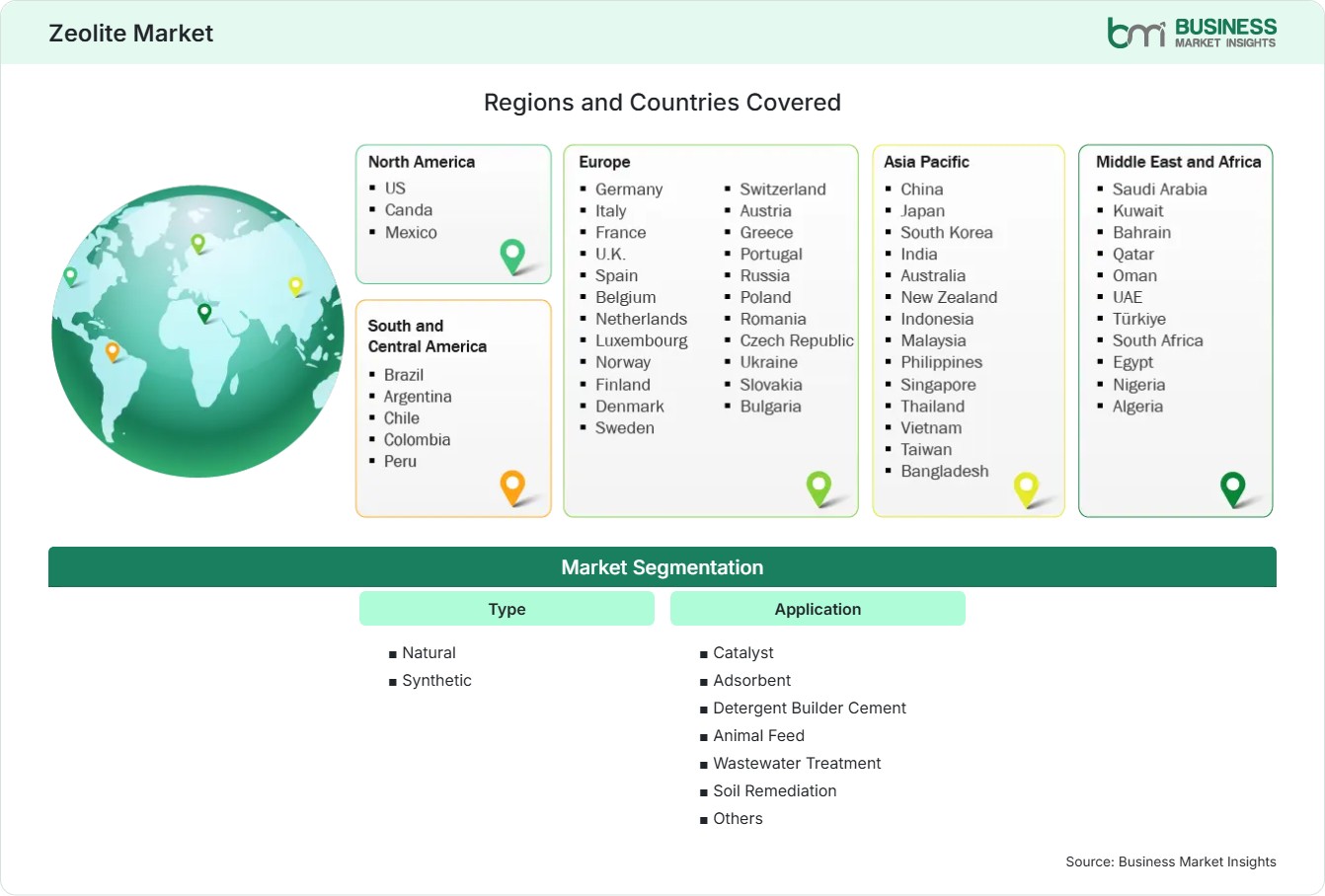
  • Type: Natural, Synthetic
  • Application: Catalyst, Adsorbent, Detergent Builder Cement, Animal Feed, Wastewater Treatment, Soil Remediation, Others
US$ 1.70 Bn Market size in 2025
US$ 2.53 Bn Market Size by 2033
5.10% CAGR, 2026 - 2033
2026-2033 Forecast Period

AI Overview

Zeolite Market Summary

  • North America Region: North America holds a 24%–28% share in 2025, expanding at a 4.7%–5.7% CAGR during 2026–2033, supported by municipal water treatment, refinery operations, environmental remediation, catalyst demand, and investments in advanced adsorption technologies.
  • Fastest Growing Region: Asia Pacific holds a 31%–35% share in 2025, expanding at a 5.8%–6.8% CAGR during 2026–2033, driven by wastewater infrastructure, detergent production, refining capacity, industrialization, agricultural applications, and demand for cost-effective treatment materials.
  • Leading Segment: Synthetic zeolites account for a 58%–62% share in 2025, growing at a 5.4%–6.2% CAGR, supported by controlled pore structures, consistent composition, catalyst applications, adsorption performance, and customized industrial formulations.
  • High Growth Segment: Wastewater Treatment represents a 15%–19% share in 2025, advancing at a 6.2%–7.2% CAGR, supported by stricter treatment requirements, contaminant removal, water reuse initiatives, and expanding municipal and industrial treatment capacity.
  • Key Market Opportunity: Rising demand for efficient water purification, sustainable adsorbents, advanced catalysts, and environmental remediation creates opportunities for tailored zeolite formulations with higher selectivity, regeneration efficiency, and application-specific performance.
  • Major Market Players: Albemarle Corporation, Arkema Group, BASF SE, Clariant AG, Honeywell International Inc., PQ Corporation, Tosoh Corporation, W. R. Grace & Co., Zeochem AG, and Zeolyst International.
Strategic Insights

Zeolite Market: Strategic Insights

Zeolite Market Strategic Framework
FREE PDF
Request your free sample
Request free sample
Stakeholder View

Key Takeaways

  • The value chain spans mineral extraction, aluminosilicate processing, activation, crystallization, formulation, packaging, distribution, and application-specific technical support, making manufacturing consistency a major competitive consideration.
  • Water treatment provides an attractive demand pathway because zeolites can support contaminant removal, ion exchange, and purification processes across municipal and industrial applications.
  • Synthetic material development is moving toward tighter control of pore architecture, particle characteristics, purity, and regeneration behavior for demanding catalytic and adsorption applications.
  • Asia Pacific provides a compelling expansion opportunity as industrialization, wastewater treatment investment, detergent production, refining activity, and environmental management requirements continue to develop.
  • Competitive activity is likely to emphasize product customization, process efficiency, application engineering, regional supply reliability, and development of higher-performance grades for specialized industrial processes.
  • Producers can strengthen margins by moving beyond commodity material supply toward engineered grades, technical services, regeneration solutions, and application-specific formulations.
Geographic Outlook

Zeolite Market Regional Highlights

North America Zeolite Market

North America represents a 24%–28% share in 2025 and is projected to grow at a 4.7%–5.7% CAGR through 2033. The region benefits from established refining, petrochemical, water treatment, detergent, and environmental management industries. The Zeolite Market share reflects mature industrial demand alongside increasing requirements for water purification and resource efficiency.

  • Municipal and industrial water treatment applications continue to provide dependable demand as operators seek efficient ion-exchange and adsorption materials for contaminant management and water reuse.
  • Refining and petrochemical applications maintain the importance of zeolite catalysts because controlled pore structures can support selective catalytic conversion and process optimization.
  • Environmental remediation provides additional demand as contaminated industrial and municipal sites require materials capable of capturing selected ions and pollutants.
  • Product suppliers are increasingly emphasizing customized particle sizes, purity levels, and performance characteristics for specialized industrial processes.

US Zeolite Market

The US represents a 76%–80% share of North American demand in 2025 and is projected to expand at a 4.8%–5.8% CAGR during 2026–2033. The country's diversified industrial base supports consumption across water treatment, refining, chemicals, detergents, agriculture, and environmental applications.

  • Water treatment applications remain important because municipal and industrial operators require reliable materials for ion exchange, adsorption, and contaminant management.
  • Refining and petrochemical operations sustain demand for specialized synthetic grades used in catalytic processes requiring controlled pore structures and consistent performance.
  • Environmental applications are creating additional opportunities for natural and engineered zeolites in remediation, soil improvement, and pollutant management programs.

Europe Zeolite Market

Europe accounts for a 22%–26% share in 2025 and is forecast to expand at a 4.2%–5.2% CAGR through 2033. Germany leads regional demand, while France, Italy, Spain, and the UK contribute across water treatment, chemicals, detergents, and environmental applications. Germany is projected to grow at a 4.5%–5.5% CAGR, while France could reach a 4.7%–5.7% CAGR. Sustainability requirements are encouraging resource-efficient material adoption.

  • Germany provides a strong base for industrial applications because chemical processing, environmental management, and manufacturing require specialized adsorption and catalytic materials.
  • France offers opportunities through municipal water treatment, chemical processing, and environmental applications where purification efficiency and resource conservation are important.
  • The UK provides demand across water infrastructure, industrial processing, detergents, and environmental management, supported by established treatment and manufacturing systems.
  • European customers increasingly favor materials that support lower waste generation, regeneration, resource recovery, and efficient industrial processing.

Asia Pacific Zeolite Market

Asia Pacific holds a 31%–35% share in 2025 and is projected to grow at a 5.8%–6.8% CAGR through 2033. China, Japan, India, South Korea, and Southeast Asia form major demand centers. India is projected to expand at a 6.2%–7.2% CAGR, while China could reach a 5.9%–6.9% CAGR. Expanding wastewater infrastructure, refining, chemicals, detergents, and agriculture support regional consumption.

  • China offers broad opportunities across refining, chemicals, detergents, environmental treatment, and industrial water management, supported by its extensive manufacturing base.
  • India is developing strong demand through urban wastewater treatment, industrialization, agriculture, refining, and increasing attention to efficient resource utilization.
  • Japan maintains demand for higher-performance materials used in sophisticated industrial processes, water treatment, catalysts, and environmental applications.
  • Southeast Asian economies provide expansion opportunities as manufacturing capacity, urbanization, water infrastructure, and industrial processing activities increase.

Rest of World Zeolite Market

Rest of World accounts for a 15%–19% share in 2025 and is expected to grow at a 4.8%–6.0% CAGR through 2033. Latin America benefits from mining, agriculture, water treatment, and industrial processing, while Middle Eastern Zeolite Markets provide opportunities through refining and petrochemical activity. Brazil is projected to grow at 5.0%–6.2% CAGR, while Saudi Arabia could reach 5.5%–6.5% CAGR.

South and Central America provide opportunities through agricultural applications, municipal treatment, mining-related environmental management, and industrial water purification. Demand is supported by the need to improve treatment efficiency while controlling operating costs.

  • Brazil provides opportunities across agriculture, water treatment, environmental remediation, and industrial applications where mineral-based treatment materials can support resource efficiency.
  • Saudi Arabia offers potential through refining, petrochemicals, water treatment, and industrial infrastructure requiring reliable adsorption and catalytic materials.
  • Mexico provides opportunities in industrial processing, water treatment, detergents, and manufacturing applications as industrial capacity expands and environmental requirements become more important.
  • Other emerging markets can adopt natural zeolites for lower-cost applications while gradually increasing consumption of engineered synthetic grades for specialized industrial processes.
Global Market Geography
FREE PDF
Request your free sample
Request free sample
Segment Analysis

Zeolite Market Segmentation

Type

Synthetic zeolites account for a 58%–62% share in 2025 and are projected to grow at a 5.4%–6.2% CAGR through 2033. Their controlled composition, pore structure, purity, and reproducibility support demanding catalyst and adsorption applications.

  • Natural: Natural zeolites provide cost-effective adsorption and ion-exchange properties for wastewater treatment, agriculture, soil remediation, animal feed, and selected industrial applications.
  • Synthetic: Synthetic grades offer controlled pore structures, consistent composition, and tailored performance, making them valuable for catalysts, detergents, advanced adsorption, and specialized purification processes.

Application

Catalyst applications account for a 25%–29% share in 2025 and are projected to grow at a 4.9%–5.9% CAGR through 2033. Their use in refining and chemical conversion benefits from controlled molecular structures and selective catalytic behavior.

  • Catalyst: Zeolite catalysts support refining and chemical conversion by providing structured active environments that improve selectivity and process efficiency across demanding industrial operations.
  • Adsorbent: Adsorbent applications use zeolites for purification, separation, moisture control, and contaminant capture across industrial, environmental, and process applications.
  • Detergent Builder: Zeolites function as detergent builders by supporting water softening and improving cleaning formulations, particularly where phosphate reduction and formulation efficiency are priorities.
  • Cement: Zeolite materials can contribute to cement formulations through mineral functionality and potential reductions in conventional clinker intensity, supporting resource-efficient construction material development.
  • Animal Feed: Feed applications use selected natural zeolites for functional mineral supplementation and moisture or contaminant management, subject to product quality and regulatory requirements.
  • Wastewater Treatment: Zeolites support ion exchange and adsorption processes for removing selected contaminants, creating demand across municipal treatment, industrial wastewater, and water reuse applications.
  • Soil Remediation: Zeolites can assist soil remediation by retaining selected contaminants and improving soil properties, supporting applications around agricultural land and contaminated sites.
Market Forces

Zeolite Market Dynamics

Key Market Drivers

Rising Demand for Zeolite Based Water Treatment Solutions

Water Treatment represents a promising application area since zeolites feature desirable ion-exchange and adsorbing properties, which are suitable for certain pollutants and processes. Municipal treatment plants, industries, and water reuse initiatives need materials capable of functioning reliably in the existing treatment systems. Growth in the Zeolite Market is driven by the need for practical treatment solutions, which would be efficient, manageable, and available. Natural types of materials can be used for cost-efficient applications, whereas synthetic types allow for the creation of materials with predictable features for certain treatment processes. The current trend in product development is to enhance selectivity, regeneration, particle handling, and compatibility with existing treatment processes.

Growing Applications in Detergent Manufacturing Processes

The use of zeolites in detergents is still valid due to the ability of zeolites to perform water-softening functions using the ion-exchange capability of the zeolite. Zeolites' demand is associated with household, institutional detergents, and regional need for phosphate-free detergents. Manufacturers have taken an interest in particle properties, formulation properties, and performance stability in order to satisfy process needs. The Zeolite market trends in this application are additionally driven by detergent manufacturers' search for raw materials capable of performing a cleaning function while fulfilling environmental and formulation needs. Suppliers of zeolites able to supply raw material of consistent quality in scalable quantities can develop strong partnerships with detergent manufacturers. The regional practices in formulation will continue impacting the choice of grades, particle characteristics, and applications.

Increasing Use of Zeolites in Industrial Catalysis

Zeolites have been employed successfully as industrial catalysts due to their unique structured pore systems capable of offering selective environments for reactions to occur. The refining and chemical industries make use of catalyst materials whose selectivity, thermal stability, and effectiveness are important determinants of production efficiency. Therefore, demand is linked to developments in refinery, petrochemical processes, and selective conversions. The trend in the synthesis of synthetic zeolites is moving towards control of pore system structures, acidity levels, crystal size, and stability in order to meet particular requirements of catalytic processes. Companies combining both materials technology and application technology will be able to cope with the rising demands on catalysts. The other factor that makes this an important consideration in the Zeolite market forecast is the applications where there are variations in performance levels to justify grades.

Key Market Opportunities

Expanding Wastewater Treatment Infrastructure Worldwide

Urbanization, industrialization, shortage of water, and resource recovery needs are presenting an opportunity for enhanced wastewater treatment capabilities. Zeolite materials can assist in the treatment process through ion exchange and adsorption, especially when there is a need for specific contaminant removal. There is considerable opportunity in the emerging market due to the fact that treatment facilities being set up are able to include treatment materials in their processes from the beginning of design. Opportunities in the field are presented to suppliers through regional production, treatment partnership, technical support, and regeneration options. Commercially speaking, success lies in the ability to show effectiveness within existing process equipment and operational needs.

Growing Demand for Sustainable Adsorbent Materials

There is a need for industrial users to have adsorption materials that not only facilitate efficiency but also control pollution, purification, and optimization of processes without causing any adverse effects on the environment. Zeolites are able to meet the needs in some specific areas using mineral structures and regeneration capabilities. There is room for enhancing the performance of the material by means of surface modification, pore tailoring, particle size modification, and regeneration features. Environmental concerns can make buyers consider different adsorption materials such as natural minerals, synthetic zeolites, activated carbon, silica, and others from the point of view of life cycle performance. Companies that are able to show application-level efficiency instead of using material-based efficiency can get better positions in niche markets.

Increasing Applications in Renewable Energy Processing

Renewable energy systems are creating new applications for separation, purification, and catalysis materials. The potential use of zeolites in selected applications for the purification of gases, conversion of biomass, control of moisture, and conversion of chemicals exists. Potential exists in instances where renewable sources of raw materials need separation and upgrading before conversion into fuels or chemicals, among others. This potential may be harnessed by suppliers of the raw materials through the engineering of their pores, tuning of their acidity and thermal stability, and application-specific catalyst development. Strategies for development involving repeatability, regeneration, and compatibility with evolving conversion technologies will assist in the entry of zeolites into high-value applications beyond traditional industries.

Market Restraints and Challenges

High Production Costs Affect Synthetic Zeolite Manufacturing

Factor: Synthetic zeolite production can require controlled raw materials, crystallization conditions, energy-intensive processing, activation, drying, and quality-control procedures. Impact: Higher production costs can limit competitiveness in price-sensitive applications where natural zeolites or alternative adsorbents provide adequate performance. Cost pressure is particularly relevant when customers prioritize bulk treatment economics over highly controlled material characteristics. Manufacturers can reduce this constraint through process optimization, energy efficiency, improved yield, raw-material management, and larger-scale production. Product differentiation also provides an avenue for protecting margins where specialized grades deliver measurable benefits.

Complex Processing Requirements Limit Product Customization

Factor: Producing zeolites with specific crystal structures, pore characteristics, particle sizes, purity levels, and surface properties can require tightly controlled processing conditions. Impact: Complex manufacturing can increase development timelines, quality-control requirements, and production costs when customers request highly customized materials. This challenge becomes more pronounced in specialized catalyst, adsorption, and separation applications where small variations in material properties can influence process performance. Advanced characterization, process monitoring, and application testing can help reduce variability. Companies with strong technical capabilities can convert customization into a competitive advantage, but less flexible producers may face difficulty serving specialized requirements economically.

Company Analysis

Competitive Landscape

The Zeolite Market analysis covers diversified chemical companies, specialty material manufacturers, catalyst suppliers, and producers serving water treatment, refining, detergent, environmental, and industrial applications. Competition is shaped by product consistency, manufacturing efficiency, pore structure control, application expertise, geographic availability, technical support, and the ability to develop specialized grades.

Company Name

Overview

Products and Services Relevant to This Market

Albemarle Corporation

Specialty chemicals company with capabilities in catalysts and advanced materials serving industrial processing applications.

Zeolite-based catalyst technologies, refining catalysts, specialty materials, technical services, and process solutions for industrial customers.

Arkema Group

Global specialty materials company serving advanced industrial applications through engineered chemicals and performance materials.

Specialty materials, catalysts, adsorbent-related technologies, process chemicals, and solutions supporting industrial applications.

BASF SE

Diversified chemical company with extensive catalyst, adsorbent, and process technology capabilities across industrial markets.

Zeolite-containing catalyst systems, refinery catalysts, adsorbents, chemical processing solutions, and technical application support.

Clariant AG

Specialty chemicals company focused on catalysts, adsorbents, sustainable chemistry, and industrial process technologies.

Catalyst materials, adsorbents, zeolite-based process solutions, refinery technologies, and application-specific technical services.

Honeywell International Inc.

Diversified technology company with established process technology and catalyst capabilities serving refining and chemical industries.

Refining catalysts, process technologies, adsorption solutions, catalyst systems, and industrial process optimization services.

PQ Corporation

Specialty materials manufacturer supplying silicates, zeolites, and related inorganic materials for industrial applications.

Zeolites, molecular sieves, silicates, adsorbent materials, catalyst support materials, and specialty inorganic products.

Tosoh Corporation

Japanese chemical company with advanced materials and catalyst capabilities serving chemical and industrial applications.

Zeolite catalysts, molecular sieves, catalyst materials, specialty chemicals, and advanced inorganic materials.

W. R. Grace & Co.

Specialty materials and catalyst company with strong capabilities in refining and engineered porous materials.

Zeolite-based catalysts, fluid catalytic cracking technologies, molecular sieves, catalyst systems, and technical services.

Zeochem AG

Specialty molecular sieve and zeolite producer focused on adsorption, separation, and purification applications.

Molecular sieves, zeolites, adsorbents, specialty purification materials, and application-specific technical support.

Zeolyst International

Specialty catalyst and molecular sieve supplier focused on zeolite materials for research and industrial applications.

Zeolite catalysts, molecular sieves, specialty catalyst materials, research products, and customized technical solutions.

Trust & Transparency

Research Methodology

The market analysis combines proprietary research with secondary data from government agencies, company disclosures, regulatory filings, industry databases and expert interviews. Market estimates are validated through data triangulation, cross-market benchmarking and analyst review.

View Full Research Methodology

Questions Answered

Frequently Asked Questions

What does the Zeolite Market Report cover?

The report covers market size, regional development, type and application segmentation, adoption dynamics, growth drivers, opportunities, restraints, competitive positioning, technological developments, and demand factors influencing the industry's 2026–2033 outlook.

What factors influence zeolite selection?

Selection in the Zeolite Market depends on pore structure, chemical composition, particle size, purity, adsorption capacity, ion-exchange behavior, thermal stability, regeneration requirements, application chemistry, and total operating cost.

How are zeolites used in wastewater treatment?

Zeolites can support wastewater treatment through ion exchange and adsorption. Depending on the material and water chemistry, they can assist with removing selected ions and contaminants and can complement conventional treatment processes.

Why are synthetic zeolites widely used in industrial applications?

Synthetic zeolites can provide controlled pore structures, consistent composition, defined crystal characteristics, and reproducible performance. These properties are particularly valuable in catalyst and adsorption applications where material uniformity directly influences process performance.

What are the major applications of zeolites?

Major applications include catalysts, adsorbents, detergent builders, cement, animal feed, wastewater treatment, soil remediation, gas separation, purification, and other specialized industrial processes. Application requirements determine whether natural or synthetic material is most appropriate.

Access the Full Zeolite Market Report

Get segment-level forecasts, regional estimates, competitive benchmarking, company profiles and downloadable Excel datasets.

Access the full Zeolite Market Report
350 pages PDF & Excel | 2026-09-15
Similar Research

Related Market Reports