
Space Propulsion Systems Market Outlook: Size, Share, Trends, Growth Analysis, Competitive Landscape & Forecast, 2026-2033

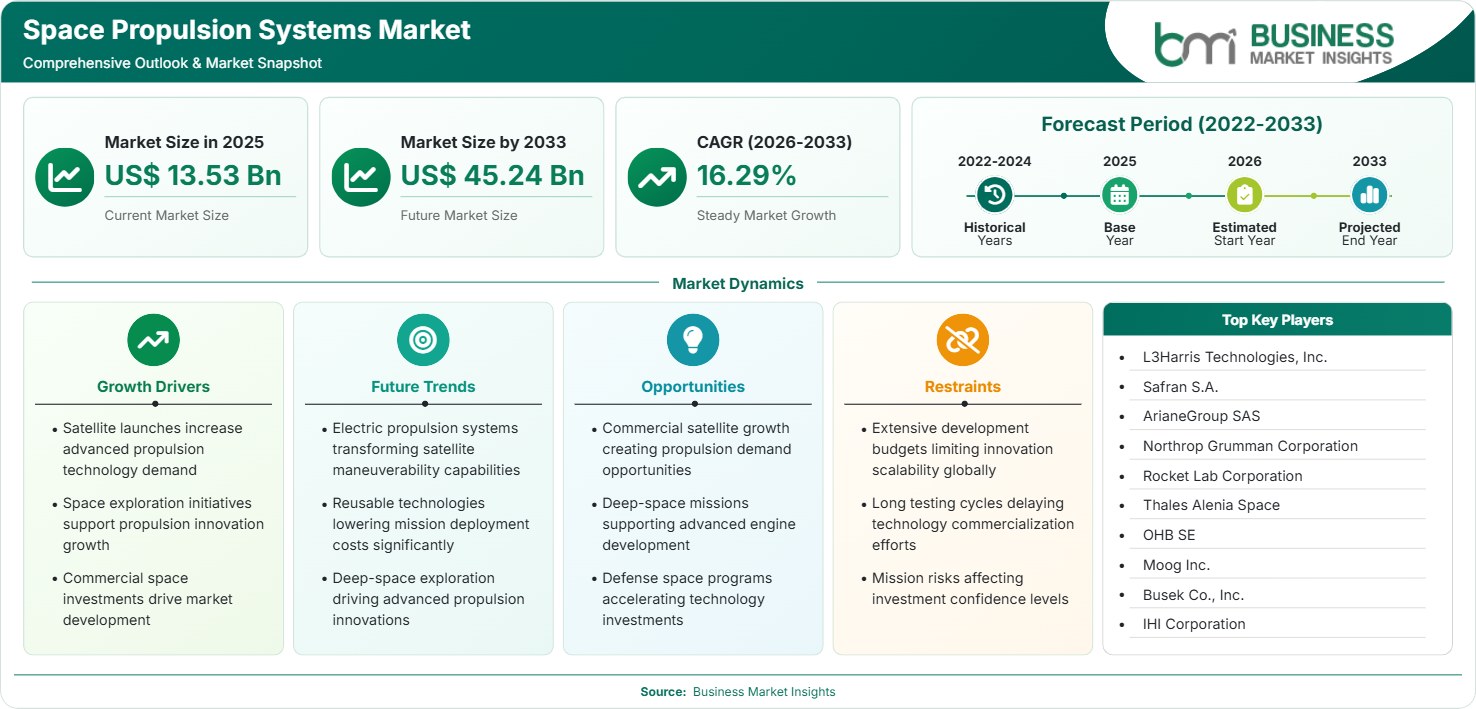
The Space Propulsion Systems Market size was valued at US$ 13.53 Billion in 2025 and is projected to reach US$ 45.24 Billion by 2033, growing at a CAGR of 16.29% during 2026–2033, driven by satellite constellation expansion, electric propulsion adoption, defense modernization, reusable launch technologies, and investment in lunar exploration and spacecraft servicing.

Report Coverage
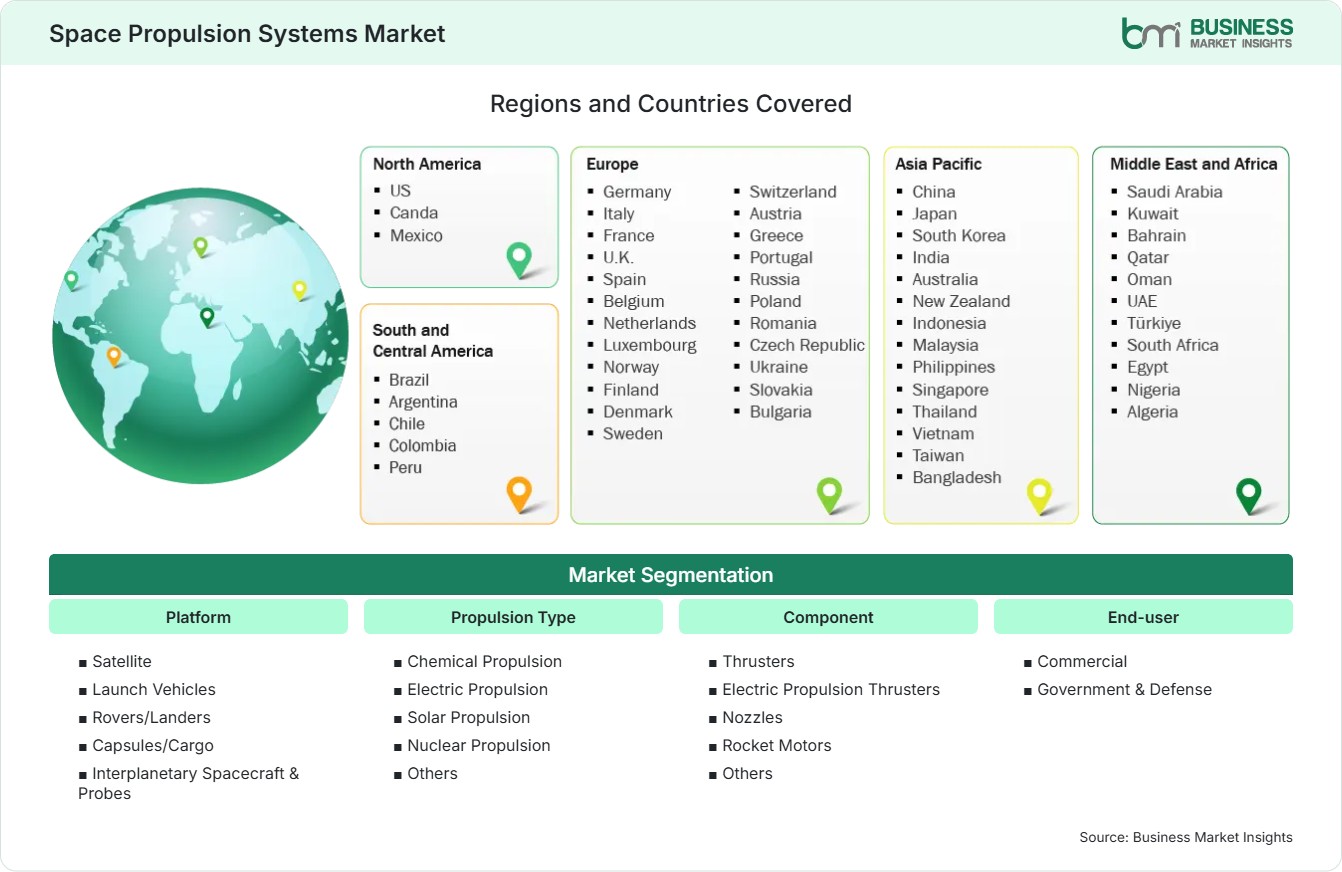
  • Platform: Satellite , Launch Vehicles, Rovers/Landers, Capsules/Cargo, Interplanetary Spacecraft & Probes
  • Propulsion Type: Chemical Propulsion, Electric Propulsion, Solar Propulsion, Nuclear Propulsion, Others
  • Component: Thrusters, Electric Propulsion Thrusters, Nozzles, Rocket Motors, Others
  • End-user: Commercial, Government & Defense
US$ 13.53 Bn Market size in 2025
US$ 45.24 Bn Market Size by 2033
16.29% CAGR, 2026 - 2033
2026-2033 Forecast Period

AI Overview

Space Propulsion Systems Market Summary

  • North America Region: North America holds an estimated 35%–38% of Space Propulsion Systems Market share in 2025, with a projected CAGR of 15%–17% during 2026–2033. Defense procurement, commercial satellite manufacturing, and advanced propulsion research support demand. The United States benefits from established aerospace suppliers, government-funded exploration, and constellation deployment, creating opportunities for integrated propulsion manufacturing and long-duration spacecraft operations. The US market is projected to grow at a CAGR of 15%–17%.
  • Fastest Growing Region: Asia Pacific accounts for an estimated 25%–29% share in 2025 and is projected to grow at a CAGR of 18%–21%. National space programs, domestic satellite production, indigenous propulsion development, and expanding launch capabilities support regional demand. China, India, Japan, and South Korea offer opportunities in propulsion engineering, component manufacturing, and spacecraft integration.
  • Leading Segment: Satellite platforms represent an estimated 42%–46% share in 2025, with a projected CAGR of 15%–17%. Communications constellations, navigation, Earth observation, and defense satellites require propulsion for orbit raising, station-keeping, maneuverability, and disposal, creating demand for standardized and reliable propulsion modules.
  • High Growth Segment: Electric propulsion represents an estimated 20%–24% share in 2025 and is projected to expand at a CAGR of 19%–22%. High specific impulse, lower propellant requirements, and improved power electronics support adoption across commercial satellites, constellation fleets, and deep-space exploration.
  • Key Market Opportunity: Standardized electric propulsion modules, orbital servicing, spacecraft refueling, and lunar logistics offer opportunities for suppliers combining flight-qualified hardware, integrated electronics, scalable manufacturing, and mission-specific engineering.
  • Major Market Players: L3Harris Technologies, Inc.; Safran S.A.; ArianeGroup SAS; Northrop Grumman Corporation; Rocket Lab Corporation; Thales Alenia Space; OHB SE; Moog Inc.; Busek Co., Inc.; and IHI Corporation.
Strategic Insights

Space Propulsion Systems Market: Strategic Insights

Space Propulsion Systems Market Strategic Framework
FREE PDF
Request your free sample
Request free sample
Stakeholder View

Key Takeaways

  • The competitiveness of a spacecraft is affected by access to suitable thrusters, valves, tanks, feed systems, and power processing units, and suppliers who provide integrated solutions are able to decrease interface complexity as well as give spacecraft manufacturers more predictable qualification and delivery schedules.
  • Small satellites call for compact and standardized propulsion, whereas large communication spacecraft and those used for exploration need higher-performance systems. Manufacturers should match their manufacturing investments with the particular economic conditions of large-volume constellations and specialized missions.
  • Development is heading in the direction of higher-power electric propulsion, better cathodes, alternative propellants, longer operational life, and simpler integration. To achieve commercial success, it is necessary to have verified performance in space and to carry out credible lifetime testing.
  • The Asia Pacific region provides opportunities by means of domestic satellite manufacturing and its national space programs. Suppliers are able to improve their access to the market via engineering partnerships, local qualification capabilities, and technology transfer.
  • Instead, investors should focus on companies that have a record of successful flights, have recurring contracts, possess differentiated technology, and have scalable manufacturing capabilities rather than just placing their trust in demonstrations or announced programs.
  • The type of propulsion used has an effect on a vehicle's payload capacity, its operating life, its maneuverability, and its disposal. In order for suppliers to distinguish their products from those of their competitors, they need to show that their offerings provide measurable benefits at the mission level.
Geographic Outlook

Space Propulsion Systems Market Regional Highlights

North America Space Propulsion Systems Market

North America Space Propulsion Systems Market represents an estimated 35%–38% share in 2025, with a projected CAGR of 15%–17% through 2033. Established manufacturers, defense procurement, commercial launch providers, and government exploration programs support demand.

  • The defense programs meet the demand for both chemical and electric propulsion to ensure secure communications, achieve maneuverability, and enable strategic spacecraft; they also have the advantage when it comes to procurement because of their established qualification records.
  • Commercial operators of satellite constellations place a priority on standardized propulsion interfaces, on having predictable delivery, and on ensuring reliable performance when it comes to large fleets of satellites.
  • The lunar exploration program promotes the development of higher-power electric propulsion, integrated power systems, and thermal management technologies.
  • Investment in manufacturing enhances the responsiveness of the supply chain and enables the domestic production of advanced propulsion components.

US Space Propulsion Systems Market

The United States Space Propulsion Systems Market accounts for an estimated 78%–82% of North American demand and approximately 27%–31% of global revenue in 2025. Its projected CAGR is 15%–17% through 2033. Government exploration, national security procurement, and commercial satellite deployment sustain demand.

  • The government's procurement program supports advanced engines and propulsion subsystems for strategic missions with a focus on reliability, security, and testing.
  • The production of commercial satellites tends to prefer compact propulsion modules since they reduce the amount of integration work and help to maintain the payload capacity.
  • The research programs are aimed at developing higher-power thrusters, reusable launch technologies, and propulsion systems for future exploration missions.

Europe Space Propulsion Systems Market

The European Space Propulsion Systems Market accounts for an estimated 25%–28% share in 2025, with a projected CAGR of 14%–16% through 2033. Institutional programs, spacecraft manufacturing, and established aerospace suppliers support regional demand. France, Germany, and Italy are important contributors through launch systems, propulsion engineering, and satellite integration.

  • France has the advantage of possessing expertise in launch vehicles, having developed electric propulsion, and benefiting from institutional procurement.
  • The engineering base in Germany provides support for the production of precision components, for manufacturing spacecraft, and for the integration of propulsion systems.
  • Italy carries out research into both satellite production and propulsion, which creates opportunities for specialized suppliers and technology partnerships.
  • The United Kingdom and Spain provide opportunities in the fields of satellite engineering, research and the manufacture of components, although progress in these areas will depend on funding and qualification.

Asia Pacific Space Propulsion Systems Market

Asia Pacific Space Propulsion Systems Market represents an estimated 25%–29% share in 2025 and is projected to expand at a CAGR of 18%–21% through 2033. China, India, and Japan contribute through national programs, satellite manufacturing, and launch capabilities. South Korea is strengthening its domestic space ecosystem. India's successful 1,000-hour stationary plasma thruster life test in March 2025 demonstrates progress in indigenous electric propulsion. Regional expansion depends on government investment, domestic manufacturing, technology qualification, and commercial satellite demand.

  • China gains from having facilities for manufacturing satellites, for launching them, and for its government-funded exploration activities, which in turn meets the demand for both chemical and electric propulsion.
  • India can take advantage of the opportunities available by developing indigenous propulsion, expanding the use of satellites, and obtaining equipment through institutional purchases.
  • The advanced aerospace engineering carried out in Japan is used to support scientific missions, deep-space exploration, and specialized propulsion systems.
  • The growth of South Korea's satellite and launch capabilities offers opportunities for local suppliers as well as for international engineering partnerships.

Rest of World Space Propulsion Systems Market

Rest of World Space Propulsion Systems Market accounts for an estimated 8%–11% share in 2025, with a projected CAGR of 15%–18% through 2033. South and Central America are developing satellite applications for agriculture, connectivity, environmental monitoring, and disaster management.

  • Brazil has opportunities in the field of satellite subsystems and in mission-specific propulsion, due to its domestic research and international cooperation.
  • The fact that Argentina has the ability to engineer satellites opens up possibilities for forming partnerships with well-established manufacturers of propulsion systems.
  • The United Arab Emirates and Saudi Arabia may promote demand by means of their communication projects, their use of earth observation, and their strategic spacecraft programs.
  • South Africa offers opportunities for carrying out research collaborations, providing engineering services, and developing satellite technology.
Global Market Geography
FREE PDF
Request your free sample
Request free sample
Segment Analysis

Space Propulsion Systems Market Segmentation

Platform

Satellite platforms lead the market, representing an estimated 42%–46% share in 2025 and a projected CAGR of 15%–17% during 2026–2033. The Space Propulsion Systems Market scope encompasses diverse spacecraft platforms, propulsion requirements, operating environments, and qualification standards, creating opportunities for suppliers serving standardized commercial production and specialized exploration missions.

Satellite: Communications, navigation, Earth observation, and defense applications require reliable station-keeping and orbital maneuvering. Standardized satellite buses encourage repeatable propulsion integration.

  • Small Satellite: Compact spacecraft require lightweight propulsion that preserves payload capacity. Miniaturized electric thrusters support constellation deployment, orbital adjustments, and mission extensions.
  • Medium Satellite: Medium platforms require balanced propulsion capacity for orbit raising, station-keeping, and collision avoidance across commercial and institutional missions.
  • Large Satellite: Large communications and strategic satellites require substantial propellant capacity, precise orbital control, and long service life.
  • Launch Vehicles: Chemical engines and rocket motors deliver the thrust needed for ascent and staging. Reliability, performance, and reusability influence procurement.
  • Rovers/Landers: Planetary missions require propulsion for descent, landing, and surface mobility. Thrust control, thermal tolerance, and reliability are critical.
  • Capsules/Cargo: Crew and cargo spacecraft need propulsion for trajectory correction, rendezvous, and deorbiting. Redundancy is essential for safety-critical operations.
  • Interplanetary Spacecraft and Probes: Long-duration missions require precise trajectory control and efficient propellant use. Electric and chemical propulsion serve complementary mission requirements.

Propulsion Type

Chemical propulsion remains essential for high-thrust maneuvers, while electric systems provide propellant efficiency for extended missions. The Space Propulsion Systems Market segment mix reflects complementary functions rather than direct substitution, rewarding suppliers that match system performance to spacecraft mass, destination, and operational requirements.

  • Chemical Propulsion: Chemical systems deliver high thrust for launch, rapid trajectory changes, landing, and emergency maneuvers. Mature engineering supports broad adoption.
  • Electric Propulsion: Electric thrusters enable efficient long-duration operation. Lower propellant requirements and improved power electronics support satellite and exploration applications.
  • Solar Propulsion: Solar-powered concepts use collected energy to support propulsion. Commercial viability depends on energy availability, spacecraft design, and validated performance.
  • Nuclear Propulsion: Nuclear thermal and electric concepts target demanding exploration missions. Adoption depends on reactor development, safety assurance, regulation, and public investment.
  • Others: Emerging architectures address specialized mission requirements. Commercial adoption requires demonstrated performance, compatibility, and a credible qualification pathway.

Component

Thrusters, nozzles, and rocket motors serve distinct functions across spacecraft and launch systems. Component selection depends on thrust, operating temperature, materials, propellant handling, and reliability.

  • Thrusters: Thrusters provide spacecraft motion for station-keeping, maneuvering, and mission extensions. Reliability and integration simplicity influence supplier selection.
  • Electric Propulsion Thrusters: Hall-effect and ion thrusters enable efficient orbit changes using relatively small propellant quantities. Power processing and cathode improvements support adoption.
  • Nozzles: Nozzles shape and accelerate exhaust gases. Thermal resistance, material selection, and manufacturing precision influence engine performance.
  • Rocket Motors: Rocket motors provide high thrust for launch, staging, and selected maneuvers. Structural integrity and acceptance testing remain essential.
  • Others: Valves, propellant tanks, feed systems, and power electronics support system reliability, integration, and operational performance.

End-user

Commercial and Government & Defense customers have different procurement priorities. Commercial operators emphasize cost, manufacturing throughput, spacecraft availability, and operational efficiency. Government buyers prioritize mission assurance, security, redundancy, and strategic capabilities.

  • Commercial: Broadband constellations, Earth observation, navigation, and satellite servicing support demand for cost-effective propulsion, predictable delivery, and efficient propellant use.
  • Government & Defense: Strategic communications, reconnaissance, navigation, and exploration require qualified propulsion, controlled supply chains, reliability, and long-term technical support.
Market Forces

Space Propulsion Systems Market Dynamics

Key Market Drivers

Expanding Satellite Constellations and Orbital Maneuvering

Demand for services such as orbital insertion, station keeping, collision avoidance, and end-of-life disposal has increased through the use of communication, navigation, and Earth observation satellite constellations. There is a rising need for propulsion that is a recurring purchase by satellite fleets. The electric propulsion system suits operators who require less propellant mass. These Space Propulsion Systems Market growth drivers favor suppliers offering standardized hardware, verified operating life, and scalable manufacturing. Constellation operators increasingly evaluate propulsion through spacecraft-level economics, including payload capacity, maintenance requirements, and mission longevity.

Defense Modernization and Institutional Mission Assurance

Government spending helps to advance secure communications, reconnaissance, navigation, and exploration. When it comes to defense missions, emphasis is placed on maneuverability, reliability, controlled manufacturing, and predictable delivery. Institutional programs also provide support for higher-power electric propulsion and advanced chemical engines. The NASA Gateway program shows what the engineering requirements are for future lunar infrastructure. Suppliers who have solid testing capabilities and dependable production processes are in a position to bid for tough institutional contracts.

Higher Propellant Efficiency and Spacecraft Economics

Spacecraft designers increasingly assess propulsion through total mission economics rather than initial hardware price. Lower propellant mass can increase payload capacity, while efficient maneuvering can extend operating life. These Space Propulsion Systems Market trends are positive for investment in the development of materials for thrusters, electronic components, propellant handling, and testing facilities. Acceptance is based on aligning the capabilities of the propulsion system with mission schedules, since electric propulsion usually takes longer to attain the same change in velocity.

Key Market Opportunities

Standardized Electric Propulsion Manufacturing

Standardized electric propulsion systems provide the chance to service satellite fleets without developing unique modules for each craft. Companies that produce these modules along with their integrated electronic systems and qualified documentation can solve the issue of manufacturing bottlenecks. In April 2026, Rocket Lab launched its Gauss electric propulsion system with the capacity to produce over 200 thrusters per year. Space Propulsion Systems Market Forecast highlights the importance of throughput alongside performance. Investment opportunities include automated assembly, scalable testing, modular power processing, and alternative propellants.

On-Orbit Servicing and Space Infrastructure

Orbital refueling and servicing can generate demand that is not limited to newly built spacecraft. Thrust and fuel interface compatibility, as well as mission control for positioning and servicing, are required. Commercial applications involve propulsion systems compatible with docking and fuel management. Space Propulsion Systems Market Adoption depends on repeatable mission economics, demonstrated technical reliability, and coordination between spacecraft manufacturers and servicing providers.

Lunar Logistics and Deep-Space Exploration

Since long-duration journeys and high power demands are involved, propulsion systems suitable for such conditions are needed for lunar transport, robotic exploration, and future crewed missions. Although electric propulsion is suitable for efficient cargo transport, chemical engines are still necessary for launch and landing. Nuclear systems have the potential to provide advantages for advanced exploration but encounter major technical and regulatory difficulties. Companies can take on development contracts in the areas of thrusters, power management, thermal control, and qualification.

Market Restraints and Challenges

High Qualification Costs and Development Timelines

The propulsion hardware has to endure vibration, shock, thermal extremes, operation in a vacuum, and long periods of operation. Meeting these requirements calls for the use of special facilities, involves carrying out repeated tests, and necessitates a thorough failure analysis. As a result, such demands raise development costs, delay commercialization, and put smaller suppliers without a history of flight operations at a disadvantage. With regard to electric systems, it is also necessary to validate cathode performance, the electronics, erosion, and operating life. Although standardized designs can help to avoid redundant testing, mission-specific qualification still presents a major obstacle to entry.

Propellant Supply and Spacecraft Integration Constraints

The performance of the propulsion system is influenced by the availability of propellant, the ability of the spacecraft to generate power, thermal management measures, the compatibility of its components, and the thrust requirements. Electric systems can demand a large amount of electrical power, and certain propellants involve difficult storage and handling. As a result, the complexity of integration can lead to an increase in the spacecraft's mass, limit the payload capacity, lengthen the development timeline, and leave manufacturers vulnerable to supply disruptions. Although alternative propellants and modular designs could help reduce some of these limitations, they still require proven performance and evidence of lifetime.

Company Analysis

Competitive Landscape

Space Propulsion Systems Market analysis indicates competition among established aerospace manufacturers, specialized electric propulsion developers, and vertically integrated space companies. Differentiation depends on flight heritage, manufacturing capacity, reliability, integration expertise, and access to commercial and institutional contracts.

Company Name

Overview

Products and Services relevant to this market

L3Harris Technologies, Inc.

Aerospace and defense technology provider serving commercial, civil, and government space programs.

Electric propulsion thrusters, chemical propulsion technologies, spacecraft propulsion engineering, and integrated mission hardware.

Safran S.A.

International aerospace group with specialized spacecraft propulsion capabilities and manufacturing operations.

Hall-effect thrusters, electric propulsion subsystems, power processing units, and satellite propulsion systems.

ArianeGroup SAS

European aerospace manufacturer with launch vehicle engineering and institutional space relationships.

Launch vehicle engines, solid rocket motors, propulsion subsystems, and associated testing services.

Northrop Grumman Corporation

Aerospace and defense supplier supporting launch vehicles and government space programs.

Solid rocket motors, launch propulsion technologies, spacecraft engineering, and propulsion-related subsystems.

Rocket Lab Corporation

Launch and space systems company expanding spacecraft hardware and propulsion manufacturing.

Chemical rocket engines, electric satellite thrusters, propulsion subsystems, and integrated spacecraft solutions.

Thales Alenia Space

Spacecraft manufacturer and systems integrator serving commercial and institutional missions.

Satellite propulsion integration, spacecraft maneuvering subsystems, platform engineering, and mission integration.

OHB SE

European space technology group participating in satellite manufacturing and institutional programs.

Spacecraft platform integration, satellite engineering, propulsion subsystem integration, and mission equipment.

Moog Inc.

Precision motion-control and aerospace technology company serving spacecraft and propulsion applications.

Propellant valves, fluid control equipment, feed components, precision actuators, and spacecraft control hardware.

Busek Co., Inc.

Specialist propulsion technology developer serving small spacecraft and exploration missions.

Hall-effect thrusters, electric propulsion systems, cathodes, micropropulsion technologies, and propulsion engineering.

IHI Corporation

Japanese industrial and aerospace group with rocket-engine and space transportation expertise.

Rocket engines, solid propulsion technologies, launch propulsion engineering, turbomachinery, and aerospace manufacturing services.

Trust & Transparency

Research Methodology

The market analysis combines proprietary research with secondary data from government agencies, company disclosures, regulatory filings, industry databases and expert interviews. Market estimates are validated through data triangulation, cross-market benchmarking and analyst review.

View Full Research Methodology

Questions Answered

Frequently Asked Questions

How should investors evaluate propulsion technology companies?

Investors should examine flight heritage, qualification status, recurring contracts, manufacturing capacity, customer concentration, and testing infrastructure. Commercial readiness depends on reliable production, successful integration, and repeat orders.

Why are alternative propellants attracting attention?

Alternative propellants may improve storage, handling, supply-chain resilience, or system cost. Their commercial value depends on efficiency, material compatibility, safety, and demonstrated operational life.

How can satellite manufacturers reduce propulsion integration costs?

According to the Space Propulsion Systems Market report, manufacturers can standardize interfaces, use modular propulsion packages, establish repeatable acceptance tests, and integrate propulsion engineering early in spacecraft design. These measures reduce redesign and improve production consistency.

What role does propulsion play in satellite end-of-life management?

Propulsion supports controlled deorbiting, movement into disposal orbits, and collision avoidance. These capabilities help operators retire spacecraft responsibly and limit the risk of adding long-lived orbital debris.

What determines the choice between chemical and electric propulsion?

Chemical propulsion suits launch, landing, and rapid maneuvers requiring high thrust. Electric propulsion is better suited to station-keeping and extended acceleration where propellant efficiency matters. Selection depends on spacecraft mass, available power, mission duration, and operational requirements.

Access the Full Space Propulsion Systems Market Report

Get segment-level forecasts, regional estimates, competitive benchmarking, company profiles and downloadable Excel datasets.

Access the full Space Propulsion Systems Market Report
350 pages PDF & Excel | 2026-11-03
Similar Research

Related Market Reports