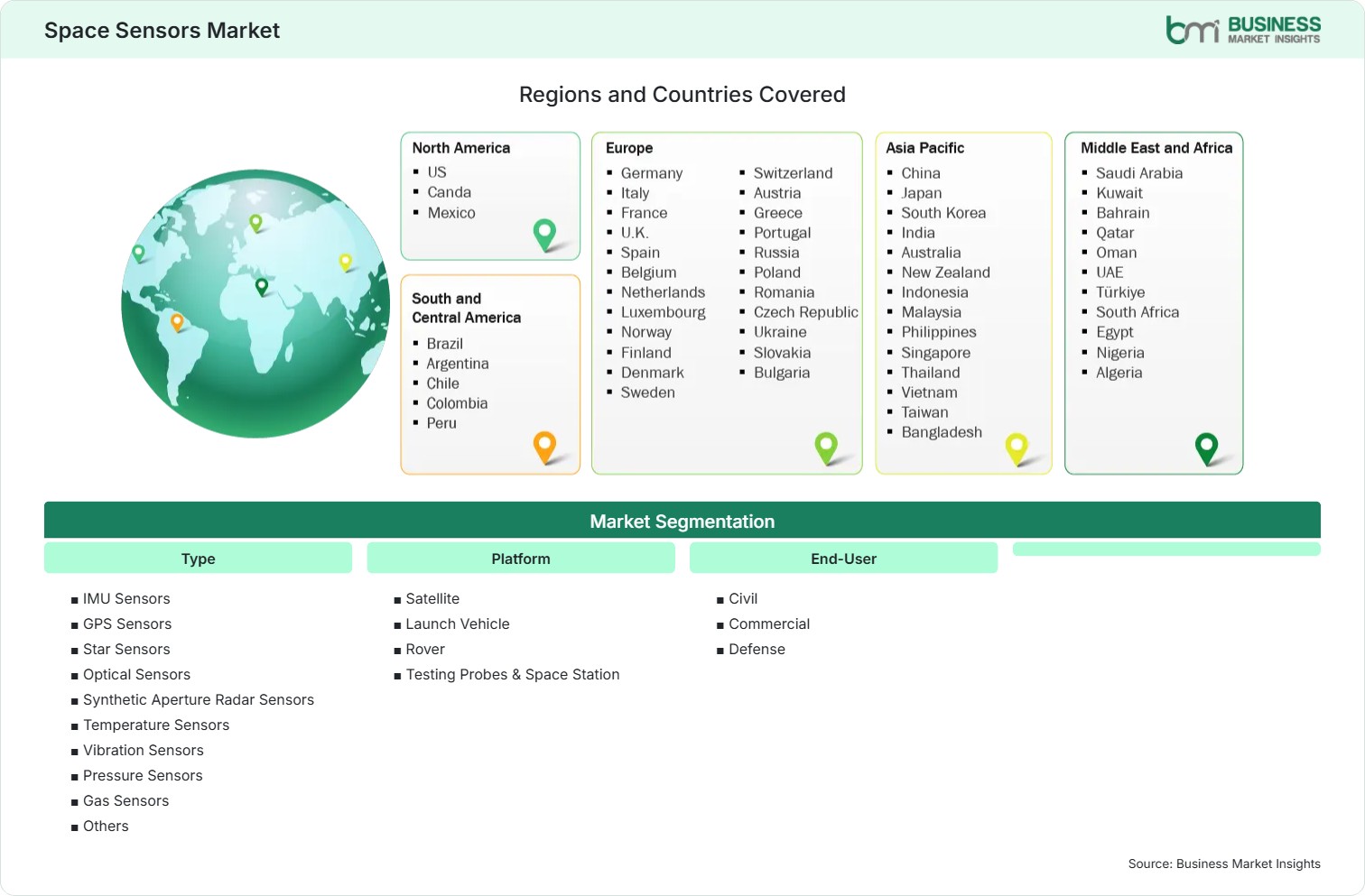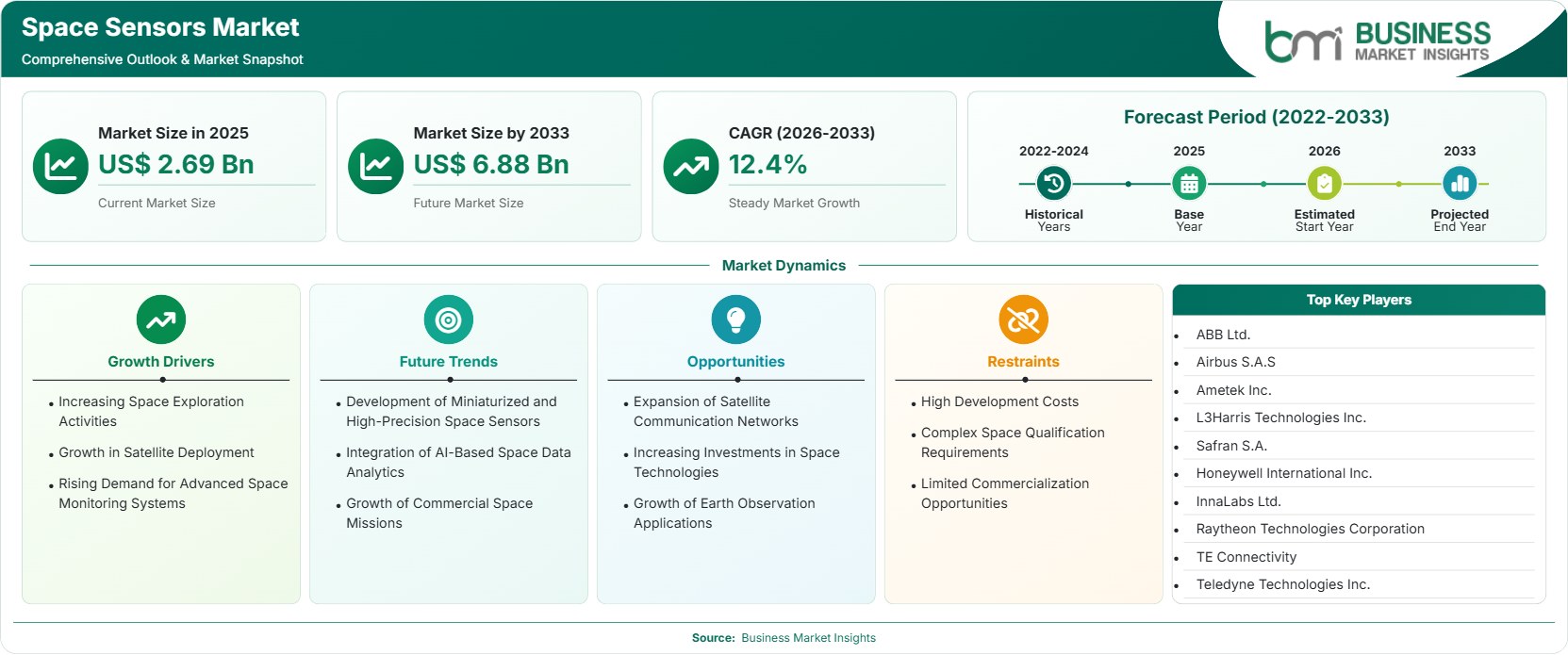
Space Sensors Market Regional Highlights
North America Space Sensors Market
The North American region has a market share of 35%-38% of the Space Sensors in 2025 and expected to grow with a CAGR of 11.8%-12.8% from 2026 to 2033. It leads in the industry due to its defense programs, commercial satellites projects, and aerospace manufacturing industry. The Space Sensors share remains supported by strong government contracts, private space investments, and continuous innovation in spacecraft technologies.
- The United States drives regional demand through NASA missions, defense satellite programs, and commercial launch activities requiring advanced navigation and monitoring sensors across multiple platforms.
- Canada contributes through Earth observation programs and aerospace research initiatives, supporting adoption of optical sensors, environmental monitoring devices, and satellite-based data collection technologies.
- Defense modernization investments are increasing requirements for precision sensors used in reconnaissance satellites, communication systems, and strategic space-based surveillance applications.
- Private companies developing satellite constellations are creating demand for compact, efficient sensing solutions designed for scalable spacecraft production and commercial deployment.
US Space Sensors Market
The United States holds an estimated Space Sensors Market share of 30% to 33%, which will further expand at a growth rate of CAGR of 12% to 13% from 2026 to 2033. There is already established aerospace infrastructure, defense expenditure, and growth in the commercial space that enables easy adoption of smart antennas in the country.
- Government-funded exploration missions are supporting demand for navigation, thermal, pressure, and vibration sensors used in spacecraft operating under extreme conditions.
- Commercial space companies are accelerating satellite manufacturing, increasing requirements for standardized and cost-efficient sensor solutions.
- Defense applications continue adopting advanced sensing platforms for intelligence, surveillance, communication, and secure space operations.
Europe Space Sensors Market
Europe holds a 22%–25% of the Space Sensors Market share in 2025 and is projected to achieve a CAGR of 11.0%–12.0% during 2026–2033. Factors such as ESA program initiatives, satellites development capability, and rising investments for climate monitoring are some of the factors driving the market in the region. Germany, France, and the UK are some major countries within the region.
- France demonstrates strong demand through government-backed missions and aerospace manufacturing capabilities supporting advanced spacecraft sensor integration.
- Germany contributes through satellite engineering, research institutions, and industrial automation expertise applied to space sensing technologies.
- The United Kingdom is expanding commercial space capabilities, creating opportunities for sensors used in communication and Earth observation satellites.
- European sustainability initiatives are increasing demand for environmental monitoring sensors supporting climate research and resource management.
- Italy and Spain are developing high-growth opportunities through participation in satellite programs and aerospace technology collaborations.
Asia Pacific Space Sensors Market
Asia Pacific accounts for a 25%–28% of the Space Sensors market share in 2025 and is expected to expand at a CAGR of 13.0%–14.5% during 2026–2033. The region is the fastest-growing market due to government space programs, satellite launches, and private sector investments. China, India, and Japan are leading countries, with India showing rapid expansion through commercial and exploration missions.
- China is increasing sensor demand through satellite networks, lunar exploration initiatives, and defense-related space programs requiring advanced technologies.
- India is expanding commercial space activities and satellite deployment programs, supporting growth of cost-effective and reliable sensing systems.
- Japan contributes through precision aerospace engineering and advanced spacecraft technologies requiring high-performance sensors.
- Southeast Asian countries are investing in communication and Earth observation satellites, creating new opportunities for sensor suppliers.
- Regional partnerships are accelerating technology transfer and improving local manufacturing capabilities for space components.
Rest of World Space Sensors Market
Rest of World contributes a 10%–13% share in 2025 and is forecast to grow at a CAGR of 12.5%–13.8% from 2026–2033. South and Central America are developing satellite capabilities for communication and environmental monitoring, while the Middle East and Africa are increasing investments in space infrastructure. Countries such as Brazil, UAE, and Saudi Arabia are creating new opportunities.
- Brazil supports regional adoption through Earth observation programs focused on agriculture, climate monitoring, and resource management applications.
- The UAE is expanding space capabilities through exploration missions and satellite programs requiring advanced sensing technologies.
- Saudi Arabia is investing in aerospace infrastructure and commercial space initiatives, increasing demand for specialized sensor solutions.
- African nations are adopting satellite technologies for connectivity, weather monitoring, and disaster management applications.
- Regional governments are encouraging partnerships with global aerospace companies to develop localized space technology ecosystems.