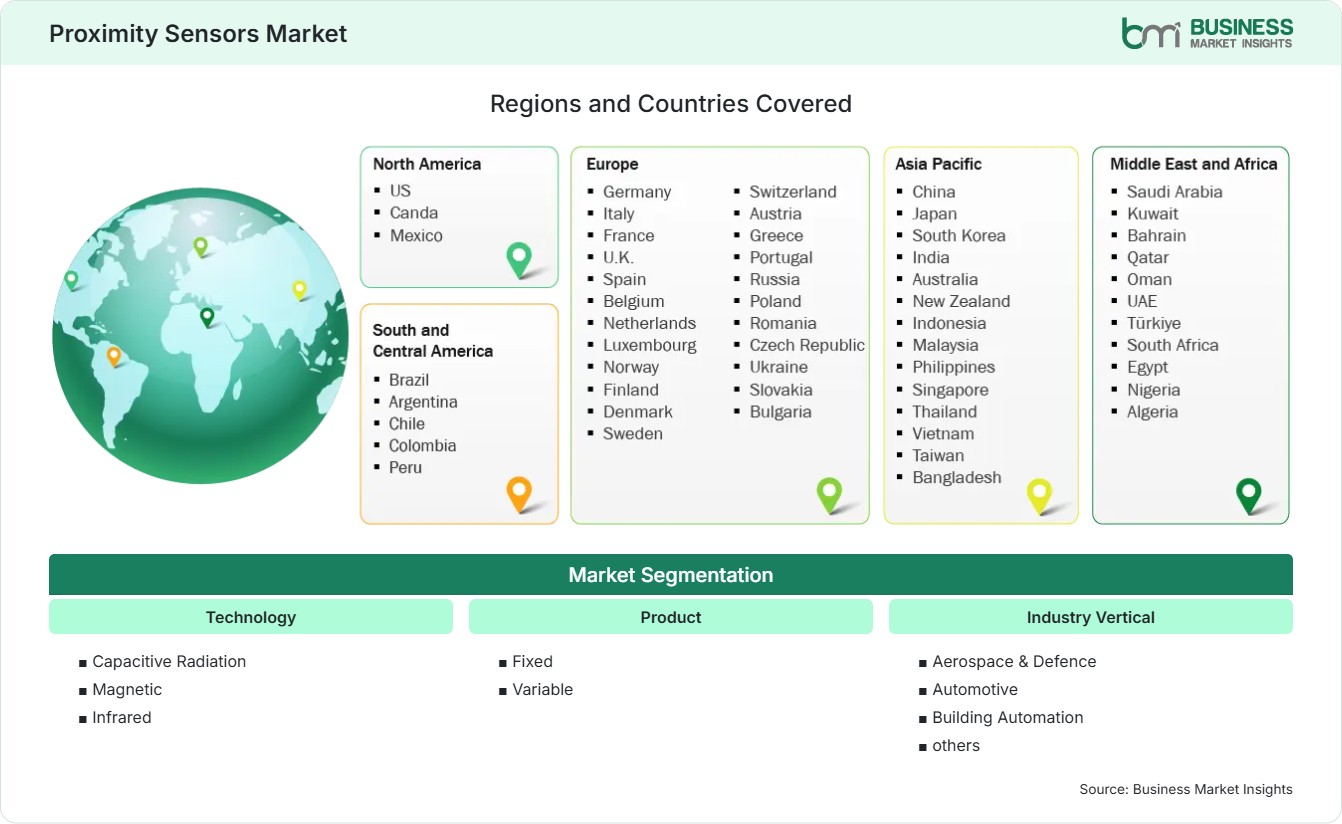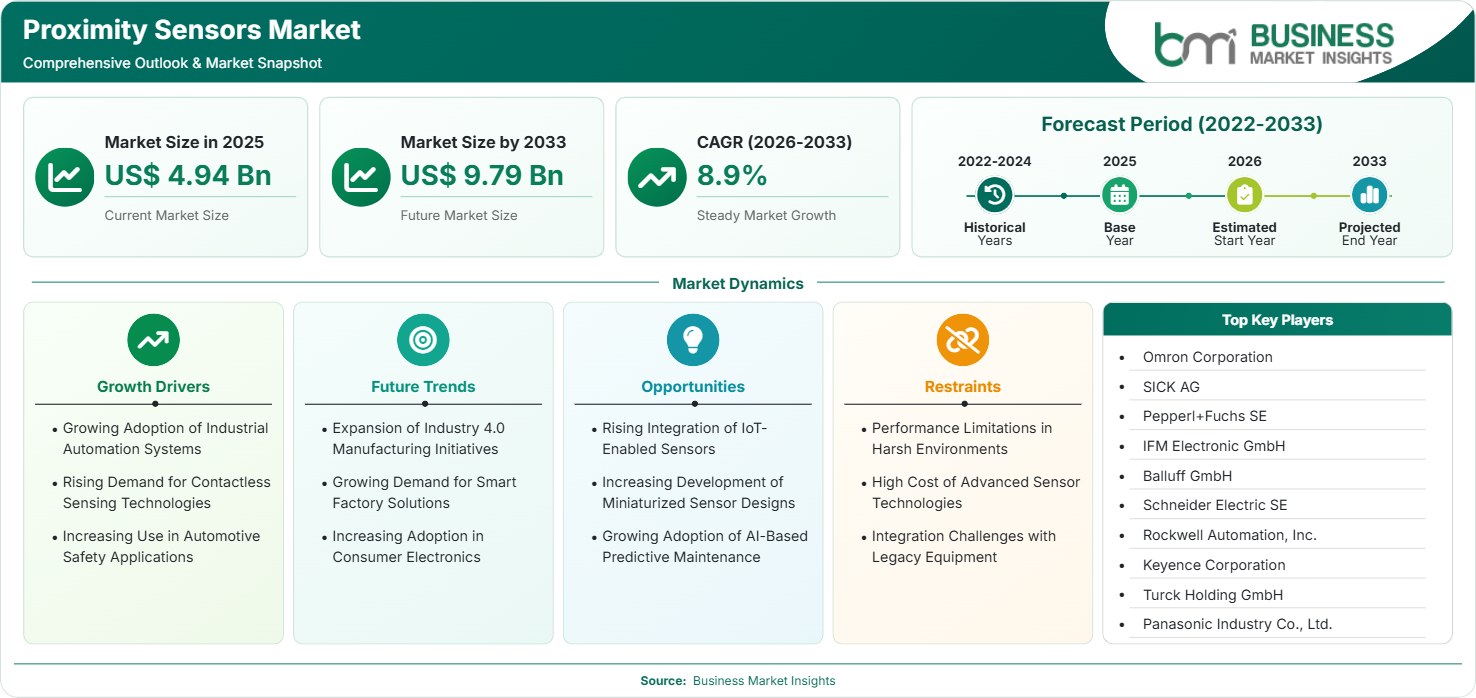
Proximity Sensors Market Regional Highlights
North America Proximity Sensors Market
North America accounted for 32%–34% of the Proximity Sensors Market share in 2025 and is projected to expand at a CAGR of 8.4%–8.8% during 2026–2033. Advanced manufacturing, industrial automation investments, and strong automotive production continue supporting regional demand for high-performance sensing technologies.
- Industrial automation projects continue increasing deployment of intelligent sensing systems across manufacturing facilities.
- Automotive manufacturers adopt advanced sensors to improve vehicle safety, positioning, and automation capabilities.
- Logistics and warehouse automation support expanding demand for contactless detection technologies.
- Smart manufacturing initiatives accelerate investments in AI-enabled industrial sensing platforms.
US Proximity Sensors Market
The United States represented 26%–28% of global revenue in 2025 and is expected to register a CAGR of 8.3%–8.7% through 2033. Growing investments in Industry 4.0, robotics, aerospace manufacturing, and industrial automation continue driving sensor adoption.
- Manufacturing modernization supports increased installation of intelligent sensing solutions.
- Aerospace production strengthens demand for highly reliable proximity sensing technologies.
- Automotive automation continues accelerating deployment of advanced sensor platforms.
- Smart warehouse expansion increases demand for industrial automation sensors.
Europe Proximity Sensors Market
Europe accounted for 25%–27% of global market revenue in 2025 and is projected to grow at a CAGR of 8.6%–9.0% during the forecast period. Industrial digitalization, automotive innovation, and factory automation continue strengthening regional demand. Germany leads the regional market, while Poland records the fastest growth.
- Germany remains the leading regional market through advanced industrial automation capabilities.
- Poland records strong growth supported by manufacturing expansion and industrial modernization.
- Automotive innovation continues driving intelligent sensor deployment across production facilities.
- Smart building automation increases commercial sensor installations throughout the region.
Asia Pacific Proximity Sensors Market
Asia Pacific accounted for 31%–33% of global market revenue in 2025 and is expected to register the highest CAGR of 9.7%–10.2% during 2026–2033. Expanding electronics manufacturing, industrial automation, and automotive production continue supporting robust regional growth.
- China leads regional demand through large-scale industrial automation investments.
- India records the fastest regional growth driven by manufacturing expansion and factory modernization.
- Japan continues advancing precision sensing technologies for industrial automation.
- South Korea strengthens semiconductor and electronics manufacturing supporting sensor demand.
- Southeast Asia increasingly adopts industrial automation across manufacturing industries.
Rest of World Proximity Sensors Market
The Rest of the World accounted for 10%–12% of global market revenue in 2025 and is projected to expand at a CAGR of 9.0%–9.4% during the forecast period.
South & Central America continue investing in manufacturing automation, while the Middle East & Africa strengthen industrial digitalization through infrastructure modernization and smart industrial projects.
- Brazil leads regional adoption through expanding industrial manufacturing investments.
- Mexico strengthens automotive manufacturing demand for proximity sensing technologies.
- Saudi Arabia invests in industrial automation under economic diversification initiatives.
- South Africa expands mining and industrial automation projects requiring advanced sensing systems.
- Smart infrastructure investments continue creating new opportunities across emerging markets.