
Inline Viscosity Sensor Market Outlook: Size, Share, Trends, Growth Analysis, Competitive Landscape & Forecast, 2026-2033

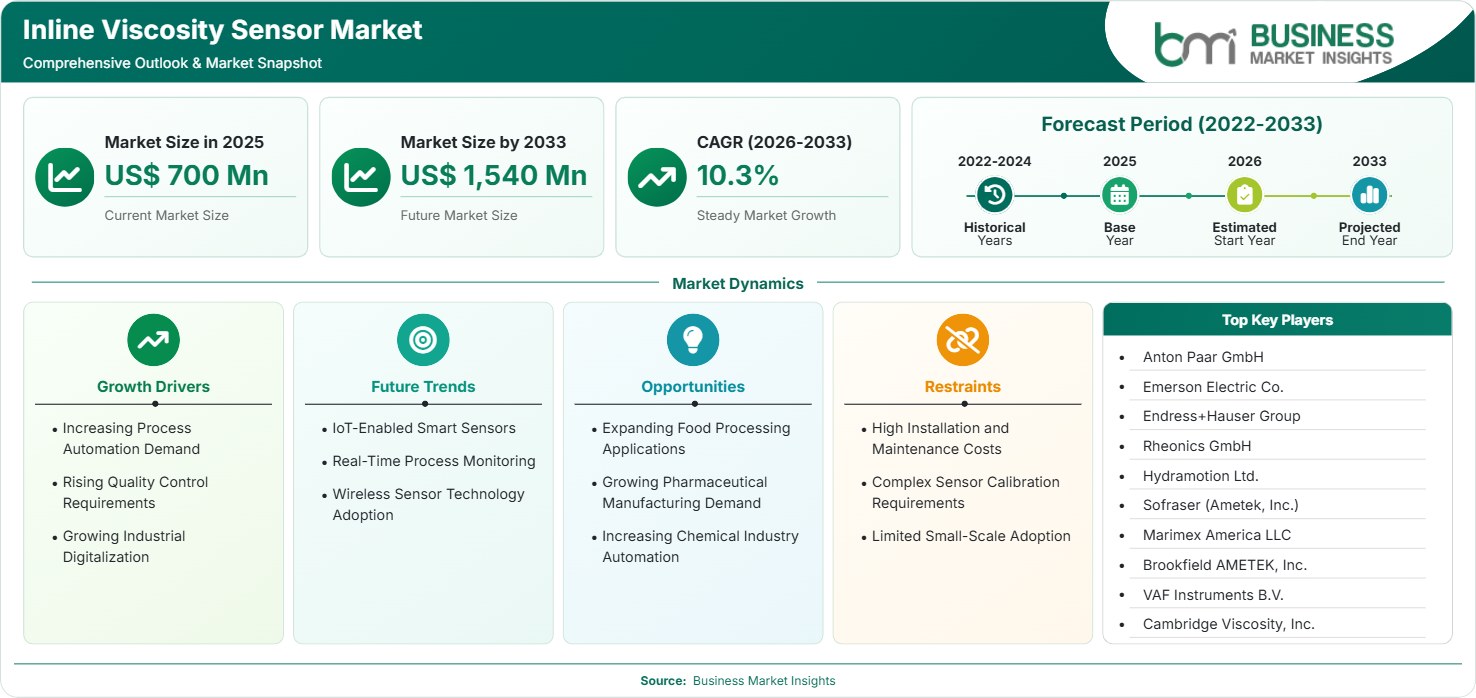
The Inline Viscosity Sensor Market size was valued at US$ 0.70 Billion in 2025 and is projected to reach US$ 1.54 Billion by 2033, growing at a CAGR of 10.3% during 2026–2033. Increasing process automation, real-time quality monitoring, and industrial digital transformation are accelerating adoption across chemical, pharmaceutical, food processing, automotive, and oil & gas applications. Rising demand for continuous measurement solutions and smart manufacturing systems is creating significant opportunities for sensor manufacturers.

Report Coverage
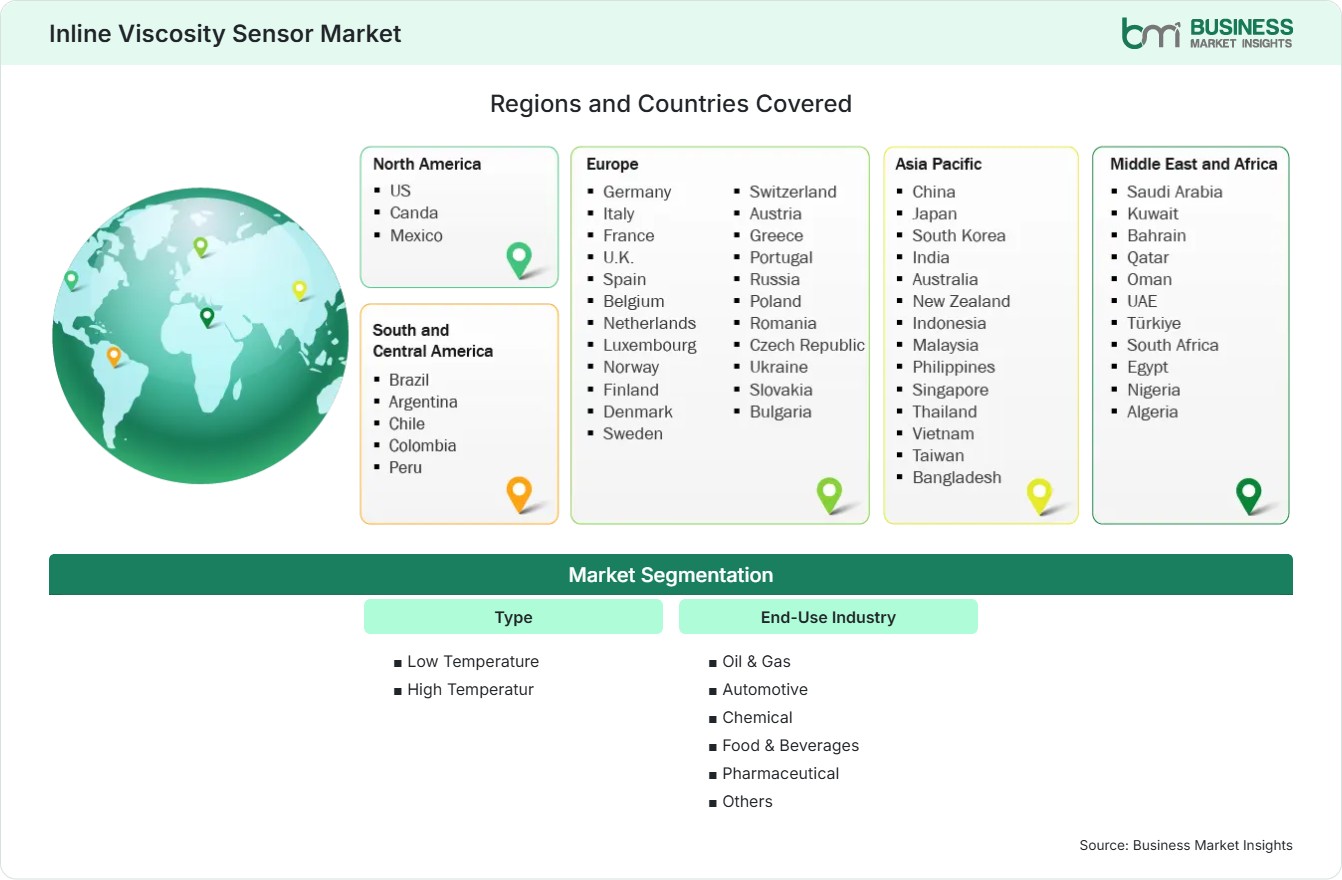
  • Type: Low Temperature, High Temperatur
  • End-Use Industry: Oil & Gas, Automotive, Chemical, Food & Beverages, Pharmaceutical, Others
US$ 700 Mn Market size in 2025
US$ 1,540 Mn Market Size by 2033
10.3% CAGR, 2026 - 2033
2026-2033 Forecast Period

01 AI Overview

Inline Viscosity Sensor Market Summary

  • North America Region: North America holds a market share of 30%–33% in 2025, growing at a CAGR of 9.4%–10.0% during 2026–2033. The region benefits from advanced manufacturing infrastructure, automation adoption, and strong demand from pharmaceutical, chemical, and energy industries. The U.S. Inline Viscosity Sensor Market report is expected to maintain leadership through process optimization initiatives, industrial IoT deployment, and increasing demand for real-time monitoring solutions, expanding at a CAGR of 9.5%–10.1%.
  • Fastest Growing Region: Asia Pacific represents 34%–37% share in 2025 and is projected to grow at a CAGR of 11.2%–11.8% during 2026–2033. Expanding manufacturing capacity, increasing automation investments, and rising pharmaceutical and food processing production are strengthening regional adoption of inline measurement technologies.
  • Leading Segment: Low Temperature sensors account for 62%–65% share in 2025, expanding at a CAGR of 9.6%–10.2%. Broad usage in chemical processing, food production, pharmaceuticals, and general industrial applications supports segment leadership due to operational flexibility and wider process compatibility.
  • High Growth Segment: Pharmaceutical end-use accounts for 15%–18% share in 2025 and is expected to grow at a CAGR of 12.0%–12.6%. Increasing regulatory focus on process consistency, automated manufacturing, and continuous quality monitoring is accelerating sensor adoption in drug production environments.
  • Key Market Opportunity: Growing adoption of smart factories, digital process control systems, and automated manufacturing platforms is creating opportunities for advanced viscosity sensors integrated with industrial analytics and predictive maintenance solutions.
  • Major Market Players: Anton Paar GmbH, Emerson Electric Co., Endress+Hauser Group, Rheonics GmbH, Hydramotion Ltd., Sofraser (AMETEK, Inc.), Marimex America LLC, Brookfield AMETEK, Inc., VAF Instruments B.V., and Cambridge Viscosity, Inc.
02 Strategic Insights

Inline Viscosity Sensor Market: Strategic Insights

Inline Viscosity Sensor Market Strategic Framework
FREE PDF
Request your free sample
Request free sample
03 Stakeholder View

Key Takeaways

  • Industrial automation is reshaping the measurement ecosystem. Manufacturers are moving from periodic sampling methods toward continuous monitoring solutions that improve production stability, reduce manual intervention, and enable faster process adjustments across complex industrial operations.
  • Pharmaceutical and food processing applications represent high-value opportunities. Increasing regulatory requirements for quality consistency and process validation are encouraging adoption of inline viscosity monitoring systems capable of delivering real-time production insights.
  • Digital connectivity is becoming a key product differentiator. Sensor manufacturers are focusing on IoT-enabled devices, advanced communication interfaces, and analytics integration to support smart manufacturing environments and predictive process management.
  • Asia Pacific provides strong expansion potential. Rapid industrialization, growing manufacturing investments, and increasing automation adoption across China, India, Japan, and Southeast Asia are creating favorable conditions for sensor deployment.
  • Technology partnerships are influencing competitive positioning. Companies are strengthening capabilities through collaborations involving automation platforms, process control systems, and digital solutions to deliver integrated monitoring ecosystems.
  • Customization is gaining importance among industrial users. Customers increasingly require sensors designed for specific temperature ranges, chemical compatibility requirements, and challenging operating environments, encouraging manufacturers to develop application-specific solutions.
04 Geographic Outlook

Inline Viscosity Sensor Market Regional Highlights

North America Inline Viscosity Sensor Market

North America accounted for 30%–33% of the global market in 2025 and is projected to expand at a 9.4%–10.0% CAGR during 2026–2033. Strong adoption across pharmaceuticals, chemicals, automotive manufacturing, and oil & gas operations supports regional growth. The Inline Viscosity Sensor Market share remains influenced by advanced industrial automation infrastructure, increasing digital transformation initiatives, and demand for precise process control technologies.

  • The United States dominates regional demand due to advanced manufacturing facilities, pharmaceutical production growth, and increasing adoption of industrial automation systems.
  • Canada is experiencing rising adoption through food processing modernization, energy sector optimization, and increased investments in automated production monitoring solutions.
  • Industrial companies are integrating smart sensors with process control platforms to improve efficiency, reduce downtime, and strengthen operational visibility.
  • Demand for real-time measurement technologies is increasing as manufacturers prioritize quality assurance and regulatory compliance across multiple industries.

US Inline Viscosity Sensor Market

The United States represented 25%–27% of the global market in 2025 and is expected to grow at a 9.5%–10.1% CAGR through 2033. The country benefits from strong pharmaceutical manufacturing, chemical processing capabilities, advanced automotive production, and widespread industrial automation adoption. Increasing investment in smart manufacturing systems is supporting demand for connected viscosity measurement technologies.

  • Pharmaceutical manufacturers are adopting inline sensors to improve process validation, batch consistency, and regulatory compliance during production activities.
  • Chemical companies are integrating automated monitoring systems to optimize formulations, reduce waste, and improve operational efficiency.
  • Industrial digitalization programs are encouraging manufacturers to replace manual testing methods with connected measurement technologies.

Europe Inline Viscosity Sensor Market

Europe held 24%–27% of the market in 2025 and is projected to grow at a 9.7%–10.3% CAGR between 2026 and 2033. Germany leads regional adoption through advanced manufacturing capabilities, while France, the United Kingdom, and Italy contribute through pharmaceutical, automotive, and chemical industries. The region’s focus on automation, efficiency improvement, and sustainable production practices supports sensor deployment.

  • Germany remains the leading market due to strong industrial automation adoption and advanced engineering capabilities.
  • France and the United Kingdom are expanding sensor adoption through pharmaceutical manufacturing and process optimization initiatives.
  • Italy supports demand through food processing, automotive production, and specialty chemical manufacturing applications.
  • European manufacturers are investing in Industry 4.0 technologies to improve production monitoring and resource efficiency.

Asia Pacific Inline Viscosity Sensor Market

Asia Pacific accounted for 34%–37% of the global Inline Viscosity Sensor Market in 2025 and is projected to expand at the fastest rate with a 11.2%–11.8% CAGR during 2026–2033. Regional growth is supported by rapid industrial automation, semiconductor manufacturing expansion, pharmaceutical production growth, and increasing adoption of smart factory technologies. China, Japan, South Korea, and India are strengthening demand through investments in advanced manufacturing infrastructure and process optimization solutions.

  • China represents the largest regional market due to extensive chemical production, automotive manufacturing, electronics processing, and increasing deployment of automated industrial systems.
  • India is emerging as a high-growth market with expanding pharmaceutical manufacturing, food processing capacity, and government-supported industrial digitalization initiatives.
  • Japan and South Korea are adopting advanced viscosity measurement solutions across semiconductor, automotive, and precision manufacturing industries requiring high process accuracy.
  • Southeast Asian countries are attracting manufacturing investments, increasing demand for automated monitoring systems across chemicals, food processing, and industrial production facilities.
  • Growing Industry 4.0 adoption across Asia Pacific is encouraging integration of inline sensors with industrial control platforms and real-time analytics systems.

Rest of World Inline Viscosity Sensor Market

The Rest of World region accounted for 6%–9% of the global Inline Viscosity Sensor Market in 2025 and is expected to register a 8.6%–9.2% CAGR from 2026–2033. Growth is supported by industrial modernization, energy sector investments, and expanding manufacturing activities across Latin America, the Middle East, and Africa. Regional adoption is increasing as companies invest in process efficiency, automation, and improved quality monitoring capabilities.

Latin America is witnessing gradual adoption through oil & gas operations, food processing industries, and chemical manufacturing expansion. Brazil and Mexico are key contributors due to their established industrial bases and increasing automation investments.

The Middle East and Africa are creating new opportunities through refinery modernization, industrial diversification programs, and growing manufacturing infrastructure development. Countries investing in advanced production technologies are increasing demand for reliable process measurement solutions.

  • Brazil is a leading Latin American market supported by food processing, automotive manufacturing, and chemical industry automation initiatives.
  • Mexico is expanding sensor adoption through automotive production growth, industrial manufacturing investments, and integration of automated quality control systems.
  • Saudi Arabia and the UAE are strengthening demand through oil & gas modernization projects and industrial diversification strategies.
  • South Africa is supporting regional growth through mining operations, chemical processing activities, and increasing industrial technology adoption.
  • Regional distributors are expanding technical support networks to improve accessibility of advanced industrial measurement technologies.
Global Market Geography
FREE PDF
Request your free sample
Request free sample
05 Segment Analysis

Inline Viscosity Sensor Market Segmentation

Type

The type segment plays a critical role in determining sensor suitability across industrial operating environments. Low Temperature sensors represented the leading category with 62%–65% share in 2025 and are projected to grow at a 9.6%–10.2% CAGR during 2026–2033. These systems are widely adopted due to their compatibility with standard manufacturing conditions, broad application range, and cost efficiency. High Temperature sensors are gaining traction in demanding industrial environments requiring accurate viscosity measurement under elevated thermal conditions.

  • Low Temperature: Low temperature sensors are extensively used in food processing, pharmaceuticals, chemicals, and general manufacturing applications where stable viscosity measurement supports quality control, process optimization, and production consistency.
  • High Temperature: High temperature sensors are designed for challenging environments including petroleum processing, specialty chemicals, and industrial applications requiring reliable measurement performance under elevated operating conditions and thermal fluctuations.

End-Use Industry

The end-use industry vertical shows growth in terms of acceptance as manufacturers give preference to automation in process control and operation, along with quality control in real time. The Chemical industry has been identified as the largest application segment with a 28%–31% share in 2025, and the inline viscosity sensor market forecast to grow at a 10.0%–10.6% CAGR from 2026–2033. The market scope continues expanding as industries adopt continuous monitoring technologies for improved production accuracy, reduced waste, and enhanced regulatory compliance.

  • Oil & Gas: Inline viscosity sensors support fuel quality monitoring, lubricant analysis, and process optimization by providing continuous measurement capabilities in refining and energy production operations.
  • Automotive: Automotive manufacturers utilize viscosity sensors for lubricant testing, fluid management, and production quality control, improving efficiency across vehicle manufacturing and component processing activities.
  • Chemical: Chemical producers increasingly adopt inline monitoring solutions for formulation control, reaction optimization, and consistent product quality across specialty chemical and industrial manufacturing processes.
  • Food & Beverages: Food processors are implementing viscosity monitoring technologies to maintain texture consistency, optimize formulations, and meet stringent quality standards across beverages, sauces, dairy products, and processed foods.
  • Pharmaceutical: Pharmaceutical manufacturers are deploying advanced sensors for continuous process monitoring, quality assurance, and production validation, supporting compliance requirements and improving manufacturing efficiency.
06 Market Forces

Inline Viscosity Sensor Market Dynamics

Key Market Drivers

Increasing Process Automation Demand

Rising acceptance of automated industry solutions is one of the key factors propelling the Inline Viscosity Sensor Market growth. Firms are adopting continuous measurement methods by eliminating manual sampling techniques to increase efficiency, lower downtime, and increase resource optimization. Process control systems that utilize inline viscosity sensors assist in making faster modifications during manufacturing processes for improved quality. Development in the Market will be driven by the growing adoption of smart factories, industrial robots, and manufacturing platforms. Sectors such as chemicals, automotive, pharmaceuticals, and food & beverages are incorporating automation technologies for greater productivity.

Rising Quality Control Requirements

The rising demand for quality control measures across industries is driving the need for efficient, precise viscosity-monitoring devices. Real-time measurements are essential for ensuring that the products meet the required specifications, reducing any inconsistencies in production, and helping with compliance in industries. Industries that manufacture pharmaceuticals and food products are taking advantage of continuous monitoring systems to aid with process validation and consistency of batches. The Inline Viscosity Sensor market trend suggests that more industries that are sensitive to the viscosity of the product are adopting these technologies.

Growing Industrial Digitalization

The digitalization process in the industry is leading to increased usage of connected viscosity measurement systems due to sensor implementation in the entire data-based production system. Smart manufacturing systems utilize real-time information about ongoing processes to improve decision-making and predict potential problems. Inline viscosity sensors equipped with digital communication capabilities allow seamless integration with industrial control systems and analytics platforms. This transition creates a need for smart sensors that provide continuous information. Firms that implement Industry 4.0 solutions tend to use more advanced measuring systems to increase flexibility and decrease unexpected equipment performance problems.

Key Market Opportunities

Expanding Food Processing Applications

The development of food processing industries opens up significant opportunities for suppliers of inline viscosity sensors due to the increasing attention by food producers to automated quality control. The need for precise viscosity control arises due to the necessity of keeping constant quality in various food products, including sauces, beverages, dairy, and other processed foods. The increasing consumer demand for standardized food quality leads to the development of new, sophisticated monitoring equipment used in the production process.

Growing Pharmaceutical Manufacturing Demand

Increasing pharmaceutical manufacturing activity is creating opportunities for advanced viscosity monitoring solutions used in formulation development, production control, and quality assurance. Drug manufacturers require precise process monitoring systems to meet strict regulatory requirements and maintain consistent product characteristics. The expansion of biologics, specialty medicines, and advanced pharmaceutical manufacturing facilities is increasing demand for automated process technologies. Inline viscosity sensors support continuous monitoring and improved manufacturing efficiency by providing real-time production insights. Suppliers offering validated solutions, regulatory support, and integration with pharmaceutical manufacturing systems can capture opportunities from expanding global healthcare production investments.

Increasing Chemical Industry Automation

The proliferation of automation in the chemical industry presents further growth prospects for manufacturers. The digital monitoring of chemical processes allows for optimizing formulations, ensuring better reaction control, and improving the safety of operations. The continuous measurement of viscosity enables manufacturers to detect process variations and ensure the uniform quality of products in complicated chemical processes. The expansion in the manufacture of specialty chemicals and increased requirements for custom formulations encourage organizations to implement sophisticated monitoring technologies. Manufacturers of sensors that deliver reliable performance in harsh chemical-processing conditions will find many opportunities in the coming year.

Market Restraints and Challenges

High Installation and Maintenance Costs

Factor: The installation of inline viscosity sensors often requires special integration needs, which could increase the financial input required by industrial customers. Maintenance processes could include regular checks and new components, as well as technical staff. Impact: High costs of ownership could hinder implementation by small- to medium-sized manufacturers, who are usually limited in terms of budgeting for automation technologies. Companies may delay technology upgrades when the expected efficiency gains do not immediately offset installation and maintenance; thus, there will be reluctance to upgrade technologies.

Complex Sensor Calibration Requirements

Factor: Calibration is essential in inline viscosity sensors for sustaining accuracy in fluid measurement at varying temperatures, pressures, and process environments. Variations in the process environment can pose difficulties in ensuring consistency in sensor readings. Complicated calibration processes add to requirements and may require expert intervention, thus placing greater demands on end users. Impact: Industries with limited automation expertise may experience slower adoption due to concerns regarding sensor management, accuracy maintenance, and long-term reliability.

07 Company Analysis

Competitive Landscape

The competitive landscape of the Inline Viscosity Sensor Market analysis highlights strong participation from global automation companies, precision measurement technology providers, and specialized sensor manufacturers. Companies are competing through advanced sensor accuracy, digital integration capabilities, application-specific solutions, and expanded service networks.

Company Name

Overview

Products and Services relevant to this market

Anton Paar GmbH

Austrian measurement technology company specializing in laboratory and process measurement solutions for industrial applications.

Provides inline viscosity measurement systems, process sensors, rheological instruments, and analytical solutions for industrial quality control.

Emerson Electric Co.

Global automation technology provider delivering process control, instrumentation, and industrial digitalization solutions.

Offers process measurement technologies, automation platforms, and industrial monitoring solutions supporting viscosity control applications.

Endress+Hauser Group

Global instrumentation company providing measurement and automation solutions for process industries.

Supplies process sensors, industrial measurement systems, and digital solutions for chemical, pharmaceutical, and manufacturing operations.

Rheonics GmbH

Swiss technology company specializing in advanced inline viscosity and density measurement solutions.

Provides real-time viscosity sensors, process monitoring systems, and industrial automation integration solutions.

Hydramotion Ltd.

UK-based manufacturer focused on inline viscosity measurement technologies for industrial processes.

Develops inline viscometers, process monitoring systems, and viscosity control solutions for manufacturing industries.

Sofraser (AMETEK, Inc.)

Industrial measurement solutions provider specializing in viscosity monitoring technologies.

Offers inline viscometers and process measurement systems for chemical, petroleum, food, and industrial applications.

Marimex America LLC

Industrial technology supplier providing process measurement and monitoring solutions.

Supplies viscosity measurement technologies and industrial instrumentation solutions for manufacturing applications.

Brookfield AMETEK, Inc.

Measurement technology provider recognized for viscosity analysis and rheology instrumentation.

Provides viscosity measurement instruments, laboratory solutions, and industrial process monitoring technologies.

VAF Instruments B.V.

Netherlands-based instrumentation company serving marine, energy, and industrial sectors.

Provides viscosity control systems, fuel monitoring solutions, and industrial measurement equipment.

Cambridge Viscosity, Inc.

Technology company specializing in precision viscosity measurement solutions.

Develops process viscosity sensors, measurement systems, and analytical technologies for industrial applications.

08 Industry Activity

Recent Developments

April 2025

Endress+Hauser Group reported strong investments in research and development, launching 81 new products in 2024 while expanding its measurement and automation portfolio, including process instrumentation supporting advanced inline process monitoring applications.

February 2025

Anton Paar GmbH opened a new APAC Technical Center in Kuala Lumpur, Malaysia, expanding regional application support, customer training, and process measurement capabilities for industries using viscosity, density, and rheology instrumentation.

March 2024

Emerson Electric Co. launched the Rosemount 9195 Wedge Flow Meter, designed for challenging applications involving high-viscosity, abrasive, and high-temperature process fluids. The solution enhances process measurement reliability and supports industries such as chemicals, oil & gas, pulp & paper, and mining.

February 2024

Endress+Hauser Group showcased new measurement and automation technologies during its 2024 Digital Technical Press Event, highlighting innovations in process instrumentation developed to address industry-specific process monitoring and quality control requirements across multiple industries.

10 Trust & Transparency

Research Methodology

The market analysis combines proprietary research with secondary data from government agencies, company disclosures, regulatory filings, industry databases and expert interviews. Market estimates are validated through data triangulation, cross-market benchmarking and analyst review.

View Full Research Methodology

11 Questions Answered

Frequently Asked Questions

What is the future outlook for the Inline Viscosity Sensor Market?

The market outlook is supported by increasing automation, smart manufacturing adoption, pharmaceutical expansion, and demand for continuous quality monitoring solutions across industrial processing environments.

What factors determine the selection of an inline viscosity sensor?

Selection depends on operating temperature, fluid characteristics, accuracy requirements, process conditions, compatibility with automation systems, maintenance requirements, and industry-specific regulatory standards.

How does digitalization influence inline viscosity sensor adoption?

Digitalization enables integration of sensors with industrial control systems, cloud platforms, and analytics tools. This allows manufacturers to monitor processes remotely, identify performance issues, and optimize production through data-driven decision-making.

Why are industries replacing traditional viscosity testing methods?

Industries are shifting toward inline measurement because it enables real-time monitoring, reduces manual sampling requirements, improves production efficiency, and allows faster corrective actions during manufacturing processes.

What industries are driving adoption of the inline viscosity sensor market?

Oil & gas, chemical processing, pharmaceuticals, food & beverages, and automotive industries are the primary adopters.

Access the Full Inline Viscosity Sensor Market Report

Get segment-level forecasts, regional estimates, competitive benchmarking, company profiles and downloadable Excel datasets.

Access the full Inline Viscosity Sensor Market Report
350 pages PDF & Excel | 2026-07-31