Market Summary
Executive Summary and Global Market Analysis
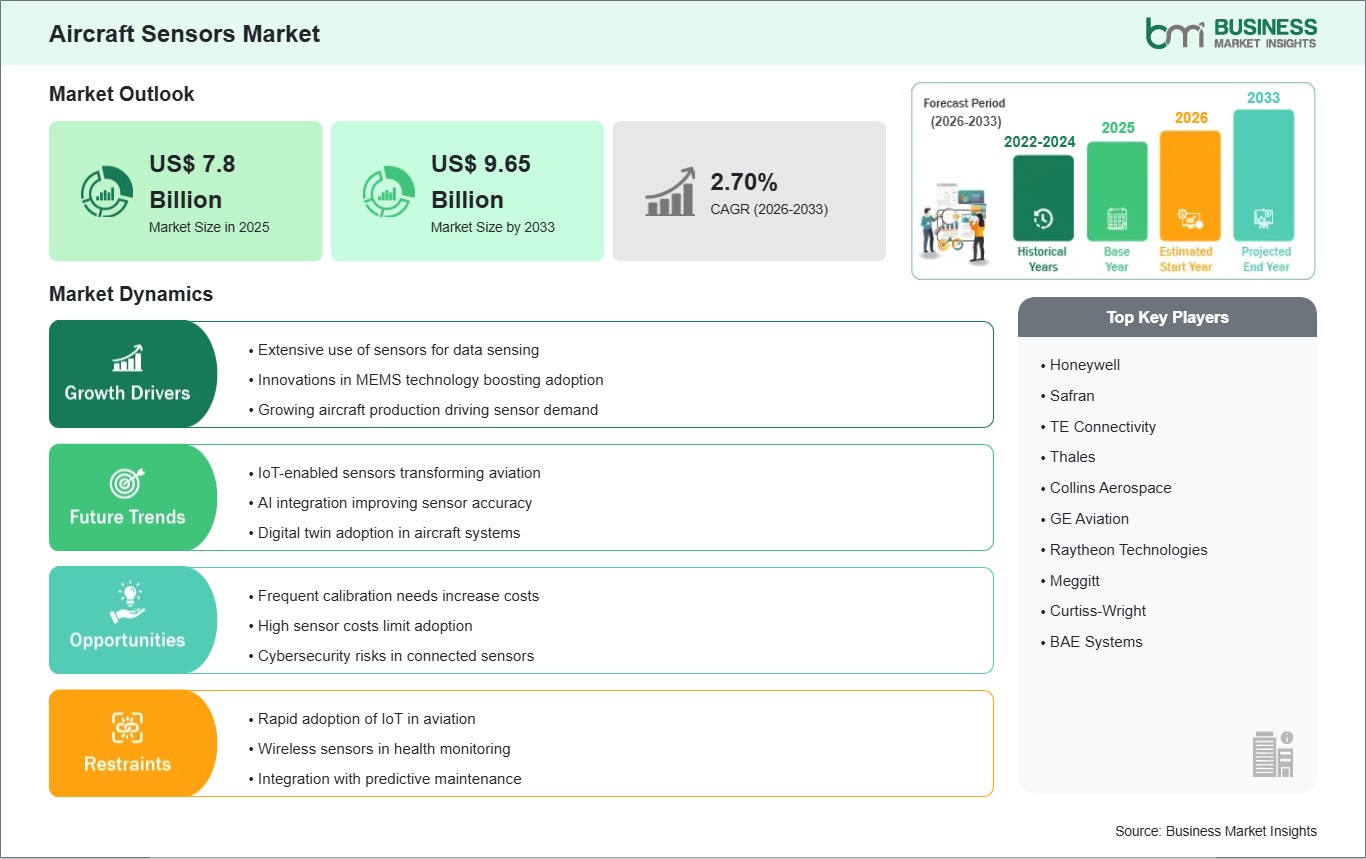
Aircraft sensors are devices used to monitor, measure, and transmit critical information related to aircraft operations, safety, and performance. Common sensor types include pressure sensors, proximity sensors, optical sensors, force sensors, radar sensors, temperature sensors, and motion sensors. These sensors are essential for propulsion systems, flight control functions, navigation, environmental monitoring, and cockpit operations. The market is growing as aircraft become more digitally connected, airlines focus on predictive maintenance, and aviation manufacturers integrate advanced monitoring technologies into next-generation aircraft. Increasing adoption of automation, smart avionics, and real-time data analytics is also supporting demand for advanced sensor systems across commercial and military aviation platforms.
Some challenges could slow market growth. The sensors used in aircraft need to meet aviation certifications, and the process can make the development and deployment of the products costly and time-consuming. Sensors must endure tough operating conditions that involve varying temperatures, vibrations, and pressure, necessitating robust sensor technology. There may also be issues related to integrating modern sensors on existing aircraft systems that would incur high costs. Furthermore, supply chain problems with electronics and semiconductors could arise. These factors can increase operational costs and create challenges for widespread deployment.
Even with these challenges, the market is expected to grow as the aviation industry adopts more intelligent and data-driven systems. New opportunities are emerging from advancements in miniaturized sensors, wireless monitoring technologies, and integrated aircraft health management systems. The increasing use of artificial intelligence for predictive maintenance and real-time diagnostics is creating demand for more sophisticated sensing capabilities. Growth in unmanned aerial vehicles, advanced air mobility platforms, and next-generation commercial aircraft is also supporting innovation in sensor technologies.
Segment Analysis
Aircraft Sensors Market Segmentation
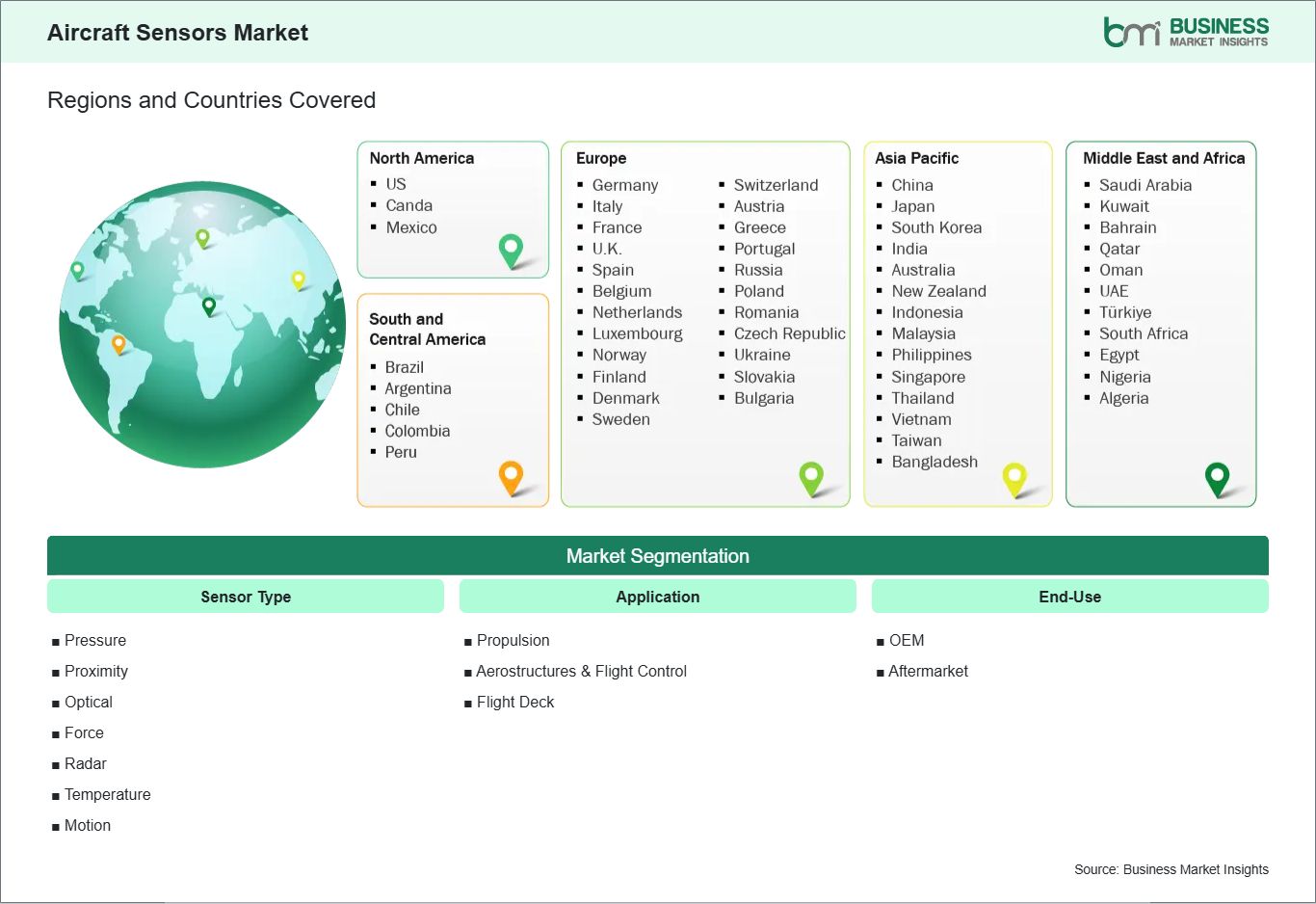
The Aircraft Sensors market is segmented based on sensor type, application, and end-use, reflecting the diverse monitoring and control requirements across aviation platforms.
By Sensor Type
- Pressure Sensors: Widely used for altitude measurement, fuel monitoring, and hydraulic system management
- Proximity Sensors: Support landing gear positioning, door monitoring, and aircraft safety functions
- Optical Sensors: Used for navigation, detection, and advanced monitoring applications
- Force Sensors: Measure structural loads and mechanical stress during operations
- Radar Sensors: Enable navigation, collision avoidance, and situational awareness functions
- Temperature Sensors: Monitor engine performance, environmental systems, and equipment health
- Motion Sensors: Support flight control, stability management, and navigation systems
By Application
- Propulsion: Dominates demand due to continuous monitoring requirements in aircraft engines and related systems
- Aerostructures & Flight Control: Supports structural health monitoring and flight performance optimization
- Flight Deck: Enables navigation, instrumentation, and pilot decision-making functions
By End-Use
- OEM: Accounts for significant demand through integration into newly manufactured aircraft
- Aftermarket: Driven by maintenance, upgrades, retrofits, and replacement requirements across existing fleets
Market Forces
Aircraft Sensors Market Drivers and Opportunities
Rising Adoption of Smart Aircraft Monitoring Systems
The aviation industry is increasingly adopting smart monitoring systems to improve safety, operational efficiency, and maintenance planning. Aircraft sensors give operators important data to monitor engine health, structural conditions, environmental factors, and flight performance as they happen. Airlines and operators are turning to predictive maintenance to cut down on unexpected failures and keep planes available. Regulations that focus on safety and reliability are also encouraging the use of advanced sensing technologies on aircraft.
Modern aircraft depend on connected systems that constantly gather and process operational data. Sensors are at the core of these systems, delivering accurate and timely information. As the aviation industry looks to lower maintenance costs and boost performance, the need for advanced sensor technologies is rising. This ongoing demand is likely to drive steady growth in the Aircraft Sensors market.
Growth Opportunities in Advanced Air Mobility and Autonomous Aviation
Emerging aviation technologies are creating new opportunities for the Aircraft Sensors market. Advanced air mobility platforms, electric aircraft, and unmanned aerial vehicles require highly reliable sensing systems to support autonomous operations, navigation, and safety management. These aircraft depend on extensive sensor networks to monitor performance and ensure operational accuracy.
With the emergence of improvements in miniaturization, wireless connectivity, and AI, smarter sensor products can be developed. Sensing device providers are now developing sensors that are lighter in weight and increase performance, but reduce weight. Digital twin technology and advanced maintenance techniques have increased the requirement for smart sensors. As the aviation industry continues to embrace automation and electrification, opportunities for innovative aircraft sensor solutions are expected to expand significantly.
Size and Share Analysis
Aircraft Sensors Market Size and Share Analysis
The Aircraft Sensors Market size is expected to reach US$ 9.65 billion by 2033 from US$ 7.8 billion in 2025. The market is estimated to record a CAGR of 2.70% from 2026 to 2033.
By sensor type, pressure sensors account for a significant share due to their extensive use in altitude measurement, hydraulic systems, fuel management, and engine monitoring applications. Temperature sensors continue to witness strong demand as aircraft operators focus on equipment health monitoring and thermal management, while radar and optical sensors are gaining importance with increasing adoption of advanced avionics and navigation technologies.
By application, propulsion dominates the market owing to the critical requirement for continuous engine monitoring and performance optimization. Aerostructures & flight control applications maintain substantial demand due to increasing emphasis on structural health monitoring and flight safety. Flight deck applications are also expanding steadily with growing integration of advanced navigation, automation, and pilot assistance systems across modern aircraft platforms.
Report Coverage
Aircraft Sensors Market Report Coverage and Deliverables
The "Aircraft Sensors Market Size and Forecast (2022-2033)" report provides a detailed analysis of the market covering below areas:
- Market size and forecast at global, regional, and country levels for all the key market segments covered under the scope
- Market trends, as well as market dynamics such as drivers, restraints, and key opportunities
- Market analysis covering key market trends, global and regional framework, major players, regulations, and recent market developments
- Industry landscape and competition analysis covering market concentration, heat map analysis, prominent players, and recent developments for the market
- Detailed company profiles, including SWOT analysis
Geographic Insights
Aircraft Sensors Market Geographic Insights
The Aircraft Sensors Market shows diverse regional adoption patterns influenced by aircraft manufacturing activities, aviation technology advancements, and increasing demand for operational safety and efficiency.
North America, being a developed aerospace region, has a strong aviation manufacturing ecosystem and a high rate of adoption of advanced aircraft sensor technologies. The region comprises the United States and Canada, where investments are being made in next-generation aircraft development, avionics modernization, and defense aviation programs. The region focuses on improving flight safety, predictive maintenance capabilities, and operational efficiency through advanced sensing systems. It has well-established aerospace infrastructure, research capabilities, and regulatory frameworks, allowing for the widespread adoption of aircraft sensors across commercial, military, and business aviation applications.
Asia Pacific is growing significantly, driven by expanding commercial aviation fleets, increasing aircraft production activities, and rising investments in aerospace infrastructure. The region comprises countries such as China, India, and Japan, where growing passenger traffic and aviation modernization initiatives are creating strong demand for aircraft sensor technologies. The region focuses on enhancing aviation safety, improving fleet performance, and supporting indigenous aerospace manufacturing capabilities. The expansion of maintenance facilities, aviation training centers, and aircraft manufacturing programs is also contributing to the growth of the Aircraft Sensors Market, along with increasing government support for aerospace development and technological innovation.
Both regions are contributing significantly to the growth of the Aircraft Sensors Market, focusing on aviation modernization, increasing aircraft production activities, and rising demand for advanced monitoring and safety technologies.
Industry Activity
Recent Developments
The Aircraft Sensors Market is analyzed using a mix of primary and secondary research sources, including corporate publications, industry associations, and verified databases. This approach ensures accurate tracking of innovation trends and strategic developments influencing the market.
- In April 2025, Collins Aerospace officially joined the Airbus-led Digital Alliance for Aviation to advance real-time predictive health monitoring solutions for commercial airlines. The strategic partnership integrates Collins's deep sensor and components expertise directly into the cloud-based Skywise data platform. The development significantly accelerates data transparency and sophisticated analytics across fleet operations, improving flight safety and allowing carriers to preemptively track aircraft system performance.
- In December 2024, Honeywell launched Honeywell Ensemble, a cloud-based digital maintenance platform engineered for business jet turbofan engines. The automated system automatically downloads and wirelessly transmits comprehensive engine diagnostics after every flight to deliver near-real-time analytics and anomaly alerts. The development significantly reduces manual safety reporting errors, optimizes fleet uptime, and highlights the accelerating integration of automated Internet of Things (IoT) data pipelines within the aviation aftermarket services ecosystem.
Trust & Transparency
Research Methodology
The market analysis combines proprietary research with secondary data from government agencies, company disclosures, regulatory filings, industry databases and expert interviews. Market estimates are validated through data triangulation, cross-market benchmarking and analyst
review.
View Full Research Methodology
Key Sources Referred:
World Bank - Global Trade IndicatorsWorld Trade Organization (WTO)International Monetary Fund (IMF)International Trade Administration (ITA)Company WebsitesCompany Annual ReportsCompany Investor Presentations