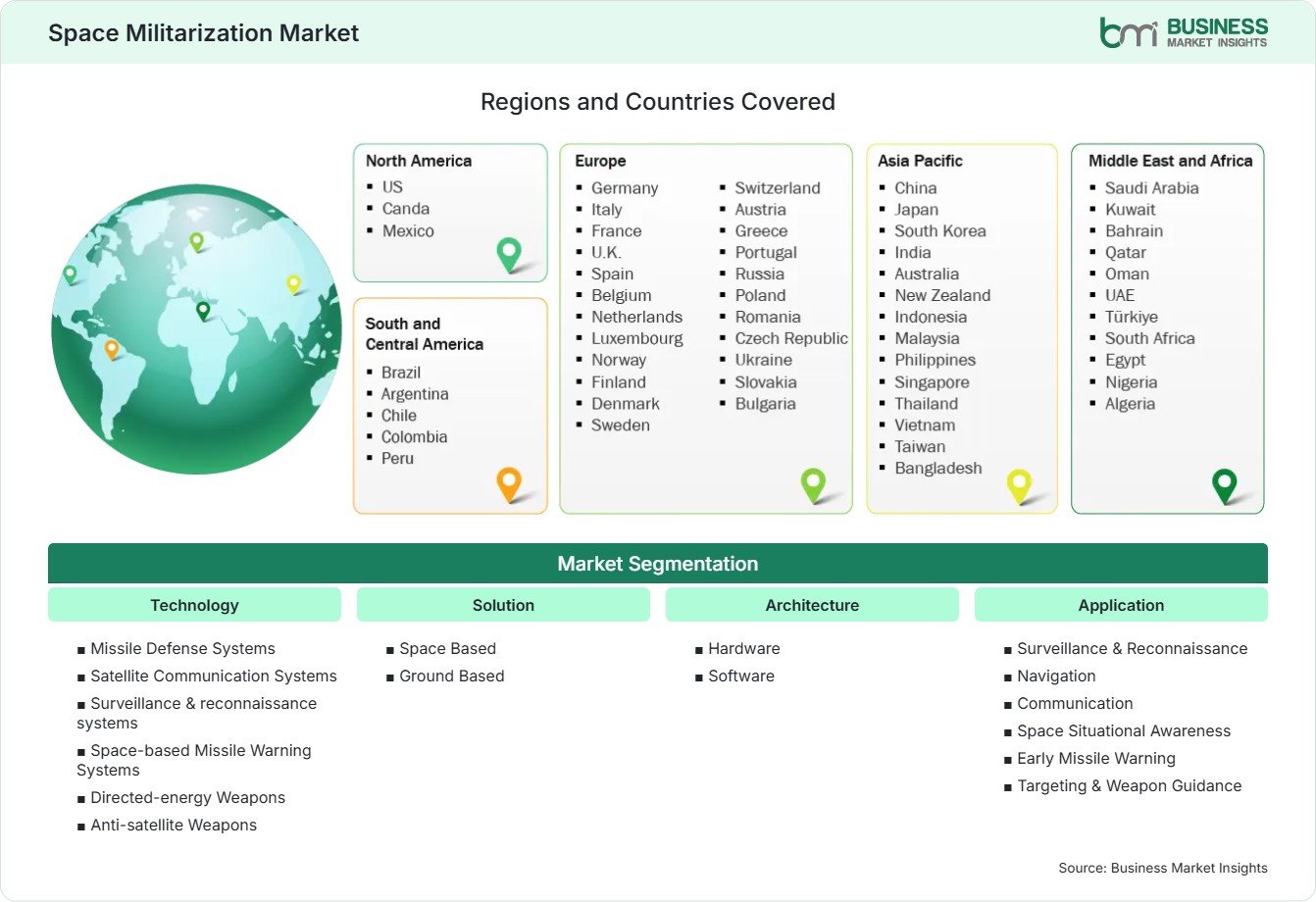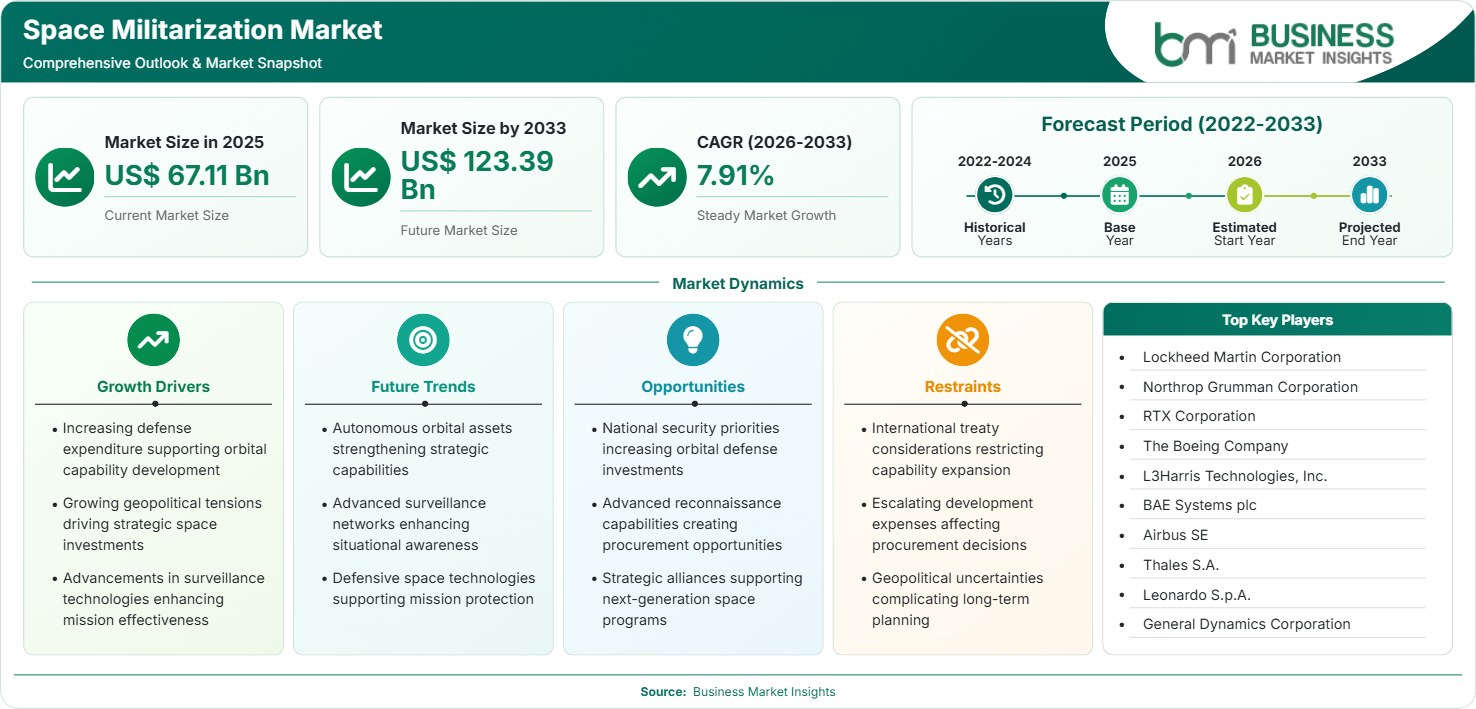
Space Militarization Market Regional Highlights
North America Space Militarization Market
North America held around 38% to 42% market share in 2025 and is expected to grow at a 7.5% to 8.0% CAGR till 2033. The United States dominates the procurement of the region through their programs of missile warning, secured communication systems, ISR, and space domain awareness. Canada also participates in surveillance and interoperability with its allies. The advantages of the region include the presence of defense prime contractors, good launch facilities, adequate research and development investments, and the existence of Space Force.
- US procurement emphasizes proliferated satellite architectures, missile tracking, and resilient communications, supporting sustained demand for spacecraft, sensors, payloads, and ground infrastructure across defense programs.
- Commercial providers increasingly supplement government-owned assets with imagery, communications, launch, and analytics, allowing military users to scale capacity rapidly without developing every capability internally.
- North American suppliers are integrating cyber resilience with spacecraft design, reflecting increasing concern over electronic warfare, jamming, spoofing, software compromise, and attacks against ground-control infrastructure.
- The region's defense ecosystem combines established primes with venture-backed space companies, encouraging rapid experimentation in autonomous spacecraft, orbital maneuvering, ISR analytics, and responsive satellite deployment.
US Space Militarization Market
The United States is estimated to contribute 30% to 34% of worldwide revenue in 2025, and its market will be growing at a CAGR of 7.7% to 8.2% between 2026 and 2033. The procurement process focuses on missile warning, missile tracking, secure communication, ISR, and space domain awareness. Resilient multi-orbit architectures are becoming popular in the Space Force and defense organizations. The Space Militarization Market Growth is being driven by modernization spending, commercialization, and rapid detection needs of threats.
- The US is increasing emphasis on distributed tracking architectures, reducing vulnerability associated with highly concentrated satellite fleets and improving persistence across multiple orbital regimes.
- Commercial space companies are gaining strategic relevance through launch, communications, imagery, and data analytics, creating a broader industrial base for military space operations.
- Missile-defense programs are increasing demand for infrared sensing, command-and-control software, tracking satellites, and high-performance ground systems capable of processing large sensor datasets.
Europe Space Militarization Market
Europe is estimated to have a market share of 16%-19% in 2025, with a CAGR of 7.8%-8.4% expected through 2033. France, Germany, Italy, and UK are the major markets in Europe, although Poland and other NATO countries are growing markets for defense-space solutions. France has spearheaded many sovereign initiatives for space defense, whereas Germany and Italy are contributing satellite, radar, and electronics technology.
- France is strengthening sovereign military-space capabilities, supporting demand for secure communications, surveillance satellites, intelligence systems, and resilient command infrastructure.
- Germany is developing stronger space-security capabilities alongside broader defense modernization, creating opportunities for satellite electronics, ground systems, sensors, and mission-management software.
- The United Kingdom combines military satellite communications, intelligence, surveillance, and space-domain awareness requirements with close cooperation across NATO and allied programs.
- European missile-defense initiatives are creating new industrial opportunities, including development of exo-atmospheric interception capabilities and supporting sensor and command architectures.
Asia Pacific Space Militarization Market
Asia-Pacific was estimated to hold around 22% to 26% market share in 2025 and is further predicted to grow at a CAGR of 9.0% to 9.6% from 2033, thus emerging as the fastest-growing region. The countries in the region, such as China, Japan, India, South Korea, and Australia are increasing their capabilities in military communication, navigation, intelligence, surveillance and reconnaissance, missile warning, and space domain awareness. The Space Militarization Market growth is driven by increased security competition in the region and enhanced space strategies of the nations.
- China is developing advanced orbital maneuvering, surveillance, counterspace, and satellite coordination capabilities, increasing competitive pressure across the regional security environment.
- India is expanding its private space ecosystem and defense-space capabilities, with more than 400 private space companies reported in 2026 and growing investment across satellite and analytics technologies.
- Japan is strengthening space-domain awareness and missile-defense integration while expanding cooperation with the US and other allied partners.
- Australia and South Korea are increasing investments in sovereign space surveillance, communications, and satellite technologies, creating opportunities for international suppliers and domestic technology companies.
Rest of World Space Militarization Market
Rest of World held around 14%-17% market share in 2025 and is estimated to grow at a CAGR of 8.1%-8.8% during 2033. Countries of South and Central America will continue to concentrate on communication, surveillance, and sovereign observation technologies whereas the nations of the Middle East will concentrate on secure communication, ISR, missile warning, and space domain awareness. Israel holds a technological edge in defense electronics and missiles. The Gulf states have been investing strategically in space, providing opportunities for satellite and defense providers.
Latin American markets will see increased demand in terms of border surveillance, disaster monitoring, secure communications, and national security-related applications. Middle Eastern purchases will be more defense-based nature due to missile threats.
- Israel contributes sophisticated sensing, missile-defense, and satellite technologies, supporting demand for integrated space and ground-based defense systems.
- Gulf states are increasing sovereign space capabilities through partnerships, satellite investments, and national technology-development initiatives.
- Brazil remains an important regional market for satellite infrastructure, communications, and Earth observation, with defense applications developing alongside civilian programs.
- Middle Eastern procurement favors turnkey architectures integrating surveillance, secure communications, command systems, and missile-defense capabilities across national security networks.